The Order of Brilliant Jade

The Order of Brilliant Jade is a civilian order established in 22 December 1933 and that can be worn only by the head of a nation.

The Order of Brilliant Jade (or 采玉大勳章 in Chinese) is a civilian order of the Republic of China instituted on 22 December 1933 and that can be worn only by the head of a nation.

According to regulations, the order can only be presented by the president of the country or an emissary expressly dispatched to friendly nations for the conferment. The Chinese official name of the order was claimed to be named after President Chiang Kai-shek’s mother, Wang Caiyu (王采玉) by Democratic Progressive Party members of Legislative Yuan. There are suggestions from the pan-green coalition to rename the order to suit Taiwanese locality as “Order of Taiwan”, but this was not passed at the Legislative Yuan in April 2007 because it faced opposition from the Kuomintang.

Previously, the Order of the Brilliant Jade was divided into two, namely Grand Order of Brilliant Jade (current) and Order of Brilliant Jade with nine ranks.

The Order of Brilliant Jade Design

The Order has a star-patterned face of inlaid jade bordered with gold and pearls. In the center, there is white sun surrounded by a blue sky, the national emblem.

The Order of the Cloud and Banner

The Order of the Cloud and Banner is a military award of the Republic of China awarded for contributions to national security.

The Order of the Cloud and Banner (or 雲麾勳章/雲麾勛章 in Chinese) also known as the Order of the Resplendent Banner is a military award of the Republic of China.

It was instituted on June 15, 1935 and is awarded in nine grades for contributions to national security such as putting down civil strife or for military exploits.

The Order is awarded in nine classes:

The order is organized into nine grades:

  • 1st, with Special Grand Cordon.
  • 2nd, with Grand Cordon.
  • 3rd, with Yellow Grand Cordon.
  • 4th, with Special Cravat.
  • 5th, with Cravat.
  • 6th, with Special Rosette.
  • 7th, with Rosette.
  • 8th, with Special Ribbon.
  • 9th, with Ribbon.

The Order of the Cloud and Banner Design

The insignia of the order features a fluttering yellow flag, surrounded by white clouds on a blue field. This image is surrounded by golden rays.

The Order of Loyalty and Valor

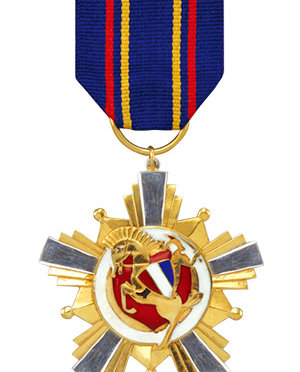
The Order of Loyalty and Valor s a military award created on 23 September 1944 and awarded for outstanding command in battle.

The Order of Loyalty and Valor (忠勇勳章 in Chinese) is a military award from the Republic of China created on 23 September 1944 and awarded for outstanding command in battle.

The Order is awarded by the President to soldiers who have killed the enemy bravely, for being wounded and not treating, or for commanding battle in danger. It can also be given tho those that defend the people, are loyal to duties, or perform heroic acts beyond the ordinary during a peace period.

The Order only has one grade.

The Order of Loyalty and Valor Design

The ribbon is dark blue with narrow red and yellow edge stripes.

The Imperial Grand Order

The Imperial Grand Order is a Chinese Order established in 1911 alongside four other medals to replace the Order of the Double Dragon.

The Imperial Grand Order is a Chinese Order established on 20 March 20 1911 (alongside four other ones) to replace the Order of the Double Dragon. Given its origins and history, it was felt that the Double Dragon was no longer adequate to meet the needs of China as a modern nation. A new system of national honors was needed to serve diplomatic protocol and, more importantly, the needs of Chinese citizens including the Emperor.

On April 2, 1909 the boy Emperor Puyi (or the regent Prince Chun) directed the Ministry of Foreign Affairs, the Army Ministry, and the Administration Bureau to develop a new system of awards. Two years later on 20 March 1911, the Emperor approved the establishment of five new awards:

  • The Grand Precious Order (Da Bao Zhang, 大宝章, also known in the West as the “Grand Order of the Throne”) intended for the Emperor.
  • The Orders of the Red Dragon and the Yellow Dragon, for members of royal families.
  • The Orders of the Blue Dragon and the Black Dragon, for nobles and high officials.

The first four existed in one class only, while the Black Dragon existed in eight classes.

The Imperial Grand Order Design

There are illustrations of this badge in the book Xun Zhang Tu (“Pictures of Orders”) or Ordres Imperiaux de Chine, which was printed for the Qing government by the royal press in Vienna.

The Order was a star comprising two rings of eight rays, one blue and one red, for a total of 16 points. The center medallion was bordered with pearls.

On the obverse, the Twelve Symbols of Imperial Authority are clearly visible as are the circle of pearls bordering the center medallion. According to the Book of Rites, one of the Five Classics of the Confucian canon, “Twelve is the number of Heaven”. The reverse bears the name of the Order (Da Bao Zhang, 大宝章) in the Chinese seal script. The breast star was the badge mounted on a star composed of eight groups of ascending diamond-cut rays.

The ribbon was Imperial yellow.

The Order of the Double Dragon

The Order of the Double Dragon was an order founded by the Guangxu Emperor on 7 February 1882 and awarded in the late Qing Dynasty.

  • Time Period: Pre-WW1 Period
  • Year of Institution: 7 February 1882
  • Country: China (Qing Dynasty)

The Imperial Order of the Double Dragon or ‘Double Dragon Precious Star’ (双龙宝星 in simplified Chinese, 雙龍寶星 in Chinese and Shuānglóng Bǎoxīng in pinyin) was an order awarded in the late Qing dynasty.

The Order was founded by the Guangxu Emperor on 7 February 1882 and awarded for outstanding services to the throne and the Qing court. It was the first Western-style Chinese order, established in the wake of the Second Opium War as part of efforts to engage with the West and adopt Western-style diplomatic practices.

Originally, the Order was bestowed only on foreigners but was extended to Chinese subjects from 1908. Traditionally the Chinese court did not have an honors system in the Western sense; however hat buttons, rank badges, feathers and plumes were routinely awarded by the Emperor to subjects and foreigners alike prior to and after the introduction of the Order of the Double Dragon.

The order was replaced in 1911 during the last days of the Qing dynasty by the Grand Order of the Throne, although this replacement was never fully implemented and the Republic of China discontinued the imperial orders after its establishment in 1912.

The order consisted of five classes, the first three of which were divided into three grades.

  • First Class, First Grade: for emperors and kings of foreign nations.
  • First Class, Second Grade: for princes, and royal family members and relatives (later limited to royal family members who had earned, and not inherited, senior positions in government).
  • First Class, Third Grade: for ministers of who had inherited their position, general ministers, and diplomatic envoys of the first rank.
  • Second Class, First Grade: for diplomatic envoys of the second rank.
  • Second Class, Second Grade: for diplomatic envoys of the third rank and customs commissioners.
  • Second Class, Third Grade: for counselors of the first rank, consul-generals and military generals.
  • Third Class, First Grade: for counselors of the second and third rank, the entourage of consul-generals, and second-tier military officers.
  • Third Class, Second Grade: for deputy consuls, and third-tier military officers.
  • Third Class, Third Grade: for translators and military officers of the fourth and fifth tiers.
  • Fourth Class: for soldiers and non-commissioned officers.
  • Fifth Class: for businessmen and traders.

The Order of the Double Dragon Design

The order took on many different designs and forms, mostly differentiated by the type and size of precious stones inlaid, the shape of the medallion, the length of the ribbon, and the material used to construct the medallion until its abolition in 1911. Gold and pearl were reserved for the higher classes of the Order, and enamel and coral for the lowest classes.

The original designs were similar in style and appearance to traditional Chinese insignia, but they proved cumbersome for many to wear and in 1897 they were redesigned in the form of a Western-style breast-badge, although the original designs were still awarded for some time afterward. Similar symbolic motifs accompanied all designs over the award’s history, most notably two dragons surrounding a central precious stone and flames which were connotative symbols of imperial authority. Other symbols of imperial authority – mountains, clouds, plum blossoms, and characters with providential meanings – were added to variations of the designs over time.

The Medal for Merit to Culture Gloria Artis

The Medal for Merit to Culture Gloria Artis is a decoration awarded for distinguished contributions to the Polish culture and heritage.

The Medal for Merit to Culture Gloria Artis (or Zasłużony Kulturze – Gloria Artis in Polish), also known as Gloria Artis Medal, is a departmental decoration of Poland in Arts awarded by the Ministry of Culture and National Heritage of the Republic of Poland to persons and organizations for distinguished contributions to, or protection of the Polish culture and national heritage.

The medal is awarded on the basis of the Act of 17 June 2005 amending the Act on organizing and conducting cultural activities and amending the Act on the education system. The award has three degrees:

  • 1st degree – Gold Medal for Merit to Culture Gloria Artis,
  • 2nd degree – Silver Medal for Merit to Culture Gloria Artis,
  • 3rd degree – Bronze Medal for Merit to Culture – Gloria Artis.

The minister awards the medal on his own initiative or at the request of other ministers or heads of central offices, rectors of universities, voivodship marshals, voivodes, statutory authorities of national social organizations or associations conducting statutory cultural activities, heads of diplomatic or consular posts of the Republic of Poland.

The Medal for Merit to Culture Gloria Artis Design

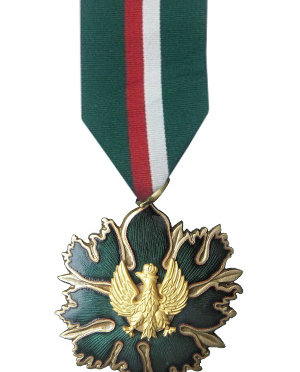
The medal was designed by Piotr Gawron. It’s made of gilded, silver-plated or bronze-patinated tombac and has the shape of a flower with irregular petals covered with green, blue or dark red enamel depending on the degree. The diameter of the Gold Medal badge is 70 mm, the Silver Medal is 55 mm, and the Bronze Medal is 40 mm.

On the obverse there is an image of a crowned eagle. On the reverse there is a woman’s head in a laurel wreath with a semi-circular inscription “GLORIA ARTIS” above.

The gold medal ribbon is 680 mm long and 50 mm wide, it is dark green in color with two vertical stripes – white and red 13 mm wide. The ribbon of the silver medal is 60 mm long and 35 mm wide, it is blue in color with two vertical stripes – white and red 5 mm wide. The ribbon of a bronze medal is 55 mm long and 35 mm wide, it is a maroon color with two vertical stripes – white and red 5 mm wide.

The Order of the Banner of Work

The Order of the Builders of People’s Poland was the highest civil decoration of Poland in the times of the People’s Republic of Poland.

The Order of the Banner of Work (or Order Sztandaru Pracy in Polish) was a governmental award in Poland during the 20th-century era of the People’s Republic of Poland, a former Marxist-Leninist state.

The order was established by the Sejm (a chamber of the Polish parliament) on 2 July 1949. It was given in recognition of “unique achievements for the Nation and the Country”. In 1960 the criteria for receiving this award were changed to “special achievements for building socialism in the People’s Republic of Poland”.

It was also awarded to institutions and was automatically awarded to miners after 20 years of dedicated labor. The Order of the Banner of Labor could be awarded to individuals and enterprises, institutions, territorial units for merits in the following areas:

  • Industry, agriculture, communication, construction, state trade, cooperatives, finance and other sectors of the national economy – by improving or improving working methods, rationalizing work or outstanding achievements in labor leadership,
  • Education, science, culture and art,
  • Increasing the country’s defense,
  • Increasing the health and physical culture of the nation,
  • Public service

The Order of the Banner of Work Design

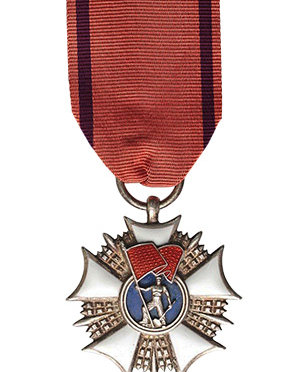
The badge of the Order of the Banner of Labor is a five-pointed star cross with a diameter of 43 mm.

On the obverse of the cross, the arms are enameled in white in the border, and there are bunches of rays between the arms. In the center of the cross there is a round sapphire-enameled shield with the figure of a worker holding a red banner in his right hand and a hammer in his left hand.

On the reverse, in the middle of the cross, on the round shield is the inscription PRL (until 1952 RP). The border of the arms of the cross, bunches of rays, the frame of the shield, the figure of a worker, the shafts and the border of the banner, the hammer and the reverse of the badge are gilded in class I, and silver in class II.

The ribbon of the order is 36 mm wide, it is red in color with narrow red stripes on the sides, 3 mm wide. There is a rosette on the ribbon in class I, which distinguishes it from class II.

The Order of the Builders of People’s Poland

The Order of the Builders of People’s Poland was the highest civil decoration of Poland in the times of the People’s Republic of Poland.

The Order of the Builders of People’s Poland (or Order Budowniczych Polski Ludowej in Polish) was the highest civil decoration of Poland in the times of the People’s Republic of Poland. Unofficially, it replaced Poland’s highest pre-war order, the Order of the White Eagle. The order was awarded to many leaders of worship, notable party members (including military personnel) and others.

The order was established by the Sejm on 2 July 1949 for “awarding unique achievements in the task of building People’s Poland”. It was awarded by the president of Poland until the office was abolished in 1952; from then it was awarded by the Polish Council of State. It had only one class. A person decorated with the order had the title of a Builder of People’s Poland (Budowniczy Polski Ludowej).

The Order was last awarded in 1985. Up to that time, about 310 individuals were awarded the Order, and 10 institutions and territorial units (for instance, cities and administrative entities – voivodeships). During the times of the People’s Republic, 7 recipients had their orders revoked. It was officially disestablished 2 years after the People’s Republic was replaced by the Third Republic.

The order could be awarded to Polish individuals, enterprises, and institutions that performed exceptional deeds in the fields of:

  • National economy, in particular through inventions, improving work organizations, and work inspiration and efficiency.
  • Education, science, culture and art.
  • National defense.
  • Health and sport.
  • Public service.

The Order of the Builders of People’s Poland Design

The medal was designed by Michał Bylina and Wojciech Jastrzębski.

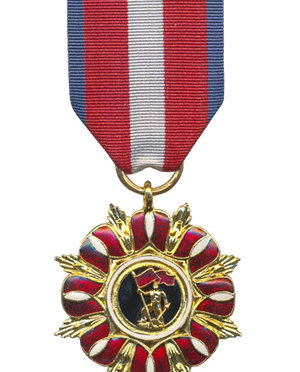
The Order has a golden rosette and measures 53 mm in diameter. The rosette has eight petals enameled with white (inner) and red (outer). Petals are separated by gold rays. In the center is a white-encircled blue medallion, which depicts a gold male figure carrying a hammer and a red banner. The reverse has a red enameled medallion with, in gold, the letters PRL, standing for Polska Rzeczpospolita Ludowa – People’s Republic of Poland (orders awarded before the state’s name changed in 1952 have the letters RP for Rzeczpospolita Polska).

The ribbon is 40 mm wide and is red-white-red with blue edges.

The Home Army Cross or Armia Krajowa Cross

The Home Army Cross is a military decoration that commemorates the efforts of the soldiers of the Polish Secret State between 1939 and 1945.

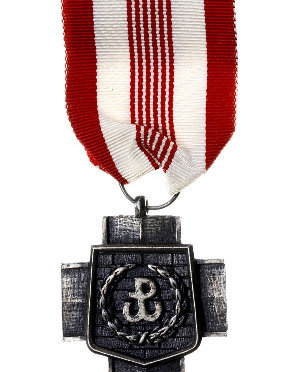
The Home Army Cross or Armia Krajowa Cross (Krzyż Armii Krajowej in Polish) is a military decoration from Poland that was introduced by General Tadeusz Bór-Komorowski on 1 August 1966 to commemorate the efforts of the soldiers of the Polish Secret State between 1939 and 1945.

The decoration was awarded to soldiers of the Home Army (Armia Krajowa) and of its predecessor organizations (Służba Zwycięstwu Polski, Związek Walki Zbrojnej). The first recipient (posthumous) was General Stefan Grot–Rowecki.

The award was supported by the Polish government in exile in London and was not recognized by the People’s Republic of Poland, which viewed members of the mostly anti-communist Armia Krajowa as enemies of the state. After the fall of communism, in 1992 it was recognized by the government of Poland and was awarded by the president of Poland until 8 May 1999.

The Home Army Cross Design

The medal measures 38 mm in diameter.

The reverse reads “1939 Armia Krajowa 1945″ (“1939 Home Army 1945”). The ribbon has stripes in red and white and measures 4.5cm high and 3.7 cm wide.

The Order of Labor Glory (USSR)

The Order of Labor Glory (or Орден Трудовой Славы) was established on 18 January 1974 and awarded for exceptional labor achievements.

The Order of Labor Glory (or Орден Трудовой Славы, Orden Trudovoj Slavy in Russian) was established on 18 January 1974 by the decision of the Praesidium of Supreme Soviet of the USSR and awarded for exceptional labor achievements.

It was divided in three classes (the highest being the 1st class), with a person initially received the third degree, and subsequently promoted to higher degrees for further achievements. It also gave a certain number of material benefits to their owners, such as an increased pension raises and free public transport.

In 1991, the following number of awards were made:

  • 1st class – 952
  • 2nd class – 50,000+
  • 3rd class – 650,000+

The Order of Labor Glory Design

The medal is struck in silvered bronze and enamels and measures 41 mm by 44 mm.

The obverse consists of an eight-pointed radiant star, bearing a raised depiction of a factory overlaid by a sickle and hammer, circumscribed by a Cyrillic inscription of “ТРУДОВАЯ СЛАВА” (“LABOUR GLORY”) on a cogwheel, topped by a five-pointed red enameled star, above a red enameled banner bearing a gilt inscription of “СССР”, flanked by wheat stalks. The reverse sometimes bears a raised maker’s mark.

The medal is mounted to a five-sided aluminum suspension with pinback. The ribbon is has a large grey stripe, and thinner yellow, red, and yellow stripes.