The Order of the Eight Trigrams

The Order of the Eight Trigrams (P’alwaejang) was instituted on 17th April 1901 by Emperor Kwangmu, the last King of Joseon and the first Emperor of Korea.

The Order was awarded in eight classes:

  • Grand Cordon
  • Second Class
  • Third Class
  • Fourth Class
  • Fifth Class
  • Sixth Class
  • Seventh Class
  • Eighth Class

The last two are equivalent to a gold and silver medal of a European Order.

The Order of the Eight Trigrams Design

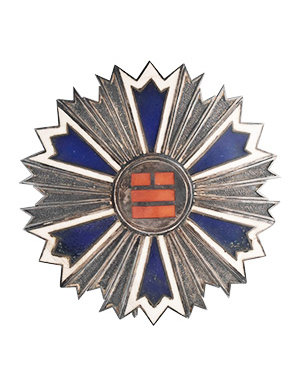
The symbolism of the Order insignia is the Chinese Ba Gua, based on Taoist principles. These Bagua or Pakua symbols are used in Taoist cosmology to represent the fundamental principles of reality, seen as a range of eight interrelated concepts. Each consists of three lines, each line either “broken” or “unbroken”, respectively representing yin or yang, 0 or 1 forming binary numbers 000-111 (0 to 7).

The 1st Class medal is enameled on both sides. The other classes have a plain reverse with an inscription in kanji.
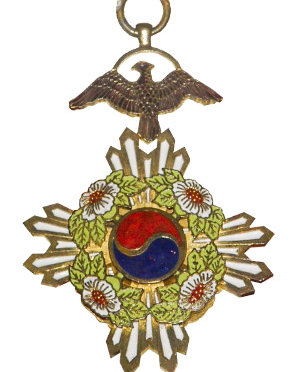
The Order of Taeguk or Order of the National Crest

The Order of Taeguk or Order of the National Crest (Taegukjang) was instituted on 11th April 1900 by Emperor Kwangmu, the last King of Joseon and the first Emperor of Korea.

The Order was only awarded in a superior class and eight ordinary classes:

  • Grand Cordon
  • Second Class
  • Third Class
  • Fourth Class
  • Fifth Class
  • Sixth Class
  • Seventh Class
  • Eighth Class

The last two are equivalent to a gold and silver medal of a European Order.

The Order of Taeguk Design

The insignia of the order is struck in silver with red, white, and blue enamels. It measures 88.5 mm (wide) x 89.5 mm (high). The Order is mounted on a wight-pointed starbase, each of the star points with three rays.

The Order of the Purple Falcon

The Order of the Purple Falcon (Chaungjang) was instituted on 16th April 1901 by Emperor Kwangmu, the last King of Joseon and the first Emperor of Korea. The Order was given as a reward for distinguished military services.

The Order was only awarded in the following classes:

  • Grand Cordon
  • Second Class
  • Third Class
  • Fourth Class
  • Fifth Class
  • Sixth Class
  • Seventh Class
  • Eighth Class

The last two are equivalent to a gold and silver medal of a European Order.

The Order of the Purple Falcon Design

The Order is a large cross struck in bronze and has colored enamels on the obverse.

The Grand Order of the Plum Blossoms

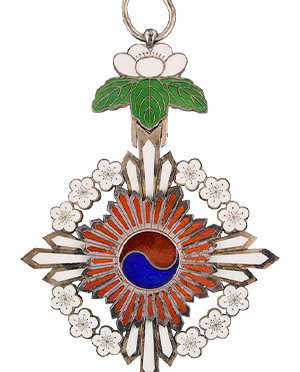
The Grand Order of the Plum Blossoms (Lihwa Taehunjang) was instituted on 17th April 1900 by Emperor Kwangmu, the last King of Joseon and the first Emperor of Korea. It was conferred upon holders of the Grand Cordon of the Taeguk Order of Merit. This decoration was actually the superior class of the that one.

The Order was only awarded in one class only (Grand Cordon).

The Grand Order of the Plum Blossoms Design

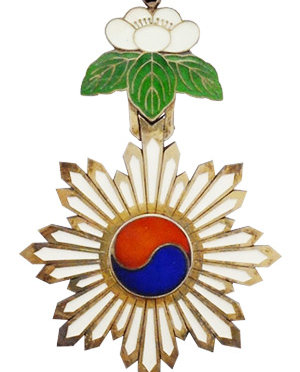
The Order is a large grand cross sash badge struck in silver gilt. It is a white four-armed star, each arm composed of a cluster of three rays with three plum blossoms in each quadrant.

The obverse presents, in the center, the taeguk in blue and red enamels with red enameled sun burst surround. The reverse is mirrored.

The suspension is a large Hibiscus flower with five green enameled leaves.

The Grand Order of the Auspicious Stars

The Grand Order of the Auspicious Stars (Sosong Taehunjang) was instituted on 17th April 1900 by Emperor Kwangmu, the first Emperor of Korea.

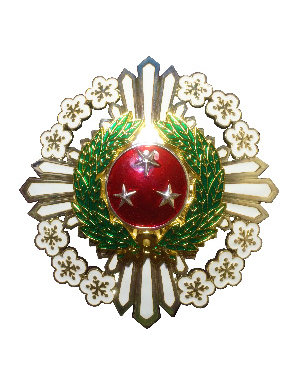
The Grand Order of the Auspicious Stars (Sosong Taehunjang) was instituted on 17th April 1900 by Emperor Kwangmu, the last King of Joseon and the first Emperor of Korea. It was conferred upon civil and military personnel who had previously been awarded the Grand Order of the Plum Blossoms, in recognition of outstandingly meritorious service.

The Order actually functioned as the second class of the Grand Order of the Golden Ruler. It was only awarded in one class only (Grand Cordon).

The Grand Order of the Auspicious Stars Design

The Order features characters in the reverse that translate to “Auspicious Stars Great Decoration”.

The Grand Order of the Gold Cheok or Golden Ruler

The Grand Order of the Gold Cheok (or Golden Ruler) was instituted in 1900 by Emperor Kwangmu, the first Emperor of Korea.

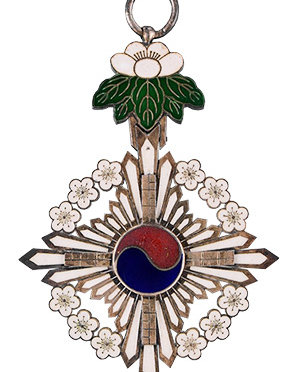
The Order of the Gold Cheok (Kumch’ok Taehunjang, also known as the Order of the Golden Ruler) was instituted on 17th April 1900 by Emperor Kwangmu, the last King of Joseon and the first Emperor of Korea.

The Order was conferred on heads of state, royalty only and very rarely on certain selected individuals that already held the Grand Order of the Auspicious Stars. The Order of the Gold Cheok was awarded in only one class: Grand Collar with Grand Cordon.

The Grand Order of the Gold Cheok or Golden Ruler Design

The Order consists of a large silver sash badge with four arms, each of them composed of groups three large white rays, plus a clusters of five rays in each quadrant. There are also three Hibiscus blossoms in white enamels in each quadrant, which form a surrounding laurel. The medal measures 66.7 mm (wide) x 108 mm (high, including suspension)

The obverse presents, in the center, the taeguk in blue and red enamels. There are silver rulers extending from center along each arm. The reverse is mirrored.

The suspension is a horizontally pierced ball with a large Hibiscus flower and five green enameled leaves.

The Dunkirk Medal

The Dunkirk Medal is an unofficial commemorative medal established om 1 May 1960 and created by the town of Dunkirk for the area’s defense.

The Dunkirk Medal is an unofficial commemorative medal established on 1 May 1960 and created by the town of Dunkirk to commemorate the defense of the area during May and June 1940.

The allocation of the award was managed by the French National Association of Veterans of the Fortified Sector of Flanders and Dunkirk (and later administrated by the now-disbanded Dunkirk Veterans Association).

The award was initially awarded to only French service personnel (with approximately 30,000 medals issued). In 1970 it was also awarded to any Allied member involved in Operation Dynamo, the evacuation of Allied forces from the Dunkirk area between 29 May and 3 June and those soldiers evacuated from the beaches.

All British servicemen from the Royal Navy, Royal Air Force, Merchant Navy, and the civilian little ship volunteers were eligible to receive the award. For citizens of the United Kingdom, the medal may be worn on the right breast, but as it is not designated an official medal it is not to be mounted with other British official medals and awards.

The History of the Dunkirk Medal

The Dunkirk evacuation, also known as Operation Dynamo, took place between May 26 and June 4, 1940. During this operation, a vast number of British, French, and other Allied troops were evacuated from the French coast as they faced encirclement by German forces. The operation involved a large-scale mobilization of various naval vessels, merchant ships, and civilian boats that braved enemy fire to rescue the stranded troops.

The unofficial Dunkirk Medal was created by private organizations or individuals to recognize the courage and sacrifice of those involved in the evacuation. These commemorative medals are often privately produced and are not officially sanctioned or recognized by the UK government. They may be available for purchase or awarded by certain veterans’ organizations as a way to honor the memory of the Dunkirk evacuation and the servicemen and civilians involved.

A Note About Unofficial Medals

It’s important to note that unofficial commemorative medals do not hold the same status as official military awards and decorations. They do not carry the same level of recognition or entitlements as official honors, such as the campaign medals and service medals awarded by the UK government.

The Dunkirk Medal Design

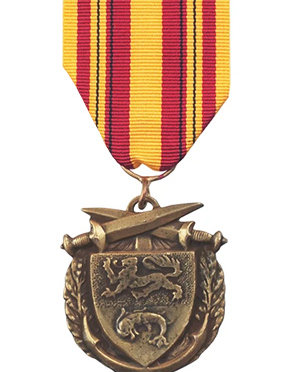
The Dunkirk Medal is struck in bronze and is 44mm high and 36mm wide.

The medal’s obverse depicts a shield bearing the arms of Dunkirk (a fish and in chief, a lion passant) superimposed on an anchor and laurel wreath, crossed swords above. The reverse features a burning oil lamp over a tablet with the inscription: DUNKERQUE 1940.

Beneath the ribbon suspension of the medal are crossed swords. A named certificate was issued with each medal though the medal itself was not inscribed. The medal ribbon measures 36mm wide and has a wide central chrome yellow stripe with one wide and one thin red stripe each side with two further chrome yellow bars and two very thin black stripes.

Right Now on eBay 
Clicking a link to eBay may result in a referral commission being paid if a purchase is made.
Loading...
]

The Manchukuo Emperor State Visit to Japan Medal

The Manchukuo Emperor State Visit to Japan medal was established in 1935 to commemorate the Manchukuo Emperor Pu-Yi’s visit to Japan in 1934.

The Manchukuo Emperor State Visit to Japan medal was established in 1935 to commemorate the Manchukuo Emperor Pu-Yi’s visit to Japan in 1934. The Emperor Pu-Yi (often called the Last Emperor) made two state visits to Japan: The first in 1935 and the second in 1940. The first one was the most celebrated because he presented himself as the Manchukuo Emperor to the Showa Emperor.

Four commemorative postage stamps were issued, while many important people assembled to welcome Pu-Yi to Japan. The Japan Mint created this official medal to commemorate the 1935 visit.

The medal was awarded by the government and not put on sale like some other Japan Mint items.

The Manchukuo Emperor State Visit to Japan Medal Design

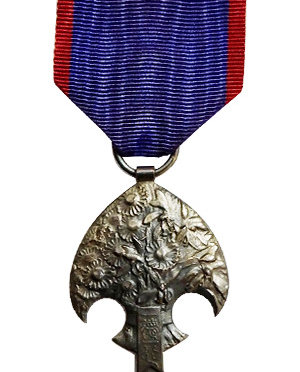
The medal is struck in silver and has the shape of a spearhead.

The obverse is decorated with orchids and chrysanthemums, the Imperial flowers of Manchukuo and Japan. There is an inscription in the banner at the bottom that reads ‘One in virtue and spirit.’ The reverse has the inscription’Kang Te 2 [1934] Manchukuo Empire, Emperor’s Visit to Japan Commemorative Medal, April 6th.’

The medal was awarded in a green case with gold lettering on the front.

The Imperial Japanese Army Koga Regiment Badge

Time Period: WW2

Institution: 1930s?
Country: Medals from Japan Japan

The Imperial Japanese Army Koga Regiment Badge is an example of a small, portable, and inexpensive regiment badge. These awards were usually given to troops by regiment commanders.

The Imperial Japanese Army Koga Regiment Badge Design

These regimental badges usually had the unit name and number inscribed in the obverse, and could also be personalized. However, they rarely had the name of the individual soldier unless they were hand-carved.

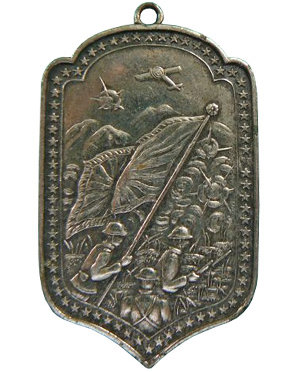
The Koga regiment badge has a border covered with Army stars. The obverse shows, it the center, Japanese soldiers battling at the front. One of them is carrying the regiment standard. In the background are clouds of smoke with stylized explosions and some hills. Above is a fighter plane and another explosion. The inscription in the reverse reads ‘Koga Regiment, Blood-Stained Regiment Standard.’

The Air Force Distinguished Service Medal (Taiwan)

The Air Force Distinguished Service Medal is a Taiwanese medal established in 1980. The medal is decorated in gilt and enamels.

The Air Force Distinguished Service Medal is a Taiwanese medal established in 1980. The medal is decorated in gilt and enamels and measures 45 by 50 millimeters.