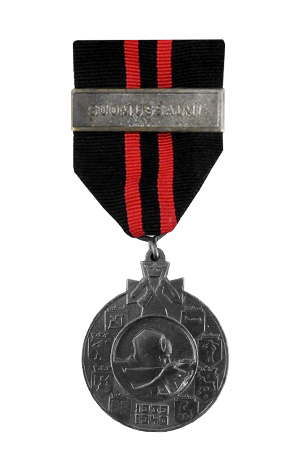
The Winter War 1939-1940 Medal

The Winter War 1939-1940 Medal was established on 2 August 1940 and awarded to soldiers and civilians for serving the Nation’s best interests. In particular, to honour those who had helped to keep Finland’s independence.

The 1939-1940 War Service Medal was created through Number 418 Finnish Code of Regulations 1940 by President Kyösti Kallio and the Minister of Defense Rudolf Walden. The first medals were presented in September of the same year.

The criteria was as follows: The medal was ‘established to commemorate the war of 1939–1940 and the unanimous will to defend it and the deeds done for the benefit of the motherland.’ The medal was generally very liberally granted to those engaged in some form of war work. This could range from those who cooked and baked in canteens to soldiers and young boys and girls who helped pass messages and washed uniforms.

Over 700,000 of all versions of the 1939-1940 War Service Medal were awarded.

The Winter War 1939-1940 Medal Design

The medal was designed by Major Aarno Karimo, who had helped found the Voimaliitto (Power League) in 1906. He was a well-known and respected poet and artist who had spent the Winter War designing propaganda posters.

The medal is made from blackened iron and measures 35 mm wide. The obverse is divided in two: An 18mm diameter circular centerpiece and a 17mm wide border. The centerpiece displays a silhouette of a snow-covered rifleman surrounded by eight provincial coats of arms of Finland. At the bottom is a stylized text reading 1939–1940. The reverse has an embossed conifer wreath around the border and the inscription ‘KUNNIA ISÄNMAA’ meaning ‘Honour Fatherland’. 
The Turkish Armed Forces Medal of Distinguished Service

The Turkish Armed Forces Medal of Distinguished Service (Türk Silahlı Kuvvetleri Üstün Hizmet Madalyası) was first created in 1967.

The Turkish Armed Forces Medal of Distinguished Service (or Türk Silahlı Kuvvetleri Üstün Hizmet Madalyası n Turkish) was first created on July 27, 1967 (although it took its current form on July 29, 1983). 

During war or peace, the medal is bestowed upon individuals whose contributions to the strengthening of the Turkish Armed Forces (TAF) have been extraordinarily high, serving national interests with exemplary determination and contributing greatly to the prestige and strength of the TAF.

This can encompass any military, scientific, material, or administrative contribution, in or outside the territory of the Republic of Turkey.

The medal can be given to civilians or soldiers, regardless of nationality. It is bestowed by any of the Commanders of the four main branches of the TAF (the Army, the Navy, the Air Force, or the Gendarmerie). 

The Turkish Armed Forces Medal of Distinguished Service Design

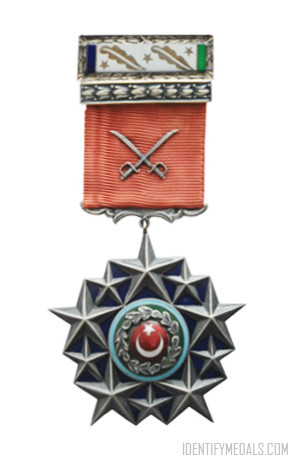
The medal is struck in bronze and measures 60 mm wide. It has five large and five small stars on dark blue background circling an insignia of a crescent moon and a star on red background (the symbol of the Turkish flag) pointing upwards.

The Chelengk

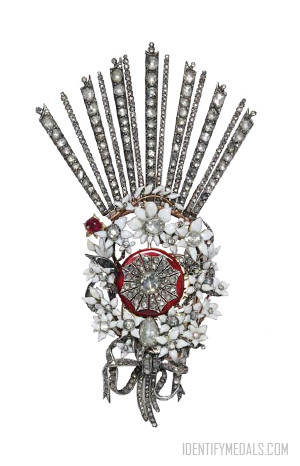
The Chelengk (çelenk) was a military decoration of the Ottoman Empire that continued to be awarded for military merit up to the 1820s.

The Chelengk (çelenk) was a military decoration of the Ottoman Empire that continued to be awarded for military merit up to the 1820s.

A çelenk was “a bird’s feather which one attaches to the turban as a sign of bravery” and became institutionalized practice amongst the Ottoman military. 

A specially-made Chelengk was awarded to Horatio Nelson by Sultan Selim III after the Battle of the Nile (a major naval battle fought between the British Royal Navy and the Navy of the French Republic at Aboukir Bay on the coast off the Nile Delta) in 1798. This was the first time that a Chelengk was conferred on a non-Ottoman. Selim III also gave a chelengk to Russian Admiral Fyodor Ushakov after the capture of Corfu in 1799.

The Chelengk Medal Design

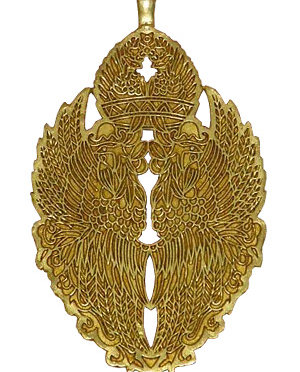
The Chelengk is a jeweled aigrette (the tufted crest or head-plumes of the egret, used for adorning a headdress) consisting of a central flower with leaves and buds, and upward-facing rays.

The 1941-1944 Finish Eastern Isthmus Campaign Cross

The 1941-1944 Finish Eastern Isthmus Campaign Cross is a military medal from Finland. The Finnish reconquest of the Karelian Isthmus (1941) refers to a military campaign carried out by Finland in 1941, which was part of what is commonly referred to as the Continuation War.

The 1941-1944 Finish Eastern Isthmus Campaign Cross Design

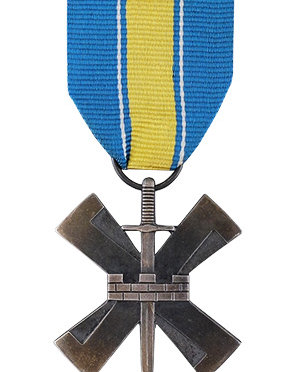
The medal is struck in silver and measures 34.2 mm by 39 mm.

The Order of Science and Technology Merit

The Order of Science and Technology Merit (과학기술훈장 in Korean) is one of the South Korea’s Orders of Merit, awarded to those who have rendered outstanding meritorious services in the interest of improving the science and technology.

This Order is mostly a newly organized order of the Republic of Korea. Before that order was established, the Order of Industrial Service Merit had been bestowed to scientists and technologists.

The Order of Science and Technology Merit is conferred in the following five classes:

  • ROK Order of Science and Technology Merit Changjo (1st Class) ribbon.png Changjo (Creation) 창조장
  • ROK Order of Science and Technology Merit Hyeoksin (2nd Class) ribbon.png Hyeoksin (Reformation) 혁신장
  • ROK Order of Science and Technology Merit Ungbi (3rd Class) ribbon.png Ungbi (Great Achievement) 웅비장
  • ROK Order of Science and Technology Merit Doyak (4th Class) ribbon.png Doyak (Leap) 도약장
  • ROK Order of Science and Technology Merit Jinbo (5th Class) ribbon.png Jinbo (Progress) 진보장

The Order of Science and Technology Merit Design

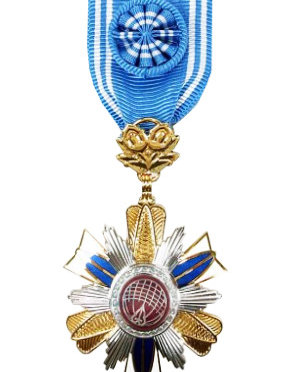
The ribbon of the Order is light blue with white stripes on the sides depending on the class.

The Order of Sports Merit

The Order of Sports Merit (체육훈장 in Korean) is one of South Korea’s Orders of Merit. It is awarded to those who have rendered outstanding meritorious services in the interest of improving citizen’s physique and national status through sports.

The Order of Sports Merit is conferred in the following five classes:

  • ROK Order of Sports Merit Cheongnyong (1st Class) ribbon.png 1st Cheongnyong (Blue Dragon) 청룡장
  • ROK Order of Sports Merit Maengho (2nd Class) ribbon.png 2nd Maengho (Fierce Tiger) 맹호장
  • ROK Order of Sports Merit Geosang (3rd Class) ribbon.png 3rd Geosang (Giant Elephant) 거상장
  • ROK Order of Sports Merit Baengma (4th Class) ribbon.png 4th Baengma (White Horse) 백마장
  • ROK Order of Sports Merit Girin (5th Class) ribbon.png 5th Girin (“Giraffe” – Although this refers to a mythical animal that on;y appears in times of prosperity and peace. It has also been called Chinese Unicorn or Kylin, Chi-lin and Kirin) 기린장

The Order of Sports Merit Design

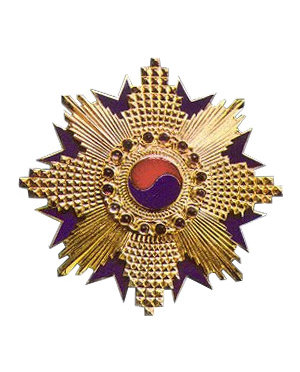
The insignia of the order follows the general European usage of sashes, breast stars, etc.

The Order of Saemaeul Service Merit

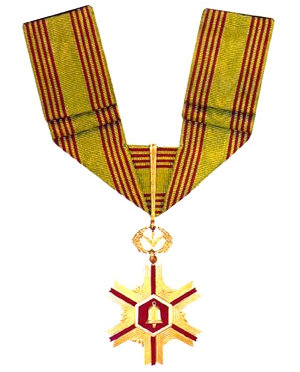
The Order of Saemaeul Service Merit (새마을훈장 in Korean) is an order of merit of South Korea, presented to individuals who contributed to the social development of the country through the New Community Movement.

Also known as the New Community MovementNew Village MovementSaemaul Movement or Saema’eul Movement, this was a political initiative launched on April 22, 1970 by South Korean president Park Chung-hee to modernize the rural South Korean economy. It was based on the Korean traditional communalism called Hyangyak (향약, 鄕約) and Doorae (두레), which provided the rules for self-governance and cooperation in traditional Korean communities.

The Order of Saemaeul Service Merit is divided into five classes:

  • ROK Order of Saemaeul Service Merit (1st Class) Jarip Medal.png Jarip Medal: 자립장 (自立章)
  • ROK Order of Saemaeul Service Merit (2nd Class) Jajo Medal.png Jajo Medal: 자조장 (自助章)
  • ROK Order of Saemaeul Service Merit (3rd Class) Hyeopdong Medal.png Hyeopdong Medal: 협동장 (協同章)
  • ROK Order of Saemaeul Service Merit (4th Class) Geunmyeon Medal.png Geunmyeon Medal: 근면장 (勤勉章)
  • ROK Order of Saemaeul Service Merit (5th Class) Noryeok Medal.png Noryeok Medal: 노력장 (努力章)

The Order of Saemaeul Service Merit Design

The ribbon of the order is light green with a different number of thin red stripes on the sides depending on the class.

The Order of Industrial Service Merit

The Order of Industrial Service Merit (산업훈장 in Korean) is an order of merit of South Korea, presented to individuals and businesses who have contributed to the development of industry and the national economy.

The Order of Industrial Service Merit is divided into five classes:

  • ROK Order of Industrial Service Merit (1st Class) Gold Tower.png Gold Tower: 금 탑(金 塔)
  • ROK Order of Industrial Service Merit (2nd Class) Silver Tower.png Silver Tower: 은 탑(銀 塔)
  • ROK Order of Industrial Service Merit (3rd Class) Bronze Tower.png Bronze Tower: 동 탑(銅 塔)
  • ROK Order of Industrial Service Merit (4th Class) Iron Tower.png Iron Tower: 철 탑(鐵 塔)
  • ROK Order of Industrial Service Merit (5th Class) Tin Tower.png Tin Tower: 석 탑(錫 塔)

The Order of Industrial Service Merit Design

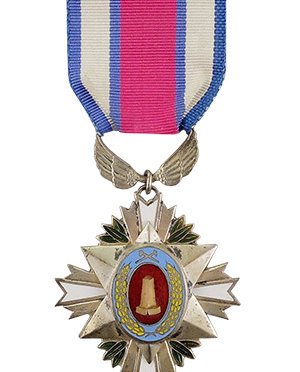
The insignia of the different classes for the Order of Industrial Service Merit all have the same symbolism. The sun shape symbolizes the enhanced,ent of national prestige. The leaves of Mugunghwa symbolize national prosperity. The leaves of the rice plant and the hoe, the increase of production. The tower symbolizes the merits of effort, and the wings symbolize peace.

The ribbon is blue (constancy), white (integrity and innocence), and red (bravery and progressive passion).

The Order of Merit for National Foundation

The Order of Merit for National Foundation (건국훈장 in Korean) was established on Apr. 27, 1949 and is one of South Korea’s orders of merit.

The Order of Merit for National Foundation (건국훈장 in Korean) was established on Apr. 27, 1949 and is one of South Korea’s orders of merit. The Order is awarded by the President of South Korea for “outstanding meritorious services in the interest of founding or laying a foundation for the Republic of Korea.”

The Order was originally established under a slightly different name, 건국공로훈장 (建國功勞勳章) and is the oldest Order of the Republic of Korea. On Jan. 16, 1967, there were major changes made to the Order under Presidential Decree #2929. The name was shortened from 건국공로훈장 (建國功勞勳章) to 건국훈장 (建國勳章), and all three classes got new names and designs.

The Order of Merit for National Foundation Design

The Order of Merit for National Foundation is awarded in five grades:

  • 1st Republic of Korea Medal (대한민국장)
  • 2nd Presidential Medal (대통령장)
  • 3rd Independence Medal (독립장)
  • 4th Patriotic Medal (애국장)
  • 5th National Medal (애족장)

The Order of the Auspicious Phoenix

The Order of the Auspicious Phoenix (Bongjang) was instituted by Emperor Yunghui. It was limited to women only and awarded in eight classes.

The Order of the Auspicious Phoenix (Bongjang) was instituted by Emperor Yunghui. It was limited to women only.

The Order was awarded in eight classes:

  • Grand Cordon
  • Second Class
  • Third Class
  • Fourth Class
  • Fifth Class
  • Sixth Class
  • Seventh Class
  • Eighth Class

The last two are equivalent to a gold and silver medal of a European Order.

The Order of the Auspicious Phoenix Design

The medal is struck in bronze and has a pink silk ribbon.