The Order of the Auspicious Phoenix

The Order of the Auspicious Phoenix (Bongjang) was instituted by Emperor Yunghui. It was limited to women only and awarded in eight classes.

The Order of the Auspicious Phoenix (Bongjang) was instituted by Emperor Yunghui. It was limited to women only.

The Order was awarded in eight classes:

  • Grand Cordon
  • Second Class
  • Third Class
  • Fourth Class
  • Fifth Class
  • Sixth Class
  • Seventh Class
  • Eighth Class

The last two are equivalent to a gold and silver medal of a European Order.

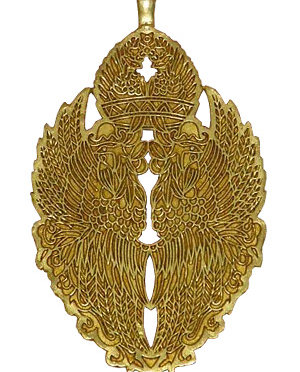
The Order of the Auspicious Phoenix Design

The medal is struck in bronze and has a pink silk ribbon.

The Order of the Eight Trigrams

The Order of the Eight Trigrams (P’alwaejang) was instituted on 17th April 1901 by Emperor Kwangmu, the last King of Joseon and the first Emperor of Korea.

The Order was awarded in eight classes:

  • Grand Cordon
  • Second Class
  • Third Class
  • Fourth Class
  • Fifth Class
  • Sixth Class
  • Seventh Class
  • Eighth Class

The last two are equivalent to a gold and silver medal of a European Order.

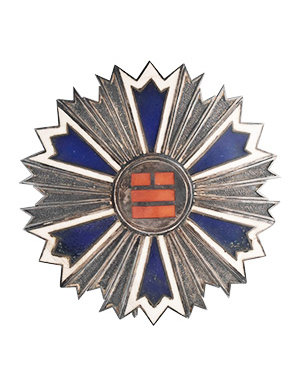
The Order of the Eight Trigrams Design

The symbolism of the Order insignia is the Chinese Ba Gua, based on Taoist principles. These Bagua or Pakua symbols are used in Taoist cosmology to represent the fundamental principles of reality, seen as a range of eight interrelated concepts. Each consists of three lines, each line either “broken” or “unbroken”, respectively representing yin or yang, 0 or 1 forming binary numbers 000-111 (0 to 7).

The 1st Class medal is enameled on both sides. The other classes have a plain reverse with an inscription in kanji.

The Order of Taeguk or Order of the National Crest

The Order of Taeguk or Order of the National Crest (Taegukjang) was instituted on 11th April 1900 by Emperor Kwangmu, the last King of Joseon and the first Emperor of Korea.

The Order was only awarded in a superior class and eight ordinary classes:

  • Grand Cordon
  • Second Class
  • Third Class
  • Fourth Class
  • Fifth Class
  • Sixth Class
  • Seventh Class
  • Eighth Class

The last two are equivalent to a gold and silver medal of a European Order.

The Order of Taeguk Design

The insignia of the order is struck in silver with red, white, and blue enamels. It measures 88.5 mm (wide) x 89.5 mm (high). The Order is mounted on a wight-pointed starbase, each of the star points with three rays.

The Order of the Purple Falcon

The Order of the Purple Falcon (Chaungjang) was instituted on 16th April 1901 by Emperor Kwangmu, the last King of Joseon and the first Emperor of Korea. The Order was given as a reward for distinguished military services.

The Order was only awarded in the following classes:

  • Grand Cordon
  • Second Class
  • Third Class
  • Fourth Class
  • Fifth Class
  • Sixth Class
  • Seventh Class
  • Eighth Class

The last two are equivalent to a gold and silver medal of a European Order.

The Order of the Purple Falcon Design

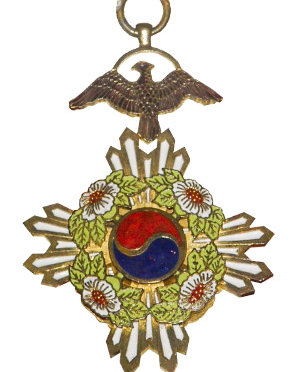
The Order is a large cross struck in bronze and has colored enamels on the obverse.

The Grand Order of the Plum Blossoms

The Grand Order of the Plum Blossoms (Lihwa Taehunjang) was instituted on 17th April 1900 by Emperor Kwangmu, the last King of Joseon and the first Emperor of Korea. It was conferred upon holders of the Grand Cordon of the Taeguk Order of Merit. This decoration was actually the superior class of the that one.

The Order was only awarded in one class only (Grand Cordon).

The Grand Order of the Plum Blossoms Design

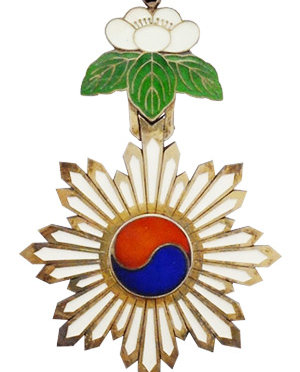
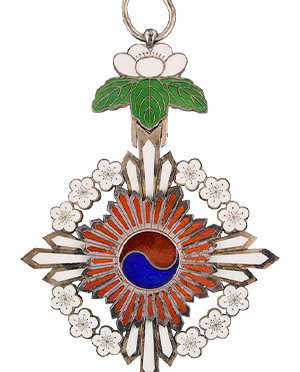
The Order is a large grand cross sash badge struck in silver gilt. It is a white four-armed star, each arm composed of a cluster of three rays with three plum blossoms in each quadrant.

The obverse presents, in the center, the taeguk in blue and red enamels with red enameled sun burst surround. The reverse is mirrored.

The suspension is a large Hibiscus flower with five green enameled leaves.

The Grand Order of the Auspicious Stars

The Grand Order of the Auspicious Stars (Sosong Taehunjang) was instituted on 17th April 1900 by Emperor Kwangmu, the first Emperor of Korea.

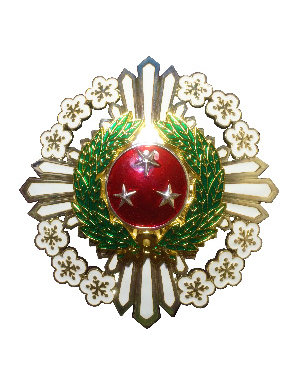
The Grand Order of the Auspicious Stars (Sosong Taehunjang) was instituted on 17th April 1900 by Emperor Kwangmu, the last King of Joseon and the first Emperor of Korea. It was conferred upon civil and military personnel who had previously been awarded the Grand Order of the Plum Blossoms, in recognition of outstandingly meritorious service.

The Order actually functioned as the second class of the Grand Order of the Golden Ruler. It was only awarded in one class only (Grand Cordon).

The Grand Order of the Auspicious Stars Design

The Order features characters in the reverse that translate to “Auspicious Stars Great Decoration”.

The Grand Order of the Gold Cheok or Golden Ruler

The Grand Order of the Gold Cheok (or Golden Ruler) was instituted in 1900 by Emperor Kwangmu, the first Emperor of Korea.

The Order of the Gold Cheok (Kumch’ok Taehunjang, also known as the Order of the Golden Ruler) was instituted on 17th April 1900 by Emperor Kwangmu, the last King of Joseon and the first Emperor of Korea.

The Order was conferred on heads of state, royalty only and very rarely on certain selected individuals that already held the Grand Order of the Auspicious Stars. The Order of the Gold Cheok was awarded in only one class: Grand Collar with Grand Cordon.

The Grand Order of the Gold Cheok or Golden Ruler Design

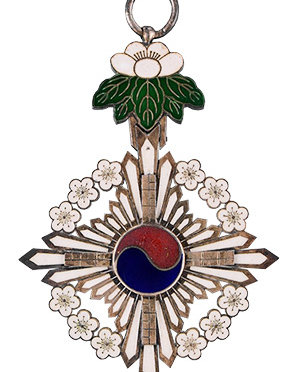
The Order consists of a large silver sash badge with four arms, each of them composed of groups three large white rays, plus a clusters of five rays in each quadrant. There are also three Hibiscus blossoms in white enamels in each quadrant, which form a surrounding laurel. The medal measures 66.7 mm (wide) x 108 mm (high, including suspension)

The obverse presents, in the center, the taeguk in blue and red enamels. There are silver rulers extending from center along each arm. The reverse is mirrored.

The suspension is a horizontally pierced ball with a large Hibiscus flower and five green enameled leaves.