The People’s Artist of the USSR Medal

The People’s Artist of the USSR Medal was an honorary title granted to artists of the Soviet Union for exceptional achievements in arts.

The People’s Artist of the USSR Medal (or Наро́дный арти́ст СССРNarodný artist SSSR in Russian) was an honorary title granted to artists of the Soviet Union. The title was introduced in 1936, replacing the earlier title of “People’s Artist of the Republic“.

The title was bestowed for exceptional achievements in the performing arts. Its recipients included many of the most acclaimed composers, dancers, singers, film and theatre directors, and actors of every Soviet republic.

Each Soviet Republic and the Autonomous Republics had a similar award held previously by virtually every receiver of the higher title of People’s Artist of the USSR.

Honorees were afforded certain privileges and would often receive commissions from the Minister of Culture of the Soviet Union. Accordingly, artists and authors who expressed criticism of the Communist Party were seldom granted such recognition, if not outright censored.

The first recipients of the title (6 September 1936) were Konstantin StanislavskiVladimir Nemirovich-DanchenkoIvan MoskvinAntonina NezhdanovaBoris ShchukinKulyash Baiseitova, and some other actors. In all, there were 1006 recipients of the award.

The People’s Artist of the USSR Medal Design

The medal was made of tombac and its shape was quadrangular with twisted corners. It measures 22.5 by 23.5 mm.

The central part is occupied by the inscription “Наро́дный арти́ст СССР” and, below, the hammer and sickle symbol. Both the symbol and inscription are embossed, with convex letters.

The medal is suspended to a single red silk fringe measuring 18 mm by 21 mm with an attached metallic buckle decorated with bay laurel leaves.

The People’s Doctor of the USSR Medal

The People’s Doctor of the USSR Medal was established in 1977 and awarded for worthwhile contributions to public health improvement. 

The People’s Doctor of the USSR Medal (or Медаль Народный врач СССР, Narodnyj vrač SSSR in Russian) was established on 25 October 1977 by Leonid Brezhnev and awarded for worthwhile contributions to public health improvement. The title was officialized on the n°44/1977 issue of Supreme Soviet’s official journal. Its regulation was later modified and completed by the Supreme Soviet’s decree of 22 August 1988.

The honorary title was conferred by the Supreme Soviet’s presidency on behalf of the Ministry of Health. A diploma of the Supreme Soviet’s presidency was given to those who were appointed People’s Doctor jointly with the medal and its concerning certificate. The title could be bestowed to individual medical doctors and nurses but also to health care structures as general hospitals, sanatoriums, maternity wards, or preventive medicine centers. The awarded people or structures were selected for their worthwhile contributions to public health improvement, for their peculiar skills and expertise, and for having proved abnegation and high moral qualities in their duties fulfillment.

Following the Dissolution of the Soviet Union in 1991, the title was replaced by that of Meritorious Doctor of the Russian Federation.

The People’s Doctor of the USSR Medal Design

The medal was made of tombac and its shape was quadrangular. It measures 22.5 by 23.5 mm.

The central part is occupied by the inscription “Медаль Народный врач СССР” on three lines and below, on the left, the Bowl of Hygieia medical symbol and, on the right, a bay laurel branch. Symbols and inscriptions were embossed, with convex letters.

The medal is suspended to a single red silk fringe measuring 18 mm by 21 mm with an attached metallic buckle decorated with the hammer and sickle symbol.

The Imperial Order of the White Eagle

The Order of the White Eagle (О рден Бе лого Орла) is an Imperial Russian Order established by Emperor Nicholas I of Russia in 1831.

The Order of the White Eagle (or О рден Бе лого Орла in Russian) is an Imperial Russian Order established by Emperor Nicholas I of Russia in 1831. A recipient of the Order was granted the title Knight of the Order of the White Eagle.

The white eagle had been associated with Poland even prior to statehood, first appearing on the Polish Coat of Arms in the 13th century. The original Order of the White Eagle (or “Order Orła Białego” in Polish) was established by King Władysław I in 1325. After the Third Partition of Poland in 1795, the Order briefly disappeared along with the Polish monarchy. The order was resurrected in 1807 by Napoleon I in his short-lived Duchy of Warsaw. When the Congress of Vienna divided the Polish lands among Prussia, the Austrian Empire, and the Russian Empire in 1815, the Order was officially “annexed” by Nicholas I on 17 November 1831 and became part of the Russian Imperial honors system.

The Imperial Order of the White Eagle Design

The Russian design of the Order featured significant alterations compared to its Polish predecessor.

The badge was struck in gold and decorated with red enamels. On the obverse, the original red maltese cross and white eagle were reduced in size and superimposed over the double-headed eagle of the Russian Empire. The reverse featured the original Polish badge design, superimposed over the Russian imperial eagle. The star now featured the Russian royal crown.

On 25 January 1832, a blue ribbon and sash were introduced.

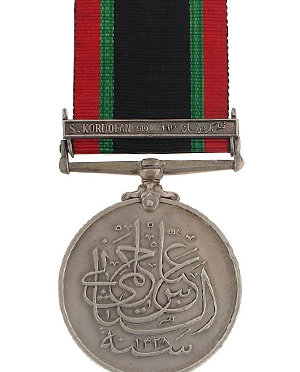
The Khedive’s Sudan Medal 1910

The Khedive’s Sudan Medal is a campaign medal established in 1911 by the Khedive and awarded by the Khedivate of Egypt for service in the Anglo-Egyptian Sudan.

The medal was awarded for minor operations in Sudan to members of the Egyptian Army, including Sudanese battalions. Recipients included a number of British Army officers seconded to the Egyptian Army, although no complete British Army units took part. A number of members of the Royal Flying Corps received the medal with the Durfur 1916 and Fasher clasps, while about thirty members of the Royal Air Force received the Garjak Nuer clasp.

This medal replaced the earlier Khedive’s Sudan Medal (1897).

The Khedive’s Sudan Medal 1910 Design

The medal is circular and measures 36 millimeters in diameter. It was issued in silver with clasps to combatants and without a clasp to non-combatants. Camp followers, such as porters and grooms, received the medal in bronze without a clasp.

The obverse shows the Arabic cipher of the Khedive, and the Hijri year of its establishment. The medal awarded in 1911 bears the cipher of Khedive Abba Hilmi, while that from 1918 shows the cipher of the Sultan Hussain Kamil. The reverse bears a lion standing on a plinth bearing the word “SUDAN” with, behind, the sun rising above the flowing River Nile.

The ribbon is 32 millimeter wide in black with thin red and green stripes on each side. The medal hangs from a bar suspension.

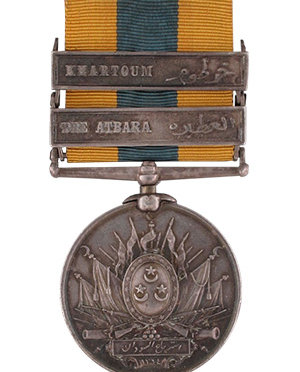
The Khedive’s Sudan Medal 1896-1908

The Khedive’s Sudan Medal is a campaign medal established 12 February 1897 by Khedive Abbas Hilmi Pasha and awarded to Egyptian and British forces for service during the reconquest of Sudan and the final part of the Mahdist War.

The medal was initially created to commemorate the reconquest of the Dongola province in 1896, but subsequently authorized for later campaigns and actions until 1908. 

All those who received the Khedive’s Sudan Medal for service on the Nile during 1896-98 also received the Queen’s Sudan Medal.

The medal was awarded with fifteen different clasps, although it’s seldom seen with more than two:

  • Firket (7 June 1896)
  • Hafir (19-26 September 1896)
  • Abu Hamed (7 July 1897)
  • Sudan 1897
  • The Atbara (8 April 1898)
  • Khartoum (2 September 1898) (For the Battle of Omdurman)
  • Gedaref (7 September to 26 December 1898)
  • Gedid (22 November 1899)
  • Sudan 1899
  • Bahar-ed-Ghazal 1900-02
  • Jerok (January to March 1902
  • Nyam-Nyam (January to May 1905)
  • Talodi (2-15 June 1905)
  • Katfia (April 1908)
  • Nyima (1-21 November 1908)

The Khedive’s Sudan Medal 1896-1908 Design

The medal is circular and measures 39 millimeters in diameter. It was awarded in silver to soldiers of the Egyptian and British armies, and in bronze to a small number of non-combatants, mainly grooms from the Indian Army and officers’ servants.

The obverse of the medal shows the Arabic cipher of the Khedive, and the Hijri year 1314. The reverse features an oval shield superimposed over a trophy of flags and arms.

The ribbon is 38 mm wide, yellow with a broad center stripe of blue, representing the Nile flowing through the desert.

The medal hangs from a straight bar suspension. For British troops, the recipient’s name and details were engraved on the medal’s edge.

The Jummoo and Kashmir Medal

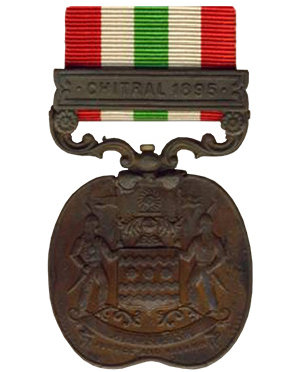
The Jummoo and Kashmir Medal is a British campaign medal established in 1895 and awarded by the Maharajah of Jummoo (Jammu) and Kashmir to the Indian troops who participated in the defense of Chitral, a dependency of Kashmir, during the siege of 4 March to 20 April by Chitralis and Afghans led by Umra Khan and Sher Afzur.

The medal always comes with the clasp and has the name of the maker (GURNEY LONDON) on the reverse. The medal in silver was presumably awarded to officers and the medal in bronze to other ranks.

The Jummoo and Kashmir Medal Design

The medal has a unique kidney shape and measures 35 millimeters high and 38 millimeters wide.

The obverse shows the arms of Jummoo (Jammu) and Kashmir. The reverse bears a view of Chitral fort with troops in the foreground.

The ribbon is white with red stripes at the edges and a central green stripe. 

The Hunza Nagar Badge

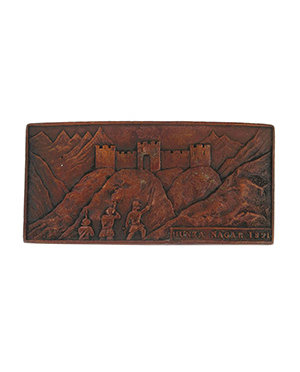
The Hunza Nagar Badge was manufactured by Gurney of London in 1891 and awarded by the Maharajah of Jammu and Kashmir to his troops who served in the operation against the border states of Hunza and Nagar. This war is known in Pakistan as the “Anglo-Brusho War”.

The British gained control of Nagar during a battle at Nilt Nagar (Jangir-e-Laye) in 1891. The fort at Nilt was stormed, and after a fortnight’s delay, the cliffs beyond it were also carried by assault. Hunza and Nagar were occupied, the chief of Nagar was reinstated on making his submission, and the half-brother of the raja of Hunza was installed as chief in the place of his brother.

Awarded in a single class, it was originally worn as a brooch at the neck, and later, it was decided that it could be worn as a medal and some of the badges had the fittings altered in order to accommodate the ribbon. Approximately 1,515 of the badges were issued.

Recipients of the Hunza Nagar badge also qualified for the Indian general service medal with clasp for Hunza 1891.

The Hunza Nagar Badge Design

The medal is a rectangular plaque struck in bronze and measures 46 by 27 millimeters in diameter.

The obverse shows an officer and two sepoys storming the fort in the hills at Nilt, with mountains in the background and the inscription “HUNZA NAGAR 1891” below and to the right.

The reverse is plain except for the maker mark “GURNEY & SON, LONDON, WOODSTOCK STREET” or just “WOODSTOCK STREET”.

The suspension in through two loops on the reverse. The ribbon is 46mm by 32mm large and has a broad red diagonal bar and white center stripe and green upper left and lower right corners.

The Order of the Iron Crown (Austria)

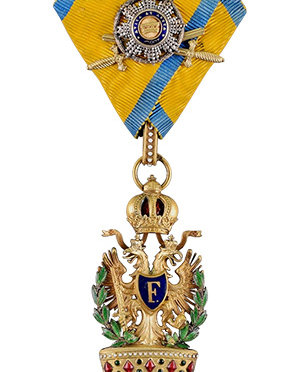
The Imperial Order of the Iron Crown was was established in 1815 by Franz I as one of the highest orders of merit of Austria-Hungary.

The Imperial Order of the Iron Crown (or Kaiserlicher Orden der Eisernen Krone in German) was one of the highest orders of merit of Austria and Austria-Hungary until 1918. It was established in 1815 by Emperor Franz I of Austria. Appointment to the third or second class of the Order of the Iron Crown became one of the main routes to ennoblement for Austrian bourgeois families and for civil servants and military officers.

The order had three classes and until 1884 all classes conferred automatic hereditary ennoblement. The first class conferred the title of Privy Councillor, the style of Excellency, and the right to attend court. The second class conferred the rank of Baron. The third class conferred the rank of Ritter.

The order could also be awarded to foreigners.

The Order of the Iron Crown Design

The medal bears an imperial eagle set within a representation of the Iron Crown of Lombardy. From 1908 for First Class knights, and from 1917 for Second Class knights, members were authorized to wear a Third Class military medal on the left breast, with an addition of a device known as a “Kleine Dekoration”. The pin device was a miniature version of the First Class breast star, and was worn on the center of the ribbon.

The Second Class Kleine Dekoration was a miniature depiction of the Iron Crown of Lombardy. For knights, it was a crown only for peacetime award, crown encircled by a wreath for the war decoration, and topped with swords for those awards “with swords”, and was worn in the same fashion as that of the First Class knights. Ordinary knights medals were also frequently adorned with crossed swords, pinned to the trifold ribbon.

The ribbon colors changed from the Imperial French gold and green to the Imperial Austrian gold and royal blue. Grand Cross (French) and First Class (Austrian) knights wore a sash and badge over the right shoulder, with an eight-pointed star on the left breast. Imperial French knight commanders wore a traditional military-style medal on the left chest, with a bow in the center of the ribbon. Imperial Austrian Second Class knights wore the medal suspended from a ribbon about the neck. French ordinary knights and Austrian Third Class knights wore a traditional military medal on the left chest.

The Royal Hungarian Order of Saint Stephen

The Order of Saint Stephen was an order of knighthood named after Hungary’s most famous king, Stephen I, who reigned between 997 and 1038.

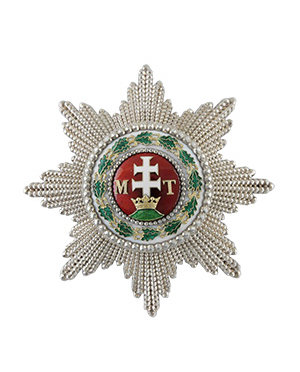
The Order of Saint Stephen (or “Szent István rend” in Hungarian) was an order of knighthood founded by Maria Theresa in 1764 and named after Hungary’s most famous king, Stephen I, who reigned between 997 and 1038. Membership was available to various members of the Hungarian nobility.

Stephen I consolidated the monarchy, established of the medieval state of Hungary and adopted Christianity as the state religion. He was canonized by Pope Gregory VII in 1083 along with his son Imre. Saint Stephen is considered the patron saint of “Hungary, kings, the death of children, masons, stonecutters, and bricklayers.”

In 1938, Miklós Horthy took the rights and activities of Grand Master as Regent of Hungary, changing its name to The Royal Hungarian Order of Saint Stephen. The Order was terminated at the time of the proclamation of the Republic of Hungary in 1946, but recreated again in 2011 as the Hungarian Order of Saint Stephen, and to this day remains the highest order in Hungary.

The Royal Hungarian Order of Saint Stephen Design

The Grand Cross

For ceremonial purposes, a full set of crimson and green robes, lined with ermine, were prescribed (or a sash for every-day wear). A collar of gold was worn about the neck and shoulders, with the badge of the Order suspended from the collar. During the waning days of the monarchy, a less formal option was also authorized: a miniature of the breast star that could be affixed to the center of the ribbon of an ordinary knight’s cross and was worn on the left breast with other orders and military medals, in order of precedence.

Knights Commander

The informal wear of the miniature, gold, Crown of Saint Stephen was worn on an ordinary knight’s cross and worn on the left breast with other orders and military medals, in order of precedence.

Knights

Wore the badge of the Order, suspended from a tri-fold ribbon of crimson, edged in green, on the left breast with other orders and military medals, in order of precedence.

The Order of Burma

The Order of Burma was awarded by the Governor for long, faithful and honorable service by Commissioned Officers in the Burma Forces.

The Order of Burma was instituted by King George VI three years after Burma became independent of British India. It was awarded by the Governor of British Burma for long, faithful and honorable service by Governor’s Commissioned Officers (for example native Burmese) in the Burma Army, the Burma Frontier Force, and the Burma Military Police.

The award was founded by Royal Warrant on 10 May 1940, and conferred in a single class. It September 1945 the royal warrant was amended to permit awards of the order for gallantry.

Only 24 awards were made.

The Order of Burma Design

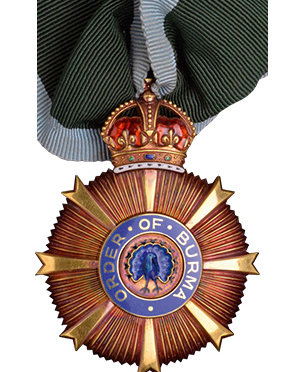
The Order was struck in gold and is a rayed circle measuring 52 mm high and 39 mm (1.5 in) in diameter.

The obverse has a central roundel showing a peacock displaying his tail, surrounded by the words ‘ORDER OF BURMA’ and surmounted by an Imperial crown.

The ribbon measures 38 mm and is dark green with light blue edges.