The Budapest Shield (Projected)

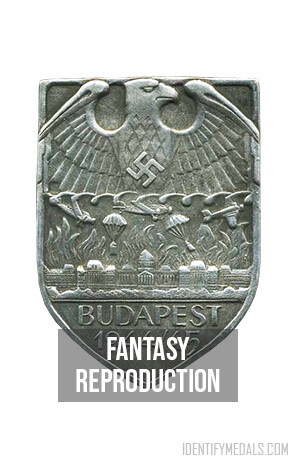
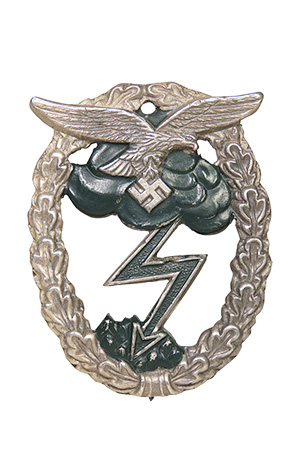
The Budapest Shield (Budapestschild) was a projected WW2 Third Reich decoration planned for participants in the Siege of Budapest.

The Budapest Shield (or Budapestschild in German) was a projected World War II German military decoration to be awarded to German forces that took part in the Siege of Budapest from December 1944 to February 1945.

The Budapest Shield was apparently approved by Adolf Hitler but abandoned with the loss of the city (as there was seemingly no hope of a reqconquest). 

The Balkans Shield Design

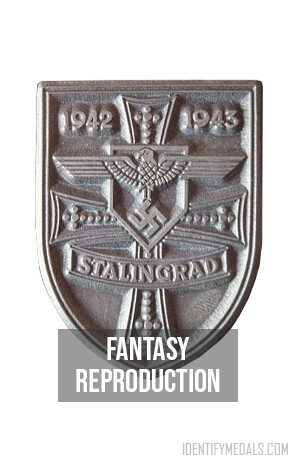
There are no descriptions of this proposed shield. All the ones you will see online are fantasy replicas made after WW2.

More Nazi Germany Shields (Ärmelschilde)

These campaign shields were awarded to members of the Wehrmacht (the unified armed forces of Nazi Germany from 1935 to 1945). They were given for participation in specific battles or campaigns and worn on the left upper arm of the uniform jacket.

The Balkans Shield (Projected)

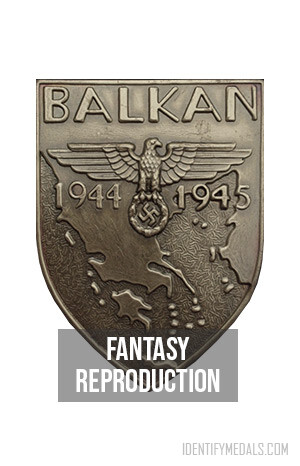
The Balkans Shield (Balkanschild) was a projected WW2 Third Reich decoration planned for participants in battes in the Balkans.

The Balkans Shield (or Balkanschild in German) was a projected World War II German military decoration to be awarded to German forces that took part in the battles of the Balkans, from 1944 to 1945.

In the book by Dr. Klietmann German Awards, the shield is described on page 156/57 as follows:
 
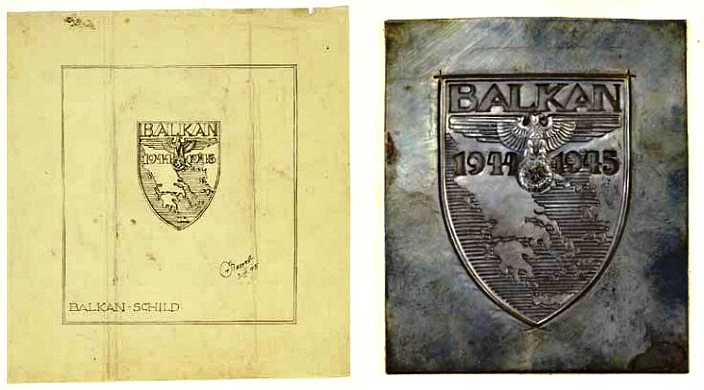
Such a shield was neither donated nor awarded. However, the creation of such an award was apparently thought of because the Reich stage designer Benno v. Arent completed one on III.7.1945 Drawing of a draft of the Balkan Shield. It seems as if this was requested by the Führer’s headquarters, but the military events that followed in quick succession prevented further decisions regarding this foundation”.

The Balkans Shield Design

The book “Awards of the German Reich 1936-1945” mentiones the shield and includes the drawing by the Reich stage designer Benno v. Arent (signed March 7, 1945).

Dr. Klietmann describes 2 template patterns:

“One pattern exists in olive-brown tinted metal, the other is silver-plated…” 

A possible Balkan Shield prototype.
A possible Balkan Shield prototype. Ex- Klietmann/Blass collections. The image shows the original Benno von Arent sketch and the original matrix. Image courtesy of Robin Lumsden and the War Relics Forum.

More Nazi Germany Shields (Ärmelschilde)

These campaign shields were awarded to members of the Wehrmacht (the unified armed forces of Nazi Germany from 1935 to 1945). They were given for participation in specific battles or campaigns and worn on the left upper arm of the uniform jacket.

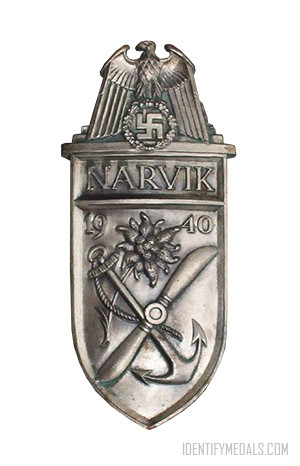
The Narvik Shield - German WW2 Medals, Badges and Awards

The Narvik Shield

The Narvik Shield (Narvikschild) is a WW2 German military decoration awarded to German forces that took part in the battles of Narvik.

Read More »
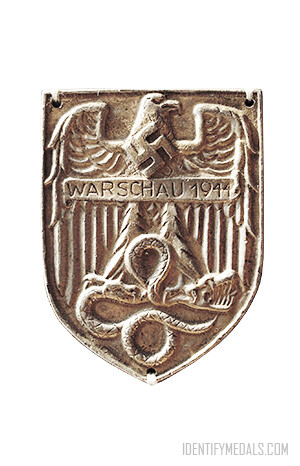
German WW2 Nazi Awards: The Warsaw Shield

The Warsaw Shield

The Warsaw Shield (Ärmelschild Warschau) is a German military decoration for those who took part in the suppression of the Warsaw uprising.

Read More »

The Stalingrad Shield (Projected)

The Stalingrad Shield (Stalingradschild) was a projected WW2 Third Reich decoration planned for participants in the Battle of Stalingrad.
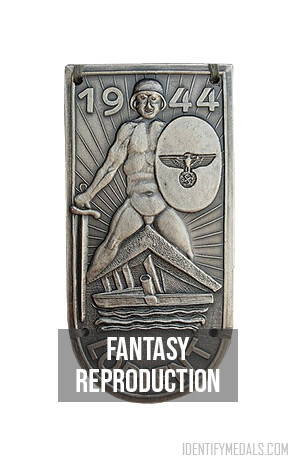
The Stalingrad Shield (or Stalingradschild in German) was a projected World War II German military decoration to be awarded to German forces that took part in the Battle of Stalingrad from 1942 to 1943.

In October 1942, the Army High Command (OKH) was convinced that Stalingrad would be captured quickly. At the suggestion of Adolf Hitler, a Stalingrad shield should also be created as a commemorative badge, similar to the Crimea shield and the Narvik shield

An order was issued on October 26, 1942 to the 6th Army fighting in Stalingrad. However, Friedrich Paulus, Commander-in-Chief of the 6th Army, replied to the OKH:

“A sad chapter. We’ve barely taken half of the city and we’re killing ourselves with the rest. Given the current fighting strength of the troops, it is impossible to predict whether we will achieve the goal we have set. Instead, we are presented with trivial, hasty stories like a Stalingrad sign.”

After the encirclement of Stalingrad and the subsequent surrender of the 6th Army, the foundation of the shield was no longer pursued.

The Stalingrad Shield Design

There were a few different design drawings made for the shield. In the exposé for a planned but unrealized Stalingrad book from March 1943, two of these shield designs intended “for the Führer” are described:

“The shield, surrounded by an eagle, shows either the Stalingrad silo with the storm flag of the 71st Division in the middle of the rubble field or the figure of an upright soldier who unites the spears aimed at his chest with his arms. The figure is placed in the ruins in an oversized size. The word “Stalingrad” is written across the sign.”

The decoration received design proposals but it was never instituted, manufactured, or awarded. Today, you can find post-war fantasy reproductions, sometimes inspired by the design proposals. 

The Stalingrad Shield was neither manufactured nor awarded. There were also no test mintings. 

More Nazi Germany Shields (Ärmelschilde)

These campaign shields were awarded to members of the Wehrmacht (the unified armed forces of Nazi Germany from 1935 to 1945). They were given for participation in specific battles or campaigns and worn on the left upper arm of the uniform jacket.

The Narvik Shield - German WW2 Medals, Badges and Awards

The Narvik Shield

The Narvik Shield (Narvikschild) is a WW2 German military decoration awarded to German forces that took part in the battles of Narvik.

Read More »
German WW2 Nazi Awards: The Warsaw Shield

The Warsaw Shield

The Warsaw Shield (Ärmelschild Warschau) is a German military decoration for those who took part in the suppression of the Warsaw uprising.

Read More »

The Honor Roll Clasp of the Army

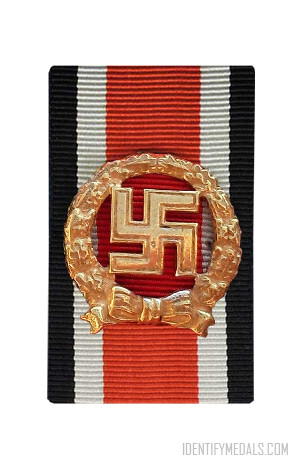
The Honor Roll Clasp of the Army / Heer was a German decoration first issued in July 1941 after the German invasion of the Soviet Union.

The Honor Roll Clasp (or Ehrenblattspange in German) was a World War II German military decoration issued in July 1941 after the German invasion of the Soviet Union.

The Honor Roll existed in three different versions: One for the Army (Heer), one for the Air Force (Luftwaffe), and one for the Navy (Kriegsmarine) – all of which also have de-nazified versions.

To be eligible for the clasp, across all three services, a recipient must have:

  • Previously received the Iron Cross in both the first and second classes;
  • Demonstrated further distinction in combat subsequent to being awarded the Iron Cross in both classes; and
  • Been listed in the Honor Roll of the German Army.

The Honor Roll of the German Army (or Ehrenblatt des Deutschen Heeres) was initially released in July 1941 and documented the names of soldiers who had displayed extraordinary valor in combat. It was originally published in the Army Ordinance Gazette (Heeres-Verordnungsblatt).

The Honor Roll Clasp of the Army Design

The clasp was crafted from gilt metal and features a wreath measuring 24.5 mm in diameter, composed of six clusters of oak leaves on either side. At its widest point, the wreath measures 5 mm in width, narrowing to a point at the apex where two oak leaves met tip-to-tip. The badge’s height from base to tip is 26 mm. The reverse of all clasps has four pins for attachment.

The Honor Roll Clasp of the Army / Heer shows a large swastika superimposed (soldered) on the wreath.

More Army/Waffen-SS War Badges

The Army/Waffen-SS war badges were military decorations awarded by Nazi Germany to members of the Army (Heer) and the Waffen-SS. Explore the complete collection below:

The Honor Roll Clasp of the Kriegsmarine

The Honor Roll Clasp of the Kriegsmarine was a German decoration first issued in July 1941 after the German invasion of the Soviet Union.

The Honor Roll Clasp (or Ehrenblattspange in German) was a World War II German military decoration issued in July 1941 after the German invasion of the Soviet Union.

The Honor Roll existed in three different versions: One for the Army (Heer), one for the Air Force (Luftwaffe), and one for the Navy (Kriegsmarine) – all of which also have de-nazified versions.

To be eligible for the clasp, across all three services, a recipient must have:

  • Previously received the Iron Cross in both the first and second classes;
  • Demonstrated further distinction in combat subsequent to being awarded the Iron Cross in both classes; and
  • Been listed in the Honor Roll of the German Army.

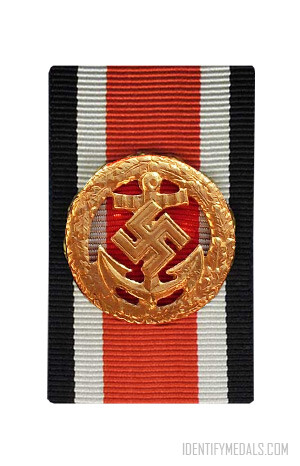
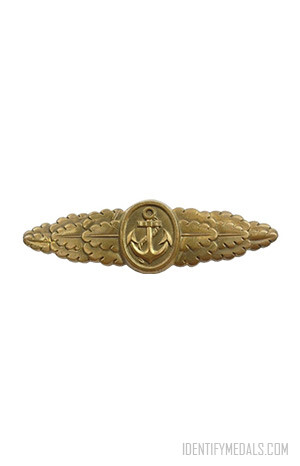
The Honor Roll Clasp of the Kriegsmarine (Ehrentafel der Deutschen Kriegsmarine) was established in February 1943 and received a wearable decoration (seen in the picture) in May 1944.

The Honor Roll Clasp of the Kriegsmarine Design

The clasp was crafted from gilt metal and features a wreath measuring 24.5 mm in diameter, composed of six clusters of oak leaves on either side. At its widest point, the wreath measures 5 mm in width, narrowing to a point at the apex where two oak leaves met tip-to-tip. The badge’s height from base to tip is 26 mm. The reverse of all clasps has four pins for attachment.

The Honor Roll Clasp of the Kriegsmarine shows a swastika superimposed on an anchor.

More Naval War Badges

The Naval War Badges (Kriegsmarine) badges were awarded to sailors, officers, and personnel of the Kriegsmarine who demonstrated exceptional skill, bravery, and dedication in naval warfare. Explore the complete collection below:

The Honor Roll Clasp of the Luftwaffe

The Honor Roll Clasp of the Luftwaffe was a German decoration first issued in July 1941 after the German invasion of the Soviet Union.

The Honor Roll Clasp (or Ehrenblattspange in German) was a World War II German military decoration issued in July 1941 after the German invasion of the Soviet Union.

The Honor Roll existed in three different versions: One for the Army (Heer), one for the Air Force (Luftwaffe), and one for the Navy (Kriegsmarine) – all of which also have de-nazified versions.

To be eligible for the clasp, across all three services, a recipient must have:

  • Previously received the Iron Cross in both the first and second classes;
  • Demonstrated further distinction in combat subsequent to being awarded the Iron Cross in both classes; and
  • Been listed in the Honor Roll of the German Army.

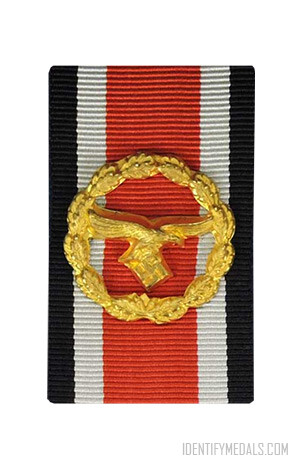
The Honor Roll Clasp of the Luftwaffe (Ehrenblatt der Deutschen Luftwaffe) was established on July 5, 1944, concurrently with the introduction of the decoration. Air Force personnel who had previously been awarded The Luftwaffe Honour Goblet or the Luftwaffe Honour Plate were automatically eligible for the Air Force Honour Roll Clasp. 

The Honor Roll Clasp of the Luftwaffe Design

The clasp was crafted from gilt metal and features a wreath measuring 24.5 mm in diameter, composed of six clusters of oak leaves on either side. At its widest point, the wreath measures 5 mm in width, narrowing to a point at the apex where two oak leaves met tip-to-tip. The badge’s height from base to tip is 26 mm. The reverse of all clasps has four pins for attachment.

The Honor Roll Clasp of the Luftwaffe shows the Luftwaffe eagle within the circular gilt metal oak wreath.

More Luftwaffe War Badges

Awarded to members of the German Luftwaffe for their achievements and contributions to air warfare, the Luftwaffe War Badges symbolized excellence, courage, and skill in aerial combat and support roles. Explore the complete collection below:

The Front Flying Clasp of the Luftwaffe

The Front Flying Clasp of the Luftwaffe was a WW2 German military decoration awarded to Luftwaffe personnel for operational flights.

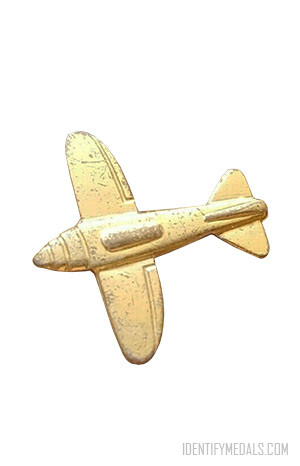
The Front Flying Clasp of the Luftwaffe (or Frontflugspange in German) was a World War II German military decoration conferred upon aircrew and select Luftwaffe personnel to acknowledge the quantity of operational flights undertaken.

Instituted by Reichsmarschall Hermann Göring on January 30, 1941, it came in Bronze, Silver, and Gold grades, with the possibility of an upgrade to include diamonds. Pennants appended to the clasp indicated the number of missions completed in specific aircraft types.

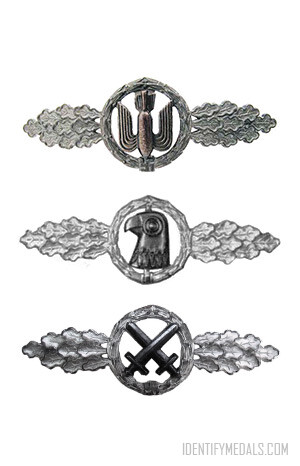
Front Flying Clasps were awarded for missions carried out in various Luftwaffe aircraft categories, including day fighters, night fighters, long-range night fighters, heavy fighters, air-to-ground support fighters, bombers, reconnaissance, transport, and gliders.

The introduction dates for the different clasps were as follows:

  • January 30, 1941, for the Front Flying Clasp
  • June 26, 1942, for the Pennant to the Gold Front Flying Clasp
  • April 29, 1944, for the Pennant indicating the number of missions completed

And the criteria for qualification was:

  • Bronze – 20 flown missions
  • Silver – 60 flown missions
  • Gold – 110 flown missions

The Front Flying Clasp of the Luftwaffe Design

Each badge features a central device, typically blackened, encircled by a wreath of laurel leaves situated between two stylized wings composed of oak leaves, with a swastika positioned at the base of the wreath.

The clasps themselves measure approximately 7.5 cm (3 in) by 2.5 cm (1 in). The design of the central device varies based on the type of aircraft flown. Additionally, the clasp pennant was introduced to provide supplementary recognition for an increased number of operational missions or flights, a distinction that expanded as the war progressed.

In accordance with the post-war German Denazification initiative, these clasps were made available for wear in 1957, albeit with their Swastika emblems removed.

More Luftwaffe War Badges

Awarded to members of the German Luftwaffe for their achievements and contributions to air warfare, the Luftwaffe War Badges symbolized excellence, courage, and skill in aerial combat and support roles. Explore the complete collection below:

The Medal of Merit in the Nuth Al-Ma’rkat Combat

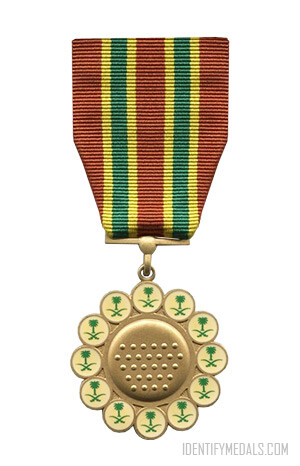
The Medal of Merit in the Nuth Al-Ma’rkat Combat was established by the Kingdom of Saudi Arabia in 1971 and given for outstanding service.

The Medal of Merit in the Nuth Al-Ma’rkat Combat (ميدالية الاستحقاق) was established by the Kingdom of Saudi Arabia in 1971 and is given for outstanding service.

There are three classes for this medal.

The Medal of Merit Design

The Order of Merit is circular and measures 35 mm wide. The reverse is plain.

The ribbon has stripes in red, yellow, and green. 

The Order of Merit (Saudi Arabia)

The Order of Merit was instituted by the Kingdom of Saudi Arabia in 1971 and is awarded for outstanding service. It has three classes.

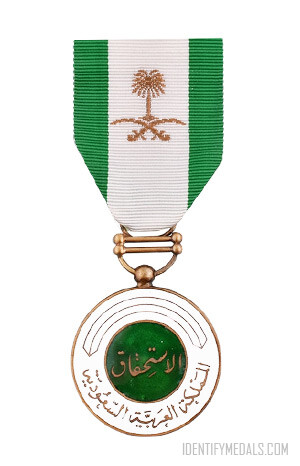
The Order of Merit (ميدالية الاستحقاق) was established on 20th or 21st March 1971 by King Faisal idn Abdulaziz by Council of Minister Decisions of the Kingdom of Saudi Arabia.

The medal is awarded to civilians for outstanding service and exists in three classes. All initial appointments are for the Third (III) Class, with higher ones being achieved by promotion. 

The Order of Merit Medal Design

The Order of Merit is circular and measures 35 mm wide. In the obverse is the inscription “Kingdom of Saudi Arabia”.

The ribbon has outer green stripes and a central larger white stripe. The medal in I Class is struck in gold.

The Presidential Unit Citation Award (PUC)

The Presidential Unit Citation or PUC was created by President Franklin D. Roosevelt on 26 February 1942 and awarded in various conflicts.

Time Period: Second World War, Post-WW2
Institution: 1941
Country: United States
 

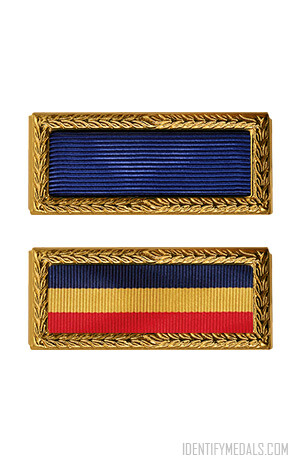
The Presidential Unit Citation (or PUC) is a military award presented to units of the United States Armed Forces and those of allied countries for extraordinary heroism in action against an armed enemy.

It is one of the highest unit awards that can be bestowed upon a military organization and is considered a significant honor.

The PUC is awarded by the President of the United States in the name of the U.S. Congress. It is typically conferred upon units that have demonstrated exceptional gallantry, determination, and proficiency in combat operations, often under extremely challenging and hazardous conditions.

The Presidential Unit Citation Ribbon Designs

There are several variations of the Presidential Unit Citation, each denoted by a different ribbon or emblem. Recipients of the PUC are authorized to wear the appropriate ribbon or emblem on their uniforms as a symbol of their unit’s extraordinary achievements.

The variations are:

  1. Army Presidential Unit Citation: Awarded to U.S. Army units for extraordinary heroism in action against an armed enemy.

  2. Navy Presidential Unit Citation: Awarded to U.S. Navy units, Marine Corps units, and Coast Guard units when operating under the control of the Department of the Navy for extraordinary heroism in action against an armed enemy.

  3. Air Force Presidential Unit Citation: Awarded to U.S. Air Force units for extraordinary heroism in action against an armed enemy.

  4. Joint Meritorious Unit Award: Awarded to joint units of the U.S. Armed Forces for outstanding meritorious achievement or service in support of combat operations.

  5. Navy Unit Commendation: Awarded to U.S. Navy units, Marine Corps units, and Coast Guard units when operating under the control of the Department of the Navy for outstanding heroism in action against an armed enemy.

The Presidential Unit Citation Submarine Clasps

The Presidential Unit Citation Clasps are small emblems or devices worn on the ribbon of the Presidential Unit Citation to denote additional awards or significant achievements by a unit. The USS Nautilus (SSN-571) and USS Triton (SSRN-586) are two submarines that received the Presidential Unit Citation for their historic achievements.

The USS Nautilus (SSN-571) Clasp

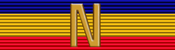
Presidential Unit Citation - USS Nautilus (SSN-571) Clasp

The USS Nautilus was the world’s first operational nuclear-powered submarine and made history by completing the first submerged voyage to the North Pole in 1958. This groundbreaking achievement demonstrated the capabilities of nuclear propulsion in submarines and significantly advanced naval technology. As a result of this historic feat, the USS Nautilus was awarded the Presidential Unit Citation for extraordinary heroism and achievement.

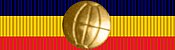
The USS Triton (SSRN-586) Clasp

The USS Triton was another nuclear-powered submarine that made history by completing the first submerged circumnavigation of the Earth in 1960. This unprecedented voyage demonstrated the endurance and capabilities of nuclear-powered submarines and provided valuable data for future naval operations. In recognition of this remarkable achievement, the USS Triton was awarded the Presidential Unit Citation.