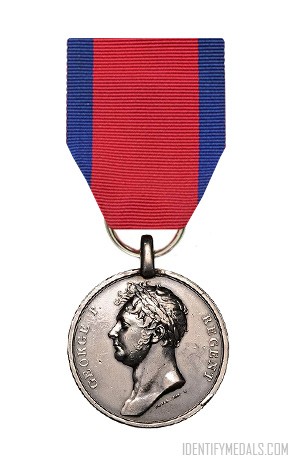
The War Commemorative Medal of 1813-15

The War Commemorative Medal for 1813–1815 was established in 1813 by King Friedrich Wilhelm III of Prussia for the Wars of Liberation.

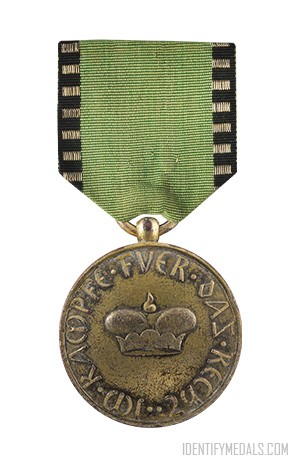
The War Commemorative Medal of 1813/15 (or Kriegsdenkmünze für 1813/15 in German) was a Prussian war commemorative medal  established on 24 December 1813 by King Friedrich Wilhelm III of Prussia to honour members of the Prussian Army who fought in the Wars of Liberation against Napoleonic France during 1813–1815.

It recognised those who served throughout the conflict, which included campaigns that eventually led to the defeat of Napoleon and the decisive Battle of Waterloo.

A later related piece, the Erinnerungs‑Kriegs‑Denkmünze, was instituted on 17 March 1863 by King Wilhelm I on the 50th anniversary of the original campaigns. This anniversary issue featured portraits of Friedrich Wilhelm III and inscriptions marking the years 1813–1815, and was intended as a keepsake for legitimate holders of the original medal and their families.

The War Commemorative Medal Design

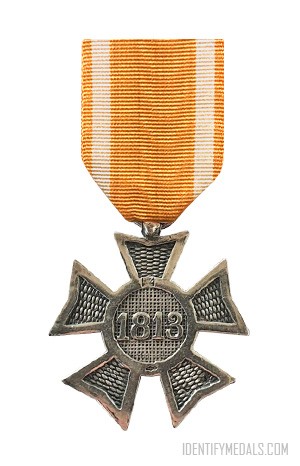
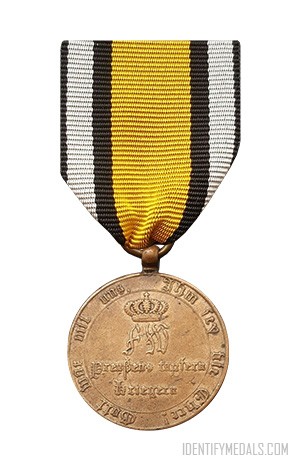
The medal is about 29 mm in diameter and features a cross on the obverse with rays between its arms and a wreath of laurel and oak leaves encircling the year or years of service (such as 1813, 1814, or 1815). The reverse bears the crowned monogram “F. W.” for Friedrich Wilhelm and the inscription Preußens tapferen Kriegern, Gott war mit uns, Ihm sey die Ehre (“To Prussia’s brave warriors, God was with us, to Him be the glory”).

There were two versions of the medal: a combatant version struck in bronze made from captured artillery, often with the edge inscription Aus erobertem Geschütz (“From captured cannon”), and a non‑combatant version cast in iron and oval in shape, which was awarded to those who did not see active combat or who supported the war effort. The iron variant became informally known as the “Eiserne Pflaume” (“Iron Plum”) due to its shape.

Both versions were worn on the left breast suspended from distinctive ribbons: combatants on an orange ribbon edged in black and white, and non‑combatants on a white ribbon edged in black, orange, and white.

The Different Waterloo Medals

The Waterloo medal was issued by the British Government to all soldiers present during action. Seven nations of the Seventh Coalition struck differently designed medals for soldiers who took part in the campaign. These are:

The Waterloo Medal - British Medals Pre-WW1

The Waterloo Medal

The Waterloo Medal is a British military medal established in 1816-17 and struck for all those who participated in the Waterloo campaign.
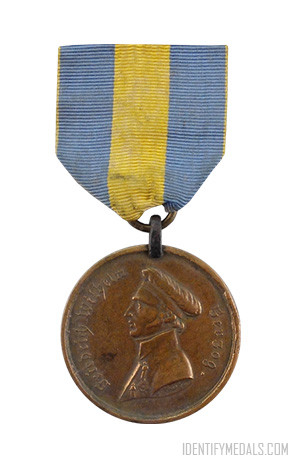
British Campaign Medals: The Brunswick Waterloo Medal

The Brunswick Waterloo Medal

The Brunswick Waterloo Medal was a campaign medal awarded to those who participated in the Battles of Quatre Bras and Waterloo.
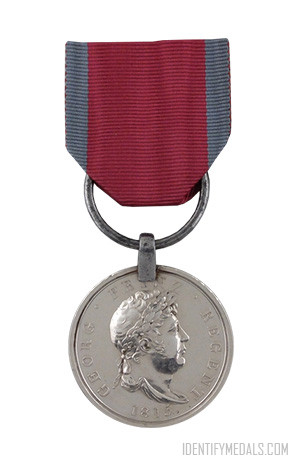
British Campaign Medals: The Hanoverian Waterloo Medal

The Hanoverian Waterloo Medal

The Hanoverian Waterloo Medal was issued to all members of the Hanoverian army who fought in the battles of Quatre Bras and Waterloo.
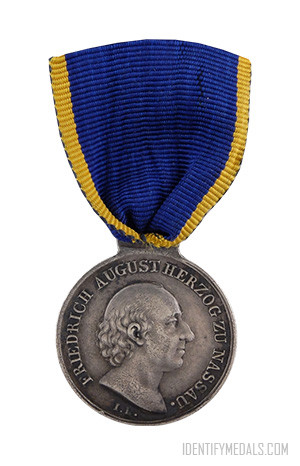
British Campaign Medals: The Nassau Medal for Waterloo

The Nassau Waterloo Medal

The Waterloo Medal is a campaign of the Duchy of Nassau established by Frederick Augustus, Duke of Nassau on 23 December 1815.
Where to Find Waterloo Medals

Right Now on eBay 
Clicking a link to eBay may result in a referral commission being paid if a purchase is made.
Loading...

The Inherent Resolve Campaign Medal

The Inherent Resolve Campaign Medal is a U.S. campaign medal created to recognise military service in Operation Inherent Resolve.

The Inherent Resolve Campaign Medal (IRCM) is a U.S. Department of Defense campaign medal created to recognise military service in Operation Inherent Resolve, the U.S.-led effort against the Islamic State extremist group in Iraq and Syria. It was established by Executive Order on 30 March 2016 during the Obama administration and is awarded retroactively to service beginning 15 June 2014.

Unlike awards for specific achievements, the IRCM is a service-based campaign medal, meaning it acknowledges participation in a defined military operation rather than an individual act of heroism. It is presented to members of the U.S. Army, Navy, Marine Corps, Air Force, and Coast Guard who meet eligibility criteria related to deployment in designated areas during the operation.

To qualify, a service member generally must have been assigned to a unit based in Iraq or Syria, have flown missions into these countries or their contiguous waters and airspace, or otherwise operated in the area for a specified period—typically 30 days (consecutive or non-consecutive). Those who are killed, wounded, medically evacuated, or engaged in combat before completing the time requirement also qualify immediately.

The award replaced the use of the Global War on Terrorism Expeditionary Medal for service in Iraq and Syria once it was instituted; personnel who previously earned that medal for qualifying service may petition to convert it to the IRCM instead, but a service member cannot receive both for the same period of service.

Today the medal remains an active award recognising U.S. military participation in one of the major post-9/11 operations and is often seen alongside campaign stars on its ribbon to denote participation in different phases of the conflict.

The Inherent Resolve Campaign Medal Design

The design and symbolism of the IRCM reflect aspects of the operational environment: an eagle and dagger denote strength and resolve, while regional artistic motifs and colours evoke the landscape where Operation Inherent Resolve was conducted.

Find This Medal Online

Right Now on eBay 
Clicking a link to eBay may result in a referral commission being paid if a purchase is made.
Loading...

The Korean Service Medal

The Korean Service Medal (KSM) is a U.S. military service medal created during the Korean War to recognise American Armed Forces members.

The Korean Service Medal (KSM) is a United States military service medal created during the Korean War to recognise American Armed Forces members who served in the Korean theatre between 27 June 1950 and 27 July 1954. It was established by Executive Order 10179 signed by President Harry S. Truman on 8 November 1950, with retroactive effect back to the start of the conflict.

The medal was awarded to service members who either served in Korea or its surrounding waters and airspace, or those who directly supported United Nations military operations during the Korean War. Eligibility generally required a period of service in the designated area or participation with a unit on permanent or temporary duty during the war.

Although active combat in Korea ended with the armistice in July 1953, the Korean Service Medal continued to be issued until mid-1954 because of ongoing occupation duties and the potential for renewed hostilities. It was not awarded for service after that date; later periods of service in Korea have been recognised by other medals such as the Korea Defense Service Medal.

The Korean Service Medal Design

The KSM is a bronze medallion about 1¼ inches in diameter. The obverse shows a Korean gateway encircled by the words “KOREAN SERVICE”, and the reverse bears the Korean taegeuk symbol from the South Korean flag with “UNITED STATES OF AMERICA” and a wreath of oak and laurel.

The ribbon uses blue and white colours inspired by the United Nations flag, reflecting the UN’s role in the conflict.

To denote participation in specific phases of the campaign, service stars were worn on the ribbon, one for each of the officially recognised campaigns within the Korean War period. In some cases, additional devices such as an arrowhead were authorised to show involvement in assault landings.

Find This Medal Online

Right Now on eBay 
Clicking a link to eBay may result in a referral commission being paid if a purchase is made.
Loading...

The Order of Mother Heroine

The Order of Mother Heroine was introduced in 1957 and awarded to mothers for bearing and raising large families.

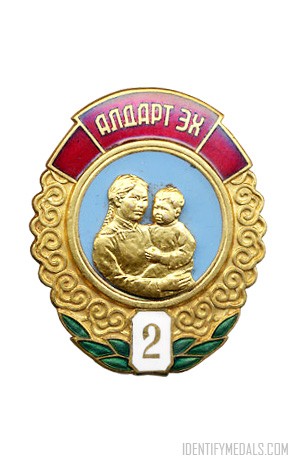
The Order of Mother Heroine was awarded to Mongolian mothers for bearing and raising large families. There medal was given in two classes: 

  • 1st Class: For mothers with eight or more children.
  • 2nd Class: For mothers with five to eight children.

The Order of Mother Heroine Design

The medal is made of bronze gilt with red, white, light blue, and green enamels and measures 39.5 mm (w) x 46.5 mm (h). 

The 1st and 2nd Class medals share the same design: A Mongolian mother holding a child, over a light blue enamel background. The difference lies in the number at the bottom of the award (a “1” for 1st Class and a “2” for 2nd Class).

Mongolian People's Republic: Order of Mother Heroine

1st Class 

Mongolian People's Republic: Order of Mother Heroine

2nd Class 

The Coast Guard Silver Lifesaving Medal

Established at the same time as the gold grade in 1874, the Silver Lifesaving Medal recognizes extraordinary lifesaving efforts.

Established at the same time as the gold grade in 1874, the Silver Lifesaving Medal recognizes extraordinary lifesaving efforts that do not meet the extremely high threshold of the Gold Lifesaving Medal.

Like its gold counterpart, it transitioned from Treasury Department administration to Coast Guard responsibility and remains authorized under U.S. law. Over 1,900 Silver Lifesaving Medals have been awarded since its creation.

The Coast Guard Silver Lifesaving Medal Criteria

The Silver Lifesaving Medal is awarded to individuals who rescue or attempt to rescue someone from drowning, shipwreck, or other water‑related dangers under circumstances that show significant effort and risk but not to the same degree of personal danger required for the gold medal.

The geographic and jurisdictional requirements are the same as for the Gold Lifesaving Medal, and awards may also be made posthumously.

The Coast Guard Silver Lifesaving Medal Design

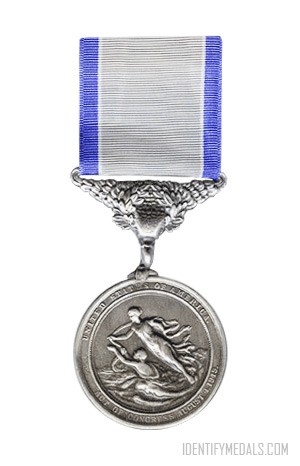
Like the gold medal, the silver version is struck from actual silver and features imagery representing lifesaving efforts.

Historically, early silver medals were worn from a light blue ribbon; post‑1949 versions use a standardized ribbon pattern with multiple colors. The obverse inscription usually identifies heroic deeds in saving life from the sea, and additional awards are often denoted by silver clasps or stars on the ribbon.

Buy Coast Guard Medals

Right Now on eBay 
Clicking a link to eBay may result in a referral commission being paid if a purchase is made.
Loading...

The Coast Guard Gold Lifesaving Medal

The Gold Lifesaving Medal is one of the oldest U.S. federal decorations, first authorized by an Act of Congress in 1874 to recognize heroism.

The Gold Lifesaving Medal is one of the oldest U.S. federal decorations, first authorized by an Act of Congress on June 20, 1874 to recognize heroism in saving lives from peril in the water.

Originally administered by the U.S. Life‑Saving Service under the Treasury Department, it became a Coast Guard‑administered award after the Life‑Saving Service merged with the Revenue Cutter Service to form the modern Coast Guard. The current legal authorization comes from Title 14 of the U.S. Code, and the medal continues to be awarded by the Coast Guard today. More than 600 Gold Lifesaving Medals have been issued since its inception.

The Coast Guard Gold Lifesaving Medal Criteria

The Gold Lifesaving Medal is awarded to any person—military or civilian—who rescues or attempts to rescue another person from drowning, shipwreck, or other perils of the water and does so at the risk of their own life, demonstrating extreme and heroic daring. The rescue must occur in waters within the United States or under its jurisdiction, or involve a U.S. citizen or vessel if outside U.S. jurisdiction. Awards may be made posthumously.

The Coast Guard Gold Lifesaving Medal Design

The medal is uniquely struck from pure gold, making it one of the few U.S. decorations made of the precious metal itself. Early versions were large, table‑display pieces; later iterations, dating from the late 19th century onward, were designed to be worn suspended from a ribbon.

The obverse depicts a rescue scene at sea, symbolizing life‑saving action, while the reverse bears inscriptions reflecting its purpose under Act of Congress.

The medal’s ribbon and size were standardized around 1949 to align with other U.S. awards. Subsequent awards are denoted by gold bars inscribed with the recipient’s name.

Buy Coast Guard Medals

Right Now on eBay 
Clicking a link to eBay may result in a referral commission being paid if a purchase is made.
Loading...

The Coast Guard Arctic Service Medal

The Coast Guard Arctic Service Medal was established on May 20, 1976 by the Commandant of the Coast Guard, Admiral Owen W. Siler.

The Coast Guard Arctic Service Medal was established on May 20, 1976 by the Commandant of the Coast Guard, Admiral Owen W. Siler, to recognize Coast Guard personnel who serve in the challenging and unforgiving Arctic region. The medal is awarded retroactively to service dating back to January 1, 1946 for qualifying Arctic duty. It remains a current award within the Coast Guard’s decorations.

The Coast Guard Arctic Service Medal Criteria

This medal is awarded to any member of the United States Coast Guard who completes twenty‑one days of non‑consecutive duty north of the Arctic Circle—either afloat aboard Coast Guard vessels or ashore at designated locations—under competent orders.

Aircrew who fly missions into and out of Arctic areas may also qualify after accumulating twenty‑one qualifying days of service. Eligible duty includes time spent aboard cutters operating in polar waters or at remote stations such as those in Alaska, Greenland, Canada, and Norway. Civilians who support Coast Guard missions in the Arctic may be recommended for the medal as well.

The Coast Guard Arctic Service Medal Design

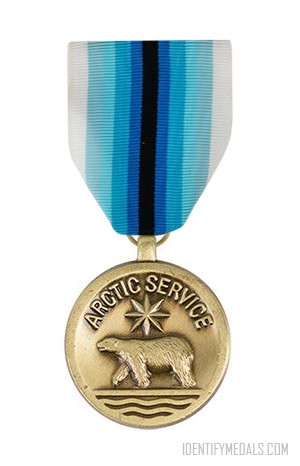
The Coast Guard Arctic Service Medal features a bronze medallion that visually reflects its geographic focus. 

The obverse (front) has a polar bear depicted in profile under an eight‑point star (representing the North Star) with the words “ARCTIC SERVICE” above. The polar bear symbolizes the harsh Arctic environment and the cutter Bear, a historic vessel associated with polar operations. The reverse (back) shows the Coast Guard Shield, signifying the authority and service of the U.S. Coast Guard.

  • Ribbon: The accompanying service ribbon has a distinctive pattern representing Arctic service and is worn on the uniform when the full medal is not displayed.
  • Devices: Although no devices for multiple awards are standard, service stars may be authorized in some cases for subsequent qualifying service.

Buy Coast Guard Medals

Right Now on eBay 
Clicking a link to eBay may result in a referral commission being paid if a purchase is made.
Loading...

The Coast Guard Reserve Good Conduct Medal

The Coast Guard Reserve Good Conduct Medal was created in 1963 as the reserve‑component equivalent of the Coast Guard Good Conduct Medal.

The Coast Guard Reserve Good Conduct Medal was created in 1963 as the reserve‑component equivalent of the active‑duty Coast Guard Good Conduct Medal. It was established to recognize enlisted Coast Guard Reservists who perform their duties with consistent professionalism and good order over an extended period of service.

The Coast Guard Reserve Good Conduct Medal Criteria

The medal is awarded to enlisted members of the U.S. Coast Guard Reserve who complete a standard tour of at least three years of satisfactory service in the Reserve without any disciplinary infractions. Service must be honorable and reflect high standards of conduct and duty performance.

Commissioned officers and warrant officers are not eligible to earn the medal, although they may wear it if they earned it previously while enlisted. Additional awards for subsequent qualifying periods are denoted by service stars worn on the ribbon.

The Coast Guard Reserve Good Conduct Medal Design

The reserve versions of the Good Conduct medals generally follow the pattern of the active‑duty versions but bear wording that reflects Reserve service.

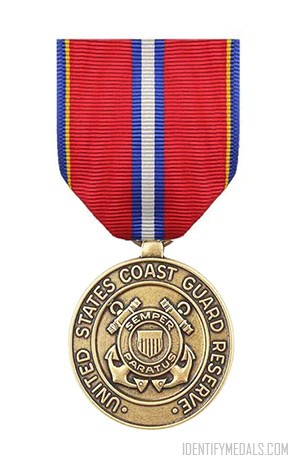
For the Coast Guard Reserve version, the medal includes imagery associated with the Coast Guard (such as the service seal) and the inscription “United States Coast Guard Reserve.”

The ribbon has distinctive striping that differentiates it from other branches’ reserve good‑conduct ribbons. Subsequent awards are indicated by service stars on the ribbon.

Buy Coast Guard Medals

Right Now on eBay 
Clicking a link to eBay may result in a referral commission being paid if a purchase is made.
Loading...

The Coast Guard Good Conduct Medal

The Good Conduct Medal is one of the oldest awards in the U.S. military and has been adopted by each branch of the armed forces.

The Good Conduct Medal is one of the oldest awards in the U.S. military and has been adopted by each branch of the armed forces at different times. The U.S. Navy first introduced its version in 1869, followed by the Marine Corps in 1896, the Coast Guard in 1923, the Army in 1941, the Air Force in 1963, and, most recently, the Space Force in 2023.

The Coast Guard Good Conduct Medal was established in 1923 to recognize enlisted personnel for honorable, faithful, and exemplary service. It is one of the oldest Coast Guard-specific awards and reflects the service’s emphasis on discipline, professionalism, and dedication. Over the decades, it has honored countless Coast Guardsmen who have consistently demonstrated integrity and reliability in carrying out their duties.

The Coast Guard Good Conduct Medal Criteria

The medal is awarded to enlisted members of the Coast Guard who demonstrate:

  • Exemplary behavior, efficiency, and fidelity during a period of service.
  • A standard qualifying period of three continuous years of active service without any disciplinary actions, such as courts-martial or non-judicial punishments.
  • Shorter qualifying periods (often one year) may apply during wartime or national emergencies.
  • Additional awards are denoted by devices (typically bronze or silver stars) added to the ribbon for each subsequent period of qualifying service.

The Coast Guard Good Conduct Medal Design

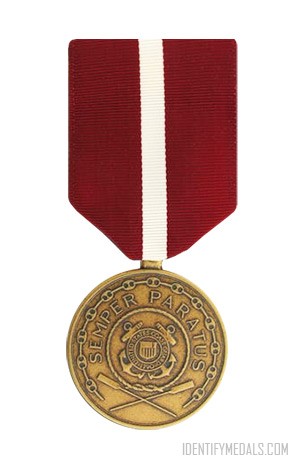
The Coast Guard Good Conduct Medal’s design closely mirrors the Navy’s version but incorporates distinct Coast Guard symbolism. The obverse (front) features a Coast Guard cutter, often depicted with rope and chain edging, symbolizing the maritime mission of the service. The reverse (back) typically bears the inscription honoring faithful and exemplary service.

The medal visually represents the Coast Guard’s values of discipline, loyalty, and “Semper Paratus” (Always Ready) while celebrating sustained, honorable service by enlisted personnel.

  • Ribbon: Primarily red with white stripes, reflecting the traditional colors associated with long-standing honorable service.
  • Devices: Bronze or silver stars indicate subsequent awards for additional qualifying service periods.

Buy Coast Guard Medals

Right Now on eBay 
Clicking a link to eBay may result in a referral commission being paid if a purchase is made.
Loading...

The Order of Sports Merit

The Order of Sports Merit is a distinguished Cuban honor that recognizes exceptional contributions to the field of sports.

  • Time Period: Post-WW2
  • Institution: 10 April 1979
  • Country: Cuba

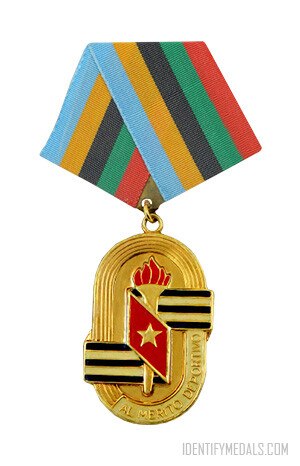
The Order of Sports Merit (Orden Al Mérito Deportivo) is a distinguished Cuban honor established on December 10, 1979, under Decree-Law No. 30. This prestigious award recognizes exceptional contributions to the field of sports and physical culture, celebrating achievements that inspire excellence, promote national pride, and advance the development of athletic programs in Cuba and beyond.

The Order of Sports Merit reflects Cuba’s deep commitment to physical education and sports as integral components of national identity and human development. Sports are not only viewed as a source of pride but also as a means of fostering discipline, teamwork, and solidarity—values that align with the ideals of the Cuban Revolution.

By extending the award to international recipients and organizations, Cuba underscores the importance of global collaboration and shared efforts in promoting physical culture, mutual respect, and the unifying power of sports.

The Order of Sports Merit Criteria

The Order of Sports Merit is conferred on:

  • Cuban and foreign athletes: Honoring extraordinary achievements in sports, including competitive excellence, breaking records, or representing their nation with distinction.
  • Contributors to physical culture and sports: Recognizing individuals who have made significant and selfless contributions to the development of physical education and athletic programs.
  • Sports professionals and organizations: Awarded to technicians, specialists, entities, and organizations (both Cuban and foreign) for their exceptional support in:
    • Enhancing the development of physical culture and sports infrastructure.
    • Providing technical expertise or innovation that advances athletic performance.
    • Supporting the training and improvement of Cuban athletes.

Recipients of the Order of Sports Merit represent the pinnacle of dedication and achievement in the realm of sports and physical culture. They inspire new generations of athletes and contribute to the broader goals of health, fitness, and unity within society.