The 1914–1918 Commemorative War Medal

The 1914–1918 Commemorative war medal was awarded to soldiers, sailors, and some civilians for service in World War I.

The 1914–1918 Commemorative war medal (or “Médaille commémorative de la guerre 1914–1918” in French) was awarded to soldiers and sailors for service in World War I, and to civilians who met certain requirements, for service between 2 August 1914 and November 11, 1918.

The 1914–1918 Commemorative War Medal Design

The design of the medals was decided by an open contest that had invited many engravers of the time. A total of 73 models were presented to the jury, and Pierre-Alexandre Morlon’s was ultimately adopted.

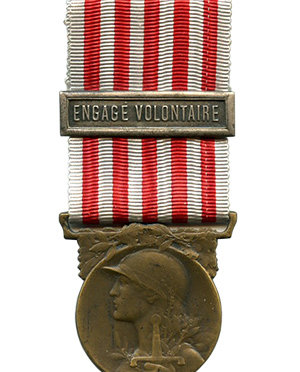
The medal is made of bronze, round and measures 33 mm in diameter. The obverse shows an effigy of a youthful Minerva in profile, wearing the helmet of 1914 which represents France. She is crowned with laurels and holds a sword in her left hand. On the reverse is the legend: GRANDE GUERRE 1914-1918, surrounded by the inscription REPUBLIQUE FRANÇAISE.

The Silver War Badge

The Silver War Badge was issued to service personnel honorably discharged due to wounds or sickness during World War I.

  • Time PeriodThe Great War
  • Year of Institution: September 1916
  • Country: Great Britain

The Silver War Badge was issued to service personnel who had been honorably discharged due to wounds or sickness from military service in World War I in the United Kingdom and the British Empire. The badge is sometimes called the “Discharge Badge”, the “Wound Badge” or “Services Rendered Badge”.

This sterling silver lapel badge was intended to be worn on civilian clothes. As the war had developed, a substantial number of servicemen had been discharged with wounds that rendered them unfit for service, but were sometimes not obvious from their outward appearance. As they could be sometimes harassed by women who confronted men of fighting age they saw in public places without a military uniform by ostentatiously presenting them with white feathers as a suggestion of cowardice; this acted as a secondary causation for the introduction of this medal.

The Silver War Badge Awardees

Approximately 1,150,000 badges were issued, which had to be claimed and then approved.

Here are the names of five individuals who received the Silver War Badge:

  1. Harry Patch: Harry Patch was a British soldier who served in World War I and was known as the “Last Tommy” due to being one of the last surviving veterans of the war. He received the Silver War Badge after being wounded in combat.

  2. Wilfred Owen: Wilfred Owen is one of the most famous poets of World War I, known for his powerful anti-war poems. He received the Silver War Badge after suffering from shell shock and being declared unfit for further service.

  3. Siegfried Sassoon: Another renowned World War I poet, Siegfried Sassoon, received the Silver War Badge. He was initially awarded the Military Cross for his bravery but later protested against the continuation of the war and was sent to a hospital, where he received the badge.

  4. Vera Brittain: Vera Brittain was a British writer and feminist who served as a nurse during World War I. She received the Silver War Badge after being injured and returning to civilian life.

  5. Eric Liddell: Eric Liddell, the Scottish athlete and missionary depicted in the film “Chariots of Fire,” received the Silver War Badge. He served as a missionary in China during World War II and was interned in a Japanese civilian internment camp during the war, where he received the badge due to his internment.

The Silver War Badge Design

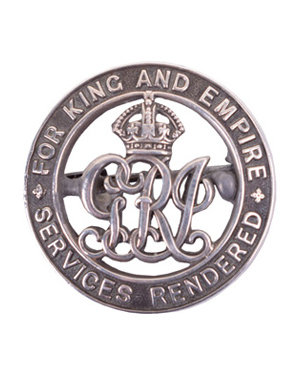
The badge bears the royal cipher of “GRI” (for Georgius Rex Imperator; George, King and Emperor) and around the rim “For King and Empire – Services Rendered”. 

The reverse side of the Silver War Badge is engraved with the recipient’s unique service number, rank, name, and regiment or unit. This information helps in identifying and confirming the recipient’s service, as each badge was uniquely numbered (Silver War Badges issued by the Empire’s dominion nations had their identification numbers on the reverse prefixed with the first letter of the issuing nation).

The Silver War Badge is typically suspended from a simple pin or brooch mechanism, allowing it to be worn on a civilian’s clothing.

The ribbon of the Silver War Badge is usually a solid, muted silver-gray color, complementing the badge’s purpose as a symbol of honor for those who had suffered wounds or illness in service to their country during World War I.

Find This Medal

Right Now on eBay 
Clicking a link to eBay may result in a referral commission being paid if a purchase is made.
Loading...

The Territorial Force War Medal

The Territorial Force War Medal is a campaign medal awarded to members of the British Territorial Force and Nursing Service from WW1.

Time PeriodThe Great War

Year of Institution: April 1920
Country: Great Britain

The Territorial Force War Medal is a campaign medal awarded to members of the British Territorial Force and Territorial Force Nursing Service who volunteered or served overseas on or before 30 September 1914 and is the rarest of the five British Great War medals.

Those who received the award had to have been serving with the Force on 4 August 1914 or have completed four years service with the Force before 4 August 1914 and rejoined on or before 30 September 1914. They also had to not have qualified for the 1914 Star or 1914-15 Star.

A total of 33,944 Territorial Force War Medals were awarded, including 227 to nurses of the Territorial Force Nursing Service (the only women to receive the medal).

The Territorial Force War Medal Design

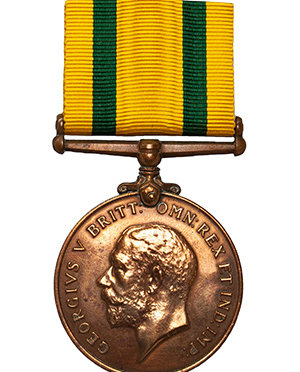
The medal is a circular, made of bronze and measures 36mm (1.42 in) in diameter.

The obverse shows a King George V bareheaded effigy, facing left, with the legend: “GEORGIVS V BRITT : OMN : REX ET IND : IMP :“. The reverse displays a wreath with the text “FOR / VOLUNTARY / SERVICE / OVERSEAS / 1914-19′ in the center, and ‘TERRITORIAL WAR MEDAL” around the upper outer edge.

The ribbon is yellow with two green stripes and measures 32 mm (1.25 in) wide. The suspender is a straight bar.