The Medal for Rescue at Sea (Norway)

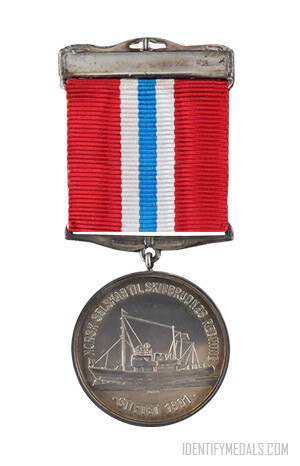
The Medal for Rescue at Sea was instituted in 1978 and is awarded to individuals who have demonstrated courage for the saving of life at sea.

The Medal for Rescue at Sea (or Medaljen for redningsdåd til sjøs in Norwegian) is a Norwegian honor established by Royal Decree on August 25, 1978. It holds the 14th position in the order of precedence for Norwegian orders, decorations, and medals.

This medal is conferred by the Ministry of Trade and Industry, based on recommendations from the Norwegian Maritime Directorate. It is awarded to individuals who have demonstrated exceptional courage, resourcefulness, and skill in saving lives at sea.

The Medal for Rescue at Sea Design

Crafted from silver, the Medal for Rescue at Sea features the Coat of Arms of Norway on the obverse, surrounded by the inscription “Kongeriket Norge” (Kingdom of Norway). The reverse bears the inscription “For Redningsdåd til Sjøs” (For Rescue at Sea) along the top edge, with an oak wreath below.

The medal is suspended from a ribbon that is red with a blue stripe edged in white down the center, mirroring the colors of the Norwegian flag.
The King Haakon VII Freedom Medal

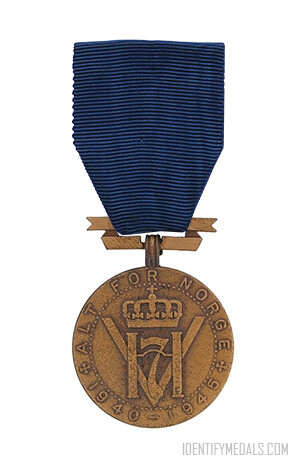
The King Haakon VII Freedom Medal was awarded for significant service to Norway during World War II and established on 18 May 1945.

Established on May 18, 1945, King Haakon VII’s Medal of Liberty (or Haakon VIIs Frihetsmedalje in Norwegian) is a prestigious Norwegian award given to both Norwegian and foreign military and civilian personnel for their significant contributions to Norway during World War II.

This recognition extends to services rendered that did not necessarily involve direct combat with the enemy.

The King Haakon VII Freedom Medal Design

The medal is made of bronze and is circular in shape. It is suspended from the ribbon by a stylized bronze element folded at both ends.

On the obverse side, the medal features the monogram of King Haakon VII positioned over a letter V, symbolizing victory. This central design is encircled by a ring of beads, outside of which the inscription “ALT FOR NORGE 1940-1945” (ALL FOR NORWAY 1940-1945) is written.

The reverse side is plain except for a wreath of oak leaves, tied with a ribbon at the base, symbolizing strength and endurance.

The ribbon is a simple dark blue. When only the ribbon is worn, it is adorned with the King’s monogram in bronze, adding a distinguished touch to the decoration.

The Armed Forces Medal for Heroic Deeds

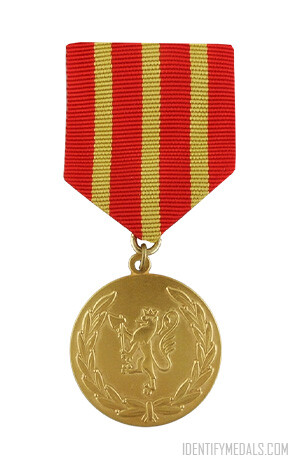
The Armed Forces Medal for Heroic Deeds, from 1982, is given for heroic deeds done while on active service for the Norwegian Defence Force.

The Armed Forces Medal for Heroic Deeds (or Forsvarets medalje for edel dåd in Norwegian) was instituted in 1982 to honor acts of heroism performed while on active duty in the Norwegian Defence Force.

This prestigious award recognizes individuals who have demonstrated extraordinary bravery and selflessness in the service of their country. It not only serves as a tangible recognition of individual acts of heroism but also as a symbol of the values upheld by the Norwegian Defence Force. 

The Armed Forces Medal for Heroic Deeds Design

The obverse of the medal prominently features the iconic Norwegian lion, symbolizing strength, courage, and national pride. This lion motif is a significant emblem in Norwegian heraldry and represents the valiant spirit of those who serve in the armed forces.

The reverse of the medal bears the inscription “FORSVARET FOR EDEL DÅD,” which translates to “The Defence For Noble Deed.” This inscription encapsulates the essence of the award, emphasizing the noble and commendable nature of the actions recognized by this medal.

The ribbon from which the medal is suspended is red with three yellow stripes. The red color signifies courage and sacrifice, while the yellow stripes add a distinctive touch, representing honor and valor.

The Norwegian War Medal

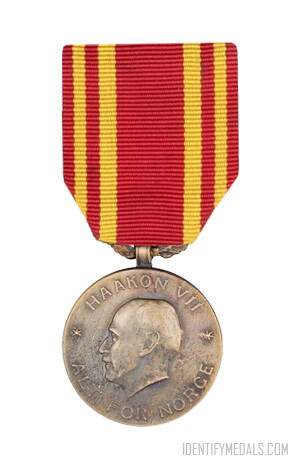
The Norwegian War Medal was instituted in 1941 by King Haakon VII of Norway and awarded for service during Second World War.

The War Medal (or Krigsmedaljen in Norwegian) is a Norwegian military decoration initially established to honor service during World War II, and later expanded to recognize meritorious service in wartime.

The Norwegian War Medal was instituted by King Haakon VII of Norway through a Royal Decree on May 23, 1941, with an additional decree on November 13, 1942. It is awarded to both Norwegian and foreign military personnel who have demonstrated meritorious participation in World War II on behalf of Norway. The medal can also be awarded posthumously to Norwegian and foreign individuals who served in the Norwegian forces or merchant marine and died for the Norwegian Resistance.

The War Medal Criteria

Although distribution of the medal ceased in 1951, a Royal Decree in 1979 reinstated it to honor Norwegian and foreign seamen who served on Norwegian Shipping and Trade Mission (Nortraship) vessels for at least 18 months, or on Royal Norwegian Navy vessels during World War II.

The criteria were revised again in 2012, allowing the medal to be awarded to Norwegians for distinguished wartime service to Norway. Notably, it has been awarded for efforts in the conflict against ISIL.

The War Medal Design

The obverse side of the medal showcases a portrait of King Haakon VII of Norway, along with his name and motto, “Alt for Norge” (All for Norway).

The reverse side features a wreath encircling the inscription “Krigsmedalje” (War Medal) and the king’s monogram.

Made of bronze, the medal is accompanied by a ribbon in the colors of the Royal Standard: red and yellow. Recipients who earn the medal multiple times may attach up to three stars to the ribbon. Each medal is issued with a certificate signed by the king. The initial production of the medal was handled by Spink & Son in London.

The King’s Medal of Merit

The King’s Medal of Merit was instituted in 1908 and is awarded for meritorious achievements in art, science, and public service.

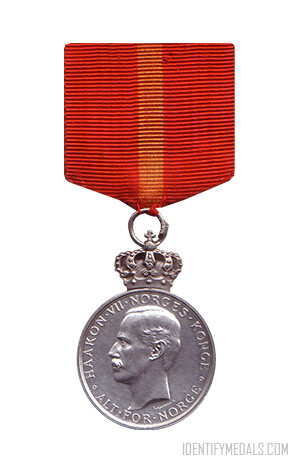
The King’s Medal of Merit (or Kongens fortjenstmedalje in Norwegian) is a distinguished Norwegian award established in 1908 to honor notable accomplishments in the fields of art, science, business, and public service.

The medal is available in two classes: gold and silver. The gold medal is awarded for extraordinary achievements of significant importance to the nation and society, while the silver medal is given for noteworthy but lesser accomplishments. The medal is attached to a ribbon featuring the colors of the Royal Standard of Norway.

In terms of precedence, the gold medal ranks eighth among Norwegian orders and medals, whereas the silver medal ranks eleventh.

The King’s Medal of Merit Ribbon Bars

The Maudheim Medal

The Maudheim Medal (Maudheimmedaljen) was established by King Haakon VII of Norway on November 14, 1951, to honor the participants of the Norwegian-British-Swedish Antarctic Expedition of 1949–1952. This medal was awarded to recognize the efforts of those involved in the expedition, which was notable for being the first to Antarctica that included an international team of scientists. During the expedition, the team established a base named Maudheim on the Quar Ice Shelf along the coast of Queen Maud Land in February 1950.

The Antarctic Medal

The Antarctic Medal is a Norwegian civil decoration established by King Olav V on February 3, 1960. It was awarded to individuals involved in the Sixth Norwegian Antarctic Expedition. This medal holds the 27th position in the order of precedence of Norwegian honors, ranking below the Maudheim Medal but above H. M. The King’s Commemorative Medal in Gold. A total of 37 individuals associated with the Sixth Norwegian Antarctic Expedition received this medal.

The King’s Medal of Merit Design

The obverse of the medal features the head of the reigning Monarch along with their name and motto. As of 2015, there have been three versions: Haakon VII (1908–1957), Olav V (1957–1991), and Harald V (since 1991).

The reverse of the medal displays a wreath encircling the words “KONGENS FORTJENSTMEDALJE” (Royal Medal of Merit), with the recipient’s name engraved within the wreath.

The ribbon is red with a yellow stripe running down the center.

The Medal for Heroic Deeds (Norway)

The Medal for Heroic Deeds was instituted in 1885 and is awarded for honorable actions in saving lives. It originally had three classes.

The Medal for Heroic Deeds was established in Norway by royal resolution on August 19, 1885, to honor individuals for commendable acts in saving lives or performing similar brave deeds. Initially, the medal was available in three classes, but since 1905, it has only been awarded in gold and silver.

To qualify for the gold medal, the recipient must have executed an exceptionally notable rescue operation where their own life was at significant risk.

The Medal for Heroic Deeds Design

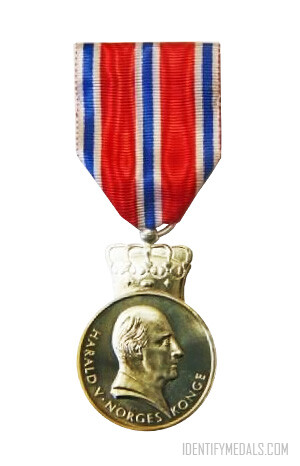
The medal is topped with the Crown of Norway, and the obverse features the portrait, name, and title of the reigning monarch. Currently, it displays the image of King Harald V of Norway, with the inscription «Harald den 5, Norges Konge» (Harald the Fifth, King of Norway).

The reverse side showcases an oak wreath and bears the words «For edel dåd» (For noble deed).

The ribbon accompanying the medal reflects the national colors of Norway: red, white, and blue.

The Medal for Outstanding Civic Service

The Medal for Outstanding Civic Service was established in 1819 and is the second highest ranked Norwegian medal.

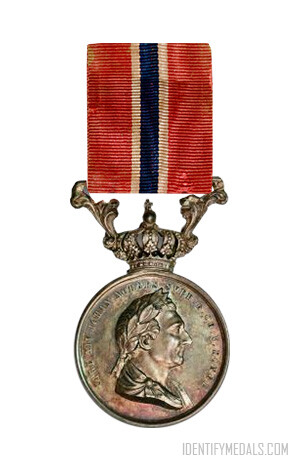
The Medal for Outstanding Civic Service (or Medaljen for Borgerdåd in Norwegian), is the second highest-ranked medal in Norway. This prestigious award was first established by a Royal Resolution on April 10, 1819, and was subsequently modified by another Royal Resolution on April 13, 1844. The medal was conferred by the cabinet in a meeting presided over by the King, based on recommendations from the Norwegian Ministry of Justice.

The medal was divided into two grades: the first class in gold and the second class in silver. It recognized individuals who rendered exceptional service to society. However, in the spring of 2004, the medal ceased to be awarded.

In terms of the Norwegian order of precedence, recipients of the Medal for Outstanding Civic Service are ranked second, positioned after recipients of the War Cross with Sword and before holders of the Royal Norwegian Order of St. Olav.

The Medal for Outstanding Civic Service Design

The medal is circular and comes in two classes: gold for the first class and silver for the second class, symbolizing the level of achievement and distinction of the recipient.

The obverse of the medal features an intricate design, including the image of the reigning monarch at the time of its institution, surrounded by a detailed border.

The medal is suspended from a red ribbon with a central blue and white stripe.

The Royal Family Order of Harald V

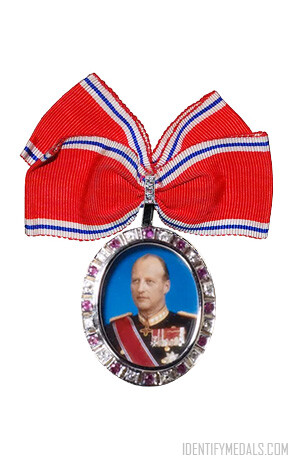
The Royal Family Order of Harald V is a prestigious honor conferred by the King of Norway upon female members of the royal family.

The Royal Family Order of Harald V (or Kong Harald Vs Husorden in Norwegian) is a prestigious honor conferred by the King of Norway specifically upon female members of the Norwegian royal family. Unlike the other two Royal Family Orders, this one is still actively awarded, highlighting its contemporary relevance within the royal household.

King Harald V, who ascended to the throne in 1991, has continued the tradition of awarding family orders as a means of honoring and recognizing the efforts of royal family members. His reign has been characterized by a modern approach to monarchy, balancing tradition with contemporary values, and this order is a testament to that balance.

This order serves as a mark of distinction and recognition for the female members of the royal family, acknowledging their service, dedication, and contributions to the monarchy and the nation. The active bestowal of this order reflects King Harald V’s appreciation and support for the roles played by women in the royal family.

The Royal Family Order of Harald V Design

The insignia of the Royal Family Order of Harald V is both elegant and symbolic. It features a portrait of King Harald V in his middle years, encased within a jeweled frame.

This portrait is suspended from a distinctive red ribbon, which is accented by a blue stripe along the edges, further bordered by a thin white stripe. The combination of these colors and the intricate design of the insignia underscores the honor’s regal significance and the esteem in which it is held.

The Royal Family Order of Haakon VII

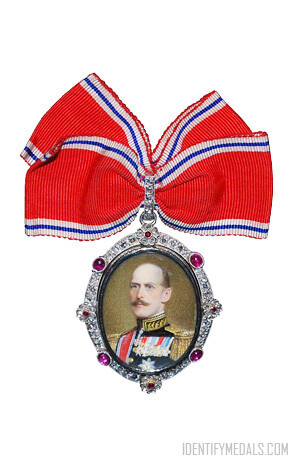
The Royal Family Order of Haakon VII was established in 1906 and bestowed by the Sovereign on members of the Norwegian royal family.

The Royal Family Order of Haakon VII (or Kong Haakon VIIs Husorden in Norwegian) is a distinguished honor that was personally conferred by King Haakon VII on members of the Norwegian royal family.

The Royal Family Order of Haakon VII is not just a ceremonial symbol but also a mark of distinction, reflecting the recipient’s service, dedication, and loyalty to the crown and the country. It serves as a unique honor, highlighting the personal appreciation and acknowledgment from the monarch to the family members who have supported and upheld the values and responsibilities of the monarchy.

King Haakon VII, who reigned from 1905 to 1957, established this order to honor and recognize the support of his family members. During his reign, he guided Norway through significant events, including its transition to independence and the challenging times of World War II.

Among the recipients of this prestigious order are key figures in the Norwegian royal family. For instance:

As of now, Princess Astrid, Mrs. Ferner, is the only living recipient of the Royal Family Order of Haakon VII. Her receipt of the honor underscores her enduring service and contributions to the royal family and Norway.

The Royal Family Order of Haakon VII Design

The insignia of the Royal Family Order includes a portrait of King Haakon VII, set in an ornate frame and suspended from a ribbon.

The ribbon is red with blue borders with a white fimbriation.

The Most Puissant Order of the Gurkha Right Hand

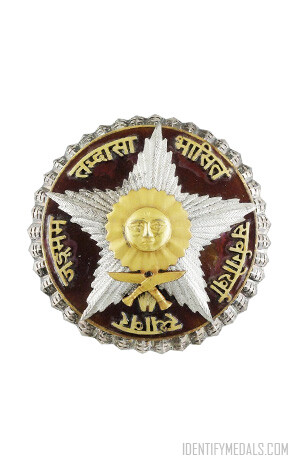
The Most Puissant Order of the Gurkha Right Hand was originally established by King Prithvi in 1896 and is composed of several ranks.

The Most Puissant Order of the Gurkha Right Hand (or गोरखा दक्षिण बाहु; Gorkha-Dakshina Bahu in Nepali) was originally an order of knighthood established by King Prithvi in 1896. It was later revived and reformed by King Tribhuvan on September 7, 1932.

The award was conferred upon both military personnel and civilians, including foreign nationals, for distinguished contributions to the nation in various fields such as arts, literature, sports, science, and social service. It held the status of the second highest honor in the Kingdom of Nepal, following the Order of Tri Shakti Patta.

This order is composed of several ranks, including:

  • The Sovereign (Parama-Suprasidha-Prabala-Gorkha-Dakshina-Bahu)
  • The Grand Master (Ati-Suprasidha-Prabala-Gorkha-Dakshina-Bahu)
  • Ordinary members, who are classified into five levels:
    • 1. Suprasidha-Prabala-Gorkha-Dakshina-Bahu
    • 2. Prasidha-Prabala-Gorkha-Dakshina-Bahu
    • 3. Suprabala-Gorkha-Dakshina-Bahu
    • 4. Prabala-Gorkha-Dakshina-Bahu
    • 5. Gorkha-Dakshina-Bahu.

Additionally, the order includes a medal (Gorkha-Dakshina-Bahu-Padak) which was introduced by King Tribhuvan in 1936.

The Most Puissant Order of the Gurkha Right Hand Design

The ribbon associated with the order is officially designated as saffron in color. This distinctive hue not only adds to the ceremonial prestige of the award but also carries cultural and symbolic significance.

Saffron is a color deeply rooted in various traditions, often representing sacrifice, valor, and dedication, thus aligning perfectly with the honor’s purpose of recognizing distinguished contributions to the nation.