The Louw Wepener Decoration

The Louw Wepener Decoration is a military honor established by the Union of South Africa in 1952 to recognize acts of remarkable bravery.

The Louw Wepener Decoration, denoted by the post-nominal letters LWD, is a military honor established by the Union of South Africa in 1952 to recognize acts of remarkable bravery and heroism displayed by members of the South African Defence Force. However, it was discontinued on July 1, 1975, with the introduction of a new series of decorations and medals.

The Louw Wepener Decoration was granted to individuals of all ranks for displaying remarkable courage or heroism in situations of great peril, primarily outside of combat contexts. It could be accompanied by a Bar for additional acts of bravery. The decoration was established in tribute to Louw Wepener, who lost his life in 1865 while leading his troops in an assault on a Basotho stronghold during the Basuto Wars of 1858 to 1865.

Only seven decorations were conferred, with the first awarded in 1961 and the last in 1974. No bars were ever added to the decoration.

The Louw Wepener Decoration Design

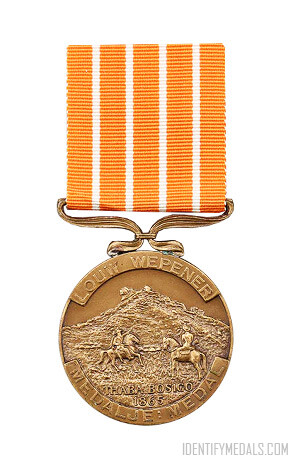
The Louw Wepener Decoration features a 38-millimeter medallion depicting the Thaba Bosigo mountain peak, with two horsemen positioned at its base. Below the riders, the inscription “THABA BOSIGO, 1865” is displayed, while around the circumference, the words “LOUW WEPENER” appear at the top and “DECORATION • DEKORASIE” at the bottom.

On the reverse side, the decoration showcases the pre-1994 South African coat of arms, with the decoration number impressed at the bottom of the rim. Specimens awarded before South Africa’s republic status on May 31, 1961, featured Queen Elizabeth’s royal cipher (E II R) above the coat of arms.

The ribbon measures 1+3⁄8 inches (35 millimeters) in width and is orange, adorned with five white bands spaced 1⁄8 inch (3.2 millimeters) apart.
The Medalje voor de Anglo-Boere Oorlog

The Medalje voor de Anglo-Boere Oorlog is a retrospective South African military campaign medal instituted on 21 December 1920.

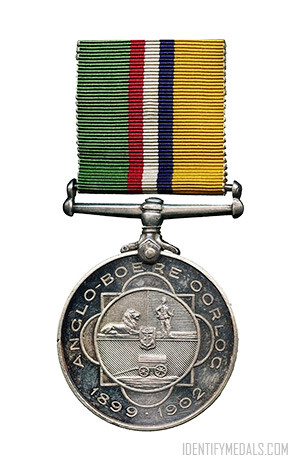
The Medalje voor de Anglo-Boere Oorlog, a South African military campaign medal, was established on December 21, 1920. It was intended as a retrospective honor for Boer veteran officers and men who fought in the 1899–1902 Second Boer War.

Originally designated as the De Zuidafrikaanse Republiek- en Oranje Vrijstaat Oorlogsmedalje (the South African Republic and Orange Free State War Medal), and commonly known as the Anglo-Boere-Oorlog Medalje, it was instituted via Government Notice no. 2307 on December 21, 1920.

Published in the Union of South Africa Government Gazette on December 24, 1920, the medal was created to provide recognition to Boer veteran officers and men who served in the combat forces of the South African Republic and the Orange Free State during the Second Boer War from October 11, 1899, to May 31, 1902. These individuals remained in service of the Republican forces until May 31, 1902, without surrendering, taking parole, or swearing allegiance before that date.

The Medalje voor de Anglo-Boere Oorlog Design

The medal is crafted in silver and measures 1+7⁄16 inches (37 millimeters) in diameter and 1⁄8 inch (3 millimeters) in thickness at the raised rim. It is attached to a fixed bar suspender using claws and a pin inserted through the upper edge. The recipient’s rank, initials, and surname are impressed in block capitals on the rim.

Both sides of the medal feature an ornamental frame encircled by the inscription “ANGLO-BOERE OORLOG” above and the years “1899 • 1902” below. One side displays the coat of arms of the South African Republic at the center of the frame, while the other side features the coat of arms of the Orange Free State. This design allows recipients to wear the medal to display the coat of arms of the state under which they served.

The ribbon, measuring 1+1⁄4 inches (32 millimeters) wide, combines the colors of the two former Republics.

The Dekoratie voor Trouwe Dienst

The Dekoratie voor Trouwe Dienst is a South African military decoration established in 1920 for Boer officers of the Second Boer War.

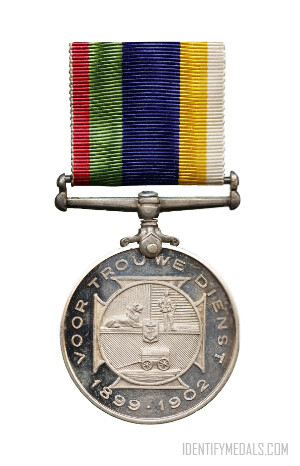
The Dekoratie voor Trouwe Dienst, abbreviated as DTD, is a military decoration in South Africa. Established in 1920, it serves as a retrospective honor for Boer officers who served during the Second Boer War from 1899 to 1902.

Neither the South African Republic (Transvaal) nor the Orange Free State had their own official honors systems. Hence, the decoration was created to provide Boer veteran officers, serving within the Union Defence Forces, with recognition parallel to their compatriots who fought on the British side during the conflict.

Throughout the Second Boer War, Republican commanders were directed to record the names of individuals within their ranks who displayed exceptional valor on the battlefield. These names were to be submitted to the War Council for verification and publication in the Staats Courant (Government Gazette) with the intention of awarding a medal post-war. However, as the Republican forces were defeated, the proposed medal never came to fruition.

It was later, in 1920, that King George V instituted the Dekoratie voor Trouwe Dienst, alongside the Medalje voor de Anglo-Boere Oorlog and the Lint voor Verwonding.

The Dekoratie voor Trouwe Dienst Design

The decoration, crafted in silver, takes the form of a disk measuring 1+7⁄16 inches (37 millimeters) in diameter and 1⁄8 inch (3 millimeters) in thickness at the raised rim. It is attached to a fixed bar suspender using claws and a pin inserted through the upper edge of the medal. The recipient’s rank and name are impressed on the rim.

Both sides of the medal feature an encircled coat of arms on a cross pattée, surrounded by the inscription “VOOR TROUWE DIENST” above and the years “1899 • 1902” below. The coat of arms of the South African Republic is depicted on one side of the cross, while that of the Orange Free State is shown on the other. This design allows recipients to wear the medal to display the coat of arms of the state under which they served.

The ribbon measures 1+1⁄4 inches (32 millimeters) wide and combines the colors of the two former Republics. While officially designated as red, green, white, blue, and orange, the orange hue appears as yellow on the actual ribbons.

The Swedish Armed Forces Medal of Merit

The Swedish Armed Forces Medal of Merit is a military decoration awarded for action during combat or during war-like situations.

The Swedish Armed Forces Medal of Merit (or Försvarsmaktens förtjänstmedalj in Swedish; FMGM and FMSM) is a prestigious decoration established by the Swedish Armed Forces and conferred in recognition of exceptional actions undertaken during combat or war-like situations. The decision to bestow this medal is made by the Supreme Commander and may be granted to both Swedish nationals and foreign personnel.

Originally, this medal was formed through the amalgamation of two previous honors: the Swedish Armed Forces International Service Medal of Reward, awarded in silver or gold with a blue ribbon adorned with a silver sword; and the Swedish Armed Forces Medal of Merit, bestowed for commendable efforts, presented in silver or gold with a yellow ribbon (sometimes featuring a sword in each denomination). These aforementioned medals are no longer presented.

The medal may be granted for national or international operations, actions undertaken during war-like conditions, or other commendable personal endeavors. The criteria for receiving this medal apply even in times of armed conflict. Eligibility also extends to individuals both within and outside the Swedish Armed Forces, regardless of nationality.

The Swedish Armed Forces Medal of Merit Design

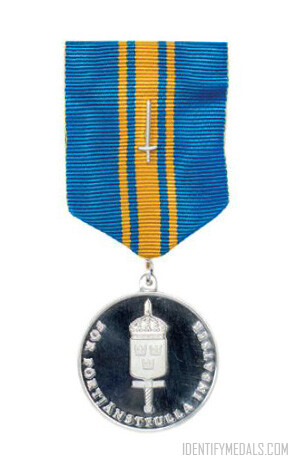
The medal is available in two classes: gold and silver. Crafted from gilded hallmarked silver or hallmarked silver with a diameter of 31 mm, the medal features the Swedish Armed Forces heraldic arms on the obverse side, encircled by the inscription “FOR MERITORIOUS SERVICES” (FÖR FÖRTJÄNSTFULLA INSATSER).

The reverse side showcases a laurel wreath along the outer edge and remains smooth, allowing for the recipient’s name, year of awarding, and, if applicable, country to be engraved. Additionally, a miniature version of the medal is available, and it is accompanied by a diploma.

The medal is worn suspended from a blue ribbon with a broad yellow stripe in the center and narrow ones on each side. If the medal is awarded for actions in combat or during war-like situations, a gold or silver upright sword is displayed on the ribbon. Alternatively, a service ribbon with a horizontal gold or silver sword is worn in lieu of the medal for such action.

The Medal For Valor in the Field / At Sea

The Medal For Valor in the Field/Sea is a Swedish military decoration awarded to officers and soldiers of the Swedish Armed Forces.

The Medal For Valor in the Field (or För tapperhet i fält in Swedish) and Medal For Valor at Sea (För tapperhet till sjöss) are esteemed military decorations of Sweden, honoring the courage and bravery demonstrated by officers and soldiers of the Swedish Armed Forces during wartime engagements, whether on land or at sea.

Instituted by Gustav III on May 28, 1789, amid conflicts with Russia, these medals were conceived to complement the Order of the Sword, which, since its establishment on February 23, 1748, had been exclusively bestowed upon officers for acts of valor on land or at sea.

These two medals, along with the various grades of the Order of the Sword, hold the distinction of being designated as Swedish war decorations (Svenska krigsdekorationer).

Through royal decrees issued on March 24, 1807, and June 10, 1809, it was decided to institute two distinct decorations: För tapperhet i fält (abbreviated Mtf) to recognize valor in the field and För tapperhet till sjöss (Mts) to honor acts of bravery at sea. Each of these awards has gold variants (prefixed with G, such as GMtf) reserved for officers and silver variants (prefixed with S, such as SMts) designated for non-commissioned officers and privates.

The Medal For Valor in the Field / At Sea Design

Initially crafted in silver, the medal was intended solely for non-commissioned officers and privates. However, in 1806, a gold version was introduced exclusively for higher-ranking officers.

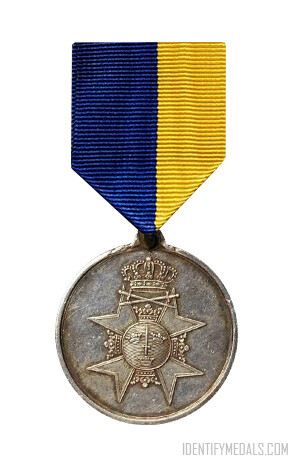
The design of the medal is characterized by its simplicity, featuring a circular shape consistent with the modern size 8 of the Swedish medal scale established in 1773, known as Mensura magnitudinis Nummorum, with a diameter of 31 mm.

On the obverse side, the medal bears the inscription “FÖR TAPPERHET I FÄLT” or “FÖR TAPPERHET TILL SJÖSS” (or for older medals “[…] TILL SIÖS”), encircled by a wreath. Since 1809, the reverse side has been adorned with the symbol of the Order of the Sword. Prior to this, it depicted a portrait of Gustav III alongside the text “GUSTAV III SVERIGES KONUNG” (“Gustav III King of Sweden”). 

The ribbon is blue and yellow and has been presented with the award since 1819.

The Prince Eugen Medal

The Prince Eugen Medal is a Swedish decoration conferred by the King of Sweden for outstanding artistic achievement.

The Prince Eugen Medal (or Prins Eugen-medaljen in Swedish) is a distinguished honor bestowed by the King of Sweden in recognition of outstanding artistic achievement.

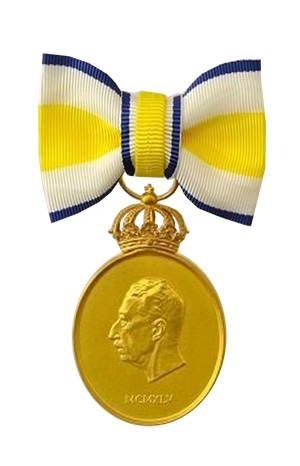
Established in 1945 by Gustaf V, the King of Sweden at the time, the medal commemorates the eightieth birthday of Prince Eugen, a renowned painter and art collector, and the King’s brother.

Annually awarded on November 5th, which coincides with Eugen’s name day, the medal ceremony takes place at the Royal Palace in Stockholm. Recipients are celebrated for their remarkable contributions to the arts. This prestigious accolade symbolizes the enduring legacy of Prince Eugen and the Swedish monarchy’s commitment to honoring excellence in artistic endeavors.

The Litteris et Artibus Medal

The Litteris et Artibus Medal is a Swedish royal decoration awarded to people who have made important contributions to culture.

The Litteris et Artibus Medal is a distinguished Swedish royal decoration established in 1853 by Charles XV of Sweden during his tenure as crown prince.

This prestigious accolade is bestowed upon individuals who have made significant and noteworthy contributions to the realm of culture, particularly in the domains of music, dramatic art, and literature.

The Litteris et Artibus Medal Design

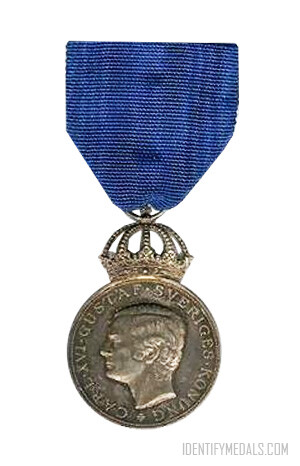
The obverse side of the medal features the likeness of the reigning monarch, while the reverse side bears the inscription “Litteris et Artibus,” which translates to “Letters and Arts” in Latin.

This emblematic representation serves as a testament to the enduring commitment of the Swedish monarchy to honor and celebrate excellence in cultural achievements.

The H. M. The King’s Medal (Sweden)

The H. M. The King’s Medal is a Swedish honor established in 1814 and awarded to Swedish and foreign citizens for special merits.

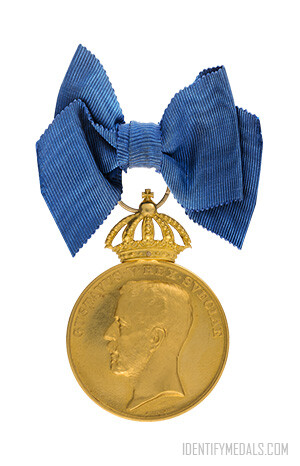
The H.M. King’s Medal (H.M. Konungens medalj in Swedish), previously known as the Court Medal (or Hovmedaljen), is a prestigious honor bestowed upon both Swedish and foreign nationals.

Established in 1814, this medal is not classified into classes but rather awarded based on size. The 12th size is the largest and is typically worn around the neck on a chain or ribbon, while the 8th and 5th sizes are worn suspended from the left breast by a ribbon, following the Seraphim Medal.

Recipients of the King’s Medal include individuals who have demonstrated exceptional merits and officials serving at the royal court. This practice became particularly common after 1975, when the conferral of Swedish Orders of Chivalry to non-royal Swedish citizens ceased, until the Orders were reopened to Swedish citizens on February 1, 2023.

The H. M. The King’s Medal Design

The King’s Medal is available in different sizes, crafted from both gold and silver, and can be worn suspended from either a ribbon or chain.

Unlike traditional classifications, Swedish medals are not divided into classes but rather into sizes. These sizes are determined by the Berch’s Scale, an 18th-century scale that assigns specific dimensions to each medal. For instance, the 12th size medal has a diameter of 43 mm, while the 8th size measures 31 mm in diameter.

The Order of Academic Palms (Togo)

The Order of Academic Palms is a Togolese decoration awarded for significant contributions to the national education system.

  • Time Period: Post-WW2
  • Institution: 25 June 1984
  • Country: Togo

The Order of Academic Palms is a Togolese decoration established on 25 June 1984 and awarded for significant contributions to the national education system.

The order has three classes.