The Nigerian Fire Service Meritorious Service Medal

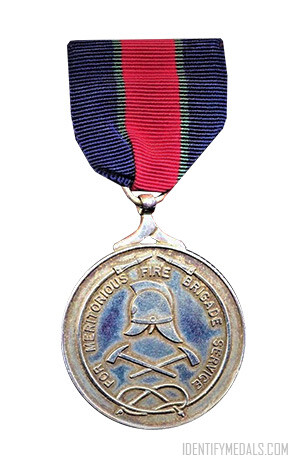
The Nigerian Fire Service Meritorious Service Medal is a decoration awarded to members of the fire service for long and devoted service.

The Nigerian Fire Service Meritorious Service Medal is a decoration awarded to members of the fire service for long and devoted service.

All the medals of the Nigerian Fire Services were instituted by a Warrant dated 28 February 1974. 

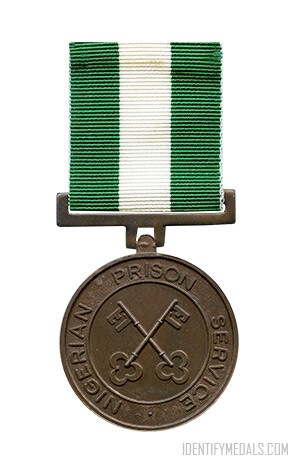
The Prisons Service Meritorious Service Medal

The Prisons Service Meritorious Service Medal is a decoration awarded to prison officers for long and devoted service.

The Prisons Service Meritorious Service Medal is a decoration awarded to members of the prison service for long and devoted service characterised by exceptional ability and exemplary record.

The Nigerian Correctional Service (NCoS), formerly referred to as the Nigerian Prison Service (NPS), is a governmental body in Nigeria responsible for managing prisons. Situated in Abuja, it operates under the jurisdiction of the Ministry of the Interior and the Civil Defence Immigration and Correctional Service. President Muhammadu Buhari officially changed its name from the Nigerian Prisons Service to the Nigerian Correctional Service on August 15, 2019, following the enactment of the Nigerian Correctional Service Act of 2019.

The Police Meritorious Service Medal (Nigeria)

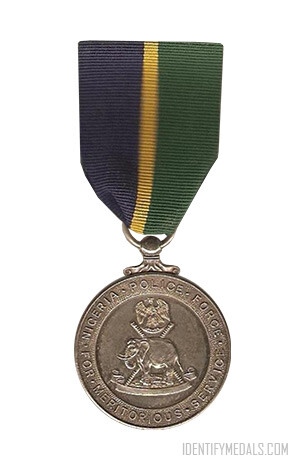
The Police Meritorious Service Medal is a Nigerian decoration awarded to members of the police force for long and devoted service.

The Police Meritorious Service Medal is a Nigerian decoration awarded to members of the police force for long and devoted service.

Awardees must also display exceptional ability and exemplary record.

The Nigeria Police Force serves as the primary law enforcement and leading security agency in Nigeria. Established by the 1999 constitution as the national police with exclusive jurisdiction across the nation, it boasts a staff strength of approximately 371,800 as of 2016.

Currently, the force is under the leadership of IGP (Inspector General) Kayode Egbetokun. Major reforms were implemented in 2020, signifying significant changes within the organization.

The Nigeria Loyal Service And Good Conduct Medal

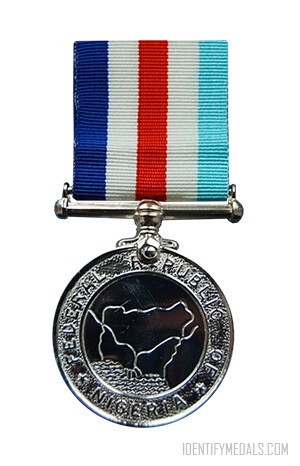
The Loyal Service And Good Conduct Medal is a Nigerian decoration awarded to members of the armed forces for 16 years’ exemplary service.

The Loyal Service And Good Conduct Medal is a Nigerian decoration awarded to members of the armed forces for completing sixteen years’ exemplary service.

As a condition, the person needs to also hold the Armed Forces Service Star. Commissioned officers cannot receive this medal. 

The Loyal Service And Good Conduct Medal Design

The medal is round and bears the inscription “Federal Republic of Nigeria” in the obverse, as well as a map of the country. The reverse bears the inscription “Nigeria Armed Forces” around the edge and “For Loyal Service and Good Conduct” in the center.

The ribbon is blue, white, red, and light blue.

The Distinguished Service Medal (Nigeria)

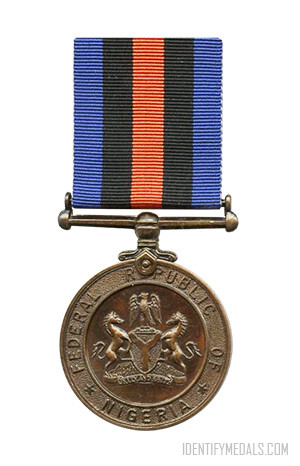
The Distinguished Service Medal is a Nigerian decoration awarded to members of the armed forces for distinguished acts of gallantry.

The Distinguished Service Medal is a Nigerian decoration awarded to members of the armed forces for distinguished acts of gallantry during duty.

Commissioned officers cannot receive this medal. 

The Distinguished Service Medal Design

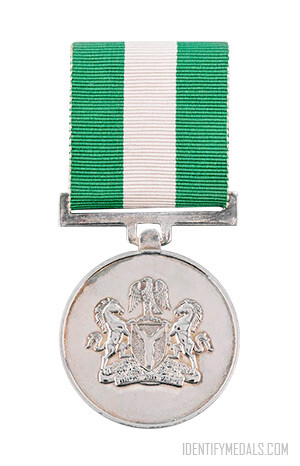
The medal is round and bears the inscription “Federal Republic of Nigeria” in the obverse, as well as a relief oftwo horses and a shield. The reverse bears the inscription “Nigeria Armed Forces” around the edge and “For Distinguished Service” in the center.

The ribbon is dark blue.

The Nigeria Eagle Medal

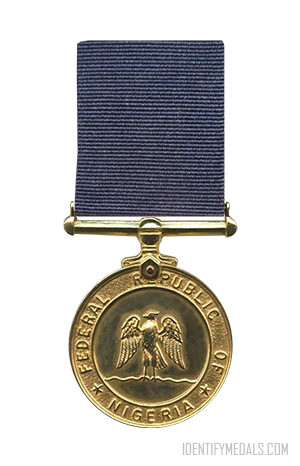
The Nigeria Eagle Medal is a Nigerian decoration awarded to members of the Nigerian Armed Forces for gallantry in the face of the enemy.

The Nigeria Eagle Medal is a Nigerian decoration awarded to members of the Nigerian Armed Forces in recognition of gallantry in the face of the enemy.

Commissioned officers cannot receive this award.

The Nigeria Eagle Medal Design

The medal is rounded and bears the inscription “Federal Republic of Nigeria” in the obverse, as well as a relief of an eagle. The reverse bears the inscription “Nigeria Armed Forces” around the edge and “For Bravery in the Field” in the middle.

The ribbon is dark blue.

The Nigerian Independence Medal

The Nigerian Independence Medal is a medal established in 1960 and awarded to those who aided in the transition toward independence.

The Nigerian Independence Medal was sanctioned by Queen Elizabeth II to mark Nigeria’s independence on October 1, 1960. It was designed to honor the individuals serving in the Royal Nigerian Military Forces, Royal Nigerian Navy, and the Nigeria Police Force on that historic day.

Additionally, it extended recognition to members of the British Army who were temporarily assigned to the Royal Nigerian Military Forces.

The Nigerian Independence Medal Design

The Nigerian Independence Medal, crafted from cupro-nickel, bears the crowned effigy of Queen Elizabeth II on its circular surface. On the reverse side, it showcases the Nigerian Coat of Arms alongside the inscription “Nigeria Independence, 1st October 1960.”

Its ribbon is adorned with three vertical stripes in green, white, and green.

The Armed Forces Service Star (Nigeria)

The Armed Forces Service Star is a Nigerian order awarded to members of the armed forces who have completed twelve years of service.

The Armed Forces Service Star is a Nigerian medal awarded to members of the armed forces for twelve years of service. During the time period, the person must also have maintained an exemplary record. 

Recipients of this honor have demonstrated excellent conduct, professionalism, and loyalty throughout their military service.

The Armed Forces Service Star Design

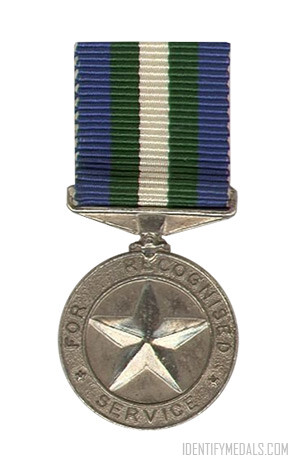
The insignia is circular and features a star and a central disc with the inscription “For recognised Service“. The reverse is plain.

The ribbon is blue, green, and white.

The Naval Front Clasp

The Naval Front Clasp was a World War II German military decoration awarded to officers and men of the Kriegsmarine during the Third Reich.

The Naval Front Clasp (or Marine-Frontspange in German) was a German military decoration awarded during World War II.

Established in 1944, the recipients were officers and enlisted personnel of the Kriegsmarine for their prolonged and frontline service across all naval units, except for the submarine service, which had its separate award.

This bronze clasp recognized service or acts of valor that exceeded the requirements of the basic war badge. Instituted on November 19, 1944, by Grand Admiral Karl Dönitz.

The Naval Front Clasp Design

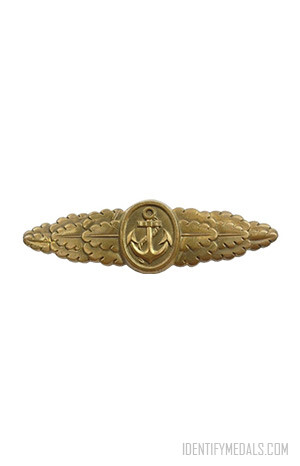
Each wing consisted of six staggered oak leaves, totaling twelve. At the bottom of the central wreath, an anchor adorned the design.

More Naval War Badges

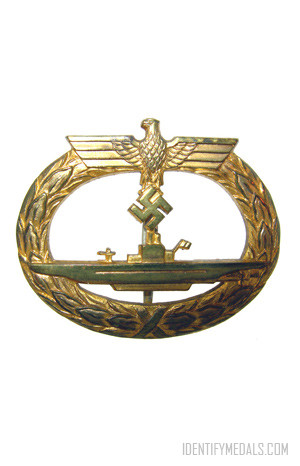
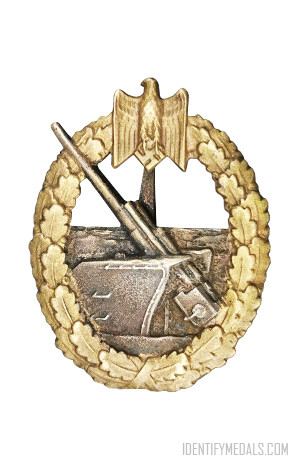
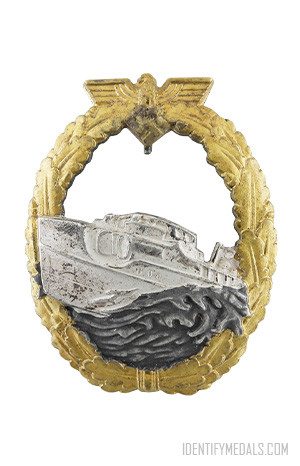
The Naval War Badges (Kriegsmarine) badges were awarded to sailors, officers, and personnel of the Kriegsmarine who demonstrated exceptional skill, bravery, and dedication in naval warfare. Explore the complete collection below:

The U-Boat Front Clasp

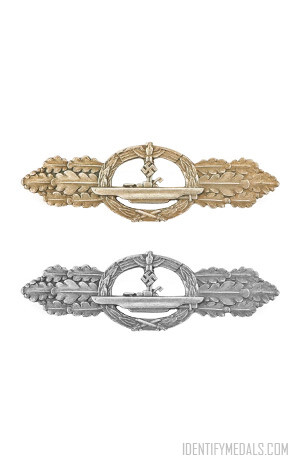
The U-Boat Front Clasp was a World War II German Kriegsmarine military decoration awarded during the Third Reich.
The U-boat Front Clasp (or U-Boot-Frontspange in German) was a German military decoration awarded for continuous service and valor during World War II.

Established on May 15, 1944, the award aimed to align the U-boat force with other branches of the German armed forces, each possessing comparable accolades to honor acts of valor. Merits for receiving the award were not explicitly outlined; rather, decorations were conferred based on recommendations from U-boat commanders, subject to approval by Karl Dönitz.

Often, awards were granted in recognition of the number of completed patrols or displays of bravery in combat. The clasp was worn on the upper left breast.

The award was conferred in two tiers, distinguished by their material.

  • Bronze: This represented the lower grade and was granted based on criteria such as the number of war patrols undertaken, the level of risk inherent in the missions, and individual acts of bravery.
  • Silver: Introduced on November 24, 1944, this class aimed to extend recognition to bronze recipients who continued to demonstrate merit, faced heightened risks, and displayed acts of valor.

The U-Boat Front Clasp Design

Wilhelm Ernst Peekhaus from Berlin presented the design for the badge, featuring a central laurel wreath adorned with a stylized submarine and wings made of oak leaves.

Each wing consisted of six staggered oak leaves, totaling twelve. At the bottom of the central wreath, two crossed swords adorned the design, while the submarine in the middle echoed the U-Boat War Badge’s design. Integrated into the wreath was an eagle with downturned wings grasping a swastika.

Following the conclusion of the war, German sailors could only wear the medal if it did not bear National Socialist symbols, in accordance with the German Ordensgesetz. An alternative design featuring a complete laurel wreath, devoid of the eagle and swastika, with a submarine emblem centered within, was created for this purpose.

More Naval War Badges

The Naval War Badges (Kriegsmarine) badges were awarded to sailors, officers, and personnel of the Kriegsmarine who demonstrated exceptional skill, bravery, and dedication in naval warfare. Explore the complete collection below: