The Army Medal for War 1939-45

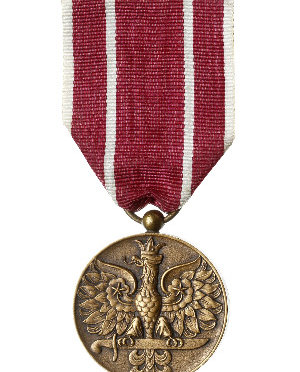
The Army Medal for War 1939-45 was created in 1945 to reward members of the Polish ground forces for service during World War II.

The Army Medal for War 1939-45 (or Medal Wojska za Wojne 1939-45 in Polish) was created in 1945 by the Polish government in Exile (in London) to reward members of the Polish ground forces for service during World War II.

The eligibility criteria for the medal were:

  • Six months of operational service during World War II, or
  • 12 months in a non-operational role.

The medal could be conferred up to four times, although for a subsequent award the period of service was doubled.

The Army Medal for War 1939-45 Design

The medal measures 35 mm in diameter.

The ribbon is crimson, with four thin stripes of white (including two edges).

The Commemorative Medal For the War 1918-1921

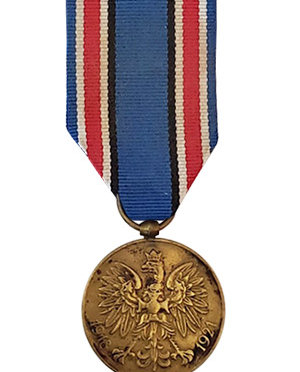
The Commemorative Medal For the War 1918-1921 medal was awarded to military who served against Soviet Russian forces.

The Commemorative Medal For the War 1918-1921 medal was instituted on 21 September 1928 and awarded to military who served for a minimum of 3 months with a unit actively engaged against Soviet Russian forces during the war of 1918 to 1921.

For volunteers, the qualifying period was two months and for auxiliary units 5 months. There was no qualifying minimum period of service for those wounded in the conflict.

The Polish-Soviet war of 1918 to 1921 arose from the chaos at the end of World War I and the Russian Revolution of 1917, with Poland seeking to reinforce its independence after centuries of occupation and division and expand its frontiers eastward and Soviet forces attempting to take control of former Imperial Russian territories. The Treaty of Riga that ended the war in 1921 effectively divided the disputed area between the two combatants.

The Commemorative Medal For the War 1918-1921 Design

The medal is circular and struck in bronze. It has a laterally pierced cylinder suspension.

The obverse features a Polish eagle, the Order of Virtuti Militari imposed on its chest, and the inscription ‘1918 1921’. The reverse is inscribed ‘POLSKA SWEMV OBROŃCY’ (“Poland for her Defenders”) within an oak leaf border.

The central stripe of the ribbon is blue flanked by thinner stripes of black, white, purple, white and blue.

The Virtus et Fraternitas Medal

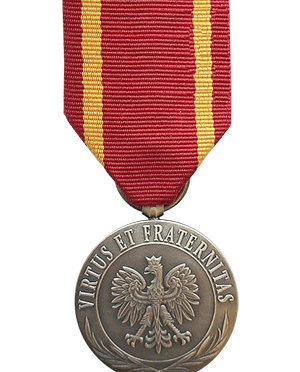
The Virtus et Fraternitas Medal was established on 9 November 2017 and awarded to those who provided aid and assistance to Polish citizens.

The Virtus et Fraternitas Medal (or Medal Virtus et Fraternitas) was established on 9 November 2017 awarded to those who provided aid and assistance to Polish citizens. It is also bestowed to honor individuals who voluntarily keep alive the memory of those who did not survive the war or the forced deportations, and found their graves abroad.

The medal is awarded by the President of Poland on recommendation of the director of the Pilecki Institute as a token of commemoration and gratitude. The medal was awarded for the first time on 19 June 2019.

The Virtus et Fraternitas Medal Design

The medal is round and struck in silver, and measures 36 mm in diameter.

On the obverse is inscribed “VIRTUS ET FRATERNITATIS” (“Virtue and Brotherhood”). In the center of the medal carved stylized image of the White Eagle. 

The Virtus et Fraternitas Medal is suspended from a purple ribbon, 36 mm wide. Symmetrically arranged along the edges of the ribbon are gold stripes each 4 mm wide, both 4 mm from the edge.

The Medal for Long Marital Life

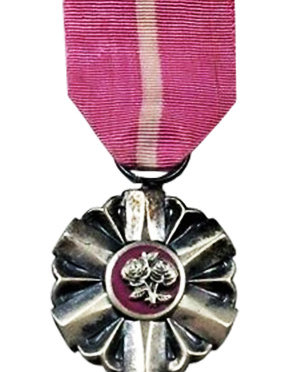
The Medal for The Medal for Long Marital Life was established in 1960 and awarded to couples who have been married for at least 50 years.

The Medal for Long Marital Life (or Medal Za Długoletnie Pożycie Małżeńskie in Polish) is a medal from Poland established on February 17, 1960 and awarded to couples who have been married for at least 50 years.

The medal is still awarded in cities across the country but ‘PRL’ has become ‘PR’ on the reverse. . In addition to having a 50-year-long marriage, couples should also have at least one child, either their own or adopted, to qualify for the medal.

The Medal for Long Marital Life Design

The medal is round, struck in silver, and has six rays. It measures 35mm in diameter.

The obverse has a pink enameled center with two roses with intertwined stems superimposed. The reverse has the letters PRL in the center. Surrounding this are the words: “ZA DLUGOLETNIE POZYCIE MALZENSKIE” in a circle.

The ribbon is 37mm wide with a 4mm wide white stripe in the centre of the ribbon.

The Medal for Long Service

The Medal for Long Service is a decoration from Poland awarded in three classes to members of the Armed Forces and other uniformed services.

The Medal for Long Service (or Medal za Długoletnią Służbę in Polish) is a decoration established on January 8, 1938 and awarded in three classes (gold, silver, and bronze) to members of the Polish Armed Forces and other uniformed services, and to civil servants who have honorably completed 30, 20 or 10 years of service to the State.

After the outbreak of the Second World War the conferment was suspended, and after that, the medal was eventually discontinued. In 1951, it was replaced by the Medal of the Armed Forces in the Service of the Fatherland for members of the armed forces. The Medal for Long Service was revived by the Law of 14 June 2007, which amended the Act of 16 October 1992, concerning medals and decorations.

The original medal was awarded by the appointed minister to any member of the armed forces or other uniformed services, or to civilian employees of the government or local government following 30 (gold medal), 20 (silver medal), or 10 years (bronze medal) of continuous or cumulative service. The recipients of the medal were required to make a monetary payment for it.

Since 2007 the medal has been conferred by the President of Poland. Unlike its pre-World War II counterpart, the conferment is not automatic but is decided on an individual basis.

The Medal for Long Service Design

The medal is circular, measures 35 mm in diameter, and is made from gilded, silver-plated or bronze-patined metal.

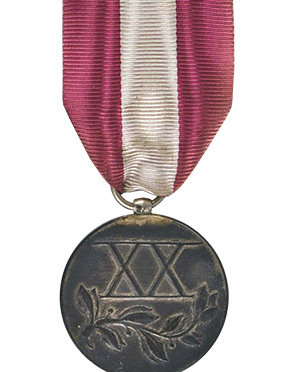
The obverse depicts a Polish crowned eagle surrounded by rye ears and circumscribed “ZA DŁUGOLETNIĄ SŁUŻBĘ” (“FOR LONG SERVICE“). On the reverse are the Roman numerals “XXX” (30), “XX” (20) or “X” (10), with a laurel spray below.

The same numeral in gold, silver or bronze is attached to the ribbon bar. The ribbon has three stripes in red, white, and red.

The Medal for Sacrifice and Courage

The Medal for Sacrifice and Courage was established in 1960 and is awarded to those who, with disregard for their own life, help others.

The Medal for Sacrifice and Courage (or Medal za Ofiarność i Odwagę in Polish) is a medal from Poland established on February 17, 1960. It is awarded to those who, with disregard for their own life, save people from drowning, aid the victims of natural disasters, fires, explosions, or other unfortunate circumstances, or protect the property of others during such events.

The Medal for Sacrifice and Courage Design

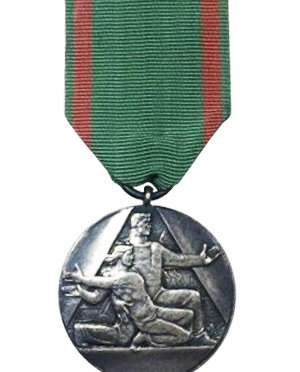
The medal is round and was designed in 1960 by Józef Gosławski. The obverse features an image of a man and woman framed by a triangular background.

The Medal of St. George (Russia)

The Medal of St. George for Bravery was established in 1878 and awarded to non-commissioned officers, soldiers, and sailors for acts of valor.

The Medal of St. George for Bravery was established on 3rd August 1878, during the reign of Tsar Alexander II. After the death of Emperor Alexander III in 1894 the Medal was re-issued, wearing the semblance of the new sovereign, Tsar Nicholas II.

The medal was awarded to non-commissioned officers, soldiers, and sailors as well as to civilians for exceptional acts of valor in times of war or peace.

On 10th August 1913, a sweeping amendment was introduced by which the Medal for Bravery was incorporated into the statute of the Order of Saint George and its name was changed to Saint George Medal for Bravery. From 23rd July 1915 the Gold Medals, similarly to the golden Saint George Crosses, were manufactured with a reduced content in gold. From January 1917 they were manufactured with substitute yellow or which metal.

The Cross of St. George Design

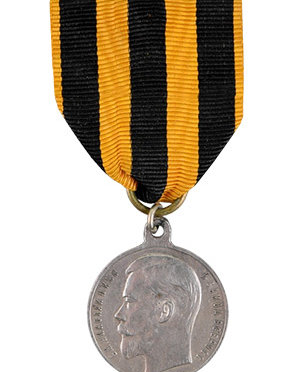
The St. George Medal came in four classes. Gold medallions for 1st and 2nd class (shown above). Silver medallions for 3rd and 4th. A bow on the ribbon denoted 1st class and 3rd. The medal was awarded for merit to other Allied soldiers as well as Russians.

The obverse features the bust of the reigning Emperor with his title. The reverse  bears, in the center, in two lines the wording FOR BRAVERY, below the recipient’s impressed award registration number followed by the class of the award.

The ribbon is the same as the Order of Saint George; orange with three black stripes, commonly called “George’s Ribbon”. It symbolizes fire and gunpowder: the Russian “colors of military glory”, and is also thought to be derived from the colors of the original Russian imperial coat of arms (black eagle on a golden background). It was subsequently associated to the colors of the Russian Guard units.

The Medal for Transforming the Non-Black Earth of the RSFSR

The Medal for Transforming the Non-Black Earth of the RSFSR was awarded for 3 years outstanding service in developing Soviet agriculture.

The Medal for Transforming the Non-Black Earth of the RSFSR (or Медаль «За преобразование Нечерноземья РСФСР», Medal «Za preobrazovanie Тechernozem’ja RSFSR» in Russian) was established on 30 September 1977 by decree of the Presidium of the Supreme Soviet of the USSR and awarded for 3 years outstanding service in developing Soviet agriculture.

The Medal “For Transforming the Non-Black Earth of the RSFSR” was awarded to workers, farmers, and employees who made an impact on the work of implementation of the long-term program for the development for agriculture of the non-black earth zone of the Russian Soviet Federative Socialist Republic, and who worked as a rule, for not less than three years in this field and that was located on state or collective farms, or worked in businesses, organizations or institutions whose activities were directly related to the transformation of the non-black earth.

The medal’s statute was amended on July 18, 1980 by decree of the Presidium of the Supreme Soviet of the USSR № 2523-X.

The Medal for Transforming the Non-Black Earth of the RSFSR Design

The medal was 32mm in diameter, circular, and made of tombac, with a raised rim on both sides. It was worn on the left side of the chest.

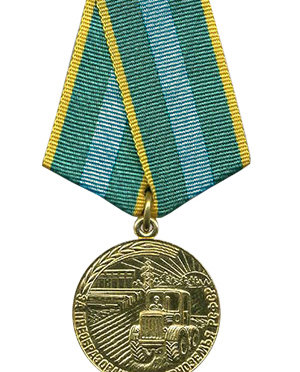
On the obverse, in the right half, the relief image of a tractor pulling a plow through a field below a rising Sun over a distant tree line; at left the relief images of barns, grain elevators, and power transmission towers; along the medal’s lower circumference, the relief inscription «За преобразование Нечерноземья РСФСР» (“For transforming the Non-Black Earth of the RSFSR”), along the upper left circumference, a panicle of wheat; the obverse had a raised rim.

On the reverse, at the center, the relief image of the hammer and sickle with wheat spikes below a relief five-pointed star emitting rays.

The Medal “For Transforming the Non-Black Earth of the RSFSR” was secured to a standard Soviet pentagonal mount by a ring through the medal suspension loop. The mount was covered by a 24 mm wide overlapping green silk moiré ribbon with 2 mm yellow edge stripes and a 6 mm central blue stripe.

The Medal for Construction of the Baikal-Amur Railway

The Medal for Construction of the Baikal-Amur Railway was awarded to workers on the BAM for 2 years outstanding service.

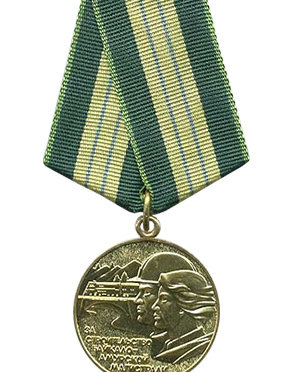
The Medal for Construction of the Baikal-Amur Railway (or Медаль «За строительство Байкало-Амурской магистрали», Medal «Za stroitel’stvo Bajkalo-Amurskoj magistrali in Russian) was established on 8 October 1976 by decree of the Presidium of the Supreme Soviet of the USSR and awarded to workers on the Baikul-Amur Railway (BAM) for 2 years outstanding service between 1974 and 1984.

The medal recognized active participation in the construction of the Baikal-Amur Railway, a huge multi year project under the leadership of then-Soviet premier Leonid Brezhnev. The Medal “For Construction of the Baikal-Amur Railway” was awarded to active participants in the construction of the Baikal-Amur Railway, on the rail section Bam – Tynda – Berkakit, on the second rail section Taishet – Lena, in the production facilities, in the building of housing for the civilian workers, for good work in construction, for high-quality designs and survey work, for honest work at enterprises, institutions and organizations directly supporting the construction efforts and the workers. The medal was usually awarded to workers, engineering-technical workers, and employees who worked on the project in its construction, design, or for its maintenance for at least three years.

The medal’s statute was amended on July 18, 1980 by decree of the Presidium of the Supreme Soviet of the USSR № 2523-X.

The Medal for Construction of the Baikal-Amur Railway Design

The medal was 32 mm in diameter, circular, and made of brass, with a raised rim on both sides. It was worn on the left side of the chest.

On its obverse, in the background in the left half of the medal, the relief image of hills and a train going left across a bridge over a river, under the bridge, the relief inscription on five lines «За строительство Байкало-Амурской магистрали» (“For the construction of the Baikal-Amur Railway”), in the right half of the medal, the left profiles of a man and a woman, the man wearing a construction helmet, the woman being closer and slightly to the right.

On the reverse, the Sun over railroad tracks intersected by a ribbon bearing the inscription «БАМ» (“BAM”) framed by a laurel wreath with the hammer and sickle at the top.

The medal was secured to a standard Soviet pentagonal mount by a ring through the medal suspension loop. The mount was covered by a 24 mm wide overlapping silk moiré ribbon with 1 mm wide light green edge stripes, three 3 mm wide central yellow stripes separated by two 0,5 mm grey stripes, bordered by two 6 mm wide dark green stripes.

The Medal for the Development of Virgin Lands

The Medal for the Development of Virgin Lands was awarded to all Soviet workers who helped cultivate 36,000,000 hectares of land.

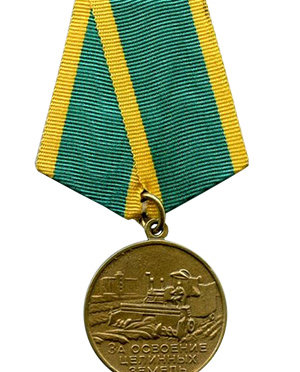
The Medal for the Development of Virgin Lands (or Медаль «За освоение целинных земель», Medal «Za osvoenie tselinnyh zemel» in Russian) was established on 20 October 1956 by decree of the Presidium of the Supreme Soviet of the USSR and awarded to all Soviet workers who helped cultivate 36,000,000 hectares of previously uncultivated lands (started in 1954 by Nikita Khrushchev) in Kazakhstan, Siberia, the Urals, the Volga area and the northern Caucasus for two solid years from 1954–56.

The medal was awarded to farmers, workers of state farms, MTS, construction and other organizations, the Party, government, labor and Komsomol workers for their good work in the development of virgin and fallow lands in Kazakhstan, Siberia, the Ural, the Volga and the North Caucasus for a period of usually at least two years. This Medal was also awarded to Yuri Gagarin right after his space flight (and it became a tradition to award the Medal to many Soviet cosmonauts after that).

The Medal for the Development of Virgin Lands Design

The medal was 32mm in diameter, circular with a raised rim on both sides. It was worn on the left side of the chest.

On its obverse, the image of a C-4 combine harvester in a field with a grain silo in the background on the horizon, at the bottom, the relief inscription on three rows «За освоение целинных земель» (“For the development of virgin lands”).

On the reverse at the bottom, the relief image of the hammer and sickle with sun rays radiating upwards towards a five-pointed star at the top, along the right circumference, ears of corn, along the left circumference, a panicle of wheat.

The medal was secured by a ring through the medal suspension loop to a standard Soviet pentagonal mount covered by an overlapping 24 mm dark green silk moiré ribbon with 3 mm wide yellow edge stripes.