The Medal for Mothers and Widows of the Fallen

Time Period: The Great War, Second World War

Institution: 24 May 1919
Country: Italy

The Medal for Mothers and Widows of the Fallen (or Medaglia di Madri e Vedove Dei Caduti in Italian) is an Italian medal instituted on 24 May 1919 (with Royal decree no. 800 of 1919) as a token of national gratitude to Italian mothers who had lost one or more children during the First World War.

Both legitimate and natural mothers who had recognized the fallen son were entitled to the badge, but only if it was indubitable that the soldier had fallen in combat or as a result of injuries sustained in combat. It was granted by the Ministry of War or the Navy, depending on whether the fallen soldier was part of the land or sea army.

The medal was established by the Kingdom of Italy and reconfirmed by the Italian Republic for the Second World War. A similar recognition was established in 1887 for the mothers of the fallen of the Battle of Dogali. The recognition was also extended to the African Campaign, the Spanish Campaign, thje Expedition to Albania, The 1940/43 War, and WW2.

The Medal for Mothers and Widows of the Fallen Design

The medal is circular and could be cast in bronze of the guns taken from the enemy. It was designed by G. Prini and measures 32 mm in diameter.

The obverse shows an allegorical design of a woman offering a laurel wreath to a dying soldier while another woman stands in the background. The reverse is bears the inscription “IL FIGLI / CHE TI NACQVE / DAL DOLORE / TI RINASCE “O BEATA” / NELLA GLORIA / E IL VIVO EROE / “PIENA DI GRAZIA ” / E TECO” (“The son which was born out of you in pain, is reborn to you, o blessed one, full of glory and he lives as a hero. With gratitude“).

There are several variants produced by private industries. Some of these show, under the left arm of the fallen, the name of the model maker “G. PRINI – MOD.” and the name of the manufacturer: Sacchini, S. Johnson or Lorioli and Castelli.

The ribbon is dark grey, with thin green, white, and red stripes in the center and measures 37 mm wide. A ministerial circular dated March 23, 1921 established that each fallen child was represented by an equivalent number of bronze crowns on the ribbon.

The Medal for the War Volunteer 1915-1918

The Medal for the War Volunteer 1915-1918 is an Italian medal instituted in 1924 and awarded to Italian armed volunteers of the Great War.

The Medal for the War Volunteer 1915-1918 (or Medaglia di Volontario di Guerra 1915-1918 in Italian) is an Italian medal instituted on 24 May 1924 and awarded to those who entered the Italian armed volunteer forces during WW1. It was established with Royal Decree n. 1163 by the Italian government.

The medal was awarded to those who had participated in the war operations in a way worthy of commendation and who gave proof of belonging to one of the following categories:

  1. Former reformers who spontaneously enlisted as officers, non-commissioned officers or troop soldiers or of the CRE at least one month before the date of the decree that would have called them for a review visit;
  2. Soldiers who, declared unsuitable for war service due to injuries sustained in the war or due to infirmities, spontaneously returned to be part of the operating army or navy;
  3. Second and third category military personnel who had spontaneously taken up military service as officers, non-commissioned officers or militaries of the troop or the CRE at least four months before the date of the decree calling their class or category and actually were incorporated into the operating army or navy before the said recall;
  4. Spontaneously enrolled at least four months before being called to visit before the conscript councils and actually left to be incorporated into the army or navy operating before the date on which they would normally have passed the visit;
  5. Exempted by law from military service who, at least five months before November 4, 1918, spontaneously renounced the dispensation to be incorporated into the operating army or navy;

The fallen, the wounded in combat and those decorated with the military Order of Savoy or the value for war actions carried out during the voluntary service, were entitled to the medal even if the service itself had started within a time limit lower than those indicated above. With art. 4 of the Royal Decree n. 1529 of 1925 merit was also granted to maritime members who had sailed on merchant steamers without having military service obligations and who had obtained the War Merit Cross or were in the conditions to obtain it. With RD n. 2127 of 1925, the eligibility criteria were regulated in a more detailed manner and the exclusion from the granting of those who, despite possessing the qualifications, were deemed, in the opinion of the competent issuing authorities, unworthy to boast of them for having in the meantime he received criminal convictions or for serious moral reasons.

The same medal was later issued for the Second World War and for a number of colonial wars. It was abolished in 2010.

The Medal for the War Volunteer 1915-1918 Design

The medal is circular. The obverse depicts the crowned head of “Italia” and the inscription “PER L’ITALIA” (or “For Italy“). The reverse bears a naked warrior bearing a shield and a veiled woman behind him. Around the rim of the medal is the inscription “VOLONTARIO DI GVERRA MCMXV-MCMXVIII” (“War volunteer” and the dates of the war).

The WW2 version of the medal has the dates 1936-1939 in Roman figures in the obverse, and the letters A.O.I (Africa Orientale Italiana, Italian East Africa) on the reverse. Many medals had no dates inscribed on them.

The ribbon is plain red.

The 1915-1918 War Medal

The War Medal 1915-1918 is an Italian medal instituted in 1920 and awarded for participation in WW1. It replaced a previous ribbon bar.

The War Medal 1915-1918 (or Commemorative Medal for the Italo-Austrian War 1915–1918) is an Italian medal instituted on 29 July 1920 and awarded for participation in WW1 – or service during and immediately after World War I in the national territory of Italy, in the Dodecanese, in Albania, Syria, and Palestine.

The medal replaced a previous ribbon bar that had been introduced on 21 May 1916 and was awarded for one year of service in a war zone. When the medal replaced the ribbon bar, a number of new bars were attached to the ribbon according to the recipient’s service. The bars were covered in laurel leaves and could be:

  • 1915
  • 1916
  • 1917
  • 1918
  • Albania 1919
  • Albania 1920

Approximately 1,800,000 War Medal 1915-1918 medals were awarded.

The War Medal 1915-1918 Design

The medal is circular and struck in bronze.

The obverse shows the helmeted head of King Victor Emanuel II. Around the rim is the inscription “GVERRA PER L’VNITA D’ITALIA 1915 1918” (“War for the Unity of Italy“). The reverse bears the figure of an upright Victory standing on shields born by two soldiers. Around the rim is the inscription “CONIATA ‘NEL BRONZO NEMICO” (“Made from enemy bronze“).

The ribbon has alternating thin stripes of green, white, and red.

The Commemorative Medal for Rescue from Danger 1925-1933

The Commemorative Medal for Rescue from Danger 1925-1933 was instituted on 9 June 1925 for rescue from danger at the peril of rescuer’s life.

The Commemorative Medal for Rescue from Danger 1925-1933 was instituted on 9 June 1925 for rescue from danger at the peril of rescuer’s life. The medal was awarded very sparingly.

The Commemorative Medal for Rescue from Danger 1925-1933 Design

The medal is large and circular, and measures 48.72mm (1.92 inches) in diameter. Records show that it was originally manufactured in silver, however there are several examples struck in zinc alloy – perhaps manufactured at a time of material shortages and economic crisis or for collectors at the time.

The obverse has the Prussian eagle, head facing right, wings outstretched, and the inscription ‘REPUBLIK’ above and ‘PREUSSEN’ below. The reverse is inscribed ‘FÜR RETTUNG AUS GEFAHR’ (“For Rescue from Danger”) within an oak leaf border in relief.

The Pro Memoria Medal

The Pro Memoria Medal is a Polish civil state decoration awarded by the head of the Office for War Veterans and Victims of Oppression.

The Pro Memoria Medal is a Polish civil state decoration awarded by the head of the Office for War Veterans and Victims of Oppression. It was created as a commemorative badge on the occasion of the 60th anniversary of the end of World War II.

Established 25 January 2005, the medal is awarded for outstanding contributions in perpetuating the memory of the people and deeds in the struggle for Polish independence during World War II. It was replaced on September 1, 2011 by the Pro Patria Medal.

The Pro Memoria Medal Design

The medal is disc shaped struck in silver colored metal.

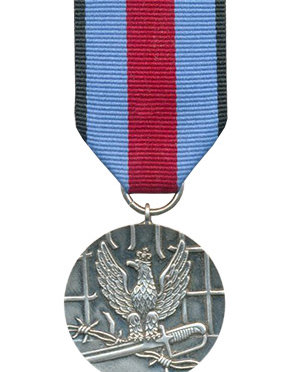
The obverse of the medal shows the Polish Eagle sitting on a sword crossed with barbed wire. In the background is a breached fence. On the reverse around the rim is the inscription “URZĄD DO SPRAW KOMBATANTÓW I OSÓB REPRESJONOWANYCH” (“Office for War Veterans and Victims of Oppression”). In the center is the inscription “PRO MEMORIA” over crossed oak and laurel branches, and the date: 8 MAJA 2005, the 60th anniversary of the end of World War II.

The medal is suspended from a ribbon in the colors blue, magenta, and black.

The Pro Patria Medal

The Pro Patria Medal is a Polish civil state decoration established in 2011 and awarded to War Veterans and Victims of Oppression.

The Pro Patria Medal is a civil state decoration of Poland established in 2011 and awarded by the Head of the Office for War Veterans and Victims of Oppression.

The medal is awarded by the Head of the Office for War Veterans and Victims of Oppression based upon an application with documentation from veterans and victims of oppression groups. Recommendations may also be made by departments of the Polish Government or Polish diplomatic missions and military attachés. The medal is awarded to mark special merit in strengthening and treasuring the memory of the Polish people’s fight for the independence of the Polish Republic during and following World War II.

The Pro Patria Medal Design

The medal is struck in silver metal and measures 36 mm in diameter.

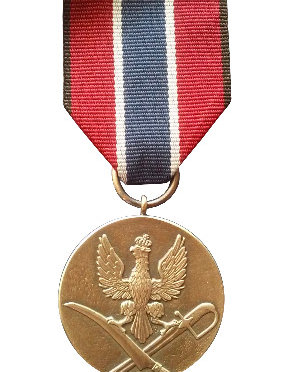
The obverse depicts a crowned Polish Eagle sitting atop a saber crossed with a war scythe. The reverse bears a cross pattee above the three-line inscription PRO PATRIA 1768-1989, with a crossed laurel and oak spray below. The date 1768 represents the year of the Bar Confederation, the first rebellion to restore an independent Poland. Around the edge is the inscription “URZAD DO SPRAW KOMBATANTOW I OSOB REPRESJONOWANYCH” (“Office for War Veterans and Victims of Oppression”).

The medal hangs from a ring suspension, attached to a 38 mm crimson ribbon with a dark blue central stripe bordered by narrow white stripes. At the edges are narrow black stripes.

The Polish Army Medal

The Polish Army Medal was established to recognize service to the Polish Army by foreign civilians and military personnel.

The Polish Army Medal (or Medal Wojska Polskiego in Polish) was established by Poland on 3 September 1999 to recognize service to the Polish Army by foreign civilians and military personnel, who have made particular merit in the field of cooperation of the Polish Army with the armed forces of other countries.

The medal is presented by the Polish Minister of National Defence in three grades:

  • 1st degree – Gold Medal of the Polish Army.
  • 2nd degree – Silver Medal of the Polish Army.
  • 3rd degree – Bronze Medal of the Polish Army.

Most awards are presented to members of allied armed forces, but the medal is also awarded to civilians who contribute to promoting the history and traditions of the Polish Army outside of Poland.

The Polish Army Medal may be awarded to persons who:

  • Actively support the peaceful activities of the Polish Army in the international arena.
  • Contributed to the development of the defense potential of the Republic of Poland.
  • They have been particularly distinguished in the field of cooperation within multinational units, which include units of the Polish Army, including primarily in integrating commands, staffs and military units at all levels of command (management).
  • Contributed to the popularization of the history and tradition of the Polish Army on the international arena.

The Polish Army Medal Design

The badge of the Polish Army Medal is a round medal with a diameter of 36 mm, framed with a laurel wreath.

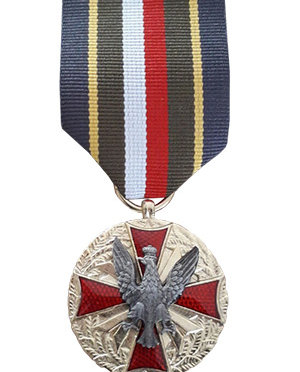
On the obverse of the medal there is a Maltese cross covered with red enamel. In the center of the cross there is a silver eagle with the sign of the Ministry of National Defense. There are bundles of rays between the arms of the cross. The wreath, the border of the cross, the bundles of rays and the reverse are gilded, silvered or patinated brown, depending on the grade of the medal. On the reverse side there is an embossed stylized inscription in two lines: “WOJSKO / POLSKIE”.

The medal badge is hung on a ribbon 65 mm long and 38 mm wide, in vertical stripes, symmetrically placed towards the center, in the colors from the edge: steel – 6 mm wide, gold – 2 mm wide and khaki – 6 mm wide. In the center of the ribbon is a vertical white and red strip 10 mm wide (white on the left).

The Medal of Merit for National Defense

The Medal of Merit for National Defense is a decoration of the Ministry of National Defense of Poland established 21 April 1966.

The Medal of Merit for National Defence (or Medal Za Zasługi dla Obronności Kraju in Polish) is a decoration of the Ministry of National Defence of Poland established 21 April 1966 and revised in 1991.

The medal recognizes the meritorious service of people who, through their work or activity, contributed to the development and strengthening of the country’s defense. The medal may also be awarded to a military unit, social organization, enterprise, plant or institution.

The medal has three grades:

  • Gold medal.
  • Silver medal.
  • Bronze medal.

The rules for awarding the medal were changed by the ordinance of the Minister of National Defence of April 19, 1991. According to this ordinance, the medal is awarded to people who:

  1. They showed bravery or courage in direct actions related to the country’s defense, or they achieved very good results in the implementation of defense tasks.
  2. Have special merits in the field of the development of modern military thought, military technology and defense potential, as well as in the field of military training and education.
  3. With their professional work or activity in social organizations, they significantly contributed to the development and strengthening of the country’s defense system.

Members of the Polish military and civilian employees are eligible for this medal. A silver medal may be awarded to a person awarded with a bronze medal, if at least three years have elapsed since it was awarded, and the gold medal may be awarded at least five years after the silver medal was awarded.

The Medal of Merit for National Defence Design

The badge of the medal was initially a round medal with a diameter of 38 mm, made of gilded, silver-plated or bronze and oxidized metal. On the obverse there was a drawing of Poland’s borders, and against it a stylized eagle. There was an inscription around the drawing: “FOR MERIT FOR COUNTRY DEFENSE”. On the reverse, there was a horizontal inscription: “MINISTERSTWO OBRONY NARODOWEJ”, surrounded by the inscription: “POLSKA RZECZPOSPOLITA LUDOWA” (“People’s Republic of Poland”).

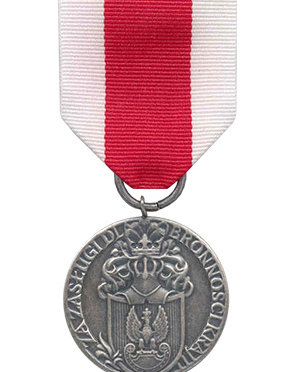
Since 1991, the medal’s badge has been a round gilded, silvered or patinated bronze medal with a diameter of 36 mm. The obverse features a crowned knight’s helmet, surrounded by acanthus leaves, and a shield underneath with a crowned military eagle. There is an inscription on the rim: “ZA ZASŁUGI DLA OBRONNOŚCI KRAJU”. On the reverse there is a horizontal inscription in two lines: “WOJSKO / POLSKIE”.

The ribbon of the medal in both versions is white, 38 mm wide, with a vertical red stripe 20 mm wide in the center.

The Medal of the Armed Forces in the Service of the Fatherland

The Medal of the Armed Forces in the Service of the Fatherland is a decoration awarded for long service and excellent work in the army.

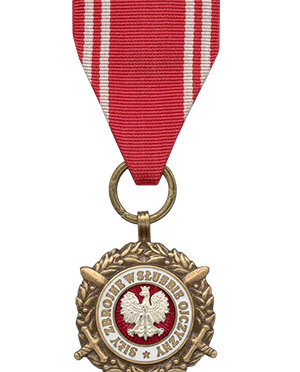
The Medal of the Armed Forces in the Service of the Fatherland (or Medal Siły Zbrojne w Służbie Ojczyzny in Polish) is a military decoration of Poland awarded for long service and excellent work in the army.

The medal was first established on 26 May 1951, although the detailed rules and grades were revised 1991 and 1995. Until 1968, it was a state distinction awarded by the head of state; from 1968 it was a departmental award, granted by the Minister of Defence.

The medal continues to be presented as an award of the Ministry of Defence, as the Medal for Long Service is a state-awarded decoration, conferred on an individual basis to selected recipients only.

The Medal of the Armed Forces in the Service of the Fatherland Design

There are three grades, Gold, Silver and Bronze, awarded for 25, 15 and 5 years, respectively.

The medal, initially defined by the regulation of the Council of Ministers of August 11, 1951, was a round laurel wreath 34 mm in diameter, on which are attached two crossed swords, pointed upwards, protruding beyond the edge of the wreath. The wreath, swords, borders and inscriptions are gilded, silvered or bronze depending on the grade of the medal.

In the obverse, in the center of the wreath there is a round shield, red enameled, 16 mm in diameter (then 15 mm), with a silver-plated eagle without a crown over it. The shield is placed in a white enamel rim. On the rim there is the inscription “SIŁY ZBROJNE W SŁUŻBIE OJCZYZNY”. At the bottom of the wreath, there was a small oval red and enameled shield with a Roman numeral placed on it, the number of years of service for which it was conferred. The reverse is plain.

Despite the subsequent changes to the medal, the badge itself has not changed significantly. From 1960, the diameter of the eagle shield was determined to be 15 mm. According to the 1995 regulations, the badge is described in the same way, except that the shield has a silver-plated eagle in the pattern of the Polish coat of arms (in the crown). Moreover, there is no small shield with a Roman numeral representing the number of years of service.

The ribbon of the medal did not change; it is red, 35 mm wide, with two white vertical stripes 2 mm wide on the sides on each side of the ribbon.

The Medal of Victory and Freedom 1945

The Medal of Victory and Freedom 1945 was a military decoration awarded to persons who fought during World War II against Nazi Germany.

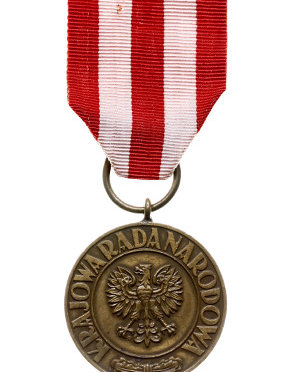
The Medal of Victory and Freedom 1945 (or Medal Zwycięstwa i Wolności 1945 in Polish) was a military decoration from Poland awarded to persons who fought during World War II against Nazi Germany.

The medal was introduced by a decree of the Council of Ministers and approved by the State National Council (Krajowa Rada Narodowa) on October 26, 1945. According to the decree, it was instituted “to commemorate the victory of the Polish Nation and its allies over the barbarism of hitlerism, a triumph of the idea of democratic freedom, and to award persons who helped in this victory”.

It was awarded to:

  • soldiers of the Polish People’s Army (Ludowe Wojsko Polskie) in the USSR.
  • soldiers fighting in the invasion of Poland in 1939.
  • soldiers of the Polish Armed Forces in the West, provided that they come back to Poland after the war.
  • Poles who fought against Germans in allied armies.
  • Polish partisans fighting in the country or abroad.
  • members of the Soviet, Yugoslav or French partisan units.
  • armed forces members who served at least three months by May 9, 1945, in auxiliary units, helping in the victory.

The medal was awarded by the Prime Minister, and from 1958 by the Council of State. It ceased to be awarded in 1992. About 670,000 Medals were awarded by 1985.

The Medal of Victory and Freedom 1945 Design

The medal in the first version was a bronze disc with a diameter of 33 mm.

On the obverse was the state eagle, surrounded by oak leaves, with the inscription KRN in the upper part, but this version was not introduced.

The final version, sanctioned by the regulations in 1946, is a disc 33 mm in diameter, patinated in brown, with the State Eagle on the obverse and the inscription around the medal: KRAJOWA RADA NARODOWA. At the bottom of the medal there are two tied oak leaves. On the reverse there are four lines separated by horizontal lines: RP VICTORY – AND FREEDOM – 9.V.1945.

In 1945, a ribbon was established, which was half red and white in a vertical line. From 1946, the ribbon of the medal was 35 mm wide and consisted of 3 red and 2 white stripes 7 mm wide, arranged alternately. Since 1960, the width of the ribbon has been defined as 33 mm.