The Order Of The Imperial Dragon or Bao Xing Merit Medal

The Order Of The Imperial Dragon or Bao Xing Merit Medal is a military award given to British and French government officials and civilians.

The Order Of The Imperial Dragon, also known as the Bao Xing Merit Medal is a Chinese military award given to British and French government officials and civilians. The medal was authorized by Imperial Decree in 1862, designed in the Western Style and awarded to those who contributed to the defeat of the Taiping Rebellion between 1850 to 1864.

The Bao Xing Merit Medal was influential in the design and creation of the later instituted Order of the Double Dragon in 1882.

The Bao Xing Merit Medal Design

The medal is struck in 24ct gold and it has a unique high handcrafted quality with exquisite attention to detail. All figures and characters are hand-carved from a single gold disc.

For the First Class, the obverse depicts two dragons pursuing a central red cabochon. The outer border is a stylized “thunder scroll” design. The reverse features the Chinese characters for Da Qing Yu Xi (Great Qing Imperially Awarded First Class Award).

The medal measures 381. mm (w) by 54 mm (including the suspension) and weights 46.6 grams. It was awarded with a tassel consisting of a green braided knot (Yun Tou or Cloud Head knot) with parallel blue and red tassels, upper suspension composed of a secondary braided blue Yun Tou.

The Wu Pei Fu Qualification Award For Public Affairs

The Wu Pei Fu Qualification Award For Public Affairs is a Chinese medal established c. 1912 and awarded for “virtuous behavior”.

The Wu Pei Fu Qualification Award For Public Affairs is a Chinese medal established c. 1912 and awarded for “virtuous behavior”.

Wu Peifu was an important figure and warlord who played a significant role in the Republic of China (in the struggles between the warlords who dominated Republican China) between 1916 and 1927.

This medal was issued in the region of Hebei during the War Lords Era (1912-1928).

The Wu Pei Fu Qualification Award For Public Affairs Design

The medal is a three-piece construction, struck in silver and decorated with enamels. It measures 50.7 by 51 millimeters.

The obverse features Chinese characters, which changes depending on what the medal was awarded for.

The Anzac Commemorative Medal

The Anzac Commemorative Medallion was instituted in 1967 and awarded to surviving members of the Australian forces who served on the Gallipoli Peninsula, or in direct support of the operations from close offshore. The time frame is any time during the period from the first Anzac Day in April 1915 to the date of final evacuation in January 1916.

Next of kin, or other entitled persons, are entitled to receive the medallion on behalf of their relatives if the medallion has not been issued.

The Anzac Commemorative Medallion Design

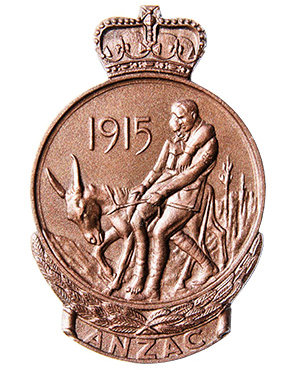
The medal is cast in bronze and measures approximately 75 millimeters high and 50 millimeters wide.

The obverse depicts Simpson and his donkey carrying a wounded soldier to safety. It is bordered on the lower half by a laurel wreath above the word ANZAC. The reverse shows a map in relief of Australia and New Zealand superimposed by the Southern Cross. The lower half is bordered by New Zealand fern leaves.

Surviving members were also issued with a lapel badge in the form of a small replica of the medallion to recognise their Gallipoli service.

The name and initials of the recipient is engraved on the reverse. The medallion is issued in a presentation box.

The Order of Liberation

The Order of Liberation is a Chinese military award given to heroes of the Liberation of mainland China during the Second Chinese Civil War.

The Order of Liberation (解放勋章 in Chinese, Jiěfàng Xūnzhāng in pinyin) was a Chinese military award awarded to heroes of the Liberation of mainland China during the Second Chinese Civil War between 3 September 1945 and 30 June 1950.

The Order was established by the Standing Committee of the National People’s Congress and awarded by the President of the People’s Republic of China. The recipients of the award were the soldiers and civilian personnel of the Chinese People’s Liberation Army and the former members of the Republic of China Army who participated in the uprising.

The medal was awarded in three grades:

  • First Class Medal.
  • Second Class Medal.
  • Third Class Medal.

The Order of Liberation Design

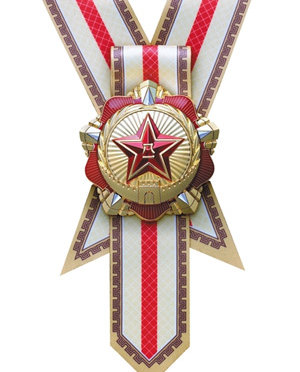
The liberation medals bear a central red star and Tiananmen Square. It’s rumored that the First Class Liberation Medal is struck in pure gold.

The ribbon has one, two, or three red vertical red bars on a yellow background, depending on the class.

The Order of Independence and Freedom

The Order of Independence and Freedom is a military award of the Rep. of China created in 1955 and given for conspicuously gallantry.

The Order of Independence and Freedom (独立自由勋章 in Chinese, Dúlì Zìyóu Xūnzhāng in pinyin) was a military award from the People’s Republic of China created in 1955. It was decided by the Standing Committee of the National People’s Congress and awarded by the President of the People’s Republic of China. The medal was in use since 1955 but has now been suspended.

The Order was given in recognition to men who distinguished themselves “conspicuously by gallantry and intrepidity” in combat with an enemy of China in the Second Sino-Japanese War (a military conflict primarily waged between the Republic of China and the Empire of Japan).

There are three grades for the Order of Independence and Freedom:

  • First Class Medal: Awarded to brigade-level and above of the Eighth Route Army and New Fourth Army.
  • Second Class Medal: Awarded to brigade-level and above of the Eighth Route Army, the New Fourth Army, and the Anti-Japanese Guerrilla
  • Third Class Medal: Awarded to the battalion and company ranks.

The Order of Independence and Freedom Design

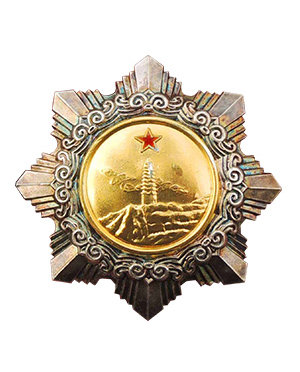
The outer contour of the medal is an octagonal star, and in the middle is the Yan’an Pagoda Mountain under the shining red star, which symbolizes the brilliance of the anti-Japanese armed forces led by Yan’an, the seat of the Central Committee of the Communist Party of China during the Anti-Japanese War.

The medal is struck in golden or gold-silver metal. The ribbon style is one to three yellow vertical bars on a green background indicating the level.

The Order of Bayi

The Order of Bayi is a Chinese military award awarded to heroes of the Liberation of China during the First Civil War between 1927 and 1949.

The Order of Bayi (八一勋章 in Chinese, Bā Yī Xūn Zhāng in pinyin) was a Chinese military award awarded to heroes of the Liberation of China during the First Chinese Civil War, between 1927 and 1949. The Chinese Civil War was a civil war fought between the Kuomintang (KMT)-led government of the Republic of China (ROC) and forces of the Communist Party of China (CPC).

The Communists gained control of mainland China and established the People’s Republic of China (PRC) in 1949, forcing the leadership of the Republic of China to retreat to the island of Taiwan. o armistice or peace treaty has ever been signed.

The Order was established in 1955 and given to soldiers and civilian personnel of the Chinese People’s Liberation Army. The award has been suspended since its last batch in 1957.

There are three grades for the Order of Bayi:

  • First Class: Awarded to cadres above the divisional level at that time.
  • Second Class: Awarded to regiment and battalion cadres at that time.
  • Third Class: Awarded to thse that participated in the First Front Army of the Chinese Workers and Peasants Red Army before October 20, 1935, the Second Front and Fourth Front Army of the Chinese Workers and Peasants Red Army before September 30, 1936, and the Northern Shaanxi Red Army and the North Shaanxi Red Army before September 30, 1935.

An August 1st medal was awarded to personnel other than the above-mentioned personnel who participated in the Red Army of the Chinese Workers and Peasants before July 6, 1937.

The Order of Bayi Design

The medal is round and decorated in gold, silver, and red enamels. The August 1st Medal have the August 1st Military Emblem as the central pattern and is a blunt pentagram.

The ribbon is one to three yellow bars on a red background indicating the rank of the medal.

The Order of Friendship

The Order of Friendship is one of the highest orders of honor of the People’s Republic of China and bestowed to foreigners for contributions.

The Order of Friendship (or 友谊勋章 in Chinese; Yǒuyì Xūnzhāng in pinyin) is, alongside the Order of the Republic, the People’s Republic of China’s highest order of honor.

It was established by law (Article 3 of the Law of the People’s Republic of China on National Medals and National Honorary Titles) on December 27, 2015, by the National People’s Congress Standing Committee (NPCSC) and constituted on January 1, 2016.

The Order of Friendship is set up by the State and bestowed on foreigners who have made outstanding contributions to China’s socialist modernization, the promotion of exchange and cooperation between China and foreign countries, and the protection of world peace. It can be directly awarded to foreign dignitaries, international friends, and other foreigners. The award is given accompanied by a medal, a National Honorary Title and a certificate.

The first Friendship Medal was awarded to:

  • Vladimir Putin, President of Russia, on June 8, 2018. In recognition of his commitment to promoting the development of China-Russia good-neighborly friendship and comprehensive strategic partnership of cooperation during his presidency, and for making important contributions to this end.
  • Nursultan Nazarbayev, first President of Kazakhstan, on April 28, 2019. In recognition of his creation and promotion of the China-Kazakhstan comprehensive strategic partnership, and the promotion of the Shanghai Cooperation Organization and the Conference on Mutual Cooperation and Confidence Measures in Asia to flourish.
  • Raul Castro Ruth, First Secretary of the Central Committee of the Communist Party of Cuba, on September 29, 2019. For establishing relations with China as the priority development direction of Cuban diplomacy, and firmly committed to carrying forward the friendship between Cuba and China, firmly supporting China on major issues, highly agreeing with the proposal of General Secretary Xi Jinping to build a community with a shared future for mankind.
  • Maha Chakri Sirindhorn, Main member of the Chakri dynasty of the Kingdom of Thailand, on September 29, 2019. For promoting Chinese traditional culture, spreading China-Thailand friendship, and making irreplaceable and outstanding contributions to the development of China-Thailand relations.
  • Salim Ahmed Salim, Former Prime Minister and Minister of Foreign Affairs of
    Tanzania, on September 29, 2019. For outstanding contributions to consolidating and promoting the friendly cooperation between China and Tanzania and China and Africa and restoring China’s legitimate seat in the United Nations.
  • Galina Vini Aminovna Kulikova, First Vice Chairman of the Russia -China Friendship Association, on September 29, 2019. For developing friendly relations with China and for outstanding contributions to the promotion of Sino-Soviet (Russian) non-governmental diplomacy.
  • Jean-Pierre Raffarin, Former Prime Minister of France, on September 29, 2019. For his long commitment to promoting Sino-French friendship and all-round cooperation between China and France and for vigorously promoting the “Belt and Road” project.
  • Isabel Kluk, Lifetime Honorary Professor of Beijing Foreign Studies University, on September 29, 2019. For innovating in English teaching and education reform and for cultivating a large number of foreign language talents for New China, making outstanding contributions to China’s education and friendly exchanges with foreign countries.
  • Norodom Monnier, Queen Mother of Cambodia, on November 6, 2020. For actively devoting herself to the cause of friendship between China and Cambodia and actively supporting exchanges and cooperation between the two countries in various fields.

The Order of Friendship Design

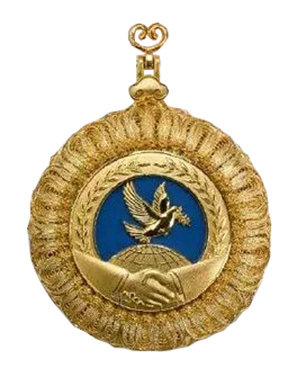
The medal is round and made in gold and blue colors.

The obverse features the the peace dove, earth, a handshake, and a lotus. The medal hangs from a chain made of Chinese knots, evergreens, peonies, jade, and bluegrass. It’s decorated with filigree inlays and enamels.

The Medal for the War of Liberation

The Medal for the War of Liberation is an Italian medal established in 1945 and awarded for minimum 3 months service after September 1943.

The Medal for the War of Liberation was instituted on 21 April 1945 and awarded to personnel of the Italian armed forces, frontier guards, Red Cross, and certain categories of civilians, for a minimum 3 months service after 9 September 1943, excluding service in the “Social Italian Republic”.

The medal was awarded to Italian forces who served in operations against the German occupational army in Italy, post the capitulation and collapse of the Mussolini Fascist regime.

The award was first instituted as a ribbon and from 6 May 1959 as a medal.

The Medal for the War of Liberation Design

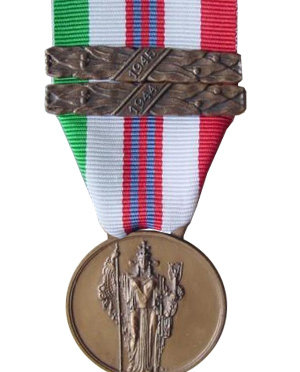
The ribbon can carry bars for each year of service: 1943, 1944, 1945, and possibly 1946. The latter year would refer to services in defusing bombs, mine clearance, etc. but seems never to have been effectively awarded or manufactured.

The Medal for Volunteers of the War 1940-45

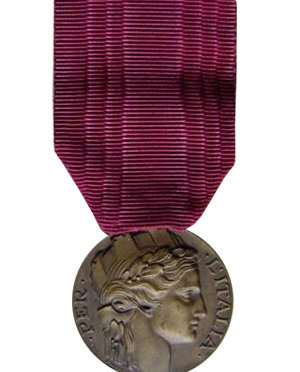
The Medal for Volunteers of the War 1940-45 was instituted on 21 April 1948 and awarded to those that volunteered for the Second World War.

The Medal for Volunteers of the War 1940-45 (or Volontario di Guerra 1940-45 in Italian) was instituted on 21 April 1948.

This medal, with a different ribbon and referred to as The Merit Medal for Crossing Enemy Lines after 8 September 1943, was also awarded to those that crossed enemy lines into Allied liberated territory before 8 September 1943 and put themselves at the disposal of the Italian National Government.

The Medal for Volunteers of the War 1940-45 Design

The official medal’s reverse has the inscription “VOLONTARIO DI GVERRA MCMXL-MCMXLV“. A type with the years in Arabic figures has also been reported to exist.

This medal can be found on different ribbons. The original decree stipulates the claret ribbon as for the WW1 Volunteer’s Medal but two other ribbons are known to exist (although they are considered unofficial). Both are purple, one with a center of four green and three red stripes, the other with three green and two red stripes in the middle. They both incorporate the War Commemorative Medal’s color scheme.

The Gold Medal of Military Valor

Institution: 21 May 1793
Country: Italy

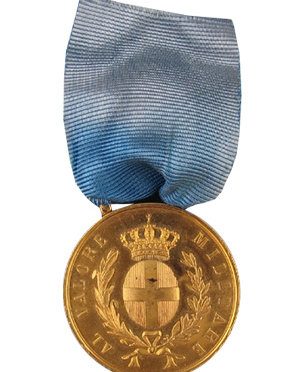
The Gold Medal of Military Valour (or Medaglia d’oro al valor militare in Italian) is a medal established on 21 May 1793 by King Victor Amadeus III of Sardinia for deeds of outstanding gallantry in war by junior officers and soldiers.

On 14 August 1815, Victor Emmanuel I of Sardinia replaced it with the Military Order of Savoy. On 26 March 1833, Charles Albert of Sardinia revived it and added to it the Silver and Bronze medals.

With the proclamation of the Republic on 2 June 1946, the coat of arms of the House of Savoy was replaced with the emblem of the Italian Republic. 

For actions performed by individuals during World War I, the Gold Medal was awarded some 368 times, as well as 37 times to military units, and once to the Unknown Soldier. Only four of the individual awards went to foreigners, one of these being Czar Nicholas II of Russia. The other three were for acts of gallantry in which the recipient was killed in action or died from his injuries (the Frenchmen John O’Byrne and Roland Morillot, and the American Coleman deWitt). 

During World War II the medal was awarded to soldiers of the Royal Italian Army; after these forces were reorganized following the Armistice with Italy in 1943, it was awarded to members of the Allies-supporting Italian Co-Belligerent forces. The Axis-affiliated Italian Social Republic created another design of the medal, with a Gladius replacing the arms of Savoy, for members of the Esercito Nazionale Repubblicano from 1943 to 1945. This version of the award was not given recognition by the postwar Italian government.

The Gold Medal for Military Valor is still awarded by the Italian state, and it, along with Silver and Bronze medals for Military Valor as well as the War Cross of Military Valor (which can only be awarded in time of war) was established by the Royal Decree of 4 November 1932.

The Gold Medal of Military Valor Design

The obverse of the medal displays the coat of arms of Savoy with laurel branches, the royal crown, and the words “For Military Valor“. On the reverse are two laurel branches enclosing the name of the decorated soldier, and the place and date of the action.