The Austrian First World War Commemorative Medal

  • Time Period: WW1
  • Institution: 21 December 1932
  • Country: Austria

The Austrian First World War Commemorative Medal (or Kreigserinnerungsmedaille in German) was awarded to those Austrians who served in the armed forces of the Austro-Hungarian Empire during the First World War 1914-1918.

The medal was officially gazetted by the Austrian government on 21 December 1932.

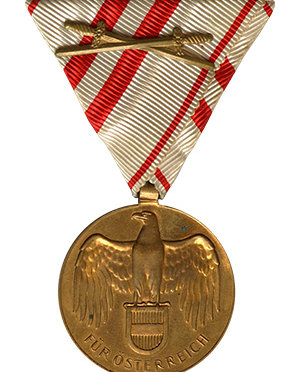
In November 1933 the government effectively created two classes for the award by announcing that all front line troops, and any other service personnel who had been wounded in action or taken prisoner, would be entitled to have a crossed swords device added to their medals to distinguish them from other recipients. The crossed swords device (in gilt) was attached to the ribbon.

The Austrian First World War Commemorative Medal Design

The medal was designed by Edwin Grienauer (1893-1964), a prominent Austrian sculptor and medalist that would later teach at the Vienna Arts Academy, who was himself a veteran of the First World War.

The obverse depicts an eagle standing on a shield displaying the medieval arms of the Duchy of Austria (which formed part of the new coat of arms of the post-war Republic of Austria) and below this is the inscription ‘FÜR ÖSTERREICH‘ (“For Austria“).

The reverse displays the dates ‘1914-1918’ and beneath them, the name of the artist, ‘GRIENAUER‘, surrounded by an oak wreath border.

The ribbon is red and white, with the stripes diagonally palced.
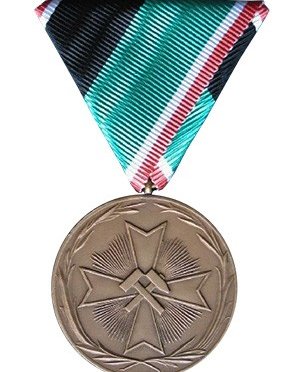
The Mine Rescue Decoration (Austria)

The Mine Rescue Decoration (or Grubenwehrehrenzeichen in German) is a state award of the Republic of Austria, established on February 24, 1954 by the National Council and presented by the Federal Ministry of Trade and Reconstruction (currently known as the Ministry of Digital and Economic Affairs) to both members and non-members of the mine rescue services.

The decoration can be awarded for the following reasons:

  • to members of a mine rescue service who made a special contribution to a rescue operation resulting in loss of their life.
  • to members of a mine rescue service who have provided satisfactory service for a period of at least 15 years.
  • to former members of a mine rescue service who were unable to complete 15 years of satisfactory service due to work-related illness or injury.
  • to any individual who, while under supervision of the mountain authorities, rescues or assists in rescuing an individual at the cost or, or at great risk to, their own life.
  • to any individual who has made a special contribution to the mine rescue services.

The Mine Rescue Decoration Design

The medal is struck in bronze, circular and measures 40 mm. The obverse shows a Maltese cross with outgoing rays, framed by a laurel wreath, and superimposed by a crossed hammer and pick (the traditional symbol of miners). The reverse bears the Austrian Coat of Arms, with the inscription “Für Verdienste im Grubenrettungsdienst” (“For merits in mine rescue service“).

The ribbon is made up of two thick stripes of black and green, bordered by thin stripes of white and red. On the full-sized medal, the ribbon is arranged as an Austrian trifold, while on the miniature medals, it is arranged as a drape.

In addition to the full-sized medal, awardees also receive a certificate, a miniature medal, a ribbon bar, a lapel pin, and a rosette.

The Decoration for Services to the Liberation of Austria

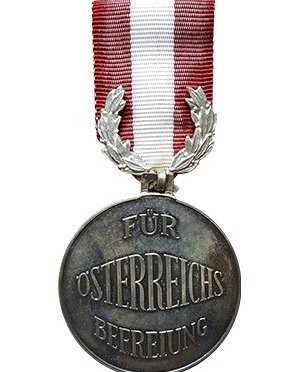
The Decoration for Services to the Liberation of Austria (or Ehrenzeichen für Verdienste um die Befreiung Österreichs in german) is an Austrian decoration created by federal law on 27 January 1976.

The award is a special distinction for men and women who actively resisted the Nazi regime contributing to Austria’s liberation from Nazi rule.

The President of Austria confers this honour when sent a proposal by the Federal Chancellor based on a report from the Committee on the Austrian Liberation Decoration of Honour.

The Decoration for Services to the Liberation of Austria Design

The medal is circular, silver-plated, and has a diameter of 42 mm.

The obverse reads the inscription “FOR AUSTRIA’S LIBERATION“. The text raised and doesn’t have a constant height, but is presented in a convex form. The reverse bears the federal eagle, also centrally positioned.

The suspension is a couple of silver crossed laurel branches. The ribbon is 27 mm wide and split red-white-red. The rosette has a diameter of 10 mm, is colored red-white-red and decorated with two silver-colored, crossed laurel branches. Instead of the rosette, a bar (stitch-like stitching) is provided for women.

The Imperial British East Africa Company’s Medal

The Imperial British East Africa Company Medal was established in 1890 and is the rarest of the medals awarded by the chartered companies. It was initially intended solely as a gallantry award, but after the BEA Company was wound up in 1895 further issues were authorised for service in Witu (1890) and the Ugandan civil war (1890-91).

The Imperial British East Africa Company (or IBEAC) was a commercial association founded to develop African trade in the areas controlled by the British Empire. The company was incorporated in London on 18 April 1888, and granted a royal charter by Queen Victoria on 6 September 1888. The IBEAC oversaw an area of about 246,800 square miles (639,000 km2) along the eastern coast of Africa. It granted immunity of prosecution to British subjects whilst allowing them the right to raise taxes, impose custom duties, administer justice, make treaties and otherwise act as the government of the area.

The following campaigns were in the company’s jurisdiction:

  • The campaign against the sultan of Witu (1890),
  • Uganda Religious War 1891-92.

There are only 29 confirmed medals and post 1895 authorizations.

The Imperial British East Africa Company’s Medal Design

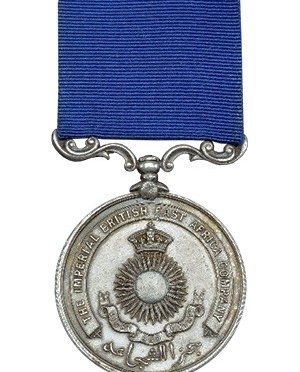
The medal is circular, struck in silver and measures 40mm in diameter.

The obverse shows the company’s arms of a crowned sun and a scroll underneath with the inscribed motto “LIGHT AND LIBERTY“. The Arabic inscription beneath that translates as ‘The Reward of Bravery‘. Around the outer edge, the name of the company is inscribed: “THE IMPERIAL BRITISH EAST AFRICA COMPANY“.

The reverse is plain, except for a lotus flower wreath.

The ribbon is plain dark blue and the suspension is a plain ring suspender (above) or a swiveling scroll suspender (below).

The North West Canada Medal

The Northwest Canada Medal is a British campaign medal established by the Canadian Government in September 1885 and issued to the soldiers, volunteers, and North-West Mounted Police (NWMP) personnel who participated in putting down the North-West Rebellion in 1885 and who served west of Port Arthur, Ontario.

The medal was created after consultation between the Governor-General of Canada and the British Secretary of State for the Colonies. Recipients included a number of volunteers, including the crew of the steamer “Northcote” for service at the Battle of Batoche, and members of the Prince Albert Volunteers for service at the Battle of Duck Lake.

Although no British Army units took part, seventeen British Army officers were attached to Canadian units. All those who received the medal, except for members of the NWMP, also received a grant of 320 acres of land, or scrip of $80 in lieu. During the 1930s, surviving NWMP recipients were each granted $300.

The clasp SASKATCHEWAN was awarded to those present at any of the three main encounters during the rebellion. Approximately 1,760 medals were awarded with this clasp. A number of veterans of the Battle of Batoche added an unofficial “BATOCHE” clasp to their medal.

Medals were issued unnamed, although many recipients had their name and unit engraved on the rim.

The North West Canada Medal Design

The medal is circular, struck in silver and measures 36 millimetres (1.4 in) in diameter. The obverse was designed by L. C. Wyon and the reverse by Thomas Brock.

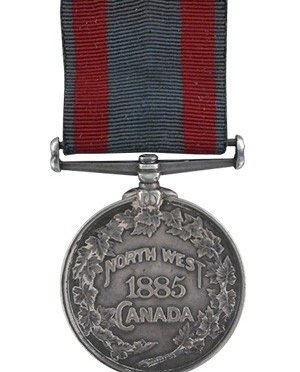
The obverse shows an effigy of Queen Victoria, facing left and wearing a diadem and veil. Around the edge is the inscription VICTORIA REGINA ET IMPERATRIX. The reverse bears the inscription NORTH WEST 1885 CANADA in three lines surrounded by a wreath of maple leaves.

The medal is suspended from a ribbon in slate grey 32 millimetres (1.3 in) wide, with crimson 6 millimetres (0.24 in) stripes, 3 millimetres (0.12 in) from each edge.

The Cape of Good Hope General Service Medal

The Cape of Good Hope General Service Medal is a British campaign medal awarded for three campaigns in and around the Cape of Good Hope.

The Cape of Good Hope General Service Medal is a British campaign medal established in 1900 and awarded to members of the Cape Colonial Forces who took part in three campaigns in and around the Cape of Good Hope, in Basutoland in 1880–1881, in Transkei in 1880–1881 and in Bechuanaland in 1896–1897.

The medal was authorized by the government of the Cape of Good Hope, and approved by Queen Victoria in December 1900. It was awarded to the officers, non-commissioned officers, and men of the Colonial Forces who were engaged in active service during the mentioned campaigns. Three campaign clasps were authorized at the same time:

  • Transkei (from 13 September 1880 to 13 May 1881)
  • Basutoland (from 13 September 1880 to 27 April 1881)
  • Bechuanaland (from 24 December 1896 to 30 July 1897)

In total 1,093 Transkei, 2,179 Basutoland and 2,601 Bechuanaland clasps were awarded.

The Cape of Good Hope General Service Medal Design

The medal is circular and struck in silver. It was designed by Sir Joseph Boehm and measures 36 mm in diameter.

The obverse shows the veiled bust of Queen Victoria, with the legend “VICTORIA REGINA ET IMPERATRIX” around the inside of the raised rim. 

The reverse bears the Cape of Good Hope coat of arms, with a spray of protea leaves and a protea flower underneath and the name “CAPE OF GOOD HOPE” on a wide raised rim around the top half of the medal.

The ribbon is dark blue with a central yellow stripe. These were also the ribbon colours of the two earlier campaign medals for service in southern Africa. The medal is affixed to the swivelling suspender by means of claws and a pin through the upper edge of the medal. The recipient’s rank, name and unit were inscribed on the rim, but the medals were not numbered.

The Turkish Medal for the Defense of Kars

The Turkish Medal for the Defense of Kars was instituted by the Sultan of Turkey in 1854 and awarded to officers and men of British forces who were present during the siege of Kars by 50,000 Russian troops.

The silver medal was awarded to the British officers present including the British Commissioner, Brigadier General Sir William Fenwick Williams. Lt C. C. Teesdale was awarded the Victoria Cross for his part in the action.

The city of Kars, in north-eastern Turkey, was a possession of the Ottoman Empire between 1378 and 1877. Over the course of the nineteenth century, it became a frequent target of Russian attacks because it was exposed and in a strategic position. Defended successfully in 1821, Kars fell in 1828, but was recovered in time to be a target anew in the Crimean War. The Russians decided as almost the last gasp of the war to open a new front directly attacking the Ottoman Empire. Kars stood in their path, and withstood a five-month siege. Facing winter without resupply, and with snowfall preventing their relief, the garrison surrendered on 26 November 1855.

The medals were issued unnamed.

The Turkish Medal for the Defense of Kars Design

The medal is circular and struck in gold or silver. It measures 36 mm in diameter.

The obverse shows the tughra (cipher) of Sultân Abdül-Mejîd I within a wreath. The reverse bears a flag flying from the citadel and an inscription in Turkish reading: “Kars 1272 AH (1855)”.

The medal is pierced for ribbon suspension with a ring and flat suspension bar.

The ribbon is crimson with green edges.

The Turkish Medal for the Defense of Silistria

The Turkish Medal for the Defense of Silistria was instituted by the Sultan of Turkey in 1854 and awarded to officers and men of British forces who were present during the actual siege of Silistria by 30,000 Russian troops. Only seven British officers were there at the time and qualified for the medal – although the medal was issued unnamed.

The Siege of Silistria took place during the Crimean War. Russian forces besieged the Ottoman fortress of Silistria and, while initially successful, the Russians were forced after several weeks to abandon the siege and retreat due to political pressure.

The Turkish Medal for the Defense of Silistria Design

The medal is circular and struck in gold or silver. It measures 36 mm in diameter.

The obverse shows the tughra (cipher) of Sultân Abdül-Mejîd I in a wreath. The reverse bears a flag flying from the ramparts. The river Danube is depicted in the foreground, and an inscription in Turkish reads: “Silistria 1271 AH (1854)”.

The medal is pierced for ribbon suspension with a ring and flat suspension bar.

The ribbon is crimson with green edges.

The Turkish Medal for Glory

The Turkish Medal for Glory was instituted by the Sultan of Turkey in 1853 and awarded to officers and men of British forces for participation in the Danube Campaign early in the Crimean War against Russia, at Silistria and Giurgevo, and later for other campaigns where no specific campaign medal was struck.

The medal is sometimes also referred to as the General Service Medal or Danube Medal.

The Turkish Medal for Glory Design

The medal is circular and struck in gold or silver. It measures 31 mm in diameter.

The obverse shows the tughra (cipher) of Sultân Abdül-Mejîd I above the date ‘1270’ (AH1270 = 1853AD) within a beaded circle imposed on crossed standards and a laurel wreath. There’s also a left-facing crescent and faceted six-pointed star above.

The reverse bears a faceted six-pointed star imposed on a faceted twelve-pointed star above a ribbon inscribed in Arabic letters ‘Nishani Iftihar’ (Order of Glory), a six-pointed star to either side and one below on a spray of laurel.

The medal is pierced for ribbon suspension with ring and flat suspension bar. The ribbon is crimson with green edges.

The Turkish Crimea Medal

The Turkish Crimean War Medal is a campaign medal issued by Sultan Abdülmecid I to allied military personnel involved in the Crimean War.

The Turkish Crimean War Medal (or Kırım Harbi Madalyası in Turkish) is a campaign medal issued by Sultan Abdülmecid I of the Ottoman Empire to allied military personnel involved in the Crimean War of 1854–56.

The medal was only awarded to those who survived the war and not to next of kin. The obverse types differed in the arrangement of the flags, corresponding with the inscription in English, French or Italian in the exergue. 

Although the medals were intended to be issued to British, French and Sardinian troops respectively, they were issued haphazardly due to most of the British version being lost at sea.

British recipients also qualified for the British Crimea Medal.

The Turkish Crimea Medal Design

The medal is circular, struck in silver and measures 36 mm in diameter. It was designed by James Robertson.

The obverse shows a cannon standing upon the Imperial Russian flag, with an anchor and a mortar, weapons, and the four Allied flags with the name and date in the exergue.

The reverse bears the Ottoman Sultan’s tughra with the Muslim calendar year of 1271 on all versions. The identifying flag is the central right-hand flag, positioned above the anchor, the Union Flag for Great Britain, the tricolor for France, or the flag of the Kingdom of Sardinia, based on the Italian tricolor. Since Sardinia was ruled at the time by the House of Savoy, this flag has the Savoy shield in the central panel. The Turkish flag is placed center-left on all three versions.

The ribbon is crimson with green edges.