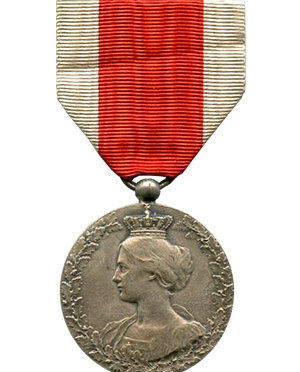
The Commemorative Medal of the National Committee for Aid and Food

The Commemorative Medal of the National Committee for Aid and Food was instituted on 31 May 1919 and awarded to those who had been active in the ‘National Committee’.

The Committee was able to direct aid and assistance to the neediest, operating under American protection and within the constraints of the occupying German forces. Much of Belgium was German-occupied from August 1914 and by the following month groups of civilian volunteers had sprung up to alleviate hunger and hardship. The Committee was also important politically and culturally in maintaining a Belgian civil identity through the period of occupation.

The Commemorative Medal of the National Committee for Aid and Food Design

The medal is circular and was engraved by Devresse. It’s divided into 4 classes, each struck in a different material:

  • 1st class: In gilded bronze and rosette ribbon.
  • 2nd class: In gilded bronze.
  • 3rd class: In silvered bronze.
  • 4th class: In bronze.

The ribbon is red with white edges.
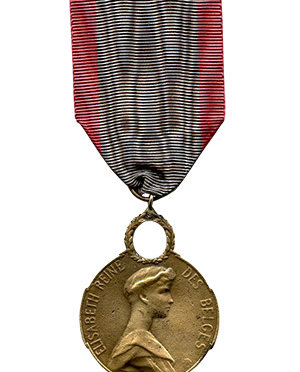
The Queen Elisabeth Medal

The Queen Elisabeth Medal (Médaille de la reine Élisabeth / Koningin Elisabeth Medaille) is a Belgian decoration created in October 1916 by royal decree to recognize exceptional services to Belgium in the relief of the suffering of its citizens during the First World War.

The medal was awarded to people, both Belgians and foreign nationals, who, like Queen Elisabeth herself, had worked and cared for the suffering victims of war for a year or more prior to 10 September 1919.

The award wasn’t limited to the medical care of the sick and wounded and included people working in hospitals (they received a variant with a red enameled cross within the suspension wreath). Many Belgian and foreign doctors and nurses received the medal too.

The Queen Elisabeth Medal Design

The medal measures 36 mm (1.4 in) in diameter and is circular and struck in bronze (although many recipients opted for silver or gilt silver variants). It has four sections inset by 1 mm (0.039 in) giving it the slight outline of a cross and a slightly raised edge on both sides.

The obverse bears the relief right profile bust of Queen Elisabeth with the circular relief inscription ÉLISABETH REINE DES BELGES (“ELISABETH QUEEN OF THE BELGIANS”). The reverse bears the relief image of a nurse sitting and holding an oil lamp with the circular inscription in Latin PRO PATRIA HONORE ET CARITATE (“FOR COUNTRY HONOUR AND CHARITY”). Below are the years “1914 – 1916”.

The ribbon was 38 mm (1.5 in) wide silk moiré with 6 mm (0.24 in) wide pink edge stripes. The medal was suspended by a ring through a suspension loop; a laurel wreath with a hollow center served as the base for it. Awards made for services to wounded or invalided soldiers incorporated a red enameled cross within the wreath.

The King Albert Medal

The King Albert Medal (Médaille du Roi Albert / Koning Albert Medaille) is a Belgian medal established on 7 April 1919 by royal decree and awarded to people who were exceptionally meritorious in promoting, organizing or administering humanitarian and charitable work that assisted Belgians in need during the First World War.

The medal could be awarded to both Belgians and foreigners.

The King Albert Medal Design

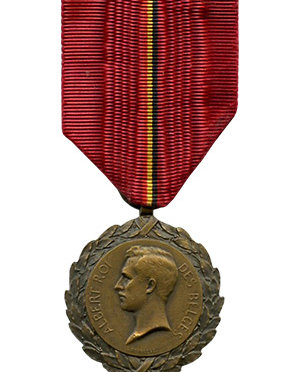
The medal measures 35mm in diameter and is circular and struck in bronze. Its obverse bears a central medallion bearing the left profile of King Albert I with the inscription in French or in Dutch “ALBERT KING OF THE BELGIANS” (“ALBERT ROI DES BELGES” /ALBERT KONING DER BELGEN”) surrounded by a 5mm wide laurel wreath along the entire medal circumference.

On the reverse is the relief inscription on four lines in French or in Dutch “IN TESTIMONY OF NATIONAL RECOGNITION” (EN TEMOIGNAGE DE RECONNAISSANCE NATIONALE” / “ALS BLIJK VAN’S LANDS ERKENTELIJKHEID”) with the years “1914-1918” below.

The ribbon is 38mm wide dark red silk moiré and bears a single 3mm wide longitudinal central stripe in the national colors of Belgium (1mm red, 1mm yellow and 1mm black). The ribbon bears two such stripes if the recipients distinguished themselves in the covert resupply of occupied Belgium. The medal is suspended by a ring through a suspension loop.

The Political Prisoner’s Medal 1914-1918

The Political Prisoner’s Medal 1914–1918 (Médaille du Prisonnier Politique 1914–1918 / Medaille van de Politieke Gevangene 1914–1918) is a Belgian medal established on 26 December 1930 by royal decree and awarded to Belgian civilians who were detained for a minimum of one month by the Germans during the First World War following an act of courage or devotion towards the Allies’ cause.

Recipients of this medal also automatically received the 1914–1918 Commemorative War Medal and the Inter-Allied Victory Medal 1914–1918.

The Political Prisoner’s Medal 1914-1918 Design

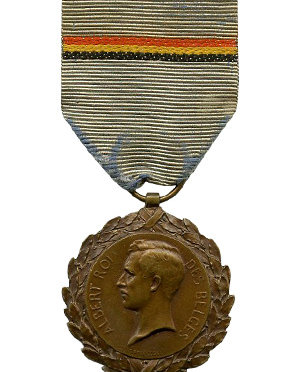
The medal measures 35 mm (1.4 in) in diameter and is circular and struck in bronze. Its obverse bears a 25 mm in diameter central medallion with the left profile of King Albert I and the inscription in French or in Dutch “ALBERT KING OF THE BELGIANS” (“ALBERT ROI DES BELGES” / “ALBERT KONING DER BELGEN”) surrounded by a 5mm wide laurel wreath along the entire medal circumference.

On the reverse of the central medallion, the relief inscription on four lines in French or in Dutch “IN TESTIMONY OF NATIONAL RECOGNITION” (“EN TEMOIGNAGE DE RECONNAISSANCE NATIONALE” / “ALS BLIJK VAN’S LANDS ERKENTELIJKHEID”) and the years “1914–1918” below.

The ribbon is 38mm wide light blue silk moiré and bears a single 4.5 mm (0.18 in) high horizontal central stripe in the national colors of Belgium (1.5 mm red, 1.5 mm yellow and 1.5 mm black). The medal is suspended by a ring through a suspension loop.

The Liège Medal

The Liège Medal is an unofficial World War I campaign medal issued by the city of Liège to its 1914 defenders against German invaders.

The Liège Medal (Médaille de Liège / Medaille van Luik) is an unofficial World War I campaign medal issued by the Belgian city of Liège to its 1914 defenders against the German invaders.

The medal was first issued in April 1920 during a large ceremony presided by the Duke of Brabant (later Leopold III) and Lieutenant General the Count Gérard-Mathieu Leman, military commander of the defense of Liège between 5th and 16th of August 1914. The medal was awarded to the military defenders of the city and later to residents of the city of Liège who were condemned to imprisonment by a German tribunal.

The Liège Medal Design

The medal measures 35mm in diameter and is circular and struck from bronze (although, being unofficial, some recipients had theirs gilded or silvered). It has a 2mm wide raised edge on both sides with laurel leaves along the entire circumference.

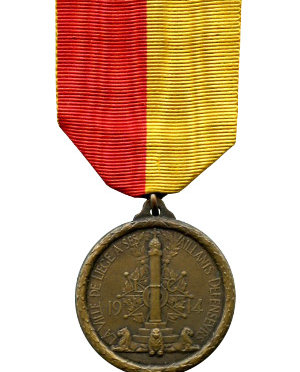
The obverse bears the relief image of the Liège Perron superimposed over a decoration akin the French Legion of Honour and bisecting the year “19” “14”. Along the circumference, a relief inscription reads “LA VILLE DE LIÈGE A SES VAILLANTS DEFENSEVRS” (“THE CITY OF LIÈGE TO ITS VALIANT DEFENDERS“). The reverse bears the relief image of a battle scene including soldiers fighting on near a partly destroyed bunker on the bank of the Meuse river.

The ribbon is a 38mm wide silk moiré half red and half yellow, the colors of the city of Liège. The medal is suspended by two interlocking rings, the lower one passing through a suspension loop on the top.

The 1914-1917 African Campaigns Commemorative Medal

The Commemorative Medal of the African Campaigns 1914–1917 (Médaille Commémorative des Campagnes d’Afrique 1914–1917 / Herinneringsmedaille van de Afrikaanse Veldtochten 1914–1917) is a Belgian military war service medal established on 21 February 1917 by Royal Decree to recognize combat service on the African continent between 1914 and 1918.

The medal was awarded in silver to Belgian military personnel and in bronze to indigenous personnel who participated in the campaigns in Cameroun, Rhodesia, German East Africa, and on the Eastern borders of the Belgian Congo (and in Tanganyika) between 1914 and 1918.

The medal was produced in two different variants:

  • Type 1 (bearing the years 1914–1916 on the reverse), and
  • Type 2 (bearing the years 1914–1917).

The 1914-1917 African Campaigns Commemorative Medal Design

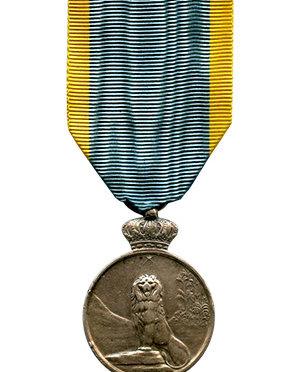
The medal measures 31mm in diameter and is circular and struck in silver for Belgians or bronze for Africans. The award is surmounted by a 14mm wide by 12mm high royal crown and has raised edges on both the obverse and reverse.

The obverse bears the relief image of a lion, its front legs on a rocky outcropping, on the left side of the lion, the base of a mountain, on the right, tropical flora. Above it, there’s a small relief five-pointed star. On the reverse there’s the relief of a five-pointed star bisecting the years “1914*1916” (for the type 1 medal), or “1914*1917” (for the type 2). Three relief laurel branches, two horizontal and one vertical are partially hidden by the names of the localities where engagements were fought inscribed on nine lines, in all capital letters: Kamerun, Ouesso Assobam, Mulundu Jaunde, Afrique Orientale Allemande, Kigali, Nyansa Udjiji, Usumbura Biaramulo, Kitega St Michael and Tabora.

The ribbon is light blue 38mm wide silk moiré with 5mm wide yellow edge stripes, suspended by a ring through a suspension loop.

The Volunteer Combatant’s Medal 1914-1918

The Volunteer Combatant’s Medal 1914–1918 (Médaille du Combattant Volontaire 1914–18 / Medaille van de Vrijwillige Strijder 1914–1918) is a Belgian wartime service medal established on 17 June 1930 by royal decree and awarded to Belgian citizens and foreign nationals who voluntarily enlisted for service in the Belgian Armed Forces during World War I.

The award was given for voluntary enlistment and service in a combat unit in a danger zone for not less than 6 months during the First World War. Later, the eligibility criteria was extended to include volunteers, older than 40 years of age who had served for 3 months in a combat unit in a danger zone, who were older than 50 years of age who had served for 1 month in a combat unit in a danger zone, and medical personnel who had served for 2 years in non-occupied Belgium.

Additional provisions were made regarding awards to youngsters who had fled occupied Belgium and persons who were wounded in action, and posthumous awards.

The Volunteer Combatant’s Medal 1914-1918 Design

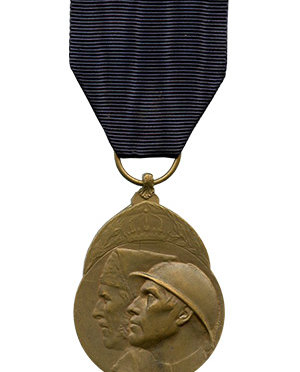
The medal measures 36 mm in diameter and is made of bronze and circular. It’s topped with a crescent-shaped section giving it a nearly oval shape of a height of 50 mm.

On its obverse is the relief image of the head of a helmeted First World War Belgian soldier facing left, to his left and partially hidden behind him, the relief image of the head of an 1830 volunteer also facing left and wearing a bonnet typically worn by the revolutionaries. The crescent section bears the relief image of the Belgian crown over laurel branches.

On the reverse, along the outer circumference, the Latin inscription “VOLUNTARIIS PATRIA MEMOR“, in the center, the years “1914–1918“.

The medal was suspended by a ring through the suspension loop to a silk moiré royal blue ribbon.

The Yser Medal

The Yser Medal is a Belgian campaign medal established in 1918 to denote distinguished service during the 1914 Battle of the Yser.

The Yser Medal (Médaille de l’Yser / Medaille van de IJzer) is a Belgian campaign medal established on 18 October 1918 to denote distinguished service during the 1914 Battle of the Yser (between 17 and 31 October 1914) in which the Belgian Army stopped the German advance of the German invasion of Belgium.

The medal could also be awarded to foreign nationals and members of allied military forces who took part in the battle, and could be given posthumously.

It was worn on the left side of the chest and when in the presence of other awards of Belgium, directly after the Belgian War Cross.

The Yser Medal Design

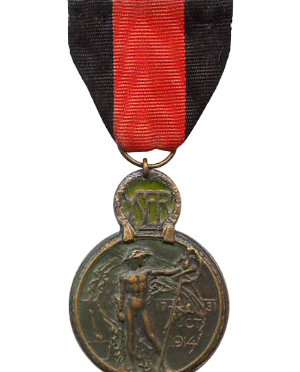
The medal measures 35 mm in diameter and is circular and struck from bronze. It’s surmounted by a smaller diameter green enameled medallion.

The obverse bears a nude, helmeted man holding a lance, which references the halting of the advance of the German forces. To his right, a relief inscription on three lines reads “17-31 OCT 1914” and “YSER“. The reverse bears the image of a roaring wounded lion lying on the bank of the Yser river, with an arrow in its left shoulder. Below the lion, a relief inscription reads “YSER“, and shows the Belgian royal crown over the relief letter “A”, the monogram of King Albert.

The ribbon is red silk moiré with wide black edge stripes. The red denoting the spilled blood, the black denoting the mourning.

The 1870-71 Commemorative Medal

The 1870–71 Commemorative Medal (Médaille Commémorative 1870–71 / Herinneringsmedaille 1870–71) is a Belgian campaign medal established on 20 September 1911 by royal decree and awarded to all members of the Belgian Army who were mobilized during the Franco-Prussian War (15 July 1870 to 5 March 1871).

The Franco-Prussian War was a conflict between the Second French Empire and the German states of the North German Confederation led by the Kingdom of Prussia. The conflict lasted from 19 July 1870 to 28 January 1871, and was caused by Prussian ambitions to expand German unification and French fears of the shift in the European balance of power that would result if the Prussians succeeded. 

The 1870-71 Commemorative Medal Design

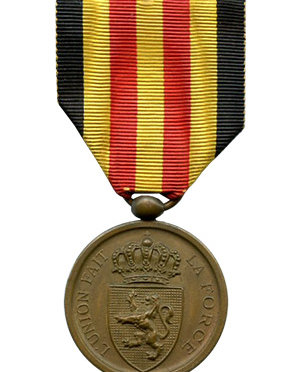
The award is a 32mm in diameter circular bronze medal with raised edges on both sides.

The obverse bears the escutcheon of the Coat of arms of Belgium under a royal crown. To the left and right, along the circumference of the medal, the relief inscription “L’UNION FAIT LA FORCE” (“Strength through unity”). The reverse bears a stylized relief capital letter A, the monogram of King Albert I of Belgium and the years 1870–71 also in relief.

The medal is suspended by a ring through the suspension loop from a 35mm wide silk moiré ribbon divided into seven equal 5mm wide longitudinal stripes, black, light green, red, light green, red, light green and black.

The Medal of Merit of the Civil Guard

The Medal of Merit of the Civil Guard (Médaille du Mérite de la Garde Civique) was established on 19 November 1830 by the Provisional Government to reward the services rendered by the members of the Civic Guard.

Only five medals of this type were awarded. Among the receivers were:

  • General Baron Emmanuel Vanderlinden d’Hoogvorst,
    Colonel-Commandant Chevalier Van Coeckelberghe de Dudzele,
  • Major François Michiels,
  • An unknown sergeant,
  • And unknown guard.

The Medal of Merit of the Civil Guard Design

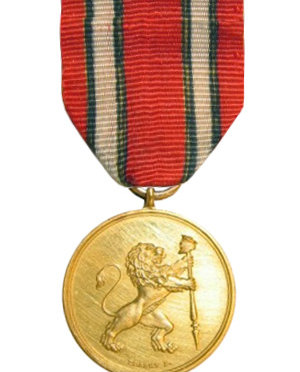
This gold medal’s engraving was designed by Braemt F, and his name is inscribed along the lower rim.

The obverse shows a standing lion holding a lance surmounted by a phrenic cap, a symbol of freedom. The reverse has a crown composed of laurel on the left and oak on the right and the words “RECOMPENSE / CIVIQUE” (Civil reward).