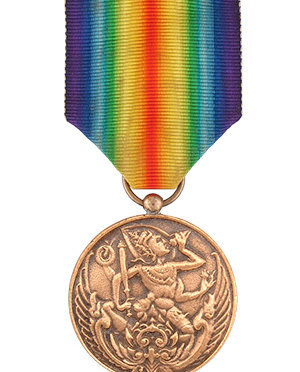
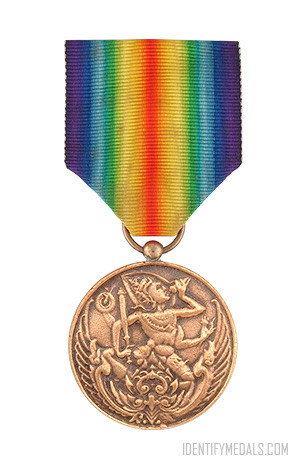
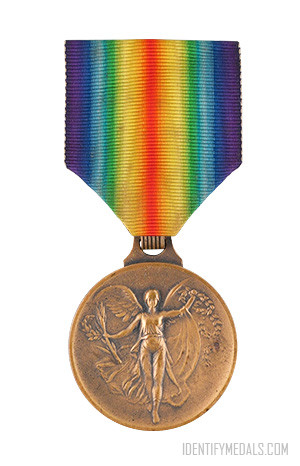
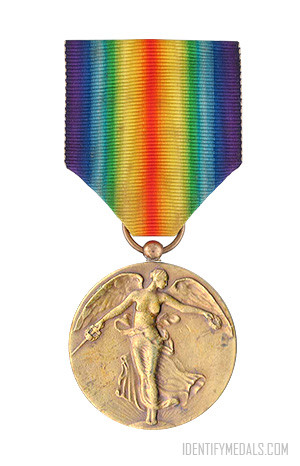
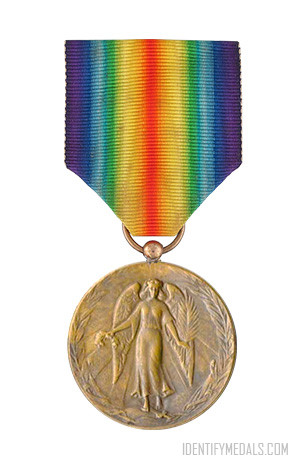
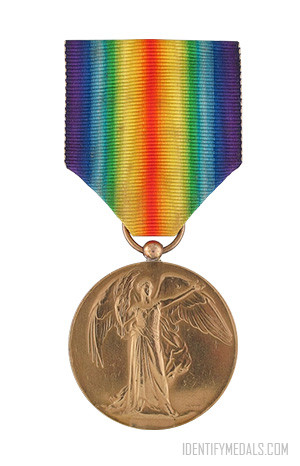
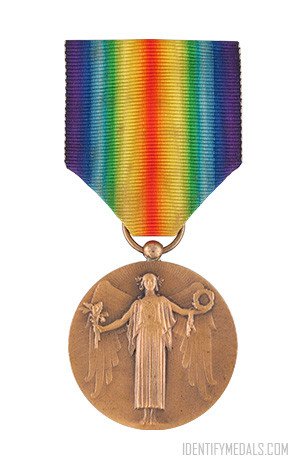
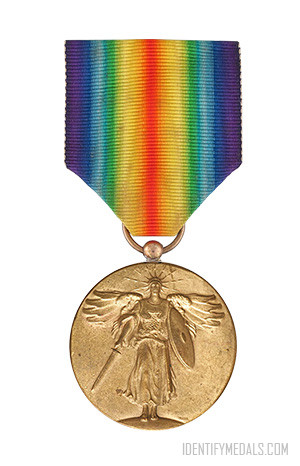
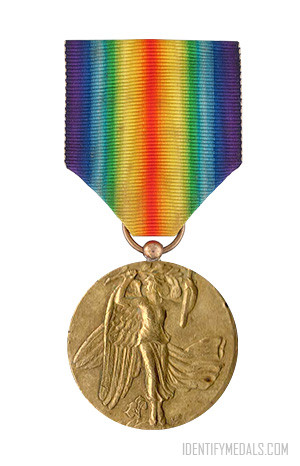
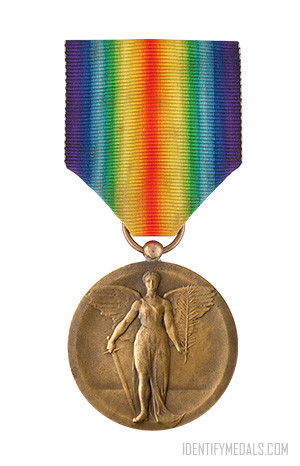
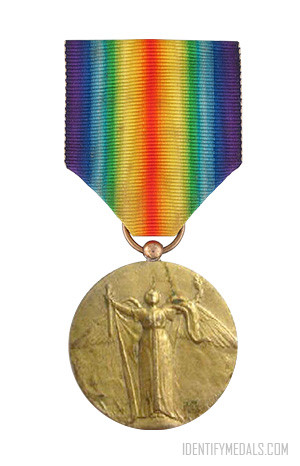
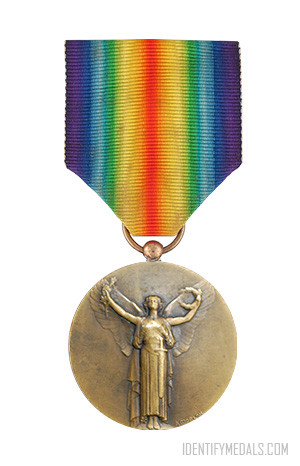
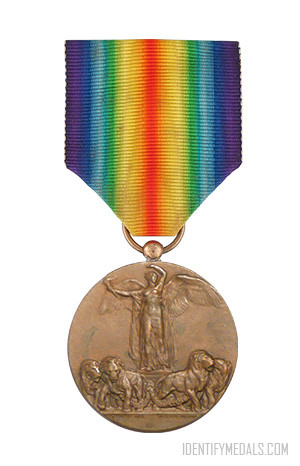
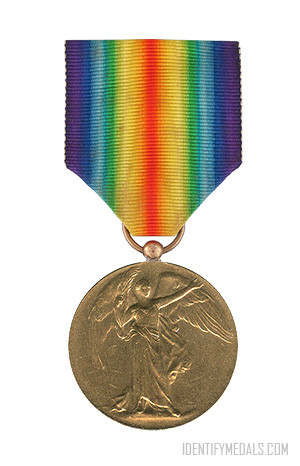

The Siam (or Thailand) Victory Medal was established in 1919, soon after the country declared war on Germany and sent a expeditionary force.
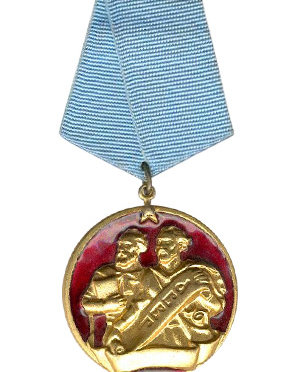
The Order Of Cyril And Methodius is a Bulgarian medal established on 13 December 1950 and awarded to Bulgarian and foreign citizens and organizations for merit in sciences, culture and information.
There are two variations of this award, originally one which is numbered and then issued later, one which is unnumbered. The medal was designed by P. Doychinov and O. Odabashja.
The award exists in three classes:
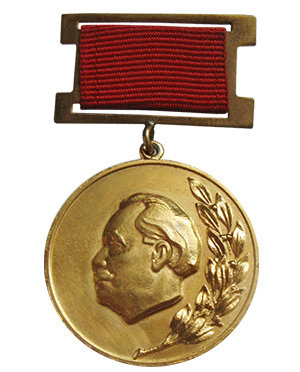
The Honored Honorary Title is a Bulgarian medal awarded to people for their achievements in science, technology, and culture. It was established on 23 May 1949 and founded by the Presidium of the Great National Assembly.
The award was named after the communist leader Georgi Dimitrov, who was the Bulgarian Prime Minister from 1946-1949. Recipients of this prize were given the label “Laureate”.
From 1960 onwards this class was the only class awarded as the 2nd and 3rd class awards ceased to be issued after 1959. The reverse inscription includes the year in which the recipient attained the Title.
There were approximately 1285 prizes awarded in total.
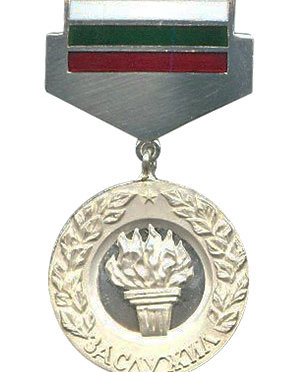
The Honored Honorary Title is a Bulgarian medal awarded to people for their exceptional merits in the field of arts, culture, science, education and health. It was established by decree No. 960 of the Presidium of the 6th Grand National Assembly on 15 June 1948.
Initially, it was awarded by the Presidium of the National Assembly, and after 1971 by the National Council of the People’s Republic of Bulgaria. Those honored with the title of “Honored” receive a diploma from the National Council of the People’s Republic of Bulgaria, the mark of the title, and a supplement to the monthly salary or pension. 4753 people are honored with the title of “Honored”.
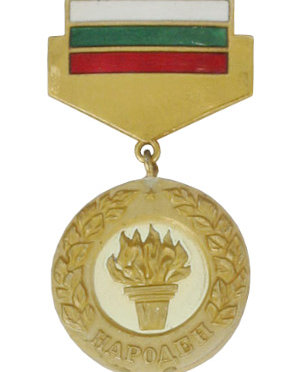
The People’s Honorary Title is a Bulgarian medal awarded to Bulgarian citizens already recognized with the Honoured title for their exceptional merits in the field of arts, culture, science, education and health. It was established by decree No. 960 of the Presidium of the 6th Grand National Assembly on June 15, 1948.
This title is the third-highest honorary title in the prize system of the People’s Republic of Bulgaria. Initially, it was awarded by the Presidium of the National Assembly, and after 1971 by the National Council of the People’s Republic of Bulgaria.
People with the title “People’s” receive a diploma from the National Council of the People’s Republic of Bulgaria and a supplement to the monthly salary or pension of 100 BGN.
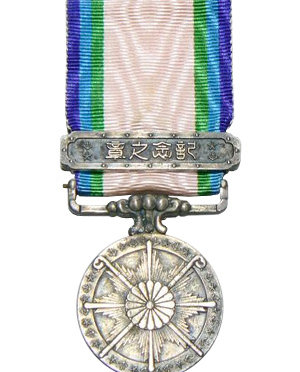
The 1941-45 Great East Asia War Medal (Daitōa sensō jūgun kishō) is a Japanese medal established on June 21, 1944 by Imperial Edict No. 417.
The 1941-45 Great East Asia War Medal (or 大東亜戦争従軍記章, Daitōa sensō jūgun kishō in Japanese) was a Japanese medal established on June 21, 1944 by Imperial Edict No. 417.
It’s not clear to whom this medal would have been awarded, but it was likely designed to become a common medal
like the China Incident War Medal. After the war ended in defeat, the circa 10,000 struck medals were destroyed by the American occupying forces.
To commemorate the 35th Anniversary of the end of the war, a new series of medals were struck by the Nihon Gouyuu Renmei, which may be translated as Federation of Japan Nationalists. The new medal bears the inscription ‘Great East Asia War, Showa 16 [1941] December 8th to Showa 20 [1945] August 15th.’
The medal was designed by the famous sculptor and designer Hinago Jitsuzou (1892-1945). It’s a a tin alloy on jointed suspension bar. The attached bar reads ‘War Medal.’
The obverse has a central Imperial Mum crest imposed on two crossed Japanese swords and, a rayed star and a ring of blossoms on the rim. The reverse a map of East Asia, inscribed with characters meaning ‘Great East Asia War Medal’.
Several post-war replicas made for veterans in the 1960s.
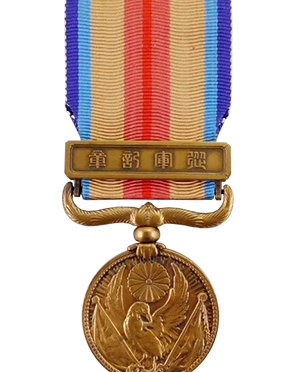
The China Incident Medal was established in 1939 and awarded for service at any time from the 12th to the 20th years of the Shōwa period.
The China Incident Medal (or 支那事変従軍記章, Sina jihen jūgun kishō) was established by Imperial Edit No. 496 on July 27, 1939 and awarded for service in China at any time from the 12th through the 20th years of the Shōwa period (1937–1945).
An amendment was promulgated by Imperial Edict No. 418 in 1944, and the decoration was abolished in 1946 by government ordinance No. 177. Although the Japanese government still uses “China Incident” in formal documents, media in Japan often paraphrase it with other expressions like Japan-China Incident (日華事変, Nikka jihen) or (日支事変, Nisshi jihen).
This medal is one of the most commonly found Japanese awards. Millions were made for those who served.
The medal is struck in bronze and has a swivel grip.
The obverse shows crossed flags, the imperial mum crest, and a crow. The reverse shows mountains, clouds, and waves, as well as the inscription ‘China Incident.’ The ribbon is 37mm wide, watered, of 3 mm blue (the
sea and the Navy), 7.5 mm tan (the soil of China, for the Army), 3.5 mm dark pink (the bloodstained soil of China), and 2 mm bright red (blood and loyalty).
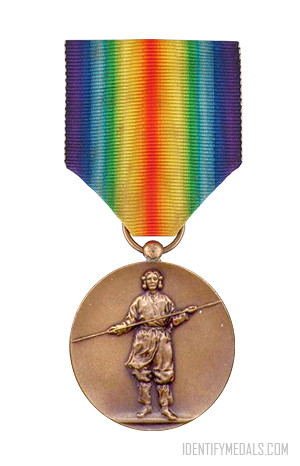
The Allied Victory Medal was recommended by an inter-allied committee in March 1919. The Japanese Medal was established by Imperial Edict.
 Japan
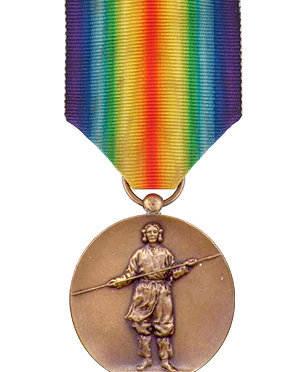
JapanThe Allied Victory Medal was recommended by an inter-allied committee in March 1919. Fourteen victorius countries finally awarded the medal after World War I, and each allied nation would design a ‘Victory Medal’ for award to their own nationals. Certain features were to be shared: a winged figure of Victory on the obverse and the same ribbon.
The Japanese Allied Victory Medal was established by Imperial Edict #406 on 17 September 1920.
The 1914-20 First World War Medal is a Japanese medal established in 1915 to commemorate Japanese participation in World War I.
The 1914-20 First World War Medal is a Japanese medal established on November 6, 1915 by Imperial Edict No. 203 to commemorate Japanese participation in World War I.
The medal was issued to naval personnel who served in the Japanese fleet in the Mediterranean during the Great War and to the military participating in the Japanese expedition to Siberia from 1918 to 1922 aimed at the Soviet Bolsheviks during the Russian Civil War that followed the October 1917 revolution.
The award is a blackened bronze circular medal with ornate swivel suspension with bar inscribed ‘ju-gun-ki-sho’ (War Medal).
The obverse bears with crossed Imperial army and navy flags, a chrysanthemum crest above, sprays of pauwlona below. The reverse shows ten characters in three columns ‘tai-sho-san-nen-nai-shi-kyu-nen-sen-eki’ (Taisho 3rd Year to 9th Year War’ – Taisho 3 to 9 = AD1914 to 1920).
The ribbon has a hook and eye fittings. The medal was issued in a fitted wooden case with pale cream felt lining, the lid embossed in gilt characters ‘tai-sho-san-nen-nai-shi-kyu-nen-sen-eki-ju-gun-ki-sho’ (Taisho 3-9 War Military Service Medal).
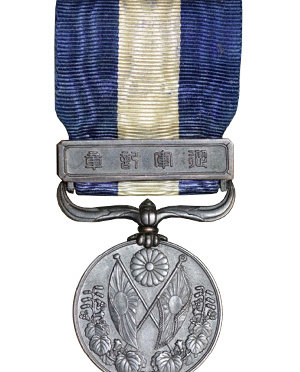
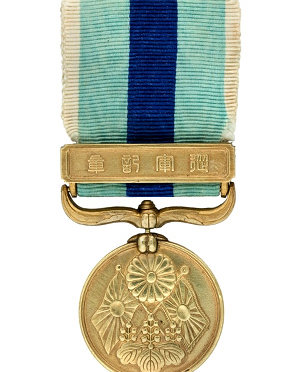
The Russo-Japanese War Medal was established in 1906 in recognition of those who served in the Russo-Japanese War during the Meiji period.
The Russo-Japanese War Medal is a unique Japanese medal, jūgun kishō. It was established on March 31, 1906 by Imperial Edict No. 51 in recognition of those who served in the Russo-Japanese War during the 37th and 38th years of the Meiji period (1904–1905).
The Russo-Japanese War was fought between the Russian Empire and the Empire of Japan over rival imperial ambitions in Manchuria and Korea. The major theatres of operations were the Liaodong Peninsula and Mukden in Southern Manchuria and the seas around Korea, Japan and the Yellow Sea.