The Military Health Service Honor Medal

The Military Health Service honour medal (or “Médaille d’honneur du service de santé des armées”) is a French decoration created 30 August 1962.

The medal recognizes individuals who have contributed or lent their support to the French Defence Health service and were particularly marked by their services or their dedication. It is presented in four different levels: gold, vermeil, silver, and bronze. It may be awarded to members of the military as well as civilians.

The four levels are awarded under the following conditions:

  • Bronze Medal for 10 years service;
  • Silver Medal for 15 years of service and the Bronze Medal
  • Vermeil Medal for 20 years of service and the Silver Medal;
  • Gold Medal which is awarded only in exceptional cases.

On the occasion of exceptional circumstances, especially during epidemic periods, nominations could be made for people that do not meet the length of service conditions.

The National Defense Medal

The National Defence Medal (or “Médaille de la Défense nationale”) is a French military decoration. It was created by Charles Hernu, Minister of Defence and established by decree on April 21, 1982.

It rewards particularly honorable service rendered by military personnel for their participation in operational activities. The medal has three levels: Gold, Silver and Bronze.

The award is made by decision of the military hierarchy, but the recipients must have achieved a personal minimum of:

  • For the Bronze level: 1 year of service and accumulated 90 points;
  • For the Silver level: 5 years of service (minimum 2 years in the Bronze level) and accumulated 600 points;
  • For the Gold level: 10 years of service (minimum 2 years in the Silver grade) and accumulated 800 points.

The yearly quota of Gold and Silver level awards are set by the minister of defence. Points are earned through participation in exercises, operations, proficiency, initiative, awards received, etc. People who had been awarded the ordre de la Légion d’honneur or the ordre du mérite can not receive the Médaille for military service.

The National Defense Medal Design

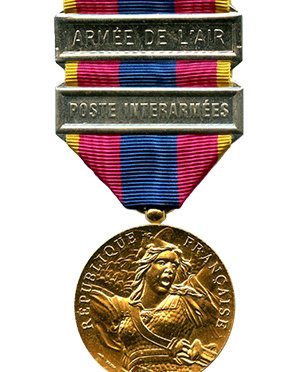
The National Defence Medal is a 36 mm in diameter circular medal struck from bronze, the gold level is gilt, the silver award is silvered.

The obverse bears the relief image of Rude’s Marseillaise with the relief inscription along the upper circumference “FRENCH REPUBLIC” (RÉPUBLIQUE FRANÇAISE). The reverse bears the relief image of a Phrygian cap over a laurel branch and the inscription along the medal circumference in the upper half “ARMY” and “NATION”, in the lower half “NATIONAL DEFENSE” (“ARMÉE” “NATION” “DÉFENSE NATIONALE”), the upper and lower inscriptions being separated by a relief five-pointed star on each side.

The medal hangs from a ring through the medal’s suspension loop. The bronze grade award’s ribbon is a 36 mm wide red silk moiré ribbon with a 12 mm wide central blue stripe. The ribbon for the silver grade award is similar with the addition of 3 mm wide white edge stripes, the edge stripes are yellow for the gold grade award.

The Medal for Voluntary Military Service

The Medal for voluntary military service (or “Médaille des services militaires volontaires”) is a French military decoration established on 13 March 1975 by decree 75-150. It was established in three grades to recognize voluntary military service in the reserves.

During World War I, the reserves served as an important part of the defense of France. Between the abolition of the Order of military merit in 1963 and the creation of the Medal for voluntary military service in 1975, no award existed to adequately recognize reservists.

The Medal for voluntary military service is awarded to military personnel not in the full-time regular army serving honorably part-time in information, training and improvement of reserves, recruiting, military preparedness as well as activities within special associations. It may be exceptionally awarded to military personnel of either the reserves or regular army who distinguished themselves by the exceptionally high quality of their service. For award to a member of the regular army, this service must have been carried out outside of normal working hours and for no pay. The medal may be awarded posthumously.

The Medal for Voluntary Military Service Design

The Medal for voluntary military service is a 32mm in diameter circular medal struck from bronze, it is silvered for the silver grade or gilt for the gold grade.

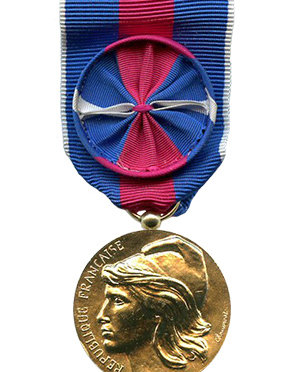
Its obverse bears the left profile of the effigy of the Republic wearing a Phrygian cap with the relief semi circular inscription “RÉPUBLIQUE FRANÇAISE” (“French Republic”) along the left circumference.

The reverse bears the relief image of a vertical sword superimposed over two crossed naval anchors themselves superimposed over air force wings, at the bottom along the medal circumference, the relief inscription “SERVICES MILITAIRES VOLONTAIRES” (“Voluntary Military Services”).

The medal hangs from a ribbon passing through a suspension ring itself passing through a ball shaped suspension loop at the top of the medal. The 37mm wide silk moiré ribbon differs according to the grade of the award. The ribbon of the bronze grade award is blue with an 11 mm central red stripe; the silver grade ribbon only differs from the bronze grade in the addition of white 2mm edge stripes; a rosette in the colors of the silver grade ribbon is added for the gold grade award.

The Overseas Medal

The Overseas Medal (or Médaille d’Outre-Mer) is a commemorative or campaign medal issued to members of the French Armed Forces for participating in operations outside national territory. It replaced the French Colonial Medal by decree on 6 June 1962.

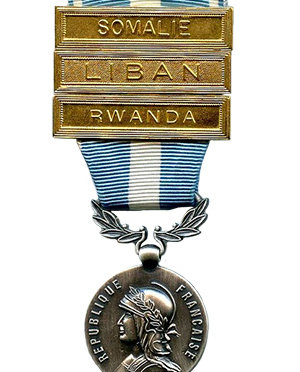
The areas of service are indicated by a gilt silver campaign clasp, there are currently 13 available:

  • Cambodge (Cambodia)
  • Liban (Lebanon)
  • Tchad (Chad), awarded to all French personnel, military or otherwise, who served in Chad regardless of the length of service from March 15, 1960 to January 27, 2008 . As of January 28, 2008, the campaign clasp is awarded for fifteen days of consecutive service or a cumulative equivalent of non-consecutive days.
  • Mauritanie (Mauritania), awarded to all French personnel, military or otherwise, who served in Mauritania from November 1977 to July 1990, regardless of length of service.
  • Moyen-Orient (Middle East)
  • Ormuz (Hormuz)
  • République centrafricaine (Central African Republic)
  • République de Côte d’Ivoire (Republic of Côte d’Ivoire)
  • République démocratique du Congo (Democratic Republic of Congo)
  • République du Congo (Congo)
  • Rwanda (Rwanda)
  • Somalie (Somalia)
  • Zaïre (Zaire)
  • Sahel (Mali)

The Overseas Medal Design

The medal’s design is the work of engraver Georges Lemaire, and it’s made in silver. The obverse shows a helmeted allegorical effigy of a woman as the personification of the French Republic, circled by the words “République française“. The reverse shows a terrestrial globe on top of trophies of military conquest with the words “MEDAILLE D’OUTRE-MER“.

The ribbon is sky blue and has three vertical white bands, the two side ones of 2mm and the central one of 7mm. The link is a silver laurel branches and the bars are gilt, showing the territory where the campaign occurred.

The Resistance Medal

The Resistance medal (Médaille de la Résistance) was a decoration bestowed by the French Committee of National Liberation during World War II.

The Resistance medal (or Médaille de la Résistance) was a decoration bestowed by the French Committee of National Liberation, based in the United Kingdom, during World War II.

It was established by a decree of General Charles de Gaulle on 9 February 1943 “to recognize the remarkable acts of faith and of courage that, in France, in the empire and abroad, have contributed to the resistance of the French people against the enemy and against its accomplices since 18 June 1940“.

The Resistance medal was awarded to approximately 38,288 living persons and 24,463 posthumously. These awards were both for membership in the Free French forces and for participation in the metropolitan clandestine Resistance during the German occupation of France in World War IIThe medal was also awarded to 18 communities and territories, 21 military units, and to 15 other organizations including convents, high schools, and hospitals that particularly distinguished themselves.

The Resistance Medal Design

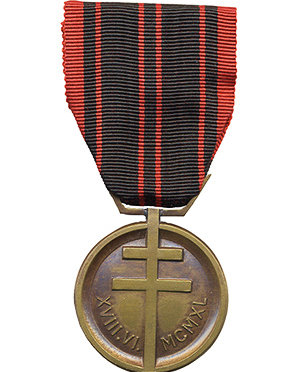
The Resistance medal is a 37mm in diameter circular medal struck from bronze. Its slightly concave obverse bears at center a vertical Cross of Lorraine with the relief semi circular inscription of the date of General de Gaulle’s appeal of 18 June 1940 in Roman numerals “XVIII.VI.MCMXL” (18.06.1940) bisected by the lower part of the cross.

The reverse bears the relief image of an unfurling ribbon bearing the relief inscription in Latin”PATRIA NON IMMEMOR” translating into “THE NATION DOES NOT FORGET”. The suspension is cast as an integral part of the medal.

The medal hangs from a 36mm wide black silk moiré ribbon with six vertical red stripes of varying widths, 3mm wide edge stripes, two 1mm wide central stripes 2mm apart, and two 1mm wide stripes 6mm from the central stripes. A 28mm in diameter rosette is on the ribbon of the Officer of the Resistance medal.

The Medal of the Gendarmerie Nationale

The Medal of the National Gendarmerie or Federal Police (Médaille de la Gendarmerie nationale) is a military decoration created in 1949.

The Medal of the National Gendarmerie or Federal Police (or Médaille de la Gendarmerie nationale) is a French military decoration created on 5 September 1949 on the proposition of the then Minister of Defence, mister Paul Ramadier.

It was originally created in a single grade for award to officers and NCOs of the Gendarmerie nationale who were cited in the orders of the entire service. Such a citation in the orders of the entire service, and all potential subsequent ones would be denoted by a grenade device on the ribbon as the medal could, and can still only be awarded once to any potential recipient.

The medal could also be exceptionally awarded to persons not members of the service for important services rendered to the gendarmerie or for help during special missions. These presentations were made without a citation and thus without any ribbon device.

The ribbon of the medal will be adorned by a device denoting the degree of the award as described in its accompanying citation:

  • Bronze palm when cited to the entire service;
  • Gilt star when cited to its relevant army corps;
  • Silver star when cited to its relevant division;
  • Bronze star when cited to its relevant brigade or division.

The medal may be awarded posthumously.

The Medal of the Gendarmerie Nationale Design

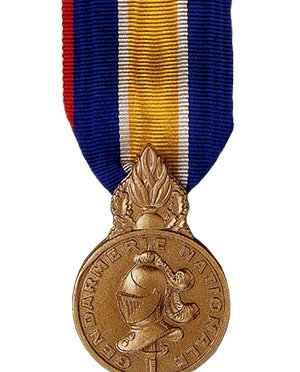
The Médaille de la Gendarmerie nationale is a 36 mm in diameter circular gilt bronze medal. At its top, also in gilt bronze and hiding the ribbon suspension loop, is affixed a grenade with flames between laurel leaves.

The obverse bears the relief image of a plumed close helmet resting on a sword pointing upward, it bears the circular inscription along its circumference “GENDARMERIE NATIONALE”. The reverse bears a laurel wreath with the relief inscription “COURAGE DISCIPLINE” on two lines at the top, the center being reserved for the inscription of the recipient’s name.

The Médaille de la Gendarmerie nationale is suspended by a 37 mm wide silk moiré ribbon divided by vertical stripes in the following colors:

  • 10 mm wide yellow central stripe representing the color of the old “Maréchaussée”, the military service charged with police and jurisdictional duties under the old regime;
  • 2 mm wide white stripes bordering the central stripe, they represent the two subdivisions of the service, the police service and the Republican Guard;
  • these central stripes are themselves bordered by 9,5 mm wide blue vertical stripes representing the color of the police service;
  • 2 mm wide bright red edge stripes represent the Republican Guard.

The Medal of the French Family

The Medal of the French Family (or Médaille de la Famille française) is a decoration awarded by the government of France to honor those who have successfully raised several children with dignity.

The decoration was created by a decree of May 26, 1920, under the name Médaille d’honneur de la famille française (Medal of Honour of the French Family) with the aim of honoring mothers of large families.

The text of the decree underwent several changes before being completely reformed by a decree of October 28, 1982, which renamed the decoration Médaille de la Famille française (Medal of the French Family). The reform opened the award of the decoration to fathers or anyone else who had raised several children in an appropriate way: for example, the Catholic priest Père Mayotte was granted the award in recognition of his raising the six children of his housekeeper, a widow who died suddenly.

Recommendations or applications for the award must be deposited at the local town hall. An inquiry into the family is then conducted. If the inquiry reports positively, the final decision on whether to grant the award belongs to the prefect of the department.

The Medal of the French Family Design

Three classes of this medal exist: bronze for those raising four or five children, silver for parents of six or seven children, and gold for those with eight or more children.

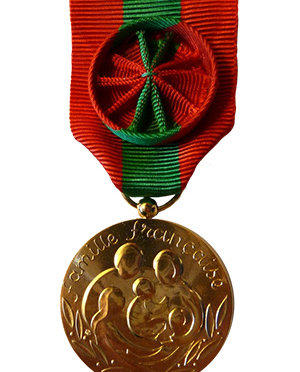
A bronze medal is also granted to widowed mothers of three children whose husbands have been killed in action. The recipient’s eldest child must be at least sixteen years old. The medal is decorated with the words “Famille Française” (“French Family”) and a modernistic image of a couple and their children. The words “République Française” (“French Republic”) are inscribed on the reverse side.

The ribbon is divided vertically into three equal parts, the outer two being red and the inner green. Recipients of silver and gold medals are also granted a rosette in the same colours.

The Escapees’ Medal

The Escapees’ Medal is a military award bestowed to prisoners of war and who successfully escaped internment or died in their attempt.

The Escapees’ Medal (or Médaille des Évadés) is a military award bestowed by the government of France to individuals who were prisoners of war and who successfully escaped internment or died as a result of their escape attempt.

The “Escapees’ Medal” was established by a 1926 law, intended to honor combatants not only of the First World War, but also of the Franco-Prussian War of 1870. Its statute was later amended to include combatants of the Second World War and later conflicts.

The award criteria for the Franco-Prussian War was established by law on 2 October 1926 and read as follows:

  • To French soldiers serving during the Franco-Prussian War, who successfully escaped their internment in Germany.

The award criteria for the First World War were established by decree on 7 April 1927 and read as follows:

  • To French soldiers serving during the First World War, who were taken prisoner during combat either in Europe or in an external theatre of operations, and who successfully escaped, regardless of the length of their internment;
  • To citizens of Alsace-Lorraine, who, between 2 August 1914 and 1 November 1918, deserted from the German army.
  • To civilians interned in Germany, or living in territories occupied by the enemy, who crossed enemy lines with the intent of making themselves available to the French military authority.

The award criteria for the Second World War were long in coming. A decree of 7 February 1959 allowed for award of the medal, followed by an Order on 20 May 1959 and detailed instructions on 10 July 1959. The medal was bestowed to persons able to prove a successful escape:

  • From a prisoner of war camp;
  • From a place of internment where they were being held for acts related to the resistance;
  • From enemy-held or controlled territory, an escape including the clandestine crossing of a front line or customs checkpoint.

The medal can be awarded to both French citizens and foreign nationals serving in the ranks of the French armed forces. Civilians and members of the military killed, or who have died as a result of wounds received during an escape attempt, are automatically awarded the medal.

The Escapee’s Medal Design

The Escapees’ Medal is a 30 mm in diameter circular medal struck from bronze. Its design is from the French engraver A. Dubois.

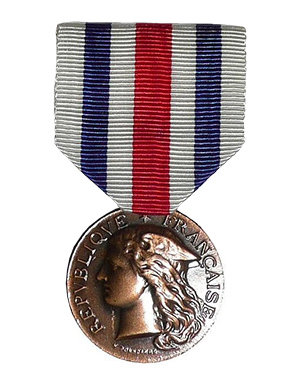
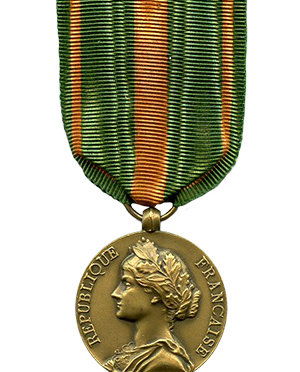
Its obverse bears the relief left profile bust of Marianne (representing the French Republic) crowned with branches of oak, along the outer circumference, the relief inscription (REPUBLIQUE FRANCAISE) “FRENCH REPUBLIC”.

On its reverse, at center, the relief inscription on three rows (MÉDAILLE DES ÉVADÉS) (ESCAPEES’ MEDAL) surrounded by a wreath of oak branches.

The medal is suspended by a ring through the suspension loop to a 36 mm wide green silk moiré ribbon with a 7 mm wide central orange stripe and 2 mm wide longitudinal orange stripes located 2 mm from the ribbon’s outer edges.

The Honour Medal for Firefighters

  • Time Period: Pre-WW1
  • Institution: 16 February 1900
  • Country: France

The Honour medal for firefighters (or “Médaille d’honneur des Sapeurs Pompiers”) is a state decoration of France bestowed by the Ministry of the Interior to members of the French Fire Service.

Although possessing a two-century-old firefighting tradition, the French government proved slow in recognizing the service and courage of the men and women who face risk on a daily basis to save lives and property. Not until 1875 was a service certificate established and bestowed for thirty years of service.

The decree of 4 March 1981 saw a new design and ribbon for the Honour medal for firefighters awarded for exceptional service.

The Honour medal for firefighters is bestowed to firefighters:

  • who have always displayed devotion to duty (long service); or,
  • who have particularly distinguished themselves (exceptional service).

The Honour Medal for Firefighters Design

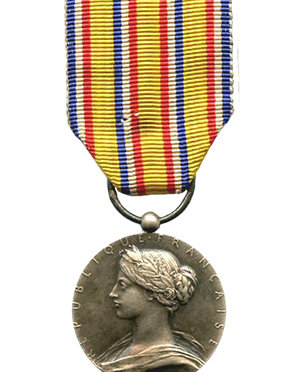
The Honour medal for firefighters bestowed “for long service” is a 30mm in diameter (27mm before 1935) circular medal.

Its obverse bears the effigy of the republic in the form of the relief image of the left profile of a woman wearing a firefighter’s helmet, also visible is her uniform collar bearing the distinctive grenade insignia of the firefighting corps in France. On either side, the relief inscription along the circumference “RÉPUBLIQUE FRANÇAISE” (“FRENCH REPUBLIC”).

The medal is struck in silver, silver-gilt and gold. The silver grade award’s ribbon suspension bar is adorned with opposing fire hose nozzles. Each grade above silver is denoted by an increasingly intricate ornamentation on the ribbon suspension bar. 

The reverse of the medal bears at its center, the relief image of a fireman’s helmet partially covering a building on fire above the inscription “HONNEUR AU DEVOUEMENT” (“HONOUR TO DEVOTION”) itself above a blank area reserved for the recipient’s name and year of award. The relief image of flames at the very bottom and on either side of the fire hall. At the top along the medal circumference, the relief semi circular inscription “MINISTÈRE DE L’INTÉRIEUR” (“INTERIOR MINISTRY”).

The current, post-1981 Honour medal for firefighters bestowed “for exceptional services” is a 32mm in diameter circular medal. Its obverse bears the relief image of the left profile of a helmeted male firefighter, above his head, the relief semi circular inscription “MINISTÈRE DE L’INTÉRIEUR” “INTERIOR MINISTRY”) along the medal’s upper circumference. The ribbon suspension bar is adorned with two crossed firemen’s axes resting atop two laurel branches from which flames shoot upwards to just above opposing horizontal fire hose nozzles. The medal is struck in silver or silver-gilt variants. The reverse bears a Phrygian cap with between two axes below the initials “R.F.”.

The medal hangs from a 37mm wide silk moiré ribbon of red on the right edge watering into yellow across its width. The ribbon bears a rosette of the same colours to indicate that it is an award “for exceptional services”.

The Honour Medal of the National Police

The Honour medal of the National Police (or Médaille d’honneur de la Police nationale) is the highest award of the French National Police, which falls under the jurisdiction of the Ministry of the Interior.

Created by the Decree of 3 April 1903 at the request of Monsieur Émile Combes, Minister of the Interior, the medal was originally called the “Médaille d’honneur de la Police Municipale et Rurale” (“Honour medal of the rural and municipal police). The decree of 17 November 1936 will rename it the “Médaille d’honneur de la Police française” (“French Police honour medal). Finally, Decree No. 96-342 of 22 April 1996 will give the medal its current designation.

The award was extended in 1972, to administrative staff and senior officers of the National Police. The medal is awarded under the following conditions:

  • to police officers, for 20 years of service;
  • to members of the administrative staff, for 25 years of combined civil and military service.

The award may be bestowed posthumously regardless of time of service. It may also be awarded in exceptional cases for acts of courage or exceptional service to the police force by national or foreign police officers regardless of time of service. Under these circumstances, the medal ribbon is adorned with a five-pointed silver star.

The Honour Medal of the National Police Design

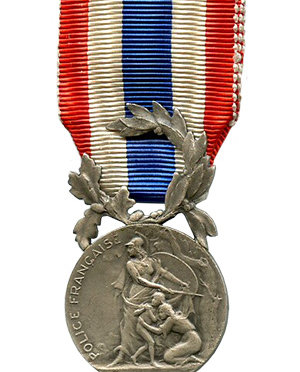
The Honour medal of the National Police, a design of engraver Marie Alexander Coudray, is a 27mm in diameter circular silver medal.

The obverse bears the relief image of the protecting Republic, in the form of a standing helmeted woman holding a sword and a shield, protecting a kneeling woman pulling a frightened child to her, behind them a tree. Along the right circumference, the semi circular relief inscription “POLICE FRANÇAISE” (“FRENCH POLICE”).

The reverse bears at its bottom a framed rectangular area destined to receive the name of the recipient and year of the award. Along the upper medal circumference, the relief inscription “RÉPUBLIQUE FRANÇAISE” (“FRENCH REPUBLIC”), at its center, the inscription “MINISTÈRE DE L’INTÉRIEUR” (“INTERIOR MINISTRY”).

The medal hangs from a 3cm wide silk moiré tricolor ribbon with an 8mm wide central blue stripe bordered by 6mm wide white stripes and 5mm red stripes at its edges. The ribbon’s suspension loop is adorned with a crown composed of an olive branch and a sprig of oak with an opening on the right.

The Honour medal of the rural and municipal police in Algeria included a clasp on the ribbon consisting of a star placed on a crescent of Islam. Today, the only ribbon device is in the form of a silver five pointed star when the medal is awarded in exceptional circumstances.