The Honour Medal of Foreign Affairs

  • Time Period: Pre-WW1
  • Institution: Type 1 award 28 July 1816 – Type 2 award 30 August 2010
  • Country: France

The Honour medal of Foreign Affairs (or Médaille d’honneur des affaires étrangères or President’s Medal) is a state decoration bestowed by the French Republic in the form of an honour medal for work.

It was originally created by a Royal decree of 28 July 1816 as a single grade medal to reward acts of courage displayed by French nationals on foreign soil. Although still bestowed in wartime for courage, the modern award is now aimed at rewarding civil servants of the ministry for Foreign Affairs.

The Honour medal of Foreign Affairs is currently divided into three grades, bronze, silver and gold. The Honour medal of Foreign Affairs may be exceptionally awarded regardless of seniority and set quotas to reward bravery and dedication.

The wartime award with swords is bestowed as follows:

  • In bronze to privates;
  • In silver to non-commissioned officers;
  • In gold (silver-gilt prior to 2010) to officers.

The Honour Medal of Foreign Affairs Design

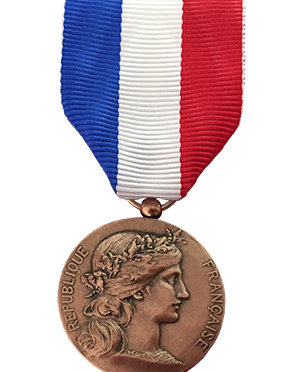
The Honour medal of Foreign Affairs, a design of engraver Daniel Dupuis, is a 27mm in diameter circular medal in bronze, silver or gold.

The obverse bears the relief effigy of the republic surrounded by the relief inscription “RÉPUBLIQUE FRANÇAISE” (“FRENCH REPUBLIC”) along the left and right circumference. The reverse bears a crown of half laurel and half oak leaves with the relief inscription “AFFAIRES ÉTRANGÈRES” (“FOREIGN AFFAIRS”) with a bare center destined to receive the recipient’s name and year of award.

The medal hangs from a silk moiré tricolour ribbon composed of three equal blue-white-red vertical stripes. The wartime award includes a wreath of oak leaves with two crossed swords on the suspension ring.

The Honour Medal for Courage and Devotion

The Honour medal for courage and devotion (or “Médaille d’honneur pour acte de courage et de dévouement”) is a French decoration that can be bestowed to individuals and whole units. It is awarded for acts of courage during a rescue.

The Honour medal for courage and devotion was created on 2 March 1820 by King Louis XVIII. It has gone through several designs during its long history. The award was given its present name by a decree of 16 November 1901.

Any person who risks his or her life to come to the rescue of one or many persons in danger, may be recognized with the medal. When the act of rescue does not warrant an award of the medal, a letter of congratulations for a successful rescue or an honorable mention for a recognized meritorious act in the form of an official certificate type scroll may be granted.

The Honour medal for courage and devotion is divided into five grades:

  • Bronze (Bronze)
  • Silver 2nd class (Argent de 2ème classe)
  • Silver 1st class (Argent de 1ère classe)
  • Silver-gilt (Vermeil)
  • Gold (Or)

The Honour Medal for Courage and Devotion Design

The design of the Honour medal for courage and devotion changed many times through the decades. It is now a 27mm in diameter circular medal struck in bronze, silver, silver-gilt or gold.

Its obverse bears the relief image of a standing woman holding palms and crowns surrounded by scenes of rescues under the relief inscription “DÉVOUEMENT” (“DEVOTION”). The reverse bears along its upper circumference, the relief inscription “RÉPUBLIQUE FRANÇAISE” (“FRENCH REPUBLIC”), at its center, the inscription “MINISTÈRE DE L’INTÉRIEUR” (“INTERIOR MINISTRY”) over a framed rectangular area destined to receive the name of the recipient and year of the award.

The medal hangs from a 3cm wide silk moiré tricolour ribbon of equal width blue, white and red vertical stripes. The 3cm wide and 22mm high ribbon suspension loop is cast as an integral part of the medal in the form of oak leaves. The leaves of the suspension loop change colour depending on the grade of the award, bronze for the bronze grade, silver for the silver grade second class, silver-gilt for the silver grade first class and silver-gilt grade, and gold for the gold grade.

Different devices may be worn on the service ribbon to denote the grade of the award when only the ribbons are worn. A plain ribbon is worn for the bronze grade, the silver grade second class is denoted by the addition of a silver five pointed star, a silver and a silver-gilt star for the silver grade first class, a silver-gilt star for the silver-gilt grade and a rosette for the gold grade.

The Military Medal (France)

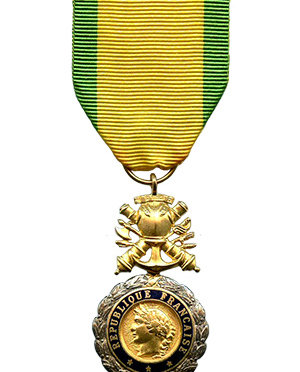
The Military Medal (Medaille Militaire) is a military decoration of the French Republic for meritorious service and acts of bravery.

The Military Medal (or Medaille Militaire) is a military decoration of the French Republic for other ranks for meritorious service and acts of bravery in action against an enemy force.

It is the third-highest award of the French Republic, after the Légion d’honneur, a civil and military order, and the ordre de la Libération, a second world war-only order. The Médaille militaire is therefore the most senior entirely military active French decoration.

The award was first established in 1852 by the first President of the French Republic, Louis-Napoléon Bonaparte who may have taken his inspiration from a medal established and awarded by his father, Louis Bonaparte, King of Holland.

During World War One, 230 000 médailles were awarded, when 1 400 000 French Army soldiers were killed and 3 000 000 wounded. After the First World War, the Military Medal was also temporarily awarded for wounds received in combat.

The Military Medal Award Criteria

Like many other French awards, the médaille can be awarded for different reasons. It can be awarded to foreign nationals serving with or alongside the French armed forces.

  • To members of the military other than commissioned officers;
    • As an award for valour, it is the second highest award ranking immediately after the Légion d’honneur.
    • As an in between medal for enlisted members, NCO and O(D) awarded the Légion d’honneur for “combat actions”, nowadays mostly done posthumously.
    • As a service medal, for long-serving NCOs.
  • To generals and admirals who have been commanders-in-chief, as a supreme award for leadership. These general officers must already have been awarded the grand cross of the Légion d’honneur.

The Military Medal Design

The Médaille militaire is a silver laurel wreath, 28 mm (1.1 in) in diameter, wrapped around a central gold medallion bearing the left profile of Marianne, effigy of the French Republic, the original 2nd Empire variant bore the left profile of Emperor Napoleon III.

The central gold medallion is surrounded by a blue enamelled ring bearing the gilt inscription “RÉPUBLIQUE FRANÇAISE” (FRENCH REPUBLIC) with a small gilt five-pointed star at the bottom for a 4th Republic award, three stars for a 5th Republic variant, the 3rd Republic variant bore the date 1870, the 2nd Empire variant bore the gilt inscription “LOUIS-NAPOLEON” in lieu of “RÉPUBLIQUE FRANÇAISE” and had flowers on both sides of the small star at the bottom.

The original variant was topped by a silver imperial eagle with a loop through which the suspension ring passed, all other variants were and are topped by a device composed of a breastplate superimposed over crossed cannons, a naval anchor, sabres, swords and battle axes, to which the suspension ring passes through a loop for attachment to a ribbon.

The reverse of the medallion is common to all variants since inception of the award, it bears the relief inscription on three lines “VALEUR ET DISPLINE” (“VALOUR AND DISCIPLINE”) and is surrounded by a blue enamelled ring.

The ribbon of the Médaille militaire is 37 mm (1.5 in) wide, yellow in color with 6 mm-wide (0.24 in) green stripes on each edge.

The Medal for the Military Protection of the Territory

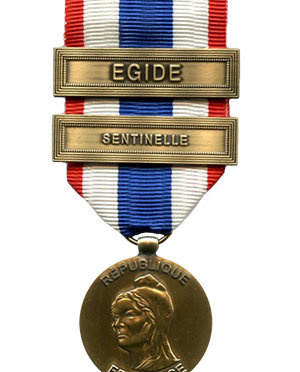
The Medal for the Military Protection of the Territory (or “Médaille de la protection militaire du territoire” in French) is a French state decoration established on 13 July 2015 by presidential decree 2015-853 and awarded to military personnel of the French Armed Forces for service during national security operations on French national territory.

It was created to recognize service following the need for an increased military presence during national security operations following the rise of international terrorism and the many incidents in France over the past years.

The Minister of Defense is responsible for the administration of the medal and will determine by decree:

  • the operations giving the right to the award of the medal and its related clasp;
  • the dates during the same operations that give the right to the award of the medal and its related clasp;
  • the minimum number of days served during the same operations giving the right to the award of the medal and its related clasp.

In exceptional circumstances, the Minister of Defense may award the medal and its related clasp to soldiers killed or wounded during one of these operations.

The Medal for Military Protection of the Territory Design

The Medal for the Military Protection of the Territory is a 30 mm in diameter circular medal struck from bronze.

Its obverse bears the effigy of the Republic with the relief inscription above “RÉPUBLIQUE” and below “FRANÇAISE” (“FRENCH REPUBLIC”). The reverse bears the relief inscription on five lines “MÉDAILLE” “DE LA” “PROTECTION MILITAIRE” “DU” “TERRITOIRE” (“MEDAL” “FOR THE” “MILITARY PROTECTION” “OF THE” “TERRITORY”).

The medal hangs from a 38 mm wide silk moiré ribbon passing through a ring through the medal’s ball-shaped suspension loop. The ribbon bears the national colors of France in the following pattern: 14 mm wide blue vertical central stripe bordered by white 8 mm wide stripes with 5 mm wide red edge stripes.

The medal is always awarded with a clasp and multiple clasps may be worn simultaneously. Five clasps are currently approved for wear on the ribbon of the Medal for the Military Protection of the Territory:

  • SENTINELLE for participation in Opération Sentinelle;
  • HARPIE for effective participation in the “Harpie” mission;
  • TRIDENT for effective participation in military surveillance and protection missions of French airspace, waters and land areas between 1 July 2013 to a date not yet specified. 
  • JUPITER for effective participation in military surveillance and protection missions by strategic forces between 1 July 2013 to a date not yet specified. 
  • ÉGIDE for effective participation in the military protection of military assets, public and state buildings, of international organizations and diplomatic and consular missions between 1 July 2013 to a date not yet specified. 

The French Commemorative Medal

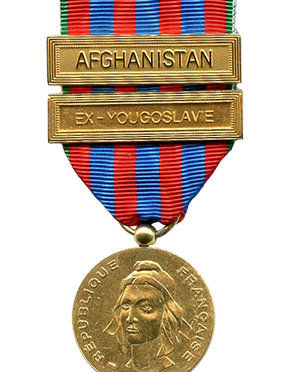
The French commemorative medal (or “Médaille commémorative française” in French) is a French decoration intended to recognize civilians and soldiers who took part in specific missions ordered by the French government carried out outside of French national territory after March 1, 1991.

It was established by decree 95-1098 on 9 October 1995 on the initiative of the then Defence Minister, François Léotard. The Minister of Defense decides by individual decree each theatre of operations in which the medal may be earned, the start and end dates for award eligibility, and the minimal time in theatre required to earn the award.

The medal may be awarded to foreign military and civilians having served under French command, subject to approval by their own governments. 

The medal is always worn with at least one clasp. Each operational mission clasp can only be earned once.

The French Commemorative Medal Design

The French commemorative medal is a 30mm in diameter circular gilded medal struck from bronze.

The obverse bears the effigy of the republic three quarters facing and wearing a Phrygian cap surrounded by the relief inscription along the medal circumference “RÉPUBLIQUE FRANÇAISE” (“FRENCH REPUBLIC”). The reverse is arranged akin a stylized globe, at the center, the relief image of a vertical sword pointing up within an olive wreath, the inscription “MÉDAILLE COMMÉMORATIVE FRANÇAISE” (“FRENCH COMMEMORATIVE MEDAL”) superimposed over it in relief.

The medal hangs from a ribbon through a ring passing through the medal’s ball shaped suspension loop. The 38mm wide silk moiré ribbon is divided into four red and three blue alternating 5mm wide stripes and is edged with 1,5mm green stripes.

To date, ten operational mission clasps have been approved for wear on the ribbon:

  • EX-YOUGOSLAVIE 1991
  • HAÏTI 1993, 2004, 2010
  • ALBANIE 1997 – 2001
  • TIMOR-ORIENTAL 1999 – 2000
  • AFGHANISTAN 2001
  • ASIE DU SUD-EST 2004
  • GÉORGIE 2008
  • LIBYE 2011
  • JORDANIE 2012
  • GUINÉE 2015

The Medal of the Nation’s Gratitude

The Medal of the Nation’s Gratitude (or “Medaille de Reconnaissance de la Nation” in French) is a French state decoration established on 12 April 2002 by decree 2002-511 and awarded to civilians, veterans of civil or military service, and to members of the French armed forces previously awarded the “Title of the Nation’s Gratitude”, a governmental scroll certifying to honorable service abroad.

The medal was primarily established to replace the North Africa medal with broader and more inclusive prerequisites following years of pressure on the French government by veterans’ organizations.

The Medal of the Nation’s Gratitude is awarded to persons who have previously been awarded the Title of the Nation’s Gratitude, its particular award criteria were fixed by law No. 93-7 of 4 January 1993. Potential recipients must meet the following conditions:

  • People who, as members of the military, and for at least 90 days, consecutive or not, served in a formation of the French army or who were detached to a foreign army during the time periods and in the theatres of operation determined by the law;
  • Civilians of French nationality who were involved in these conflicts, operations or missions and meeting the prerequisites set by the Minister of Defence.

The Medal of the Nation’s Gratitude Design

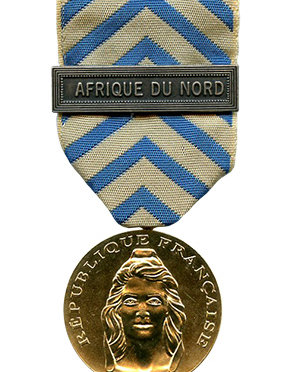
The Medal of the Nation’s Gratitude is a 34mm in diameter circular medal struck from bronze and gilded.

Its obverse bears the effigy of the Republic on surrounded by the relief inscription “RÉPUBLIQUE FRANÇAISE” (“FRENCH REPUBLIC”). The reverse bears the relief inscription on four lines “MÉDAILLE” “DE” “RECONNAISSANCE” “DE LA NATION” (“MEDAL” “OF” “GRATITUDE” “OF THE NATION”) over the relief image of a sprig of three oak leaves.

The medal hangs from a ribbon passing through a ring through the medal’s ball shaped suspension loop. The 34mm wide sand coloured silk moiré ribbon bears inverted 34mm wide and 3mm thick blue chevrons. The undress ribbon bears three such chevrons.

The medal is always awarded with a clasp and may be awarded with multiple clasps. Five clasps are currently approved for wear on the ribbon of the Medal of the Nation’s Gratitude:

  • 1914–1918
  • 1939–1945
  • INDOCHINE
  • AFRIQUE DU NORD (NORTH AFRICA)
  • OPERATIONS EXTERIEURES (FOREIGN OPERATIONS)

The United Nations Interim Force in Lebanon Medal

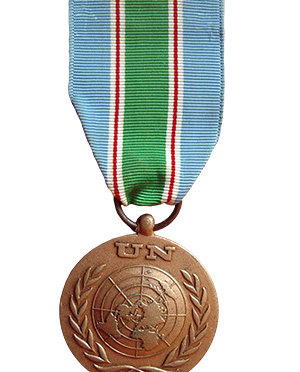
A United Nations Medal is an international decoration awarded by the United Nations (UN) to the various world countries’ militaries for participation in joint international military and police operations such as peacekeeping, humanitarian efforts, and disaster relief.

Since 1955, many additional United Nations medals have been created and awarded for participation in various United Nations missions and actions around the world.

The most common United Nations medal is the standard UN decoration known simply as the United Nations Medal. Most countries bestow this award for any action in which a member of the military participated in a joint UN activity.

The United Nations Interim Force in Lebanon Medal Design

In situations where a service member participated in multiple UN operations, service stars, campaign clasps, or award numbers are authorized as attachments to the United Nations Medal. These devices vary depending on the regulations of the various armed forces.

Most operations utilize a different ribbon for each mission, though there have been some notable exceptions. In some countries where the UN Security Council determines a mission in the same geographic region, but changes the mission mandate by way of Security Council Resolution, there may be a number of missions which have identical campaign ribbons and then later will change the ribbon to reflect the changing environment.

The North Africa Medal

The North Africa medal (Médaille d’Afrique du Nord) was established in 1997 for those who had fought in North Africa between 1952 and 1962.

The North Africa medal (or Médaille d’Afrique du Nord in French) was a French commemorative medal established on 29 April 1997 by French President Jacques Chirac via decree 97-424, following an initiative of Pierre Pasquini, Minister for veterans’ affairs and victims of war who expressed “the importance that an exceptional decoration be established for those who had fought in North Africa“.

Unfortunately, not all veterans awarded the “Title of the Nation’s Gratitude” met the new medal’s award prerequisites and almost immediately, new pressures were placed on the government for new medals or for a single one encompassing all bearers of the Title. It took five years for the new award to be established on 12 April 2002 by decree 2002-511. 

The North Africa medal ceased to be awarded that very day following barely five years of existence. It was replaced by the Medal of the Nation’s Gratitude with the clasp “AFRIQUE DU NORD” (“NORTH AFRICA”).

The North Africa medal was bestowed to French civilians and military personnel, as well as to foreign nationals serving in the ranks of the French Foreign Legion, who held the “Title of the Nation’s Gratitude” (“Titre de la Reconnaissance de la Nation” in French) for at least ninety days service in:

  • Algeria between 31 October 31, 1954 and 2 July 1962;
  • Morocco between 31 June 1953 and 1 March 1956;
  • Tunisia between 1 January 1952 and 19 March 1956.

The North Africa Medal Design

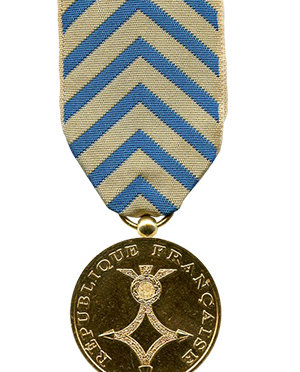
The North Africa medal was a 34mm in diameter gilded medal struck from bronze.

The obverse bore the relief image of an Agadez cross (Southern cross) surrounded by the inscription also in relief “RÉPUBLIQUE FRANÇAISE” (“FRENCH REPUBLIC”).

The reverse bore the relief inscription on two lines “MÉDAILLE” “D’AFRIQUE DU NORD” (“MEDAL” “OF NORTH AFRICA”) over the relief image of a sprig of three oak leaves.

The medal hung from a ribbon passing through a ring through the medal’s ball shaped suspension loop. The 34mm wide sand coloured silk moiré ribbon bore inverted 34mm wide and 3mm thick blue chevrons. The undress ribbon bore three such chevrons.

The North Africa Security and Order Operations Commemorative Medal

The Commemorative Medal for Security Operations and the Maintenance of Order (or “Médaille Commémorative des Opérations de Sécurité et de Maintien de l’Ordre en Afrique du Nord” in French) is a French commemorative medal established in the late 1950s for award to members of the French armed forces and French civil servants under military authority for service in French North Africa during the hectic years that would become the end of French colonialism in the region.

A medal was initially created by decree 56-1032 of 12 October 1956 and called the Médaille Commémorative des Opérations de Sécurité et de Maintien de l’Ordre en Afrique du Nord (“Commemorative Medal for Security Operations and Maintenance of Order in North Africa”). It was designed to fill this void and recognize their service in what was officially called a “police action” to quell disorder, rather than a military campaign against an armed and organized enemy.

Decree 58-24 of 11 January 1958 modified the design and renamed the award to “Médaille Commémorative des Opérations de Sécurité et de Maintien de l’Ordre” (English: “Security and Order Operations Commemorative Medal”).

Rather than design a new medal for each operation in North Africa, the government decided to extend the eligibility, the existing medal could then be awarded to anyone who had served in North Africa during the 1950s and 1960s.

TheNorth Africa Operations Commemorative Medal Design

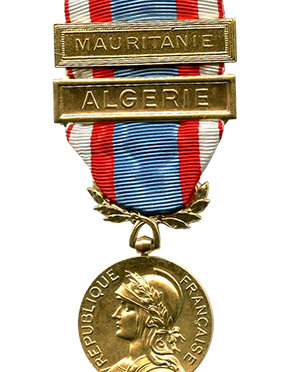
The medal is a 30mm in diameter circular medal struck from bronze and gilded.

The obverse, engraved by Georges Lemaire, bore an allegorical image of the warrior French Republic wearing a helmet adorned with and oak leaf wreath and surrounded by the relief inscription along the medal circumference “RÉPUBLIQUE FRANÇAISE” (“FRENCH REPUBLIC”).

On the reverse, the relief inscription on five lines “MÉDAILLE” “COMMÉMORATIVE” “OPÉRATIONS SÉCURITÉ” “ET MAINTIEN” “DE L’ORDRE” (“MEDAL” “COMMEMORATIVE” “SECURITY OPERATIONS” “AND MAINTAINING” “ORDER”) surrounded by a wreath of oak and olive leaves along the medal circumference.

The pre January 1958 variant had the reverse inscription on four lines “MÉDAILLE” “COMMÉMORATIVE” “D’AFRIQUE” “DU NORD” (English: “NORTH” “AFRICA” “COMMEMORATIVE” “MEDAL”).

The medal hung from a ribbon passing through a wreath shaped ring through the medal’s suspension loop. The red silk moiré ribbon was 36mm wide with a 14mm central light blue stripe and two 5mm wide white stripes each 1mm from the edge.

The Middle East Operations Commemorative Medal

The Middle East operations commemorative medal (or Médaille commémorative des opérations du Moyen-Orient in French) was a French commemorative medal established on 22 May 1957 to recognize the participation of French nationals in the military operations conducted during the Suez Crisis of 1956.

In 1956, Egyptian President Nasser decided to nationalize the Suez Canal Company, this action was against French and British interests in the region leading to a military intervention by both countries. For its part, France decided to send a 10,000 man strong expeditionary force under the command of Admiral Pierre Barjot and General André Beaufre. Under heavy diplomatic pressure from both the United States and the USSR, the Franco-British forces withdrew from the retaken territories and the entire expedition was abandoned after barely four months. The French forces had suffered fifteen dead.

The Middle East operations commemorative medal was awarded to French soldiers from all three services and civilians (including the crews of merchant vessels and civilian airliners) for participation in the operations that took place in the geographical area lying between the 20th and 36th Northern parallels and the 24th and 40th Eastern meridians between 1 September and 22 December 1956.

The Middle East Operations Commemorative Medal Design

The Middle East operations commemorative medal is a 30mm in diameter circular medal struck from bronze, it may be gilt.

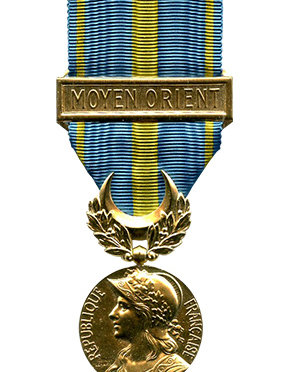
The obverse bears the relief image of the “warrior republic” in the form of the left profile of a helmeted woman’s bust, the helmet being adorned by a crown of oak leaves. On either side, the relief inscription along the circumference “RÉPUBLIQUE FRANÇAISE” (FRENCH REPUBLIC).

On the reverse, the relief inscription on five lines “MÉDAILLE COMMÉMORATIVE DES OPÉRATIONS DU MOYEN-ORIENT 1956” (MIDDLE EAST OPERATIONS COMMEMORATIVE MEDAL 1956).

The medal hangs from a ribbon through a ring passing through the medal’s suspension loop. The ring is adorned by a 24mm in diameter bronze laurel wreath and half crescent. The silk moiré ribbon is 37mm wide and is light blue with a yellow central 7mm wide and 2mm wide stripes 2mm from the edges.

A gilt clasp bearing the relief inscription “MOYEN-ORIENT” (MIDDLE EAST”) is worn on the ribbon.