The Carnegie Hero Fund Medal

The Carnegie Hero Fund Commission was established to recognize persons who perform extraordinary acts of heroism in civilian life.

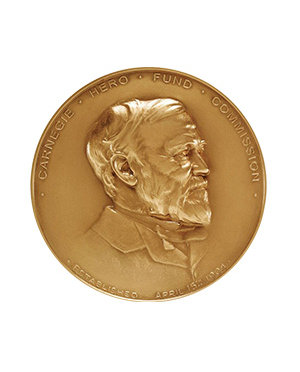
The Carnegie Hero Fund Commission (or Medaille van het Carnegie Heldenfonds in Dutch), also known as Carnegie Hero Fund, was established to recognize persons who perform extraordinary acts of heroism in civilian life in the United States and Canada, and to provide financial assistance for those disabled and the dependents of those killed saving or attempting to save others.

Those chosen for recognition receive the Carnegie Medal and become eligible for scholarship aid and other benefits. A private operating foundation, the Hero Fund was established in Pittsburgh, Pennsylvania, in 1904 with a trust fund of $5 million by Andrew Carnegie, a Scottish-American industrialist and philanthropist.

The fund was inspired by Selwyn M. Taylor and Daniel A. Lyle, who gave their lives in rescue attempts following the Harwick Mine disaster in Harwick, Pennsylvania, just outside Pittsburgh, on January 25, 1904. The disaster claimed 181, including Taylor and Lyle, who were killed during rescue attempts. Greatly touched by Taylor’s and Lyle’s sacrifice, Carnegie had medals privately minted for their families, and within two months he wrote the Hero Fund’s governing “Deed of Trust”, which was adopted by the newly created commission on April 15, 1904.

Administered by a 21-member board still based in Pittsburgh, the Hero Fund has awarded 9,893 medals as of September, 2016, and has given $38.5 million in one-time grants, scholarship aid, death benefits, and continuing assistance.

The Carnegie Hero Fund Medal Design

The three inch (7.13 cm) in diameter bronze medals which are given to awardees, are struck by Simons Brothers Co. of Philadelphia and consist of 90% copper and 10% zinc.

A verse from the New Testament of the Bible encircles the outer edge: “Greater love hath no man than this, that a man lay down his life for his friends” (John 15:13).

The first medals issued by the trust were in bronze, silver and gold. The trust soon stopped issuing gold medals. The last silver medal was issued in 1981.
The Medal of Recognition 1940-1945

The Medal of Recognition 1940–1945 is a medal of the Kingdom of the Netherlands that was established by Royal Decree on 9 February 1946.

The Medal of Recognition 1940–1945 (or Erkentelijkheidsmedaille 1940–1945 in Dutch) is a medal of the Kingdom of the Netherlands that was established by Royal Decree on 9 February 1946.

The decoration was of two classes, silver and bronze, and was awarded to those who aided the Dutch during the period of World War II, or afterwards helped relieve those who had suffered from the German occupation.

The Medal of Recognition 1940-1945 Design

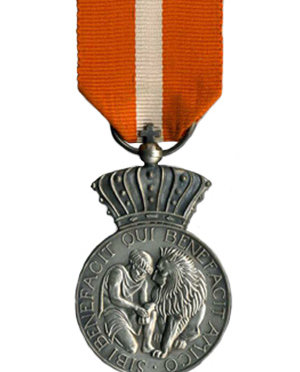
The decoration was designed as a circular medal 29 millimeters in diameter and exists in two classes, silver and bronze.

On the front Androcles is portrayed taking the thorn from the lion’s paw. The choice of motif was guided by the fact that the lion is the royal emblem of the Netherlands and the story was once commonly cited as an example of enduring gratitude. The inscription round the front edge reads SIBI BENEFACIT QUI BENEFACIT AMICO (‘He benefits himself who benefits a friend’). On the reverse of the medal the inscription reads POPULUS BATAVUS GRATO ANIMO (‘With the gratitude of the Dutch people’).

The medal’s ribbon is orange with a broad white stripe down the middle, on which there is a small silver or bronze crown according to class.

The Flood Disaster Medal

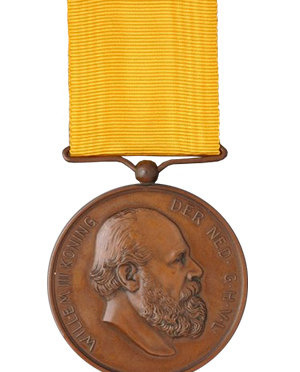
The Flood disaster Medal (Watersnoodmedaille) was created by royal decree on 27 March 1855 by King William III of the Netherlands.

The Decoration for acknowledgment of excellent deeds performed during a flood disaster (or Onderscheidingsteken ter erkenning van uitstekende daden bij watersnood verricht in Dutch), usually called Flood disaster Medal (Watersnoodmedaille), was created by royal decree on 27 March 1855 by King William III of the Netherlands.

The medal is intended for those civilians who have shown zeal, courage, leadership, and self-sacrifice during the event of a flood disaster

The Flood Disaster Medal Design

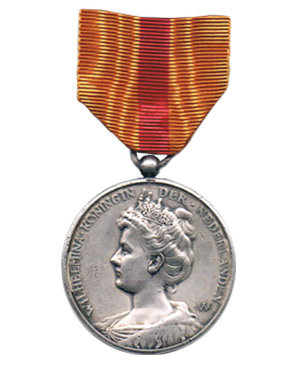
The Flood Disaster medal is round, made of bronze and features the profile of King William III of the Netherlands. The ribbon is yellow.

The Museum Medal

The Honorary Medal for Merits toward Museum Collections (or Museum Medal) is one of the oldest civil decorations of the Netherlands.

The Honorary Medal for Merits toward Museum Collections (or Erepenning voor Verdiensten jegens Openbare Verzamelingen in Dutch), also known as the Museum Medal, is one of the oldest civil decorations of the Netherlands.

It was created by royal decree on 26 June 1817 by King William I of the Netherlands. The decree describes the following: “An honorary medal for appearance of interest in the state collection by donation shown“. The medal is awarded in gold, silver or bronze as a token of appreciation to those who “donate to the Dutch monarch any works of art, that were collected with much effort.

By royal decree, on 5 May 1877, eligibility for this award was extended by King William III of the Netherlands, with the description “to those who donated important works of art to the state museums or who showed praiseworthy acts regarding the different scientific collections or art collection of the state museums“.

Due to this description, the medal obtained its current official name. However, since the end of the 19th century, this decoration is primarily known as the “Museum Medal”.

Eligibility for this award was once again extending, by Queen Wilhelmina, on 28 October 1919 with the description “merit towards community (public) collections“. What was initially a medal for generous donors became now an official royal award for merit.

The Museum Medal Design

Up until 1897, the honorary medal was only a standing decoration, when Queen Wilhelmina of the Netherlands declared that the medal could be worn suspended from a ribbon. Queen Juliana of the Netherlands decided by royal decree on 26 July 1952 that the shape of the medal and ribbon should be changed.

The current ribbon is orange with two red lines descending down the middle. A ribbon bar is also given with the award, with a palm branch device in either gold or silver for recipients of the gold or silver versions of the medal, respectively. Queen Beatrix of the Netherlands later changed the composition of the medallion, and is now depicted on the obverse of the medal.

The De Ruyter Medal

The De Ruyter Medal was created by royal decree to be awarded to those members of the Dutch Merchant fleet who distinguish themselves.

The De Ruyter Medal (or De Ruyter-medaille in Dutch) was created by royal decree no. 1 on 23 March 1907 by Queen Wilhelmina of the Netherlands, to be awarded to those members of the Dutch Merchant fleet who distinguish themselves by praiseworthy acts of duty for the Dutch Ship transport.

With the De Ruyter Medal the Kingdom of the Netherlands honors since 1907 the three-hundredth birthday of Michiel de Ruyter, one of the most famous admirals in Dutch history. The medal can be awarded in gold, silver or bronze. Awarding is on basis of nomination of the Netherlands government and by royal decree.

The Ruyter Medal Design

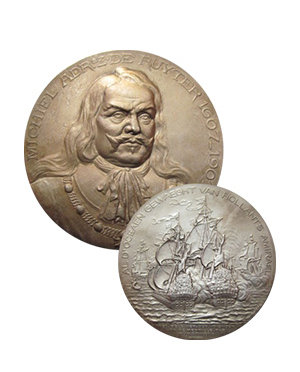
The Ruyter medal is a round medal with, on the front side, a picture of Michiel de Ruyter. The medal is worn with a dark orange ribbon.

The Bronze Lion

The Bronze Lion (Bronzen Leeuw) is a high Royal Dutch award intended for servicemen who have shown extreme bravery and leadership in battle.

The Bronze Lion (or Bronzen Leeuw in Dutch) is a high Royal Dutch award intended for servicemen who have shown extreme bravery and leadership in battle favoring The Netherlands.

It was first created in 1944 and has since been issued 1210 times. Proposals for an award are reviewed by the Dutch Board for Bravery Awards, which is part of the ministry of Defense. If awarded they are enforced by a Royal Decree. In some special cases, the Bronze Lion can however be awarded to Dutch or foreign civilians.

The Bronze Lion has precedence after the Order of the House of Orange, but is the second highest military decoration still being awarded for bravery (only preceded by the Military William Order).

The Bronze Lion Design

The Bronze Lion is a cross in bronze, covered by a round shield. On the front is a relief of the crowned Dutch Lion.

The cross is attached to a 37 millimeter wide ribbon, divided into nine equal vertical stripes, alternately orange and ‘Nassau blue’, the strips on either edge are Nassau blue. It is possible for a single person to receive more than one award of the Bronze Lion, in which case a number ‘2’ in gold is added on the ribbon of the Bronze Lion.

The Honorary Medal for Charitable Assistance

The Honorary Medal for Charitable Assistance is one of the oldest decorations for bravery in the Kingdom of the Netherlands.

The Honorary Medal for Charitable Assistance (or Erepenning voor Menslievend Hulpbetoon in Dutch) was created at 18 June 1822 and is after the Military William Order the oldest decoration for bravery in the Kingdom of the Netherlands.

The Honorary Medal is the highest civilian decoration still being awarded for bravery, and is specifically for those who carried out a voluntary act of bravery or self-sacrifice, with an emphasis on charity.

The medal can be awarded in gold, silver or bronze. Awarding is on basis by nomination of the Netherlands government and by royal decree. The golden medal has precedence only after the Dutch Cross of Resistance (also a civilian bravery decoration, but not awarded anymore), and the silver and bronze medals have precedence after the Airman’s Cross (a military bravery award).

Lieutenant Alexander de Langle was the first person to be rewarded with this medal in 1821 for rescuing a sergeant who was stuck at the bottom of a well. Although this was considered an act of bravery, King William I did not deem it important enough to award the lieutenant the distinguished Military William Order, so inatead a new award for bravery was created: the Honorary Medal for Charitable Assistance.

The Honorary Medal for Charitable Assistance Design

In 1837 King William II decided by royal decree that the size of the golden, silver and bronze medals would be all 50 millimeter. Also his portrait was put on the medals.

Since 1849 the portrait of King William III was shown on the medals and from 1875 a portrait of the older and bold King William III.

When Emma of Waldeck and Pyrmont became the queen regent of the Netherlands she decided to put on the medal the portrait of her minor daughter Queen Wilhelmina. In 1897 a new type of medal was created, the medal did get a ribbon to wear and also did get the same shape as the French “Medal of Saint Helena”.

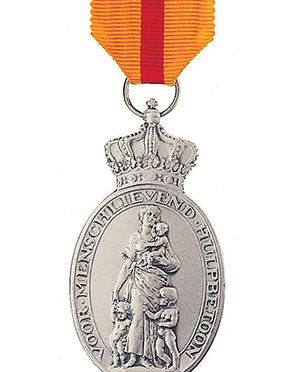
Since 1912 the medal has its current shape. The medal is ovally shaped with at the top a stylised royal crown. On the medal a mother with three children is portrayed. The motif is taken from the city hall in Bolsward. At the reverse side the words “De koningin aan” (English: The Queen Rewards to) and also some space is reserved for an inscription. The medal is worn with an orange ribbon that has a red band in the middle. The medallion is today still award as gold, silver or bronze.

The Inter Allied Victory Medal (France)

The French Victory Medal was established on 20 July 1922 and awarded to all soldiers who served three months between 1914 and 1918.

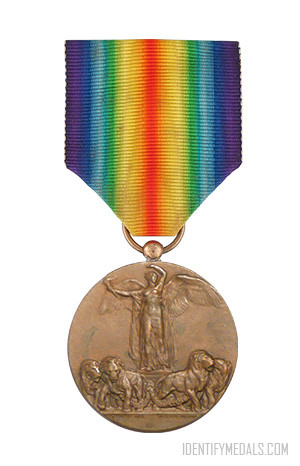
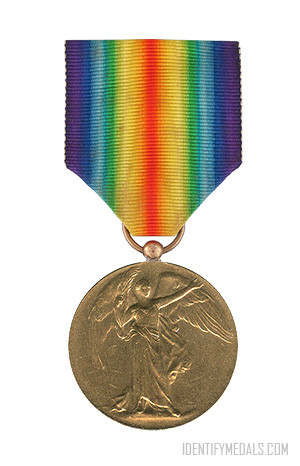
The Allied Victory Medal was recommended by an inter-allied committee in March 1919. Fourteen victorious countries were finally awarded the medal after World War I, and each allied nation would design a ‘Victory Medal’ for award to their own nationals. Certain features were to be shared: a winged figure of Victory on the obverse and the same ribbon.

The French Victory Medal was established on 20 July 1922 and awarded to all soldiers who served three months between 2 August 1914 and 11 November 1918, as well as to civilian nurses, aliens who served directly under French command, Marshals and generals who had a command for at least three months, and prisoners of war from Alsace and Lorraine who then served in the French forces.

The France Inter-Allied Victory Medal Design

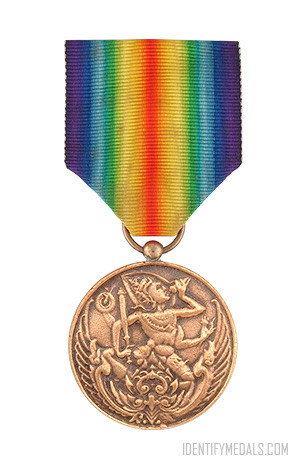
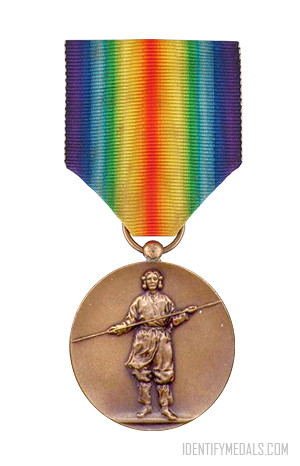
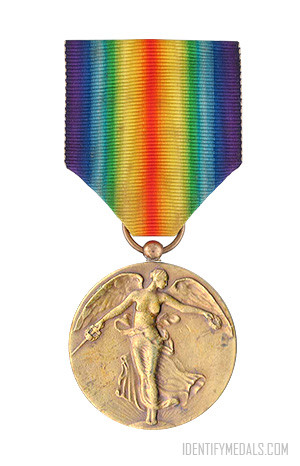
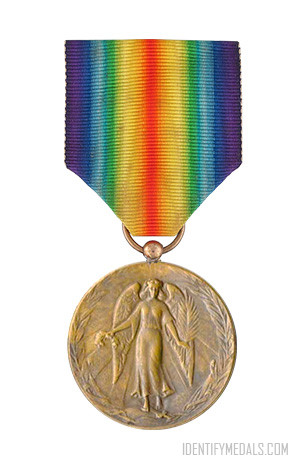
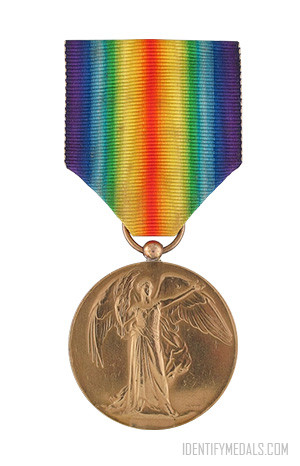
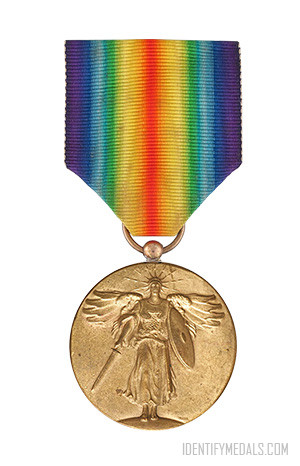
The Victory Medal measures 36 millimetres (1.4 in) in diameter and was designed by William McMillan. The design and ribbon was also adopted by Belgium, Brazil, Cuba, Czechoslovakia, France, Greece, Italy, Japan, Portugal, Romania, Siam, Union of South Africa and the USA. Each allied nation would design a ‘Victory Medal’ for award to their own nationals, all issues having certain common features, including a winged figure of victory on the obverse and the same ribbon.

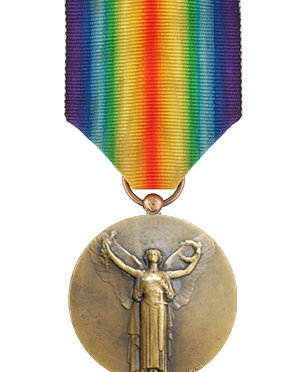
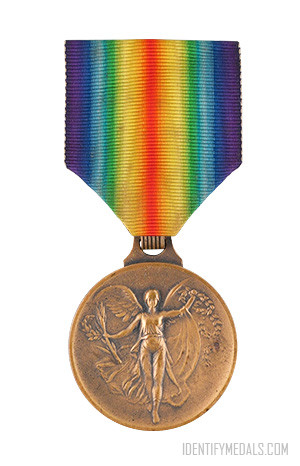
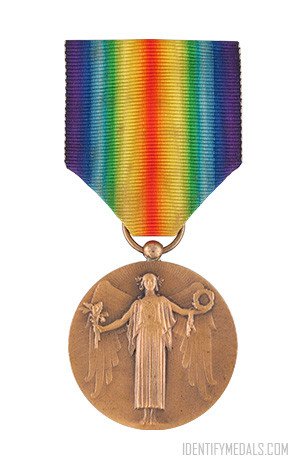
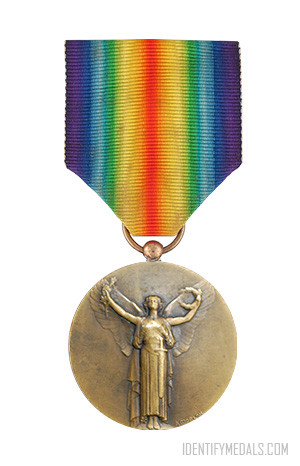
The obverse of the medal bears the winged, full-length and full-front figure of Victoria and the designer’s signature “A. Morlon”. The reverse reads “LA GRANDE GVERRE POUR CIVILISATION 1914-1919” and a Phrygian cap between the letters R. F.

The 39 millimeters (1.5 in) wide watered ribbon has an iridescent color scheme, with the violet moving through to a central red stripe where both schemes meet. It attaches to the medal through a ring suspender. The recipient’s name, rank, service number and unit were impressed on the edge of the medal. The name of the regiment or corps was omitted on medals awarded to Army officers.

All the Inter-Allied Victory Medal Variations

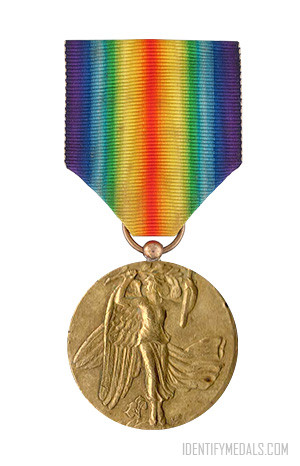
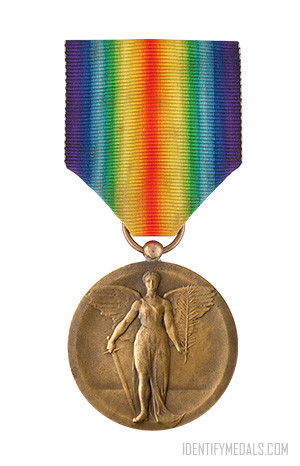
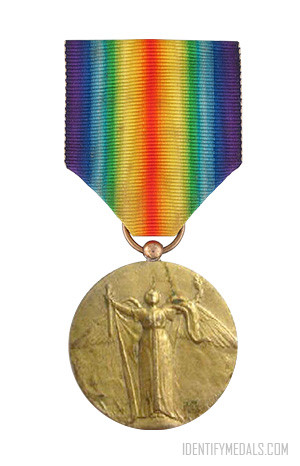
Although each country designed its own version of the Inter-Allied Victory Medal, all of them shared some common elements, such as a winged victory figure on the obverse and a similar ribbon with rainbow colors symbolizing unity among the Allies. Here are the versions for all countries:

Find an Inter-Allied Victory Medal Online

Right Now on eBay 
Clicking a link to eBay may result in a referral commission being paid if a purchase is made.
Loading...

The Indochina Campaign Commemorative Medal

The Indochina Campaign commemorative medal (or Médaille commémorative de la campagne d’Indochine in French) is a military decoration established on 1 August 1953 to recognize participation in the Indochina War by the members of the French Far East Expeditionary Corps, regular and reserve.

The conflict in Indochina started right after the end of World War II with the French forces initially under the command of general Philippe Leclerc. During the first eight years of the conflict, French and colonial troops received the Colonial Medal with the “EXTRÊME-ORIENT” clasp, but this award couldn’t be earned by all in theater and outright excluded indigenous personnel.

Politicians and generals alike petitioned the government for a dedicated commemorative award available to all participants under French command. The Indochina Campaign commemorative medal was awarded to soldiers of the army, navy and air force involved, for a minimum of ninety days, in a regular or supplementary unit in the Indochina campaign between 16 August 1945 and 11 August 1954. The medal could also be awarded to civilians, citizens of France or of the French Union, members of the Merchant navy or civil aviation.

The Indochina Campaign Commemorative Medal Design

The medal measures 36mm in diameter, is circular and struck in bronze.

On the obverse a 24mm wide by 5mm high rectangular panel bearing the relief inscription “INDOCHINE” is supported by a seven headed naja, five of its heads being below the panel, two being above the upper corners, one on each side. Atop the panel, a three headed elephant surrounded by the relief semi circular inscription “RÉPUBLIQUE FRANÇAISE” along the medal circumference.

On the reverse in relief, a 25mm in diameter wreath of laurels and oak leaves surrounded by the inscription “CORPS EXPÉDITIONNAIRE FRANÇAIS D’EXTRÊME-ORIENT” (“FRENCH FAR EAST EXPEDITIONARY CORPS”) running along the entire medal circumference.

The ribbon suspension ring is adorned with a 20mm high by 25mm wide bronze twisted dragon. The ring passes through a loop atop the medal which hangs from a 39mm wide green ribbon bearing four 5mm wide yellow stripes set 5mm apart starting 2mm from the edges.

The Commemorative Medal for United Nations Operations in Korea

The Commemorative medal for United Nations operations in Korea (or Médaille commémorative des opérations de l’ONU en Corée in French) is a commemorative war medal established on 8 January 1952 and awarded to members of the French armed forces who fought in the Korean war.

On 25 June 1950, North Korean forces invaded South Korea in an effort to unify both countries under the northern communist government. A United Nations military force composed of seventeen nations soon began to arrive in theatre. France joined the U.N. forces in a 23 August with a battalion of 1,051 volunteers setting sail from Marseille on 25 October 1950. This battalion was under the command of general Raoul Magrin-Vernerey.

The French particularly distinguished themselves at the battles of WonjuChipyong-ni and Heartbreak Ridge. Out of 3,421 Frenchmen who fought in Korea, 262 were killed, 1008 wounded and 7 remain unaccounted for.

The United Nations operations in Korea commemorative medal was awarded to soldiers of the French United Nations detachment and to naval personnel with a minimum of two months in theatre.

The Commemorative Medal for United Nations Operations in Korea Design

The medal measures 36mm in diameter, is circular and struck in bronze.

The obverse bears on a background of sun rays radiating out from its center, the relief image of the national emblem of the Republic of South Korea on a flower-like eight lobe geometric form superimposed over a lit torch with its flame extending 7mm over the medal’s upper edge and forming the suspension loop. The torch also bisected a relief laurel wreath extending along all but the upper most of the medal’s circumference. The straight ribbon mount was adorned with a bronze decoration resembling the top of a pagoda.

The reverse bears the relief inscription on seven lines “MÉDAILLE” “COMMÉMORATIVE” “FRANÇAISE” “DES OPÉRATIONS” “DE L’ORGANISATION” “DES NATIONS UNIES” “EN CORÉE” (“FRENCH COMMEMORATIVE MEDAL OF THE OPERATIONS OF THE ORGANIZATION OF THE UNITED NATIONS IN KOREA”) surrounded by the relief circular inscription “RÉPUBLIQUE FRANÇAISE”.

The medal hangs from a 36mm wide silk moiré ribbon in the colors of the United Nations and France. It’s multicoloured vertical stripes were disposed as follows beginning with three central equal width light blue, white and light blue stripes totalling 20mm, these were bordered by three equal width dark blue, white and red stripes totalling 8mm, the dark blue being closer the ribbon’s edge.