The Morocco Commemorative Medal

The Morocco commemorative medal (1909) (or Médaille commémorative du Maroc 1909 in French) is a military campaign medal established by the law of 22 July 1909 and awarded to soldiers participating in the Second Franco-Moroccan War under the command of general Hubert Lyautey.

Long time French colonial interests in North Africa led to tensions between European nations but particularly disturbed Germany. France pushed established international agreements to their limits bringing tensions to a high point in the Agadir Crisis. Moroccan forces took advantage of the situation to attack French positions leading to an escalation in the number of French troops in their country under the auspices of so-called pacification operations. These military operations went on until 30 March 1912, the date on which the Treaty of Fez was signed making of Morocco a French Protectorate.

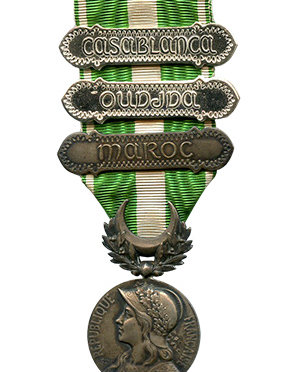
Four silver clasps of oriental design could be worn on the ribbon:

  • CASABLANCA
  • OUDJDA
  • HAUT-GUIR
  • MAROC

The Morocco Commemorative Medal Design

The medal measures 30mm in diameter, is circular and struck in silver.

The obverse bears the relief image of the effigy of the “warrior republic” in the form of the left profile of a helmeted woman’s bust, the helmet being adorned by a crown of oak leaves. On either side, the relief inscription along the circumference “RÉPUBLIQUE FRANÇAISE” (English: “FRENCH REPUBLIC”).

The reverse, representing both the army and navy, bears the relief images of an infantry rifle crossed with a naval anchor below two military banners and lances surmounted by the relief inscription “MAROC” (“MOROCCO”), the banners bore the inscriptions “HONNEUR ET PATRIE” and the words “CASABLANCA”, “HAUT-GUIR”, and “OUDJDA”. In the background, sand dunes, the wall of a Kasbah and palm trees.

The medal hangs from a 36mm wide silk moiré green ribbon with a 7mm white central stripe and two 2mm wide white stripes 1mm from the ribbon edges. The medal suspension ring was adorned by a silver laurel wreath and a crescent.
The 1901 China Expedition Commemorative Medal

The 1901 China expedition commemorative medal is a military campaign medal established to recognize service in China in 1900 and 1901.

The 1901 China expedition commemorative medal (or “Médaille commémorative de l’expédition de Chine 1901” in French) is a military campaign medal established by the law of 15 April 1902 to recognize service in China in 1900 and 1901 during the Boxer rebellion.

In May 1900, an uprising throughout Northern China threatened the interests of nations with established concessions in major cities and leased territories in the empire of China (this hostility was mainly driven by a secret nationalist and xenophobic group called “the Society of Righteous and Harmonious Fists”, or “Boxers”)

Eight major powers (Germany, Austria, United States, France, Britain, Italy, Japan and Russia) decided to establish an international army of 150,000 men under the supreme command of German Field Marshal Count von Waldersee to rescue their besieged compatriots in Peking and put down the rebellion in the provinces.

The medal was awarded by the President of the French Republic to all officers, sailors and soldiers having participated in the French expedition to China during the following time periods:

  • for the personnel under the War Department, to all those who served in China between 30 June 1900 and 8 August 1901;
  • for the personnel under the Navy Department,
    • concerning members of crews, to those who were in service in theater between 30 May 1900 and 31 December 1901 who received an indemnity for service in China;
    • concerning officers, military functionaries or agents that did not figure on crew rosters, to those who received an indemnity for service in China covered in the decree of 4 August 1900 or an indemnity for expenses granted prior to 1 September 1900.

It was also awarded, on the recommendation of the Minister for External Affairs, to the French civilians who took part in the defense of the legations in Peking.

Allied troops entered Peking on 14 August 1900 but a peace treaty with China was only signed on 7 September 1901.

The 1901 China Expedition Commemorative Medal Design

The medal measures 30mm in diameter, is circular and struck in silver.

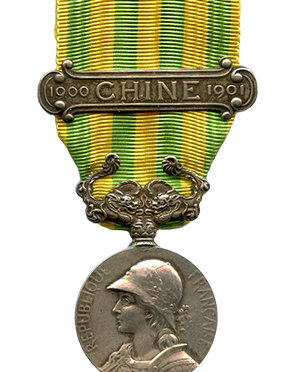
The obverse bears the relief image of the effigy of the “warrior republic” in the form of the left profile of a helmeted woman’s bust, the helmet being adorned by a crown of oak and laurel leaves. On either side, the relief inscription along the circumference “RÉPUBLIQUE FRANÇAISE” (English: “FRENCH REPUBLIC”).

The reverse displays a pagoda surrounded with military and naval articles or war. The ribbon’s suspension loop was adorned with two Chinese dragons.

The medal hangs from a 36 mm wide silk moiré yellow ribbon with four 4 mm wide equidistant green vertical stripes.

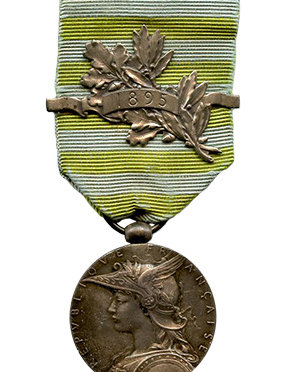
The Colonial Medal

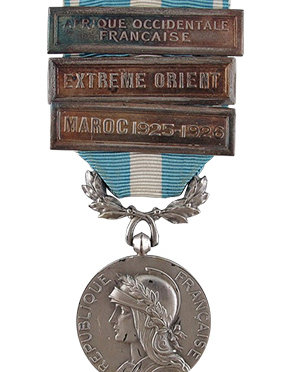
The Colonial Medal is a decoration created by the loi de finances of 26 July 1893 to reward military services in the colonies. 

The Colonial Medal (or Médaille Coloniale in French) is a decoration created by the loi de finances of 26 July 1893 (article 75) to reward military services in the colonies. Its implementing decree dated 6 March 1894 lists the military operations carried out by France in its colonies or protectorates: Algeria – Cochin – Gold Coast – Marquesas Islands – Nossi- Bé – New Caledonia – Senegal and Sudan – Society Islands – Tunisia.

The colonial medal is closely linked to the existence of the French colonial empire.

The scope of the decree was therefore a broad retroactive effect, since the first operations considered for the award of the Medal colonial dating back to 1827, at the very beginning of the conquest of Algeria. A decree of 6 June 1962 changed the term “colonial” to “overseas”.

The Colonial Medal Design

The medal measures 30mm in diameter and is struck in silver.

On the obverse there is the helmeted effigy of the Republic with “République française” engraved above. On the reverse, a world map occupies the central field, resting on an anchor across a trophy of arms.

The ribbon is white and blue with vertical stripes. Its length can vary this from 35 to 37 mm.

The design of the medal is attributed to Capitaine de frégate Saulnier Pinellas, because the original award was for sailors. Its production had the distinction of being performed by the administration of the Paris Mint and a private company that was responsible for manufacturing the socket of the pendant ring leaves and clasps crimping indentations. The sets were to be delivered complete to the ministries of the Navy and War. The ribbon, the skewer assembly and assembly were also part of the supply.

The Second Madagascar Commemorative Medal

The Madagascar commemorative medal (or Médaille commémorative de Madagascar in French) is a commemorative medal issued to the participants to the First Madagascar expedition in 1883, and the Second Madagascar expedition in 1894-95.

Two different medals were issued, the first one by the law of 31 July 1886, the second one by the law of 15 January 1896. In 1883 the French bombarded and occupied Toamsina (then Tamatave), and in 1885 established a protectorate over Madagascar – which was recognized by Great Britain in 1890. In 1896, French troops under J. S. Gallieni defeated the Merina and abolished the monarchy. Queen Ranavalona III was sent into exile in Algeria in 1897, effectively ending the monarchy.

About 2,500 copies of the medal were awarded.

The First Madagascar Commemorative Medal Design

The medal was designed by Jean-Baptiste Daniel-Dupuis and has a diameter of 30 millimeters.

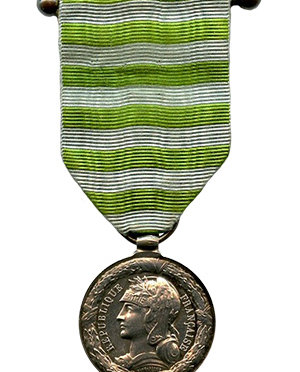
Within a broad wreath in the obverse is engraved the writing “République Française” arranged around the head of a symbolical helmeted and in armor-clad female figure. It is called the “armed republic” and bears the letters “PATRIE” on its ornate helmet.

The reverse bears a laurel wreath and a radiant five-pointed star, alongside the name of the island “MADAGASCAR“. Next to the star are the years 1883 and 1886 engraved. Under the rays is a trophy which depicts an anchor.

The medal was worn with light green and yellow horizontal striped ribbon on the left chest. That ribbon is a simple and rectangular silver buckle with the designation “MADAGASCAR“.

The Dahomey Expedition Commemorative Medal

  • Time Period: Pre-WW1
  • Institution: 24 November 1892
  • Country: France

The Dahomey Expedition commemorative medal (or Médaille commémorative de l’Expédition du Dahomey in French) is a campaign medal bestowed to the participants of the First Franco-Dahomean War (1890) and the Second Franco-Dahomean War (1892–1894).

In 1892, France decided to send an expeditionary force of 1,801 Europeans and 1,769 natives under the command of Marine Infantry Colonel Alfred Dodds in response to the harassment of the kingdom of Porto-Novo under its protectorate and its trading posts on the coast of Dahomey by the troops of Behanzin, the king of Abomey. The expedition lasted five months, and the men defeated the 12,000 warrior strong army of Behanzin at Dogba. France thus reconquered the kingdom of Dahomey (now the Republic of Benin) and placed at its head, Toffa as the king of Porto-Novo. 

The Law of 24 November 1892 instituted the Commemorative Medal of the Dahomey Expedition for award to the officers, sailors and soldiers who took part in this campaign.

All recipients were to adhere to the code of conduct as set under the Grand chancellor of the Legion of honour. Posthumous awards were made to the widow or parents of the recipient.

The Dahomey Expedition Commemorative Medal Design

The medal measures 30 mm in diameter and is struck in silver. It was designed by Jean-Baptiste Daniel-Dupuis.

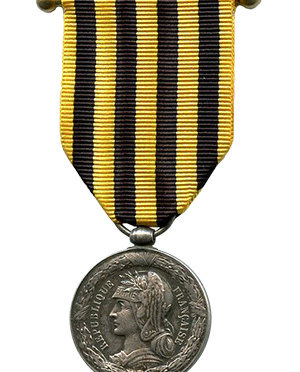
The obverse bears an effigy of the Republic and the words “RÉPUBLIQUE FRANÇAISE” enclosed within a laurel wreath running along the entire circumference. The Republic is represented as a helmeted young woman with the word “PATRIE” (HOMELAND) inscribed on the visor of her helmet.

The reverse of the medal features, within the same laurel wreath as on the obverse, a small five pointed star amid protruding rays, at center the relief inscription “DAHOMEY“, in the lower section, a naval sea anchor over four flags. A small relief Cornucopia trademark is just off the tip of the leftmost flag.

The medal hangs from a 36 mm wide “daffodil yellow” silk moiré ribbon bearing four equidistant 4 mm black vertical stripes.

The Tonkin Expedition Commemorative Medal

  • Time Period: Pre-WW1
  • Institution: 6 September 1885
  • Country: France

The Tonkin Expedition commemorative medal (or Médaille commémorative de l’expédition du Tonkin in French) was awarded to all the French soldiers and sailors who had taken part in the battles of the Tonkin and the Sino-French War between 1883 and 1885.

The medal, created by a law of 6 September 1885, was minted at the Monnaie de Paris and distributed shortly before the Bastille Day parade on 14 July 1886 to around 65,000 soldiers and sailors. Administrative and support staff, including cantinières and officials working in the treasury, postal and military telegraphy services, were eligible for the award of the medal. The medal was not awarded to participants whose service records were marred by serious military offences or habitual misconduct.

The medal was later awarded to participants in a number of earlier and later campaigns in Indochina, bringing the total number of recipients to 97,300.

The Tonkin Expedition Commemorative Medal Design

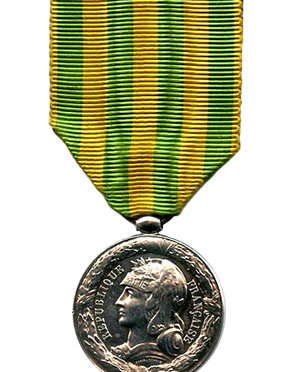
The obverse of the medal features an effigy of the Republic and the words République française, enclosed within a laurel wreath.The Republic is represented as a helmeted young woman with the word patrie (motherland) inscribed on the visor of her helmet.

On the reverse of the medal are a list of some of the more notable engagements of the Tonkin Campaign and the Sino-French War.

Two medal issues were made, one for the army and one for the navy and the troupes de marine. The navy issue medal includes the following names: Cau-Giaï, Sontay, Bac-Ninh, Fou-Tchéou, Formose, Tuyen-Quan, Pescadores. The army issue medal omits the name Cau-Giaï, as it was at this engagement that the French commandant supérieur in Tonkin was killed.

The medal ribbon, envisaged in the law of 6 September 1885 as half green and half yellow, was redesigned in the course of production, and the final version featured four green stripes on a yellow background. The clasp is inscribed with the word Tonkin.

The First Madagascar Commemorative Medal

The Madagascar commemorative medal (or Médaille commémorative de Madagascar in French) is a commemorative medal issued to the participants to the First Madagascar expedition in 1883, and the Second Madagascar expedition in 1894-95.

Two different medals were issued, the first one by the law of 31 July 1886, the second one by the law of 15 January 1896. In 1883 the French bombarded and occupied Toamsina (then Tamatave), and in 1885 established a protectorate over Madagascar – which was recognized by Great Britain in 1890. In 1896, French troops under J. S. Gallieni defeated the Merina and abolished the monarchy. Queen Ranavalona III was sent into exile in Algeria in 1897, effectively ending the monarchy.

About 2,500 copies of the medal were awarded.

The First Madagascar Commemorative Medal Design

The medal was designed by Jean-Baptiste Daniel-Dupuis and has a diameter of 30 millimeters.

Within a broad wreath in the obverse is engraved the writing “République Française” arranged around the head of a symbolical helmeted and in armor-clad female figure. It is called the “armed republic” and bears the letters “PATRIE” on its ornate helmet.

The reverse bears a laurel wreath and a radiant five-pointed star, alongside the name of the island “MADAGASCAR“. Next to the star are the years 1883 and 1886 engraved. Under the rays is a trophy which depicts an anchor.

The medal was worn with light green and yellow horizontal striped ribbon on the left chest. That ribbon is a simple and rectangular silver buckle with the designation “MADAGASCAR“.

The Commemorative Medal of the 1870-1871 War

The Commemorative medal of the 1870–1871 War is a military campaign medal awarded to those who served during the Franco-Prussian War.

The Commemorative medal of the 1870–1871 War (or Médaille commémorative de la guerre 1870–1871 in French) is a military campaign medal awarded to those who served during the Franco-Prussian War.

The French Emperor, confident of the strength of his armies declared war on Prussia on 19 July 1870.  A 1866 peace agreement between Prussia and Austria greatly enlarged the forces he would face, adding the armies of Bavaria, Württemberg, Saxony, Hanover, Baden, Hesse, Schaumburg-Lippe, Saxe-Meiningen, Nassau and Reus to the already formidable Prussian Army. Soon the French armies were defeated or encircled within the walls of their cities. Over a five-month campaign, German forces defeated newly recruited French armies in a series of battles fought across northern France. Following a prolonged siege, Paris fell on 28 January 1871 and the war ended with the Treaty of Frankfurt of 10 May 1871.

Forty years would have to elapse before the government would agree to a tangible form of recognition for the surviving veterans of the conflict. The Commemorative medal of the 1870–1871 War was finally established by a law of 9 November 1911.

The Commemorative Medal of the 1870-1871 War Design

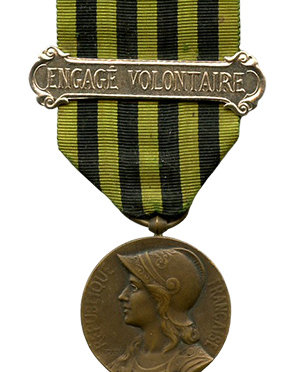
The medal measures 30-mm in diameter, is circular and struck in bronze. It was engraved by artist Georges Lemaire, his model to represent the effigy of the republic was Miss Fernande Dubois, an artist at the Opéra-Comique.

The obverse bears the relief image of the effigy of the “warrior republic” in the form of the left profile of a helmeted woman’s bust wearing armor. On either side, the relief inscription along the outer medal circumference “RÉPUBLIQUE FRANÇAISE“.

The reverse bears, at its lower center, a rectangle with the relief inscription “AUX DÉFENSEURS DE LA PATRIE” (“TO THE NATION’S DEFENDERS”), superimposed over the relief images of military weapons (sabres, lances, cannons), a naval anchor and a flowing banner, at its top, the relief years “1870 1871” bisected by the banner’s mast.

The medal hangs from a ribbon passing through a ring itself passing through a ball shaped suspension loop at the top. The 36-mm-wide green silk moiré ribbon bears four 4-mm-wide equidistant vertical black stripes, the whole forming nine alternating 4 mm stripes. The clasp “ENGAGÉ VOLONTAIRE” (“VOLUNTEER ENLISTEE”) could be worn on the ribbon.

The Commemorative Medal of the 1862 Mexico Expedition

The Commemorative medal of the Mexico Expedition is a commemorative campaign medal established by French emperor Napoleon III.

The Commemorative medal of the Mexico Expedition (or Médaille commémorative de l’expédition du Mexique in French) is a commemorative campaign medal established by decree on 29 August 1863 by French emperor Napoleon III. The medal recognizes military service during the 1862-1863 French intervention in Mexico.

On 30 April 1863, sixty two legionnaires resisted for nine hours against over two thousand Mexicans, allowing for the capture of the city of Puebla on 17 May 1863 thus paving the way to Mexico. In the capital, an assembly of notables recognized Archduke Maximilian of Habsburg as Emperor of Mexico. However, even with the support of 20,000 Mexicans who embraced the new emperor, Maximilian’s forces were harassed in their work of pacification by the troops of President Benito Juárez, who had the support of the United States. In February 1867, Emperor Napoleon III ordered the repatriation of all remaining French troops from Mexico.

No minimum time of service was mentioned in the award statute.

The Commemorative Medal of the 1862 Mexico Expedition Design

The medal measures 30 mm in diameter, is circular and struck in silver.

The obverse bears the left profile of Emperor Napoleon III crowned with a laurel wreath surrounded by the relief inscription “NAPOLEON III” “EMPEREUR“. A 4 mm wide relief laurel wreath ran along the entire circumference of both the obverse and reverse of the medal.

On the reverse and within the laurel wreath, a circular relief inscription reads “*EXPEDITION DU MEXIQUE * 1862-1863“, with two small five pointed stars separating the text from the dates. At the center, the relief inscription on five lines of the campaign’s major battles “CUMBRES” “CERRO-BORREGO” “SAN-LORENZO” “PUEBLA” “MEXICO”.

The medal hangs from a 36 mm wide white silk moiré ribbon bearing 5 mm red and green stripes arranged at a 45 degree angle forming a cross, over which was superimposed a black eagle, its wings spread and holding a green snake in its beak and talons, a design inspired by the coat of arms of Mexico.

The Commemorative Medal of the 1860 China Expedition

The Commemorative medal of the 1860 China Expedition is a military award of the Second French Empire awarded to soldiers and sailors.

  • Time Period: Pre-WW1
  • Institution: 23 January 1861
  • Country: France

The Commemorative medal of the 1860 China Expedition (or Médaille commémorative de l’expédition de Chine de 1860 in French) is a military award of the Second French Empire awarded to soldiers and sailors who had participated in the Anglo-French expedition to China during the Second Opium War.

The medal was created by imperial decree on 23 January 1861, by Napoleon IIIThe British Empire had been engaged in an ongoing conflict with the Qing Dynasty since 1856. Following the 1857 general election in the United Kingdom, the new parliament decided to seek redress from China. The French Empire, the United States, and the Russian Empire received requests from Britain to form an alliance. France joined the British action against China, prompted by the execution of a French missionary, Father August Chapdelaine. The conflict concluded with the 1858 Treaty of Tianjin in the Convention of Peking on 18 October 1860.

The medal was awarded by the Emperor to all who served in the China Expedition on propositions of the minister overseeing the service in which the potential recipient served. All recipients also received a certificate of award.

The Commemorative Medal of the 1860 China Expedition Design

The medal measures 30 mm in diameter, is circular and struck in silver. It was designed and engraved by Albert Désiré Barre.

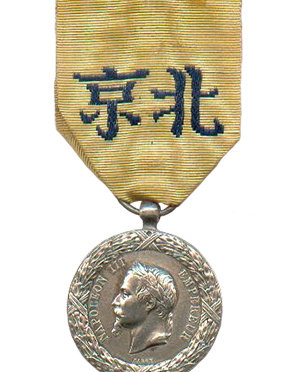
The obverse bears the left profile of Emperor Napoleon III crowned with a laurel wreath surrounded by the relief inscription “NAPOLEON III” “EMPEREUR”. A 4 mm wide relief laurel wreath runs along the entire circumference of both the obverse and reverse of the medal.

On the reverse, within the laurel wreath, there’s the circular relief inscription EXPÉDITION DE CHINE 1860. At the center, the relief inscription on four lines of the campaign’s major battles TA-KOU, CHANG-KIA-WAN, PA-LI-KIAO, PE-KING.

The medal is suspended from a 36 mm wide silk moiré yellow ribbon, at its center, the name of the city of Peking woven in blue Chinese characters.