The Commemorative Medal of the 1859 Italian Campaign

The Commemorative medal of the 1859 Italian Campaign is a French commemorative medal established by Napoleon III in 1859.

The Commemorative medal of the 1859 Italian Campaign (or Médaille commémorative de la campagne d’Italie de 1859 in French) is a French commemorative medal established by Napoleon III in 1859 following the French campaign in Italy during the Second Italian War of Independence.

In Europe, Italian unification was only supported by Emperor Napoleon III of France who, on 28 January 1859, based on the clauses of the Treaty of Turin, decided to bring aid and support from France. France declared war on the Austrian Empire on May 3, 1859. In spite of the lack of preparation of the French army, the soldiers and allies were to illustrate themselves in several famous battles, including that of Magenta on June 4th, which allowed Napoleon III and Victor Emmanuel II to enter triumphantly in Milan on 8 June. An armistice was signed at Villafranca on July 12.

During the three-month campaign, French losses amounted to 8,000 dead and 40,000 wounded. To reward all participants and ensure the memory of this glorious military campaign, the Medal was created by Imperial Decree on August 11, 1859.

Nearly 120,000 medals were awarded to reward all soldiers and sailors who participated in the Italian campaign of 1859. All recipients also received a certificate of award.

The Commemorative Medal of the 1859 Italian Campaign Design

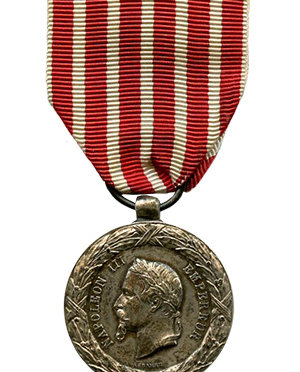
The medal was designed by Albert Désiré Barre. It measures 30 mm in diameter and is circular and struck in silver.

The obverse bears the left profile of Emperor Napoleon III crowned with a laurel wreath surrounded by the relief inscription “NAPOLEON III” “EMPEREUR” (English: “NAPOLEON III” “EMPEROR”). A 4 mm wide relief laurel wreath ran along the entire circumference of both the obverse and reverse of the medal.

On the reverse, within the laurel wreath, the circular relief inscription CAMPAGNE D’ITALIE 1859 (English: ITALIAN CAMPAIGN 1859). At the centre, the relief inscription on six lines of the campaign’s major battles MONTEBELLO, PALESTRO, TURBIGO, MAGENTA, MARIGNAN, SOLFERINO.

The medal hangs from a 36 mm wide silk moiré ribbon bearing six 4 mm wide red stripes and five 2 mm wide white stripes.
The Saint Helena Medal

The Saint Helena Medal (or Médaille de Sainte-Hélène in French) is the first French campaign medal, established in 1857 by a decree of emperor Napoleon III. The medal recognizes participation in the campaigns led by emperor Napoleon I, creator of the Legion of Honour and various other orders (who never instituted commemorative campaign medals for his soldiers).

In time, many veterans of these campaigns, sometimes called the “débris de la Grande Armée” (“remnants of the Great Army”), began meeting within various new veterans’ associations. Keeping alive their war memories and the myth of Napoleon in popular culture, they issued many unofficial commemorative and associative medals. It would be forty two years after the exile of the emperor to the island of Saint Helena called for the need to adequately and officially recognize the service of these combat veterans.

The Saint Helena Medal was awarded to all French and foreign soldiers, from the land armies or naval fleets, who served the Republic or the Empire between the years 1792 and 1815 inclusive. It was awarded with no condition of minimum time of service, however, it was necessary to prove one’s right with a record of service or leave record. The Saint Helena Medal could be revoked following a condemnation to a fixed prison term of one year or more for a crime committed by the recipient.

The medal was accompanied by an award certificate from the Grand Chancery of the Legion of Honour and came in a white cardboard box with intricate ornamentation on the lid in the form of an embossed imperial eagle over the inscription on seven lines “AUX COMPAGNONS DE GLOIRE DE NAPOLÉON I DÉCRET IMPÉRIAL DU 12 AOÛT 1857” (English: “TO NAPOLEON I COMPANIONS IN GLORY IMPERIAL DECREE OF 12 AUGUST 1857”).

The Saint Helena Medal Design

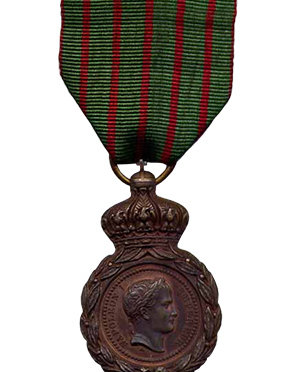
The Saint Helena Medal is of irregular (round) shape and struck in bronze. It measures 2 cm in diameter and its medallion is surrounded by a 50mm wide laurel wreath tied with a bow at the bottom.

Atop the medal there is a 2 cm wide Imperial Crown. The obverse bears the relief image of the right profile of Emperor Napoleon I surrounded by the relief inscription “NAPOLEON I EMPEREUR” (English: “NAPOLEON I EMPEROR”). A ring or small orbs separates the central medallion from the wreath. Just below the image of the emperor, a small anchor, the privy mark of the award’s designer, Désiré-Albert Barre.

The reverse is identical except for the medallion which bears the relief circular inscription within a narrow 20mm band “CAMPAGNES DE 1792 A 1815” (English: “CAMPAIGNS OF 1792 TO 1815”). In the centre, the relief inscription on nine lines “A” “SES” “COMPAGNONS” “DE GLOIRE” “SA DERNIÈRE” “PENSÉE” “STE HÉLÈNE” “5 MAI” “1821” (English: “TO HIS COMPANIONS IN GLORY HIS LAST THOUGHT ST HELENA 5 MAY 1821”).

The medal hangs from a 38mm wide green silk moiré ribbon bearing five 1,8mm wide red vertical stripes spaced 4,5mm apart and 1mm red edge stripes.

The German Armed Forces Deployment Medal

The German Armed Forces Deployment Medal is a decoration of the Bundeswehr awarded for military service in a designated military campaign.

The German Armed Forces Deployment Medal (or Einsatzmedaille der Bundeswehr in German) is a decoration of the Bundeswehr, the armed forces of the Federal Republic of Germany, awarded for military service in a designated military campaign.

It is awarded to all German soldiers regardless of rank. It is also the only type of German campaign medal awarded, the only difference is the campaign bar worn on the medal and ribbon.

The decoration has three grades. The grade is awarded without consideration of rank but by the time a served in the designated campaign area:

  • Bronze for 30 days in theatre.
  • Silver is for 360 days in theatre.
  • Gold for 690 days in theatre.

The medal has been awarded for 56 different operations or missions since its establishment. The medal is issued with a clasp denoting foreign the operation recognized by the medal. Like the medal the clasp is either, bronze, silver or gold.

The German Armed Forces Deployment Medal Design

The medal is round, on its center in the obverse is displayed the German eagle surrounded by a wreath of laurel leaves, the reverse side is plain. The combat version differs slightly from standard grades in that the medal is always golden with a black and red rim and a black eagle.

The ribbon has two black stripes on the edges with two red stripes beside it and two golden stripes on the in side with another bold red stripe in the middle, the ribbon bar has the campaign bar attached to it.

The Centenary Medal (Prussia)

The Kaiser Wilhelm Memorial Medal was established in 1897 by Wilhelm II to celebrate the 100th Birthday of his grandfather Emperor Wilhelm I.

The Kaiser Wilhelm Memorial Medal (also known as the Centenary Medal or Kaiser-Wilhelm-Erinnerungsmedaille Zentenarmedaille in German) was established on March 22, 1897 by Wilhelm II to celebrate the 100th Birthday of his grandfather, Emperor Wilhelm I.

The Centenary Medal was awarded by Prussia to state and university officials, as well as all military officers, non-commissioned officers and enlisted personnel, who had been actively serving in army, navy and Schutztruppe.

Medals were also awarded to the surviving veterans of the First Schleswig WarSecond Schleswig WarAustro-Prussian War, and the Franco-Prussian War.

The Centenary Medal Design

The Centenary Medal is struck made of bronze gunmetal from captured cannons. It measures 40 mm in diameter and is suspended from a ribbon 36 mm wide.

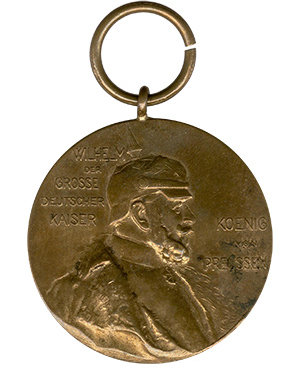
The obverse depicts a right facing effigy of Wilhelm I in military uniform wearing a mantle and Pickelhaube. To the left of the effigy is the inscription WILHELM / DER / GROSSE / DEUTSCHE / KAISER (William the Great German Emperor). To the right is KOENIG / VON / PREUSSEN (King of Prussia).

The reverse of the medal shows symbols of royal authority including the German State Crown, an orb, sword, and scepter placed upon a pillow surrounded by oak leaves, in the lower half of the medal. To the left is an upward climbing laurel branch. In the upper half is the inscription in six lines ZUM ANDENKEN AN DEN HUNDERTSTEN GEBURTSTAG DES GROSSEN KAISERS WILHELM I. 1797 22.MAERZ 1897 (IN MEMORY OF THE HUNDREDTH BIRTHDAY THE GREAT EMPEROR WILHELM I. 1797–MARCH 22–1897).

The China Medal (German Empire)

The China Medal is a medal of the German Empire established in 1901 by Kaiser Wilhelm II as King of Prussia and German Kaiser. 

The China Medal (or China-Denkmünze in German) is a medal of the German Empire established on 10 May 1901 by Kaiser Wilhelm II, in his capacity as King of Prussia and German Kaiser.

There were 14 medal clips awarded for involvement in battles.

The China Medal Design

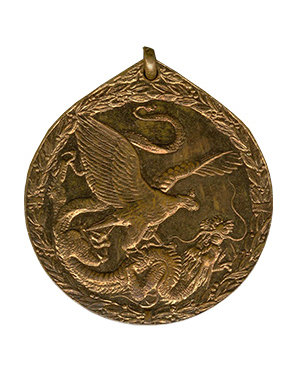
There were two versions of the China Medal: one in bronze and a variant in steel. Both measure 32.7 mm in diameter.

The bronze medal was rewarded for service by German troops and civilians during the Boxer Rebellion. The steel medal was awarded to those contributing to the war effort at home and the sailors of the merchant fleet transporting the soldiers to China.

The initial design came from Wilhelm II himself and was executed by professor Walter Schott. The medals were produced by the company Mayer & Wilhelm in Stuttgart.

The Colonial Medal (German Empire)

The Colonial Medal is a medal of the German Empire established in 1912 by Kaiser Wilhelm II and awarded retroactively.

The Colonial Medal (or Kolonial-Denkmünze in German) is a medal of the German Empire established on 13 June 1912 by Kaiser Wilhelm II and awarded retroactively for participation in military operations in the German colonies.

There were some exceptions: Those who had participated in the Boxer Rebellion 1900-01, and German South-West Africa in the years 1904-08. These operations were eligible for their own unique commemorative medal.

The medal was awarded with claps which were manufactured of gold plated brass. Claps were mounted on the ribbon of the medal.

The Colonial Medal Design

The Colonial medal is made of bronze. The obverse depicts the right-facing bust of Wilhelm II in uniform, with the initials W II. The reverse shows oak leaves on the right and a laurel branch on the left. In the center is the imperial crown which sits above the inscription “DEN TAPFEREN STREITERN FÜR DEUTSCHLANDS EHRE” (“The brave warriors for Germany’s honor”).

The ribbon is white with four thin red lines in the center and black stripes on the edges.

The War Commemorative Medal of 1870/71

The War Commemorative Medal of 1870/71 was a campaign medal presented by Kaiser William I in his capacity as King of Prussia.

The War Commemorative Medal of 1870/71 (or Kriegsdenkmünze für die Feldzüge 1870–71 in German) is a campaign medal presented by Kaiser William I in his capacity as King of Prussia to commemorate service in the Franco Prussian War.

The medal was presented to members of the united German armies. For combat service the medal was bronze, and non-combat service was steel. Each version bore minor differences in inscription and design. The war medal was presented to officers, military physicians, civil servants and men of the German armies who took part in the Franco-Prussian war through 2 March 1871. It was also awarded to the crew of the SMS Augusta for service from 11 December 1870 to 2 March 1871.

Clasps were authorized on the 25th anniversary of the German victory, to commemorate selected battles. The clasps were only allowed to be worn on combatant medals by front line soldiers. They are 6 mm high and 32–39 mm wide and were made of gilt bronze or brass.

The War Commemorative Medal Design

The medal for combatants was manufactured from captured bronze cannon barrels.

The obverse shows the crowned Royal cypher of William I over the inscription Dem siegreichen Heere (To the victorious army). Inscribed around the edge is Gott war mit uns, Ihm sei die Ehre (God was with us, to Him be the glory).

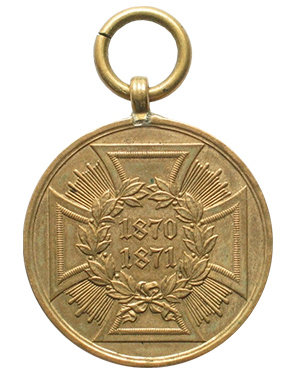
The reverse shows a cross with rays between the four arms. In the center of the cross is a laurel wreath surrounding the dates 1870 and 1871. On the edge of the coin is inscribed AUS EROBERTEM GESCHUETZ (From conquered cannon).

The medal for non-combatants is made of steel. It follows a similar design with only minor deviations. The center inscription on the obverse is Für Pflichttreue im Kriege (For devotion to duty in the war). On the reverse the wreath on the cross is of oak leaves.

The Warrior Merit Medal (Prussia)

The Warrior Merit Medal is a military decoration of Prussia established by Friedrich Wilhelm III and awarded primarily to troops.

  • Time Period: Pre-WW1
  • Institution: 1835
  • Country: Germany (Kingdom of Prussia)

The Warrior Merit Medal (or Krieger-Verdienstmedaille in German) is a military decoration of Prussia established by Friedrich Wilhelm III and awarded primarily to troops not in Prussian service.

The first recipients of the Warrior Merit Medal were members of the Imperial Guard grenadier company guarding the Russian imperial residence during Friedrich Whilhelm’s visit to St. Petersburg in 1835.

The Warrior Merit Medal Design

There are two versions of the Warrior Merit Medal. Both versions are circular and struck in silver, and measure 25 mm in diameter.

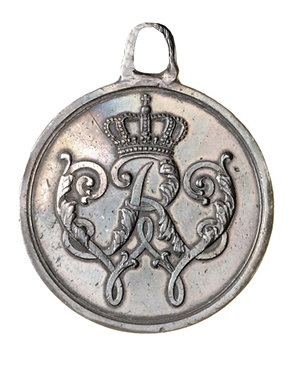
The first version depicts the crowned cypher of Friedrich Wilhelm III on the obverse of the medal. The reverse bears the inscription KRIEGER VERDIENST (Warrior Merit) surrounded by a wreath of two laurel sprigs, tied at its base with a bow. The medal is suspended by a ring suspension and hangs from the ribbon of the Order of the Red Eagle.

The later version of the medal depicts the crowned cipher of King Wilhelm I on the obverse. The reverse is also inscribed KRIEGER VERDIENST and surrounded by a thicker laurel wreath than the early version.

The medal is suspended by a ring and hangs from the black with white stripes kämpferband (combatants ribbon) or the white with black stripe nichtkämpferband (non-combatants ribbon).

The Wilhelm Orden

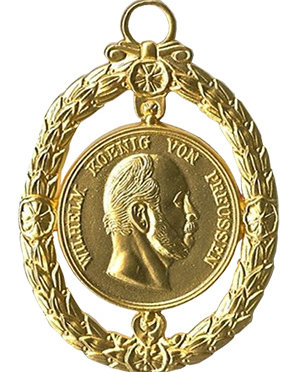
The Wilhelm-Orden was instituted on 18 January 1896 by the German Emperor and King of Prussia Willhelm II as a high civilian award.

The Wilhelm-Orden (or “William-Order” in English) was instituted on 18 January 1896 by the German Emperor and King of Prussia Willhelm II as a high civilian award. The order was dedicated to the memory of his grandfather Emperor William I “the Great”.

The order was very exclusive. One of the first to be decorated was Otto von Bismarck.

The Wilhelm Order Design

The insignia of the Order consists of a golden medal with the portrait of William I, surrounded by a golden wreath and suspended from a heavy golden collar. It was designed by the jewellers Emil Weigand en Otto Schultz.

The collar weights 222 grams and bears the words “WIRKE IM ANDENKEN AN KAISER WILHELM DEN GROSSEN” (“Work in the memory of Emperor William the Great”).

More Prussian Orders

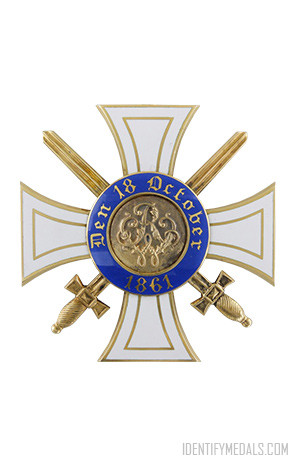
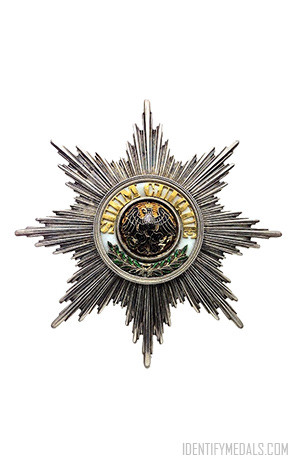
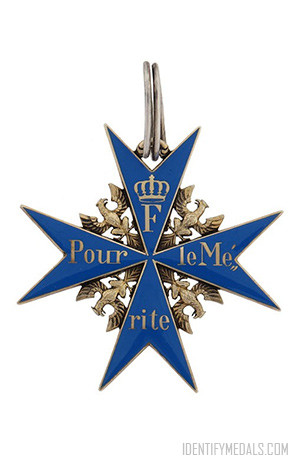
Throughout Prussian history, these orders played a significant role in the social hierarchy and served as tangible expressions of royal favor and recognition. They continued to be awarded even after the dissolution of the Kingdom of Prussia, remaining as enduring symbols of valor, service, and honor in German society. Here are some more about Prussian Orders:

The U-boat War Badge (WW1)

The U-boat War Badge was a German war badge that was awarded to U-boat (submarine) crew members during World War I and World War II.

The U-boat War Badge (or U-Boot-Kriegsabzeichen in German) was a German war badge that was awarded to U-boat (submarine) crew members during World War I and also World War II. It was originally instituted during WW1 on February 1, 1918, to recognize U-boat crews who had completed three war patrols. 

The U-Boat War Badge Design

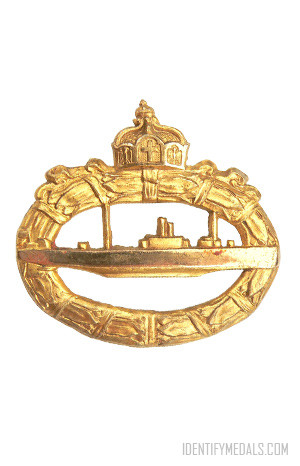
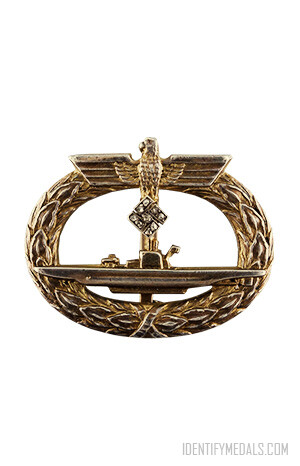
The badge was worn on the lower left side of the uniform and was oval shaped resembling a wreath of laurel leaves. On the obverse is a submarine laying across the center. The German State Crown is inlaid at the top center of the wreath.

The 1939 version was very similar to the original badge with the exception of the imperial crown being replaced with a German Eagle above a swastika, and a more modernized submarine now facing towards the left was used.

The new version was first made of bronze metal, with later ones made of zinc with a “gold wash”.

More Variants of the U-Boat Badge

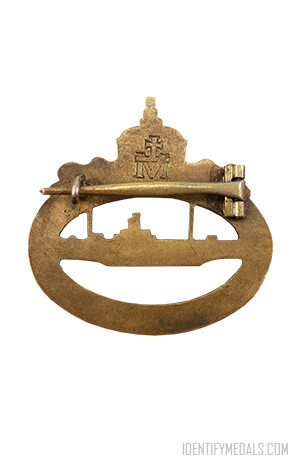
Imperial U-Boat Badge, reverse.
Imperial U-Boat Badge, reverse. The "M" is an original maker mark but the manufacturer is unknown.
The U-boat War Badge - German WW1 Medals & Badges
The WW1 U-boat War Badge - Obverse.
U-Boat Badge with diamonds, reverse.
German WW2 U-Boat Badge with diamonds. 1939 version, obverse.

Find an U-Boat War Badge

Right Now on eBay 
Clicking a link to eBay may result in a referral commission being paid if a purchase is made.
Loading...