
The U-boat War Badge (Nazi Germany)

The U-boat War Badge (or U-Boot-Kriegsabzeichen) was a German war badge that was awarded to U-boat (submarine) crew members in WW2.

The U-boat War Badge (or U-Boot-Kriegsabzeichen in German) was a German war badge that was awarded to U-boat (submarine) crew members during World War I and World War II.

The original U-boat War Badge was originally instituted during WW1 on February 1, 1918, to recognize U-boat crews who had completed three war patrols. On October 13, 1939, the U-boat War Badge was reinstituted and bestowed in two classes:

  • U-Boat War Badge: For the completion of two or more war patrols. Completing two war patrols could be equally dangerous as the U-boat has to endure constant attacks by Allied aircraft and warships. The other occasion when this badge was awarded was having been wounded during a patrol or killed in action.
  • U-boat War Badge with Diamonds: It was instituted by Großadmiral Karl Dönitz after he had received from Grand Admiral Erich Raeder a special solid gold version of the U-boat War Badge in which the wreath as well as the swastika were inlaid with diamonds.

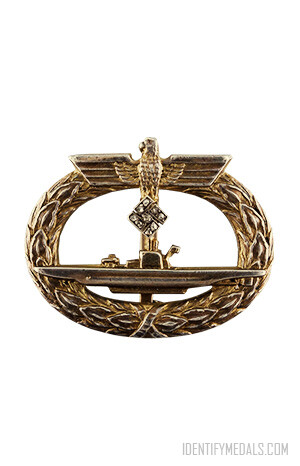
This second version of the badge was a special issue award given to U-boat commanders who had received the Knight’s Cross of the Iron Cross with Oak Leaves. Made of gold plate over silver and manufactured by Schwerin u. Sohn and Gebr. Godet & Co., it was the same as the basic pattern but with nine small diamonds inlaid in the swastika. 

This award was more of a personal award by Dönitz, and approximately 30 were awarded, including the original one to Admiral Dönitz.

The U-Boat War Badge Design

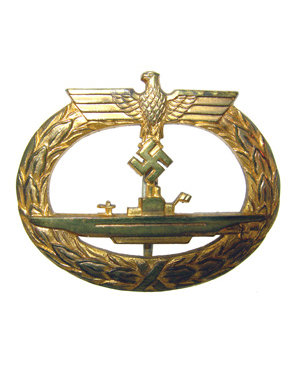
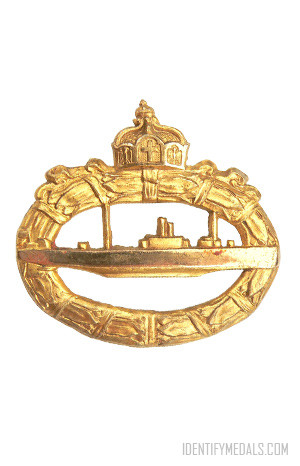
The badge was worn on the lower left side of the uniform and was oval shaped resembling a wreath of laurel leaves. A submarine lay across the center and the German State Crown was inlaid at the top center of the wreath.

The 1939 version was very similar to the original badge with the exception of the imperial crown being replaced with a German Eagle above a swastika, and a more modernized submarine now facing towards the left was used.

The new version was first made of bronze metal, with later ones made of zinc with a “gold wash”.

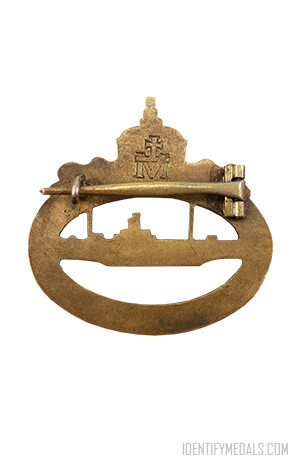
Imperial U-Boat Badge, reverse.
Imperial U-Boat Badge, reverse. The "M" is an original maker mark but the manufacturer is unknown.
The U-boat War Badge - German WW1 Medals & Badges
The WW1 U-boat War Badge - Obverse.
U-Boat Badge with diamonds, reverse.
German WW2 U-Boat Badge with diamonds. 1939 version, obverse.

Find an U-Boat War Badge

Right Now on eBay 
Clicking a link to eBay may result in a referral commission being paid if a purchase is made.
Loading...

More Naval War Badges

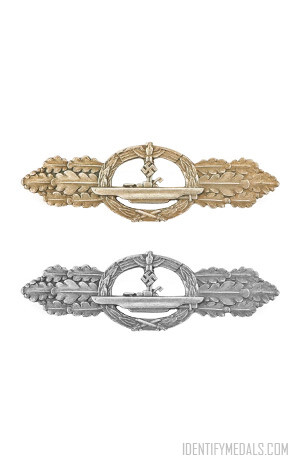
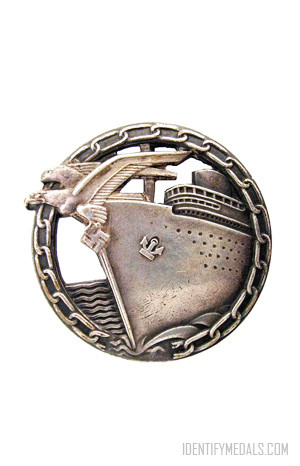
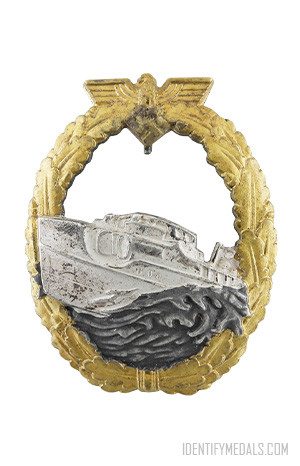
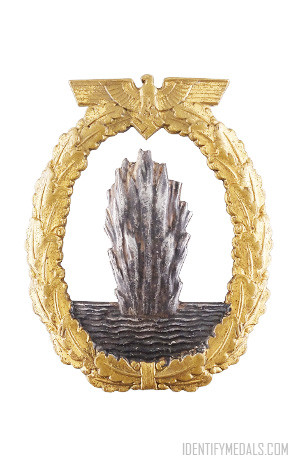
The Naval War Badges (Kriegsmarine) badges were awarded to sailors, officers, and personnel of the Kriegsmarine who demonstrated exceptional skill, bravery, and dedication in naval warfare. Explore the complete collection below:

The Memel Medal

The Return of Memel Commemorative Medal is a decoration of Nazi Germany awarded during the interwar period, and the last of a series.

The Return of Memel Commemorative Medal (or Medaille zur Erinnerung an die Heimkehr des Memellandes; 22. März 1939 in German) is a decoration of Nazi Germany awarded during the interwar period, and the last of the series of German Occupation Medals.

Germany annexed the Klaipėda Region (Memel Territory) from Lithuania on 22 March 1939 after an oral ultimatum. On 23 March an occupation of the city and district was carried out by German Army troops. To commemorate the occupation the “Memel Medal” was authorized on 1 May 1939.

It was awarded until 31 December 1940. The award was presented to all military, political and civil personnel who had distinguished themselves in actions related to the annexation of the district to Germany. In all 31,322 medals were awarded.

The Memel Medal Design

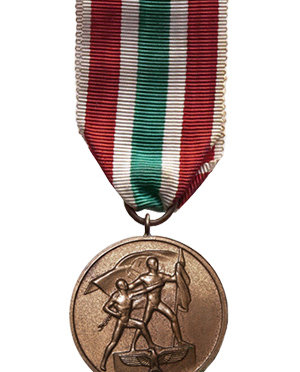
The medal was designed by Professor Richard Klein and die struck in bronze. It was worn on the left tunic pocket suspended from a white ribbon with a green strip in the middle and two red strips on each side, the historic colors of Lithuania Minor.

The obverse was the exactly the same as the previous two medals, but the reverse reads “Zur Erinnerung an die Heimkerhr des Memellandes 22. März 1939” (To commemorate the return of the Memel District. 22 March 1939), surrounded by an oak leave wreath.

The Operational Service Medal Iraq and Syria

The Operational Service Medal Iraq and Syria is a British armed forces campaign medal awarded mostly to military personnel.

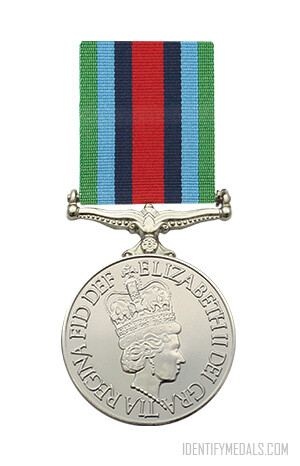
The Operational Service Medal Iraq and Syria (also known as Operation Shader Medal) is a British armed forces campaign medal awarded mostly to military personnel who served in the operational area of, or in support of Operation Shader.

The Operational Service Medal (Iraq and Syria) was first announced by former Defence Secretary, Sir Michael Fallon on 19 September 2017 and was first awarded in July 2018 in London by Defence Secretary Gavin Williamson. The medal is awarded either for 30 days continuous, or 45 days cumulative, service in theatre.

The Operational Service Medal Iraq and Syria Qualifying Criteria

This Operational Service Medal is the first to be awarded to individuals who served outside of the operational area, reflecting the changing nature of warfare. The Operational Service Medal (OSM) was established in 1999 to replace the General Service Medal (1962) for all new operations.

Clasp: Iraq & Syria clasp awarded to those recipients who served in the operational area. A silver rosette denotes the clasp when worn on the ribbon bar.

The Operational Service Medal Iraq and Syria Design

The Operational Service Medal for Iraq and Syria is struck in silver and circular in shape.

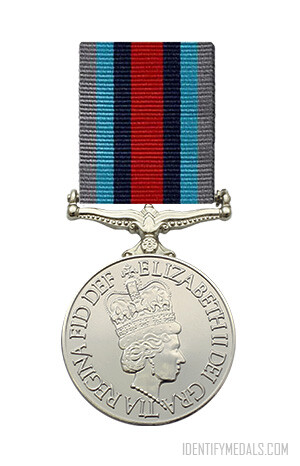
The obverse shows the crowned effigy of Queen Elizabeth II with the inscription ELIZABETH II DEI GRATIA REGINA FID. DEF. 

The reverse displays the Union Flag, surrounded by the inscription FOR OPERATIONAL SERVICE and the four major points of the compass with, between the points, four Coronets: Royal (top left), Naval (top right), Mural-Army (bottom left), and Astral-Royal Air Force (bottom right).

The ribbon is a broad central red stripe, flanked each side by a stripe of navy blue and one of light blue, to represent the three services, with an outer stripe of grey.

The General Service Medal Variants

The OSM has been awarded for four separate campaigns, each with a distinctive ribbon. The other three are:

Buy an OSM Medal Online

Right Now on eBay 
Clicking a link to eBay may result in a referral commission being paid if a purchase is made.
Loading...

The Ebola Medal for Service in West Africa

The Ebola Medal for Service in West Africa (also known simply as the Ebola Medal) is a service medal issued to the Armed Forces and to civilians, working either for Her Majesty’s Government or for non-governmental organisations, in support of the British Government’s response to the Ebola crisis in West Africa between March 2014 and March 2016.

The medal is the first medal awarded by the UK Government for a humanitarian crisis response.

The medal is awarded either for 21 days of continuous service within the operating area, or 30 days accumulated service on working visits of 48 hours or more to the operating area. The following groups are eligible for award:

  • Military personnel under the command of Commander, Joint Operations, and other members of UK Armed Forces providing direct support to HM Government’s response.
  • Any volunteer or employee directly deployed by the Department for International Development (DFID), UK-Med, Public Health England, the National Health Service or the Stabilisation Unit in support of HM Government’s response.
  • Any member of Her Majesty’s Civil Service.
  • Any UK national employed by an NGO funded by the DFID supporting HM Government’s response.
  • Any UK national responding to the Ebola crisis in support of HM Government’s response whose service can be verified.

The Ebola Medal for Service Design

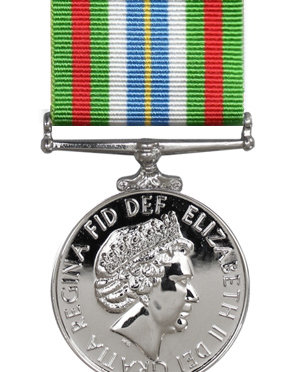
The medal is circular, struck in nickel-silver and manufactured by Worcestershire Medal Service. It measures  36mm diameter and is suspended from a ribbon by way of a swivel straight bar.

The obverse was designed by Ian Rank-Broadley, has the legend “ELIZABETH II DEI GRATIA REGINA FID.DEF.” and the effigy of Elizabeth II wearing the Girls of Great Britain and Ireland tiara.

The reverse is designed by John Bergdahl, and features a flame on a background depicting the Ebola virus – above this are the words “For Service” and below “West Africa Ebola Epidemic”.

The name of the recipient (name and title if civilian; name, rank and serial number if military) is engraved on the rim of the medal.

The ribbon is a central yellow stripe, flanked by blue and white stripes, and symmetrical red stripes flanked by green stripes either side. These represent the colours from the national flags of the countries in West Africa affected by Ebola.

The Civilian Service Medal (Afghanistan)

The Civilian Service Medal (Afghanistan) is a medal awarded by the British government to civilians (and members of the UK Armed Forces in certain non-combat roles) to recognize service since 19 November 2001 in the transition to democracy in Afghanistan.

The medal can be awarded to:

  • Crown servants, whether recruited in the United Kingdom, Afghanistan or elsewhere;
  • who have served in the geographical territory of Afghanistan on or after 19 November 2001, for 30 days continuously, or 45 days aggregated;
  • No minimum qualifying period for those killed, captured, wounded or disabled during service;
  • The medal was not awarded to those eligible for the Operational Service Medal for Afghanistan.
  • Locally employed civilians were not eligible.

The Civilian Service Medal Design

The Civilian Service Medal (Afghanistan) is circular and measures 36.07 mm in diameter and 4 mm thick. It’s struck in cupro-nickel with a rhodium plating/coating.

On the obverse, the medal has the Ian Rank-Broadley effigy of Queen Elizabeth II with the wording ELIZABETH II DEI GRATIA REGINA FID DEF.

On the reverse, there’s an Afghanistan mountain scene with the word Afghanistan written in Latin and Arabic lettering. The recipient’s name is inscribed on the rim.

  • The medal has a plain, straight suspender. The 32 millimeter-wide ribbon is sand-colored with a broad green central stripe and narrow pale grey stripes towards each edge. The ribbon is the same as for the Iraq Reconstruction Service Medal but with grey, rather than blue thin stripes.

The Iraq Reconstruction Service Medal

Time Period: Post-WW2
Year of Institution: 26 June 2004
Country: Great Britain

The Iraq Reconstruction Service Medal is a British service medal awarded to civilian public servants, contractors and consultants, and to members of the Armed Forces working with British Government Departments, who were either appointed, deployed or employed by Her Majesty’s Government (HMG) to work in Iraq, and who had served at least 40 days. The medal is distributed by the Foreign and Commonwealth Office.

The Iraq Reconstruction Service Medal was not awarded for service that also qualified for the Iraq military (campaign) Medal, although both medals could be awarded for different periods and types of service.

There are no clasps for this medal.

The Iraq Reconstruction Service Medal Design

The medal is circular, made of plated cupro-nickel and produced by the Royal Mint. It measures 36 mm in diameter.

The obverse has the Ian Rank-Broadley effigy of Elizabeth II, with the legend “ELIZABETH II DEI GRATIA REGINA FID.DEF.”

On the reverse are cuneiform symbols which can be roughly translated as “land bringing forth life”, with the stylized depiction of two rivers, based on a relief carving from Mesopotamia in the British Museum. Below is the word “IRAQ”.

The recipient’s name is inscribed on rim of the medal. The ribbon is 32 mm wide and sand-colored with a broad green central stripe and narrow blue stripes towards each edge.

The Iraq Medal

The Iraq Medal is a campaign medal issued to members of the British Armed Forces and certain attached personnel who served between 20 January 2003 and 22 May 2011 on, or in support of, Operation Telic.

The Iraq Medal is a campaign medal issued to members of the British Armed Forces and certain attached personnel who served between 20 January 2003 and 22 May 2011 on, or in support of, Operation Telic – the designation for British operations during the 2003 Invasion of Iraq and its aftermath. It was authorized on 23 February 2004.

The medal was awarded to those meeting the qualifying period of service within the defined operational area. Eligibility was extensive, and included both Regular and Reserve members of the armed forces, foreign and Commonwealth exchange and attached forces, Ministry of Defence civilians, members of the Royal Fleet Auxiliary and embedded journalists.

The medal was awarded with the clasp “19 Mar to 28 Apr 2003″ to British service and attached personnel who:

  • served in Zone 1 (Iraq) between 19 March and 28 April 2003, and:
  • completed seven days continuous service; or
  • served as aircrew flying into Iraq and who completed two or more operational sorties.

A silver rosette denotes the clasp when worn on the ribbon bar.

The Iraq Medal Design

The Iraq Medal is made of cupro-nickel and measures 36 millimeters (1.4 in) in diameter.

The obverse shows the crowned effigy of Queen Elizabeth II facing right, with the inscription ELIZABETH II DEI GRATIA REGINA FID DEF. The reverse shows an image of a Lamassu (an ancient Assyrian statue) above the word IRAQ.

The ribbon measures 32 millimeter (1.25 in) wide and is sand color with three narrow central stripes of black, white, red representing the Iraqi flag.

Find This Medal

Right Now on eBay 
Clicking a link to eBay may result in a referral commission being paid if a purchase is made.
Loading...

The OSM for the Democratic Republic of Congo

The Operational Service Medal for the Democratic Republic of the Congo is a British armed forces campaign medal awarded to military personnel who had served between 14 June and 10 September 2003 on Operation Coral.

The medal with clasp is awarded for 25 days continuous service in Bunia in the Ituri Province of the Congo, or five return operational flights between Entebbe and Bunia, between 14 June and 10 September 2003 on Operation Coral.

The medal was established in 1999 to replace the General Service Medal (1962) for all new operations.  It has been awarded for three separate campaigns:

A DROC clasp awarded with every medal. A silver rosette denotes the clasp when worn on the ribbon bar.

The General Service Medal for Afghanistan Design

The Operational Service Medal for the Democratic Republic of Congo is struck in silver and circular in shape.

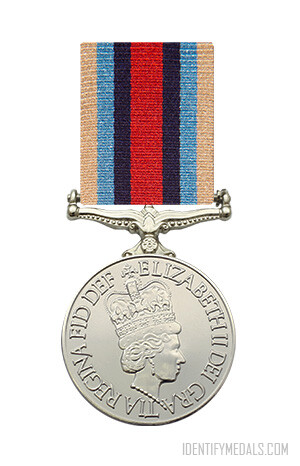
The obverse displays the crowned effigy of Queen Elizabeth II with the inscription ELIZABETH II DEI GRATIA REGINA FID. DEF.

The reverse shows the Union Flag, surrounded by the inscription FOR OPERATIONAL SERVICE and the four major points of the compass with, between the points, four Coronets: Royal (top left), Naval (top right), Mural-Army (bottom left), and Astral-Royal Air Force (bottom right).

The ribbon is a broad central red stripe, flanked each side by a stripe of navy blue and one of light blue, to represent the three services, with an outer stripe of ochre, to represent the Congolese landscape.

The Operational Service Medal for Afghanistan

The Operational Service Medal for Afghanistan is a campaign medal awarded for service by British Armed Forces in support of the Afghan War.

The Operational Service Medal for Afghanistan is a campaign medal awarded for service by British Armed Forces personnel in support of the post-2001 Afghan War by the Ministry of Defence of the United Kingdom.

The Operational Service Medal was established in 1999 to replace the General Service Medal (1962) for all new operations. A separate medal of the same design is awarded for each campaign, differentiated by a distinct ribbon and, where appropriate, a specific clasp.

The General Service Medal for Afghanistan Qualifying Criteria

The Operational Service Medal for Afghanistan can be awarded both with and without a clasp inscribed ‘AFGHANISTAN‘. A silver rosette on the ribbon denotes entitlement to the clasp when no medal is worn.

The medal is also awarded to UK civilians employed on Ministry of Defence contracts in support of the British Forces in Afghanistan.

The General Service Medal for Afghanistan Design

The GSM for Afghanistan medal is struck in silver and circular in shape.

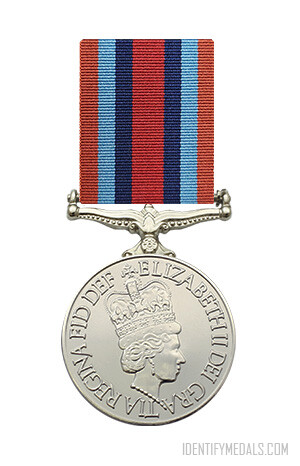
The obverse shows the crowned effigy of Elizabeth II with the inscription “ELIZABETH II DEI GRATIA REGINA FID. DEF..”

The reverse bears the Union Flag, surrounded by the inscription FOR OPERATIONAL SERVICE and the four major points of the compass with, between the points, four Coronets: Royal (top left), Naval (Navy, top right), Mural (Army, bottom left), and Astral (Royal Air Force, bottom right).

The ribbon consists of a broad central red stripe, flanked each side by a stripe of navy blue and one of light blue, to represent the three services, with an outer stripe of light brown, to represent the Afghan landscape.

The General Service Medal Variants

The OSM has been awarded for four separate campaigns, each with a distinctive ribbon. The other three are:

Buy an OSM Medal Online

Right Now on eBay 
Clicking a link to eBay may result in a referral commission being paid if a purchase is made.
Loading...

The Operational Service Medal for Sierra Leone

The Operational Service Medal for Sierra Leone is a campaign medal awarded for participation in the Sierra Leone Civil War.

The Operational Service Medal for Sierra Leone is a campaign medal awarded for participation in the British military intervention during and after the Sierra Leone Civil War, from May 2000 to July 2002. The medal was established in 2000 by the Ministry of Defence of the United Kingdom.

The Operational Service Medal (also known as OSM) was established in 1999 to replace the General Service Medal (1962) for all new operations. A separate medal of the same design is awarded for each campaign, differentiated by a distinct ribbon. 

The General Service Medal for Sierra Leone Qualifying Criteria

The length of service to qualify for the medal is determined by the mission participated in:

  • 1 day of service on Operations Barras or Maidenley
  • 14 days continuous or accumulated service on Operation Palliser
  • 30 days continuous or accumulated service on Operations Basillica or Silkman.

No clasp was issued for this medal. A large South Atlantic Medal type silver rosette is worn on the medal for operational service within Sierra Leone during Operations Maidenly and Barras. A smaller rosette is worn on the ribbon bar.

The General Service Medal for Sierra Leone Design

The Operational Service Medal for Sierra Leone is struck in silver and circular in shape.

The obverse shows the crowned effigy of Queen Elizabeth II with the inscription ELIZABETH II DEI GRATIA REGINA FID. DEF.

The reverse bears the Union Flag, surrounded by the inscription FOR OPERATIONAL SERVICE and the four major points of the compass with, between the points, four Coronets: Royal (top left), Naval (top right), Mural (Army, bottom left), and Astral (RAF, bottom right).

The ribbon consists of a broad central red stripe, flanked each side by a stripe of navy blue and one of light blue, to represent the three services, with an outer stripe of green to reflect the jungle landscape of Sierra Leone.

The General Service Medal Variants

The OSM has been awarded for four separate campaigns, each with a distinctive ribbon. The other three are:

Buy an OSM Medal Online

Right Now on eBay 
Clicking a link to eBay may result in a referral commission being paid if a purchase is made.
Loading...