The Mexican Service Medal

The Mexican Service Medal is an American award given for service in Mexico from 1911 to 1919. It was established in 1917.

The Mexican Service Medal is a United States military award recognizing service in Mexico from 1911 to 1919.

The Army version of the Mexican Service Medal was established on December 12, 1917, by General Orders from the United States War Department. The Navy version followed, established by Navy Department General Orders Number 365 on February 11, 1918, and later amended by General Orders No. 464 on April 27, 1919. This medal honors servicemen who participated in military actions against Mexican forces from April 12, 1911, to June 16, 1919.

To receive the Mexican Service Medal, servicemen had to engage in one of the specified military actions:

  • Veracruz Expedition: April 21 to November 23, 1914
  • Punitive Expedition into Mexico: March 14, 1916 to February 7, 1917
  • Buena Vista, Mexico: December 1, 1917
  • Aftermath of Brite Ranch raid, San Bernardino Canyon: December 26, 1917
  • La Grulla, Texas: January 8–9, 1918
  • Aftermath of Neville Ranch raid, Pilares, Chihuahua: March 28, 1918
  • Battle of Nogales, Arizona: November 1–26, 1915, or Ambos Nogales: August 27, 1918
  • Battle of Ciudad Juárez: June 15–16, 1919

The Navy also awarded the medal to those who served on U.S. naval vessels patrolling Mexican waters during the designated periods or who were involved in the above actions.

The medal was awarded only once, with no service stars for multiple engagements. Soldiers cited for gallantry could receive the Citation Star on their Mexican Service Medal. No additional devices were authorized for the Navy version.

The Mexican Service Medal Design

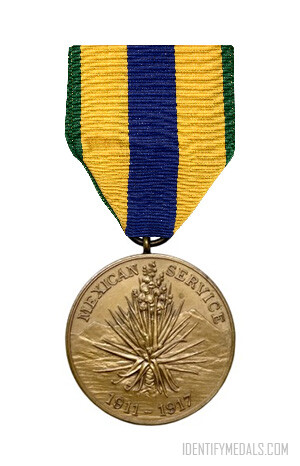
The medal is bronze and includes engravings that signify service and participation in the specified military engagements. The distinct designs for the Army and Navy versions reflect the different branches’ traditions and service contexts.

The designs are:

  • Army Version: Engraved with a yucca plant.
  • Navy Version: Depicts the San Juan de Ulúa fortress in Veracruz harbor. Both versions bear the inscription “1911 – 1917.”

The Antarctica Service Medal

The Antarctica Service Medal was established in 1960 and intended as a military award for previous Antarctica expeditions from 1928 to 1941.

The Antarctica Service Medal (ASM) was established on July 7, 1960, by the United States Congress through Public Law 600 of the 86th Congress. This medal was created to serve as a military award, replacing several commemorative awards issued for prior Antarctic expeditions from 1928 to 1941. The medals made obsolete by the creation of the ASM include the Byrd Antarctic Expedition Medal, the Second Byrd Antarctic Expedition Medal, and the United States Antarctic Expedition Medal.

The ASM is a recognized award of the United States Armed Forces, authorized for wear on active duty uniforms and issued in the name of the U.S. Department of Defense. It can also be awarded to U.S. civilians and foreign citizens participating in U.S. Antarctic expeditions at the invitation of a U.S. agency, such as the National Science Foundation.

The Antarctica Service Medal Criteria

Eligibility for the Antarctica Service Medal requires personnel to train or serve for ten days on the Antarctic continent or on vessels in Antarctic waters (south of 60 degrees latitude). Flight crews qualify by performing transport missions to Antarctica, with one day of service credited for each mission within a 24-hour period. Civilians working in research facilities or on research vessels south of 60 degrees latitude for at least ten days (or thirty days before October 10, 2008) are also eligible, facilitated through the National Science Foundation.

The Antarctica Service Medal Design

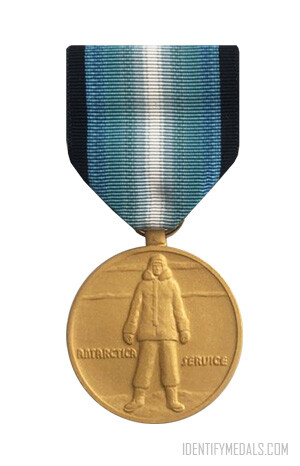
The medal is a 1¼ inch bronze piece. The obverse features a polar landscape with a figure in Antarctic clothing, flanked by the words “ANTARCTICA” and “SERVICE.” The reverse displays a polar projection of Antarctica with geodesic lines, overlaid with the words “COURAGE,” “SACRIFICE,” and “DEVOTION,” encircled by penguins and marine life.

The service ribbon, 1⅜ inches wide, has a design symbolizing the Antarctic environment: black and dark blue edges represent five months of darkness, while the center, with colors grading from white to medium blue, symbolizes seven months of sunlight and the aurora australis.

Buy this Medal

Right Now on eBay 
Clicking a link to eBay may result in a referral commission being paid if a purchase is made.
Loading...

The Korea Defense Service Medal

The Korea Defense Service Medal is an American military service medal awarded to those who have served duty in South Korea in the 1950s.

The Korea Defense Service Medal (KDSM) is a military decoration of the United States Armed Forces, established in 2002 through legislation signed by President George W. Bush. The initiative to create this medal was led by Representative Elton Gallegly (R-CA) and Senator Jeff Bingaman (D-NM). John Sproston designed the final version of the medal.

Recipients of the KDSM are eligible for membership in veterans’ organizations such as the Veterans of Foreign Wars (VFW) and the American Legion.

The Korea Defense Service Medal Criteria

The KDSM is awarded to U.S. Armed Forces members who have served in South Korea in support of its defense post-Korean Armistice Agreement. To qualify, a service member must have served at least 30 consecutive days or 60 non-consecutive days in the South Korean theater. This includes reservists on annual training. Exceptions to the time requirement include participation in combat, injury in the line of duty requiring medical evacuation, or aircrew members who have logged over 30 days of sorties in South Korean airspace.

The medal is retroactive to service performed after July 28, 1954. The National Personnel Records Center verifies the entitlement for discharged members who served in South Korea before the KDSM’s creation. Additionally, service members can receive both the Armed Forces Expeditionary Medal and the KDSM for the same period between October 1, 1966, and June 30, 1974. Only one KDSM is awarded per individual, regardless of the length of service in South Korea.

The Korea Defense Service Medal Design

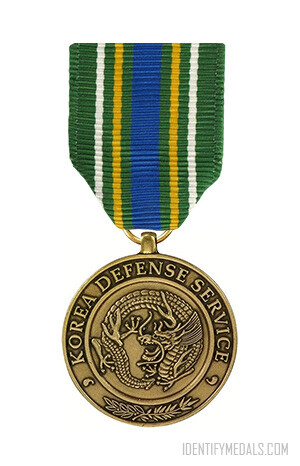
The KDSM is a bronze medal measuring 1¼ inches in diameter. The obverse features a Korean “circle dragon” with a scroll inscribed “KOREA DEFENSE SERVICE,” flanked by laurel and bamboo sprigs.

The reverse side displays the outline of the Korean Peninsula with two crossed swords.

The medal’s ribbon is mainly green with an ultramarine blue stripe in the center, flanked by golden yellow and white stripes.

Buy this Medal

Right Now on eBay 
Clicking a link to eBay may result in a referral commission being paid if a purchase is made.
Loading...

The Royal Air Force Long Service and Good Conduct Medal

The Royal Air Force Long Service and Good Conduct Medal was instituted by King George V in 1919 and awarded to officers and airmen.

The Royal Air Force Long Service and Good Conduct Medal is awarded to regular members of the Royal Air Force in recognition of their long service and exemplary conduct.

Instituted by King George V in 1919, following the establishment of the world’s first independent air force, the medal was initially awarded to non-commissioned officers and airmen. The criteria were later broadened to include officers who had served a minimum period in the ranks before being commissioned. Since 2016, all regular members of the RAF, including officers who have never served in the ranks, are eligible for this medal.

Originally, the medal was awarded after eighteen years of unblemished service, later reduced to fifteen years from December 1, 1977. An airman became eligible upon completing the requisite service period, provided there were no disqualifying offenses. Recommendations for the medal required a commanding officer’s endorsement and were awarded only to serving personnel. Before 1944, up to four years of service in the Royal Navy or British Army could count towards the RAF service requirement. During wartime or emergencies, the medal could be awarded for distinguished service without the usual time or conduct requirements.

The Royal Air Force Long Service and Good Conduct Medal Design

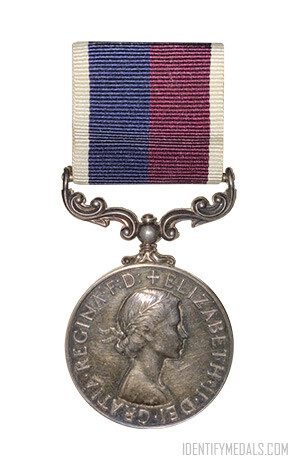
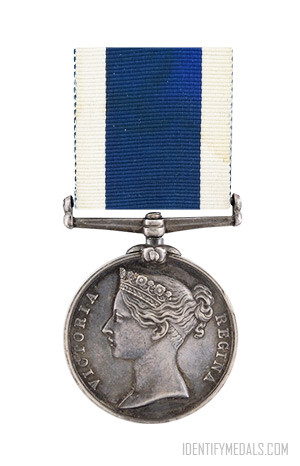
The silver medal is a 36-millimeter disk, with the obverse featuring the effigy of the reigning monarch.

The reverse displays the RAF eagle with outstretched wings, surmounted by the crown, and the inscription “FOR LONG SERVICE AND GOOD CONDUCT.” The clasp features an eagle with outstretched wings and a crown, with a silver rosette on the ribbon bar denoting the award in undress uniform.

The ribbon is 32 millimeters wide with distinct bands of white, dark blue, and crimson.

More British Long Service and Good Conduct Decorations

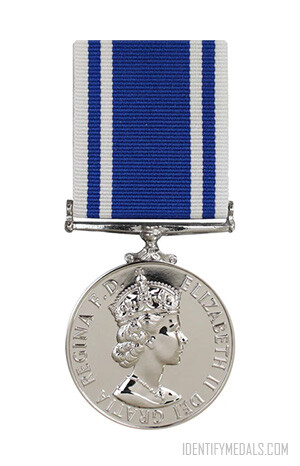
The British military has instituted several Long Service and Good Conduct Decorations, each honoring the dedication and exemplary service of its personnel across different branches. Here are some other ones from different time periods:

Find these medals online:

Right Now on eBay 
Clicking a link to eBay may result in a referral commission being paid if a purchase is made.
Loading...

The Permanent Forces of the Empire Beyond the Seas Medal

The Permanent Forces of the Empire Beyond the Seas Medal was established in 1910 to supersede the several local versions of the Army one.

The Permanent Forces of the Empire Beyond the Seas Medal, also known as the Permanent Overseas Forces Long Service and Good Conduct Medal, was established in 1910 to recognize long service and good conduct among other ranks of the Permanent Forces of the Dominions and Colonies of the British Empire.

This medal replaced the various local versions of the Army Long Service and Good Conduct Medal. Superseded in 1930 by the Medal for Long Service and Good Conduct (Military), it continued the tradition of honoring exemplary service.

Commonwealth of Australia Version

The Commonwealth of Australia version of the Army Long Service and Good Conduct Medal emerged following Australia’s federation on 1 January 1901.

The five distinct medals for New South Wales, Queensland, South Australia, Tasmania, and Victoria were unified into a single version with King Edward VII’s effigy and the inscription “COMMONWEALTH OF AUSTRALIA” on the reverse.

These medals retained the same crimson ribbon, but with a distinctive 4-millimeter central band representing the Commonwealth. This version was part of the broader effort to standardize awards across the British Empire’s territories.

The Permanent Forces of the Empire Beyond the Seas Medal Design

The Permanent Forces of the Empire Beyond the Seas Medal is crafted in silver, with a diameter of 36 millimeters (1.42 inches) and a thickness of 3 millimeters (0.12 inches). It features a single-toe claw mounting, secured to the medal by a horizontal pin through its upper edge, and is supported by double-scroll claws on the rim. The medal is attached to a straight, swiveling suspension bar.

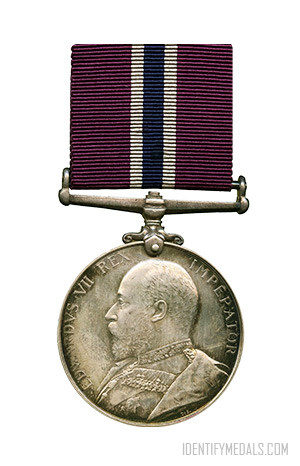
The initial version of the medal’s obverse showcases the effigy of King Edward VII in a Field Marshal’s uniform, facing left, with the inscription “EDWARDVS VII REX IMPERATOR” around the edge. Following the coronation of King George V on June 22, 1911, the obverse was updated to depict his effigy, also in a Field Marshal’s uniform and facing left, with the inscription “GEORGIVS V BRITT: OMN: REX ET IND: IMP:” around the perimeter.

The reverse side of the medal is smooth with a raised rim. It features the inscription “PERMANENT FORCES OF THE EMPIRE BEYOND THE SEAS” around the edge, and “FOR LONG SERVICE AND GOOD CONDUCT” in four lines at the center.

The medal is suspended from a ribbon that is 32 millimeters wide. The ribbon consists of an 11.5-millimeter wide crimson band and a 2.5-millimeter wide white band, repeated in reverse order and separated by a 4-millimeter wide dark blue band.

More British Long Service and Good Conduct Decorations

The British military has instituted several Long Service and Good Conduct Decorations, each honoring the dedication and exemplary service of its personnel across different branches. Here are some other ones from different time periods:

Find these medals online:

Right Now on eBay 
Clicking a link to eBay may result in a referral commission being paid if a purchase is made.
Loading...

The Army Long Service and Good Conduct Medal

This Army long service medal was instituted by King William IV in 1830 and remained in use for a hundred years, until 1930.

Instituted by King William IV in 1830, the Army Long Service and Good Conduct Medal was awarded for long service and exemplary conduct. It remained in use until 1930, when it was replaced by the Medal for Long Service and Good Conduct.

On 31 May 1895, Queen Victoria authorized Dominion and Colonial governments to adopt various military medals, including the Army Long Service and Good Conduct Medal, for their local military forces. Territories that utilized this authorization included Canada, Cape of Good Hope, India, Natal, New South Wales, New Zealand, Queensland, South Australia, Tasmania, Victoria, and, from 1901, the Commonwealth of Australia.

Originally awarded for 21 years (infantry) or 24 years (cavalry) of service, the qualifying period was reduced to 18 years in 1870.

The Army Long Service and Good Conduct Medal Design

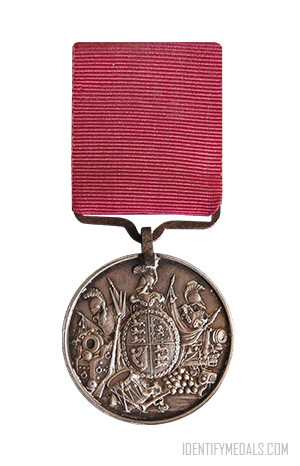
Initially featuring a Trophy of Arms and the Royal Coat of Arms, the medal’s obverse changed with each monarch. The reverse consistently displayed “FOR LONG SERVICE AND GOOD CONDUCT”.

Authorized in 1895 for Dominion and Colonial forces, these medals were similar but included specific territory names and unique ribbon colors. Made of silver, 36mm in diameter, the medal’s suspension evolved over time, with the ribbon changing in 1916 to a crimson or reddish-violet with white edges.

More British Long Service and Good Conduct Decorations

The British military has instituted several Long Service and Good Conduct Decorations, each honoring the dedication and exemplary service of its personnel across different branches. Here are some other ones from different time periods:

Find these medals online:

Right Now on eBay 
Clicking a link to eBay may result in a referral commission being paid if a purchase is made.
Loading...

The Medal for Long Service and Good Conduct

The Medal for Long Service and Good Conduct was instituted by King George V in 1930 and initially awarded to Regular Force officers.

The Military Medal for Long Service and Good Conduct is awarded to regular members of the armed forces. It was instituted by King George V in 1930 and replaced the Army Long Service and Good Conduct Medal and the Permanent Forces of the Empire Beyond the Seas Medal.

Initially awarded to Regular Army warrant officers, non-commissioned officers, and men of the UK Armed Forces, it also had territorial versions for the British Dominions. In 1947, eligibility was extended to include officers with prior service in the ranks, and since 2016, it includes all regular members who meet the required length of service.

The Medal for Long Service and Good Conduct Design

The medal is crafted in silver, measuring 36 millimeters in diameter.

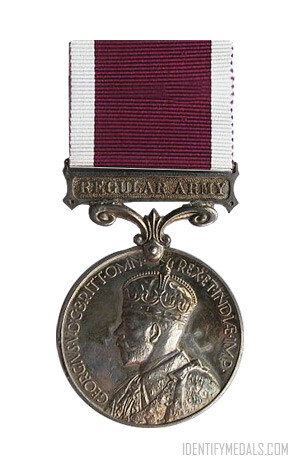
The obverse features the effigy of the reigning monarch. Two versions were made during the reigns of King George VI and Queen Elizabeth II. All versions share an ornamented scroll pattern suspender, attached to a bar inscribed “REGULAR ARMY,” affixed with a single-toe claw and a horizontal pin.

The reverse, unchanged across versions, is smooth with a raised rim and bears the inscription “FOR LONG SERVICE AND GOOD CONDUCT” in four lines. The bar’s reverse is smooth and undecorated.

The clasp displays the Army Crest. A silver rosette on the ribbon bar denotes the award of the clasp in undress uniform. The ribbon, identical to that of the Army Long Service and Good Conduct Medal introduced in June 1916, is 32 millimeters wide and crimson or reddish violet, edged with 3-millimeter-wide white bands.

More British Long Service and Good Conduct Decorations

The British military has instituted several Long Service and Good Conduct Decorations, each honoring the dedication and exemplary service of its personnel across different branches. Here are some other ones from different time periods:

Find these medals online:

Right Now on eBay 
Clicking a link to eBay may result in a referral commission being paid if a purchase is made.
Loading...

Special Service Commissions Medal (Portugal)

Special Service Commissions Medal was established on 28 May 1946 to recognise service during ‘non-warlike’ operations.

The Commemorative Medal for Special Service Missions of the Portuguese Armed Forces (or Medalha comemorativa de comissões de serviço especiais in Portuguese), established on May 28, 1946, is awarded to military personnel who have completed service missions abroad, whether as part of national or multinational forces.

Initially, this decoration was part of the 1946 Campaign Commemorative Medal of the Portuguese Armed Forces, differing only in its ribbon, which was white with red edges. It was awarded in “cases of simple expeditions or actions of any nature where the circumstances did not require the conduct of war operations” (Art. 43 of the 1946 Regulations).

This medal is given to soldiers and sailors who participate in multinational forces under NATO, the UN, and the EU, as well as in technical-military cooperations.

Special Service Commissions Medal Design

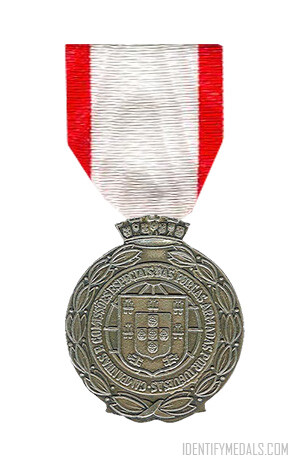
Since 1971, there has been a clear distinction between the Medal for Special Service Commissions and the Campaign Medal, although the design of both remains the same, with only the ribbon colors differing. The ribbon for this medal is white, edged with red. The design, since 2002, is as follows:

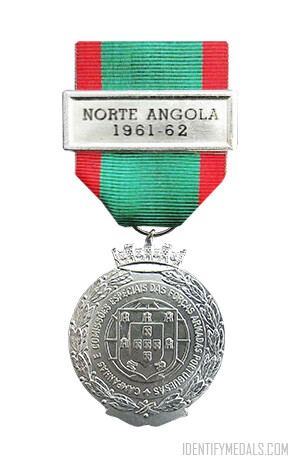
The obverse features the national emblem surrounded by a circular strip with the inscription “CAMPANHAS E COMISSÕES ESPECIAIS DAS FORÇAS ARMADAS PORTUGUESAS” in uppercase Elzevir type letters. This inscription is encircled by two laurel branches, with fruits, tied at the proximal ends with a wide bow. Above this ensemble is a mural crown with five towers.

The reverse is a disc featuring a National Flag at the top. Superimposed on the flag, and occupying nearly the entire diameter, are the figures of an Army soldier (right), an Air Force soldier (center), and a Navy sailor (left), standing on a pedestal. The disc is surrounded by the inscription “ESTE REINO É OBRA DE SOLDADOS” (“This kingdom is the work of soldiers”), a quote from Joaquim Augusto Mouzinho de Albuquerque in a letter to Prince Royal D. Luís Filipe, in uppercase Elzevir type letters, within a circular strip, concluded at the bottom by a wide bow. Above this ensemble is a mural crown identical to the one on the obverse.

The Campaign Service Medal (Portugal)

The Campaign Service Medal was established on 30 November 1916 to recognize wartime service and issued with a clasp for each campaign.

The Campaign Commemorative Medal (or in Portuguese) was created on November 30, 1916, by Decree No. 2870, alongside the War Cross, commemorates the campaigns of the Portuguese Armed Forces outside mainland Portugal, particularly in the context of Portugal’s entry into World War I.

The medal is awarded to military personnel who have served in a campaign situation (Art. 46 of the 2002 Regulations).

This medal functions as a general campaign medal, with each specific campaign indicated by a clasp on the ribbon, with the most recent campaign above the older ones. The following clasps have been approved:

  • South Angola, 1914-1915 (Decree No. 2941, 18/1/1917)
  • Mozambique, 1897-1898 (Decree No. 2965, 1/2/1917)
  • Timor, 1912-1913 (Decree No. …, 23/9/1918)
  • Mozambique, 1914-1918 (Decree No. 5060, 30/11/1918)
  • At Sea, 1916-1917-1918 (Decree No. 5086, 3/1/1919)
  • France, 1917-1918 (Decree No. 5400, 12/4/1919)
  • Lunda, 1911 (Decree No. …, 14/5/1919)
  • Congo, 1914-1915 (Decree No. …, 14/5/1919)
  • Maritime Defense, 1914-1918 (Decree No. 5799, 28/5/1919)
  • At Sea, 1916-1917-1918 + Maritime Defense, 1914-1918 (Decree No. 5983, 31/7/1919)
  • Occupation of Mozambique District, 1906-1913 (Decree No. 6546, 8/4/1920)
  • Cuanza-Sul, 1917-1918 (Decree No. …, 30/4/1920)
  • Cuanhama, 1915 (Decree No. 7433, 25/6/1920)
  • Beyond Cunene, 1904 (Decree No. 6731, 8/7/1920)
  • Satary, 1912 (Decree No. 7434, 18/7/1920)
  • Bissau, 1915 (Decree No. …, 10/9/1920)
  • CEL, Maritime Defense, 1916-1918 + Funchal, Maritime Defense, 1916-1918 + Ponta Delgada, Maritime Defense, 1916-1918 (Decree No. 1123, 4/3/1921)
  • Cape Verde, 1917-1918 (Decree No. 8613, 3/2/1923)
  • Dembos, 1918-1919 (Decree No. 8791, 1/5/1923)
  • Lunda, 1922-1923 (Decree No. …, 12/7/1924)
  • Lunda, 1920 (Decree No. 10442, 31/12/1924)
  • Congo, 1918 (Decree No. 15026, 13/1/1928)
  • Northern Angola (since 15/3/1961) (Decree No. 19683, 4/2/1963)
  • Guinea (since 1/3/1963) (Decree No. 20564, 7/5/1964)
  • Mozambique (since 1/8/1965) (Decree No. 21941, 6/4/1966)
  • Angola (since 23/12/1966) (Decree No. 22838, 21/8/1967) (extinguishes the legend Northern Angola)
  • Afghanistan 2008 (Decree No. …, …)
  • Somalia / Africa 2009-2013 (Anti-Piracy Operations) (Decree No. …, …)
  • Kosovo 2012-2013 (Decree No. …, …)
  • Central African Republic 2012-2019 (Civil War) (Decree No. …, …)

The Campaign Service Medal Design

The obverse features the national emblem surrounded by a circular strip with the inscription “CAMPANHAS E COMISSÕES ESPECIAIS DAS FORÇAS ARMADAS PORTUGUESAS” in capital Elzevir type letters, encircled by two laurel branches with fruits, tied at the top with a wide bow. Above this ensemble is a mural crown with five towers.

The reverse bears a disc featuring a National Flag at the top. Superimposed on the flag are the figures of an Army soldier (right), an Air Force soldier (center), and a Navy sailor (left), standing on a pedestal. The disc is surrounded by the inscription “ESTE REINO É OBRA DE SOLDADOS” (“This kingdom is the work of soldiers“), a quote from Joaquim Augusto Mouzinho de Albuquerque in a letter to Prince Royal D. Luís Filipe, in capital Elzevir type letters, within a circular strip, concluded at the bottom by a wide bow. Above this ensemble is a mural crown identical to the one on the obverse.

The Exemplary Behavior Medal (Portugal)

The Exemplary Behavior Medal was created on October 2, 1863 and distinguishes military personnel who have served with exemplary moral.

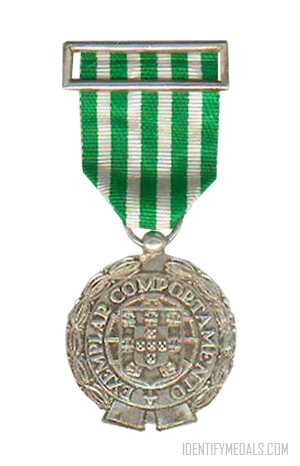
The Exemplary Behavior Medal (or Medalha de Comportamento Exemplar in Portuguese) is a Portuguese military award established on October 2, 1863, by decree of the Secretary of State for the Affairs of War.

The medal is awarded in three grades—gold, silver, and copper—and recognizes military personnel who have demonstrated exemplary moral and disciplinary conduct, as well as a proven spirit of loyalty to the Portuguese Republic throughout their careers.

The Distinguished Service Medal Grades

The Exemplary Behavior Medal is awarded in the following grades:

  • Gold Medal (MOCE): Awarded to military officers with at least thirty years of service, who have never received any criminal or disciplinary punishment, and who have consistently demonstrated a high sense of virtue, obedience, and military discipline.
  • Silver Medal (MPCE): Granted to military officers with at least fifteen years of effective service, who have maintained a spotless record without any criminal or disciplinary punishment.
  • Copper Medal (MCCE): Awarded to officers, sergeants, and enlisted personnel who have completed at least six years of effective service and have never suffered any criminal or disciplinary punishment.