The Imperial Order of Elizabeth and Theresa

The Imperial and Royal Decoration of Elizabeth and Theresa was a decoration of the Austro-Hungarian Empire, created in Vienna in 1750.

The Imperial and Royal Decoration of Elizabeth and Theresa (or Elisabeth-Theresien-Orden in German) was a decoration of the Austro-Hungarian Empire, created in Vienna in 1750 by Elisabeth Christine of Brunswick-Wolfenbüttel, widow of Charles VI, Holy Roman Emperor, in her testament, to reward the deserving officers who distinguished in battles.

The number of awarded officers reached hardly 20 originally. Those had to serve faithfully in the army of the House of Austria for 30 years and have reached at least the rank of colonel, and had to be inscribed in the Court Council of War, but without distinction of fatherland, birth, or religion. The Order only has one rank: Knight.

The Order was granted with 16,000 florins of annuity to be divided among the recipients. There were originally three grades of annuity: 1000, 800, and 500 florins.

The Imperial and Royal Decoration of Elizabeth and Theresa was revised in 1771 by her daughter Empress Maria Theresa I, as the Elizabetho-Theresian Military Foundation (Elisabeth-Theresianische Militärstiftung). The yearly pension amount was reviewed and the number of maximum members was settled in 21.

The Order was canceled by the Austrian Republic in 1918.

The Order of Elizabeth and Theresa Design

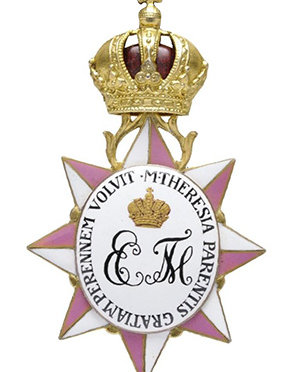
The decoration consists of a star of gold with eight triangles enameled in half-red, half-silver and supported by the imperial crown. It’s charged with an oval shield in the heart with the initials of the two empresses (“ECMT” for Elizabeth Christine Maria Theresa), all topped by a crown, surrounded by the legend: “MARIA THERESIA PARENTIS GRATIAM perennem VOLUIT”.

The ribbon of the Order is black. The decoration was hanging from a triangular knot of that black ribbon on the left chest.
The Order of the Starry Cross

The Order of the Starry Cross (Sternkreuz-Orden) is an imperial Austrian dynastic order founded in 1668 and awarded to Catholic noble ladies.

The Order of the Starry Cross (or Sternkreuz-Orden in German) is an imperial Austrian dynastic order founded in 1668 and awarded to Catholic noble ladies. Only high-born ladies could be invested with the Order, including princesses, countesses, and other high nobility. Once invested, members were to “devote themselves to the service and worship of the Holy Cross, and to lead a virtuous life in the exercise of religion and works of charity.”

The Order was founded in 1668 by Eleonora Gonzaga of Mantua, dowager empress of the Holy Roman Empire and confirmed by Pope Clement IX on 28 June 1668, who placed it under the spiritual management of the Prince-Bishop of Vienna.

According to legend, the Habsburg dynasty owned a piece of the True Cross on which Jesus was crucified. In the aftermath of a fire at the Hofburg on 2 February 1668 the relic was discovered in near-perfect condition. The dowager empress founded the Order in celebration that the relic had survived the fire, believing it to be a true miracle.

The order still exists under the House of Habsburg, though the Austrian Empire no longer exists. It was conceived with only one class.

The Order of the Starry Cross Design

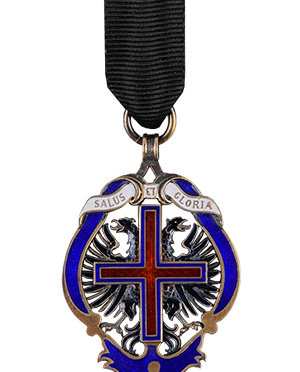
Members of the Order wore en insignia consisting of an oval medallion, with a broad blue enameled border, inclosing a black enameled Eagle with two heads and claws. On it lies a Gold Cross, enameled green, and bordered with brown wood. Over this, on an entwined wreath in black letters, on a white ground, is the motto of the Order, “Salue et Gloria” (“Hail and Glory“).

The insignia was worn, pendent to a strip of black band, on the left breast.

The Order of Franz Joseph

The Imperial Austrian Order of Franz Joseph was founded by Emperor Franz Joseph I on the 1st anniversary of his accession to the throne.

The Imperial Austrian Order of Franz Joseph (or Kaiserlich-Österreichischer Franz-Joseph-Orden in German) was an Order founded by Emperor Franz Joseph I of Austria on December 2, 1849, on the first anniversary of his accession to the imperial throne.

The order was originally awarded in three classes: Grand Cross, Commander’s Cross, and Knight’s Cross. In 1869, the class of Commander with Star was added, which ranked immediately below the Grand Cross. On February 1, 1901, the Officer’s Cross, which ranked between Commander and Knight, was introduced.

The order ceased to exist as a governmental award with the dissolution of the Austro-Hungarian Empire in 1918 and was not re-established with the foundation of the Republic of Austria. However, it remains active as a dynastic order of the House of Habsburg.

The Order of Franz Joseph Design

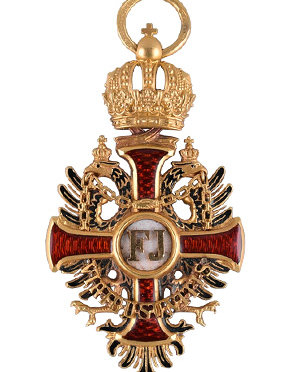
Knights wore the decoration suspended from a triangular ribbon on the left breast. Officers wore it on the left breast without a ribbon. Commanders wore the decoration at the neck, as did Commander with Star, who also wore a breast star. The Grand Cross was worn suspended from the shoulder and also came with a breast star. The ribbon of all classes of the order was plain red.

In common with the other Austro-Hungarian awards of the period, the Franz Joseph Order was further distinguished with the addition of the War decoration and Swords which could be awarded for military merit. However, if soldiers were honored, it was usually for distinguished service as opposed to gallantry in the face of the enemy.

The Austrian Imperial Order of Leopold

The Austrian Imperial Order of Leopold (Österreichisch-kaiserlicher Leopold-Orden) was founded on 8 January 1808 by Franz I of Austria.

The Austrian Imperial Order of Leopold (or Österreichisch-kaiserlicher Leopold-Orden in German) was founded on 8 January 1808 by Franz I of Austria.

The order’s statutes stipulated only three grades: Grand Cross, Commander and Knight. During the war, crossed swords were instituted to reward bravery in the face of the enemy. An Imperial Decree of 1 February 1901 ordered that then onwards, there were four ranks:

  • Grand Cross.
  • First Class.
  • Commander.
  • Knight.

Until 18 July 1884, the award of the order also entitled the recipient, if he was not already of that standing, to be raised to the following appointments and/or ranks of the nobility:

  • Grand Cordon: Privy Councillor.
  • Commander: Baron.
  • Knight: Ritter.

After 1918, the Order was no longer awarded.

The Austrian Imperial Order of Leopold Design

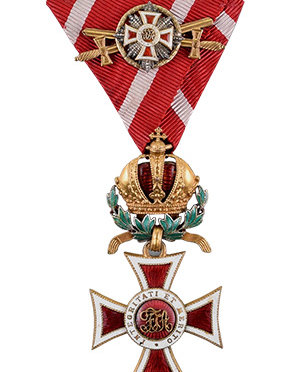
The badge of the Order consists of a red enameled gold cross, with white enamel edging. The obverse displays the initials “FIA” in gold on a red enamel background. The Cross is surmounted by a golden Emperors’ Crown.

The ribbon was red with two narrow white side-stripes. The Grand Cross could also be awarded with diamonds.

Both the Grand Cross and the First Class Members of the Order wore their orders in the form of a sash with the Order attached to the Bow and respectively an eight-pointed and a four-pointed breast Star on formal occasions. The Commanders’ Cross was worn to the neck, suspended from a 52 mm wide ribbon; the Knight wore his Order on a triangular ribbon on the left breast.

The Mottoes of the Order were “INTEGRITATI ET MERITO” and “OPES REGUM CORDA SUBDITORUM“.

The Order of the Iron Crown (Austria)

The Imperial Order of the Iron Crown was was established in 1815 by Franz I as one of the highest orders of merit of Austria-Hungary.

The Imperial Order of the Iron Crown (or Kaiserlicher Orden der Eisernen Krone in German) was one of the highest orders of merit of Austria and Austria-Hungary until 1918. It was established in 1815 by Emperor Franz I of Austria. Appointment to the third or second class of the Order of the Iron Crown became one of the main routes to ennoblement for Austrian bourgeois families and for civil servants and military officers.

The order had three classes and until 1884 all classes conferred automatic hereditary ennoblement. The first class conferred the title of Privy Councillor, the style of Excellency, and the right to attend court. The second class conferred the rank of Baron. The third class conferred the rank of Ritter.

The order could also be awarded to foreigners.

The Order of the Iron Crown Design

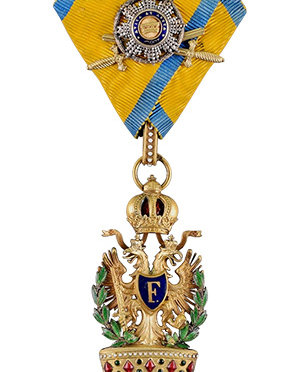
The medal bears an imperial eagle set within a representation of the Iron Crown of Lombardy. From 1908 for First Class knights, and from 1917 for Second Class knights, members were authorized to wear a Third Class military medal on the left breast, with an addition of a device known as a “Kleine Dekoration”. The pin device was a miniature version of the First Class breast star, and was worn on the center of the ribbon.

The Second Class Kleine Dekoration was a miniature depiction of the Iron Crown of Lombardy. For knights, it was a crown only for peacetime award, crown encircled by a wreath for the war decoration, and topped with swords for those awards “with swords”, and was worn in the same fashion as that of the First Class knights. Ordinary knights medals were also frequently adorned with crossed swords, pinned to the trifold ribbon.

The ribbon colors changed from the Imperial French gold and green to the Imperial Austrian gold and royal blue. Grand Cross (French) and First Class (Austrian) knights wore a sash and badge over the right shoulder, with an eight-pointed star on the left breast. Imperial French knight commanders wore a traditional military-style medal on the left chest, with a bow in the center of the ribbon. Imperial Austrian Second Class knights wore the medal suspended from a ribbon about the neck. French ordinary knights and Austrian Third Class knights wore a traditional military medal on the left chest.

The Military Order of Maria Theresa

The Military Order of Maria Theresa was the highest military honor of the Habsburg Monarchy, Austrian Empire and Austro-Hungarian Empire.

The Military Order of Maria Theresa (or “Militär-Maria-Theresien-Orden” in German and “Katonai Mária Terézia-rend” in Hungarian) was the highest military honor of the Habsburg Monarchy, Austrian Empire and Austro-Hungarian Empire. It is considered to be the highest honor for a soldier in the Austrian armed services.

The order was founded on 18 June 1757, the day of the Battle of Kolin, by Empress Maria Theresa, and awarded for especially meritorious and valorous acts by commissioned officers, especially the act of defeating an enemy, and thus “serving” their monarch.

Because the Order was given for “successful military acts of essential impact to a campaign that was undertaken on [the officer’s] own initiative and might have been omitted by an honorable officer without reproach“, this gave rise to a popular myth that it was awarded for (successfully) acting against an explicit order.

The Military Order of Maria Theresa Classes

The Order of Theresa consisted of several classes, each representing a different level of distinction and honor. Originally, the order had two classes: Knight’s Cross and Grand Cross.

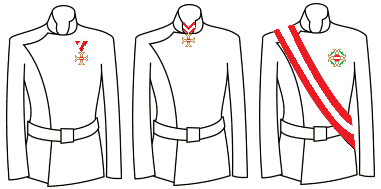
On 15 October 1765, Emperor Joseph II added a Commander’s Cross, and a breast star to be worn by holders of the Grand Cross. The three classes are, then:

The three classes of the Order of Maria Theresa and their insignia.
  1. Knight’s Cross (Ritterkreuz): The lowest class was awarded to officers and soldiers who had displayed acts of bravery, courage, or exceptional service on the battlefield. 

  2. Commander’s Cross (Komturkreuz): The next higher class of the order was awarded to officers who had demonstrated exceptional leadership, strategic skill, or distinguished service in combat. 

  3. Grand Cross (Großkreuz): The highest and most prestigious class of the Military Order of Maria Theresa was reserved for generals, field marshals, and other high-ranking military leaders who had achieved extraordinary accomplishments or held positions of great responsibility. 

The Military Order of Maria Theresa Design

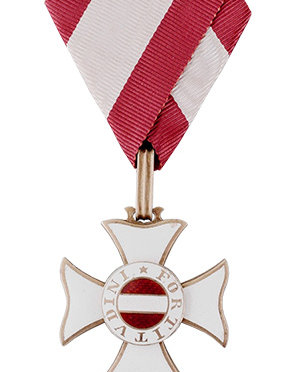
The badge of the order is a gilt, white-enameled cross. The central disc bears the coat-of-arms or national flag of Austria, surrounded by a white ring bearing the motto “Fortitudini” (“For Courage“).

The star of the order is a silver faceted cross of the same shape as the badge, with a wreath of green-enameled oak leaves between the arms of the cross. The central disc is the same as the one on the badge.

The ribbon is red-white-red, inspired by the national flag of Austria.

By class:

  • Recipients of the Knight’s Cross were entitled to wear a medal consisting of a Maltese cross with a central medallion depicting the profile of Empress Maria Theresa surrounded by a laurel wreath.
  • Recipients of the Commander’s Cross wore a larger version of the medal, often with additional embellishments such as oak leaves or swords to denote further acts of valor.
  • Recipients of the Grand Cross wore a significantly larger medal, often adorned with additional decorations and worn around the neck on a ribbon of crimson.
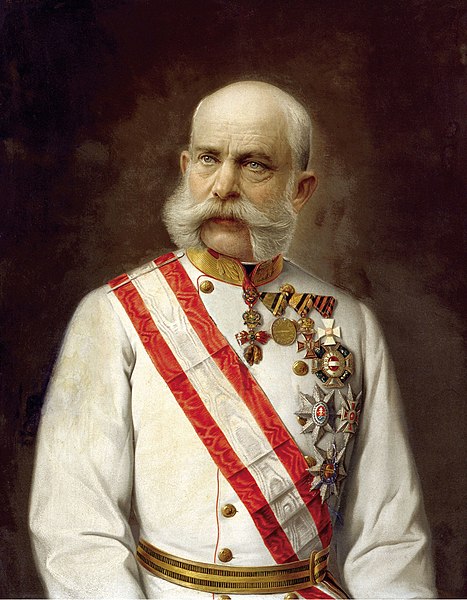
Franz Josef I wearing the Grand Cross sash and star
Franz Josef I wearing the Grand Cross sash and star.

The Royal Hungarian Order of Saint Stephen

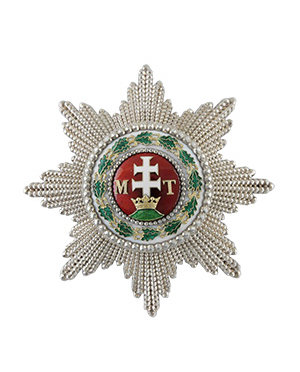
The Order of Saint Stephen was an order of knighthood named after Hungary’s most famous king, Stephen I, who reigned between 997 and 1038.

The Order of Saint Stephen (or “Szent István rend” in Hungarian) was an order of knighthood founded by Maria Theresa in 1764 and named after Hungary’s most famous king, Stephen I, who reigned between 997 and 1038. Membership was available to various members of the Hungarian nobility.

Stephen I consolidated the monarchy, established of the medieval state of Hungary and adopted Christianity as the state religion. He was canonized by Pope Gregory VII in 1083 along with his son Imre. Saint Stephen is considered the patron saint of “Hungary, kings, the death of children, masons, stonecutters, and bricklayers.”

In 1938, Miklós Horthy took the rights and activities of Grand Master as Regent of Hungary, changing its name to The Royal Hungarian Order of Saint Stephen. The Order was terminated at the time of the proclamation of the Republic of Hungary in 1946, but recreated again in 2011 as the Hungarian Order of Saint Stephen, and to this day remains the highest order in Hungary.

The Royal Hungarian Order of Saint Stephen Design

The Grand Cross

For ceremonial purposes, a full set of crimson and green robes, lined with ermine, were prescribed (or a sash for every-day wear). A collar of gold was worn about the neck and shoulders, with the badge of the Order suspended from the collar. During the waning days of the monarchy, a less formal option was also authorized: a miniature of the breast star that could be affixed to the center of the ribbon of an ordinary knight’s cross and was worn on the left breast with other orders and military medals, in order of precedence.

Knights Commander

The informal wear of the miniature, gold, Crown of Saint Stephen was worn on an ordinary knight’s cross and worn on the left breast with other orders and military medals, in order of precedence.

Knights

Wore the badge of the Order, suspended from a tri-fold ribbon of crimson, edged in green, on the left breast with other orders and military medals, in order of precedence.

The Insigned Order of the Golden Fleece

The Order of the Golden Fleece is a Roman Catholic Order of chivalry founded by Duke Philip the Good in 1430 to celebrate his marriage.

The Order of the Golden Fleece (or Orden del Toisón de Oro in Spanish) is a Roman Catholic order of chivalry founded in Bruges by the Burgundian duke Philip the Good in 1430, to celebrate his marriage to the Portuguese princess Isabella.

Having had only 1,200 recipients ever since its establishment, the Spanish Order of the Golden Fleece has been referred to as the most prestigious and exclusive order of chivalry in the world, both historically and contemporaneously. Unlike any other distinction, the Golden Fleece is only granted for life, meaning it must be returned to the Spanish Monarch whenever the recipient deceases.

The choice of the Golden Fleece of Colchis as the symbol of a Christian order caused some controversy, not so much because of its pagan context, which could be incorporated in chivalric ideals, as in the Nine Worthies, but because the feats of Jason, familiar to all, were not without causes of reproach. The bishop of Châlons, chancellor of the Order, rescued the fleece’s reputation by identifying it instead with the fleece of Gideon that received the dew of Heaven.

Today, two branches of the Order exist, namely the Spanish and the Austrian Fleece; the current grand masters are Felipe VI, King of Spain, and Karl von Habsburg, grandson of Emperor Charles I of Austria, respectively.

The Prohibition on Belonging to Other Orders

Non-royal knights of the Golden Fleece were forbidden to belong to any other order of knighthood. This rule was a strict and fundamental tenet of the order’s regulations. This prohibition was intended to uphold the exclusivity and prestige of the Golden Fleece, ensuring that membership in the order remained a singular honor and distinction.

By forbidding non-royal knights from joining other orders of knighthood, the Order of the Golden Fleece sought to emphasize the special status accorded to its members. It aimed to prevent dilution of the order’s significance and to maintain a sense of unity and loyalty among its knights.

This rule also served to reinforce the sense of camaraderie and brotherhood among the members of the Golden Fleece. By prohibiting external affiliations, the order fostered a strong bond among its knights, who shared a common commitment to upholding the ideals and values of chivalry.

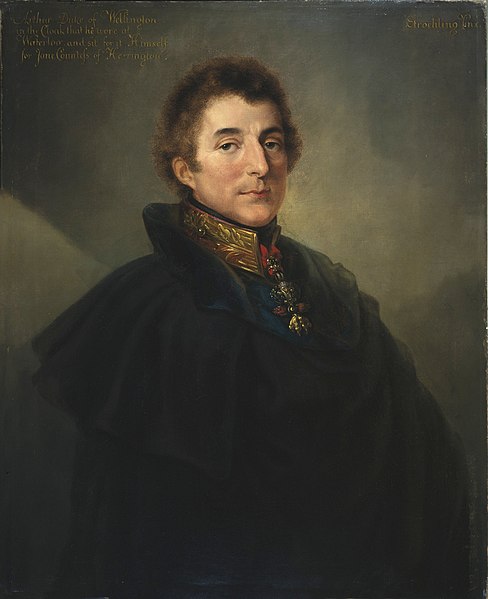
The Duke of Wellington wearing the Spanish Fleece in 1820.
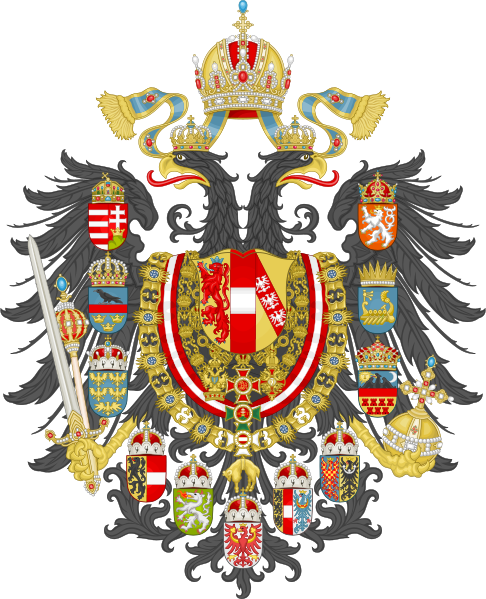
Imperial Coat of Arms of the Austro-Hungarian Empire with the Golden Fleece.
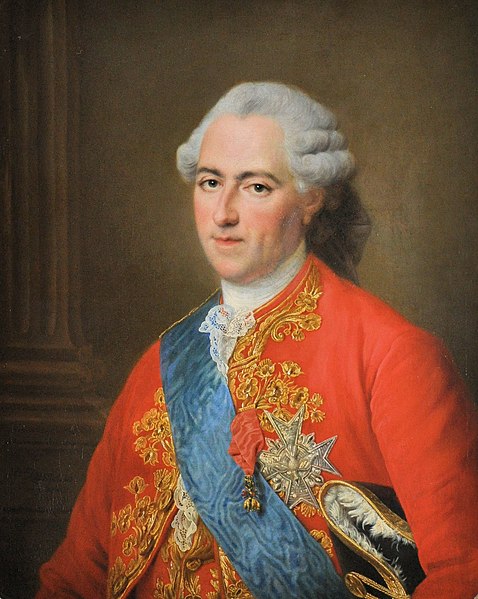
Louis XV of France wearing the Spanish Fleece in 1773
Louis XV of France wearing the Spanish Fleece in 1773.

The Order of the Golden Fleece Medal Design

Surrounding the central image of the Golden Fleece are various symbols and motifs that hold significance within the order’s tradition. These may include heraldic elements such as crowns, crosses, and fleur-de-lis, as well as symbolic animals like lions and eagles. These symbols represent the virtues and values upheld by members of the order, including loyalty, faith, and nobility.

The badge of the Order, in the form of a sheepskin, was suspended from a jewelled collar of firesteels in the shape of the letter B, for Burgundy, linked by flints; with the motto “Pretium Laborum Non Vile” (“No Mean Reward for Labours”) engraved on the front of the central link, and Philip’s motto “Non Aliud” (“I will have no other”) on the back.

Overall, the design of the Order of the Golden Fleece medal is steeped in tradition and symbolism, reflecting the esteemed history and heritage of one of Europe’s oldest and most illustrious orders of chivalry.

Famous Members of The Order of The Golden Fleece

  1. King Philip IV of Spain: Philip IV was the Spanish monarch during the 17th century and a prominent member of the Order of the Golden Fleece. He played a significant role in the politics and affairs of Europe during his reign.

  2. Emperor Charles V: Charles V, also known as Charles I of Spain, was one of the most powerful rulers of the 16th century. As the Holy Roman Emperor and King of Spain, he wielded immense influence and was a key figure in European politics and warfare.

  3. King Henry VIII of England: Henry VIII, infamous for his six marriages and his role in the English Reformation, was also a member of the Order of the Golden Fleece. His reign had a profound impact on English history and the wider European stage.

  4. Emperor Maximilian I: Maximilian I, Holy Roman Emperor from 1493 until his death in 1519, was a patron of the arts and a key figure in the Renaissance. He expanded the influence of the Habsburg dynasty and played a significant role in shaping the politics of his time.

  5. King Louis XIV of France: Louis XIV, also known as the Sun King, ruled France for over 72 years and was one of the most powerful monarchs in European history. His reign was characterized by lavish court life, artistic patronage, and military conquests.