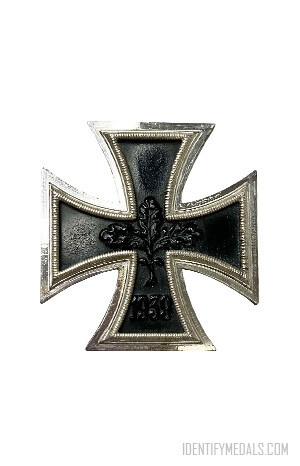
The Iron Cross (EK 1957)

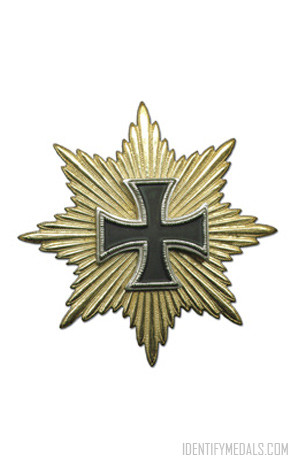
The Iron Cross 1957 was introduced to allow German veterans to wear their WWII decorations in a denazified form.

Institution: 26 July 1957
Country: Germany

The Iron Cross 1957 was officially established on July 26, 1957. It aimed to honor the bravery and leadership of those who had served during World War II while adhering to new legal requirements.

Following the end of World War II, Germany underwent significant political and social changes, including the denazification process to remove Nazi symbols from public life. By the mid-1950s, many German veterans sought recognition for their wartime service without the stigma associated with Nazi imagery. In response, the Federal Republic of Germany (West Germany) introduced the Iron Cross 1957.

This version allowed veterans to wear their decorations in a form that conformed to post-war regulations, promoting reconciliation and respect for individual bravery.

The Iron Cross 1957 Criteria

The criteria for the Iron Cross 1957 remained the same as those of the 1939 version. It was awarded to recognize acts of bravery and leadership in combat. Veterans who had earned the Iron Cross during World War II were eligible to wear the 1957 version, ensuring that their wartime service could be publicly acknowledged without the associated Nazi symbols

More Variations of the Iron Cross

The Iron Cross, a prestigious German military decoration, has undergone several variations since its inception. For example, the Iron Cross 1813 was instituted during the Napoleonic Wars by King Frederick William III of Prussia, the Iron Cross 1914 was awarded during World War I, it was reinstated by Kaiser Wilhelm II, and the Iron Cross 1939 was revived by Adolf Hitler for World War II, with modifications including a swastika.

Find the Iron Cross Medal Online

Right Now on eBay 
Clicking a link to eBay may result in a referral commission being paid if a purchase is made.
Loading...

Further Reading About the Iron Cross

Discover the stories behind the Iron Cross with these compelling books and delve into the rich history and significance of this prestigious military decoration.

The Grand Cross of the Iron Cross

The Grand Cross of the Iron Cross was the highest grade Nazi decoration above the various classes of the Knight’s Cross.

The Grand Cross of the Iron Cross (or Großkreuz des Eisernen Kreuzes in German) was reinstituted as a German decoration in September 1939. The Grand Cross of the Iron Cross is above the different classes of Knight’s Cross of the Iron Cross

During World War II, only one person received the Grand Cross of the Iron Cross: Hermann Göring. 

The original award was destroyed during an air raid in 1943 – after Hitler had deprived Göring of his after feeling betrayed. 

The Grand Cross of the Iron Cross Design

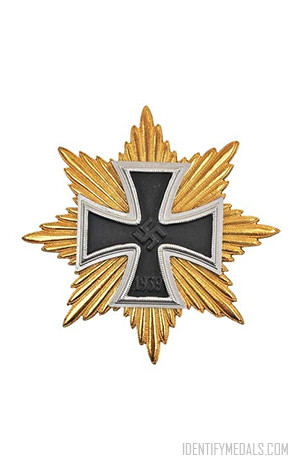
The Grand Cross was designed as having an outline in gold. However, this was changed before Göring’s award. He actually had several copies made of his medal, one with platinum edges which he wore. Göring was wearing this version at the time of his surrender in 1945.

The medal was awarded in a red leather case with an embossed gold Reich Eagle. The interior was made in black velvet. 

More Variations of the Iron Cross

The Iron Cross, a prestigious German military decoration, has undergone several variations since its inception. For example, the Iron Cross 1813 was instituted during the Napoleonic Wars by King Frederick William III of Prussia, the Iron Cross 1914 was awarded during World War I, it was reinstated by Kaiser Wilhelm II, and the Iron Cross 1939 was revived by Adolf Hitler for World War II, with modifications including a swastika.

Find the Iron Cross Medal Online

Right Now on eBay 
Clicking a link to eBay may result in a referral commission being paid if a purchase is made.
Loading...

Further Reading About the Iron Cross

Discover the stories behind the Iron Cross with these compelling books and delve into the rich history and significance of this prestigious military decoration.

The Iron Cross (EK 1813)

The Iron Cross (Eisernes Kreuz) is a military decoration of the Kingdom of Prussia and later the German Empire and Nazi Germany.

  • Time Period: Pre-WW1
  • Institution: March 1813
  • Country: Germany (Kingdom of Prussia)

The Iron Cross (or Eisernes Kreuz, EK, in German) is a military decoration of the Kingdom of Prussia (and later the German Empire 1871–1918 and Nazi Germany 1933–1945.

It was established by King Friedrich Wilhelm III of Prussia in March 1813 and backdated to the birthday of his late wife Queen Louise on 10 March 1813 during the Napoleonic Wars. Louise was the first person to receive this decoration (posthumous).

The Iron Cross was normally a military decoration only, though there were instances of it being awarded to civilians for performing military functions.

The Iron Cross Design

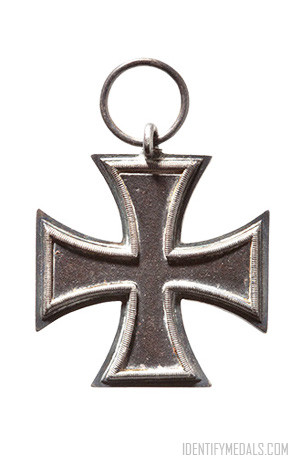
The design of the cross symbol is black with a white or silver outline, and was ultimately derived from the cross pattée of the Teutonic Order, used by knights on occasions from the 13th century.

It was designed by neoclassical architect Karl Friedrich Schinkel, based on a sketch by Frederick William. This heraldic cross took various forms throughout the order’s history, including a simple Latin cross, a cross potent, cross fleury and occasionally also a cross pattée.

The ribbon for the 1813 EK was black with two thin white bands, the colors of Prussia. The non-combatant version of this award had the same medal, but the black and white colors on the ribbon were reversed.

More Variations of the Iron Cross

The Iron Cross, a prestigious German military decoration, has undergone several variations since its inception. For example, the Iron Cross 1813 was instituted during the Napoleonic Wars by King Frederick William III of Prussia, the Iron Cross 1914 was awarded during World War I, it was reinstated by Kaiser Wilhelm II, and the Iron Cross 1939 was revived by Adolf Hitler for World War II, with modifications including a swastika.

Find the Iron Cross Medal Online

Right Now on eBay 
Clicking a link to eBay may result in a referral commission being paid if a purchase is made.
Loading...

Further Reading About the Iron Cross

Discover the stories behind the Iron Cross with these compelling books and delve into the rich history and significance of this prestigious military decoration.

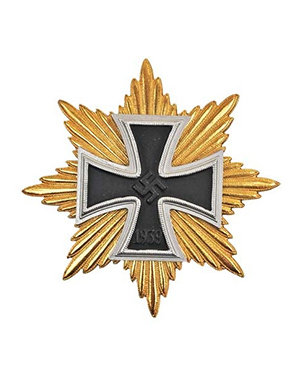
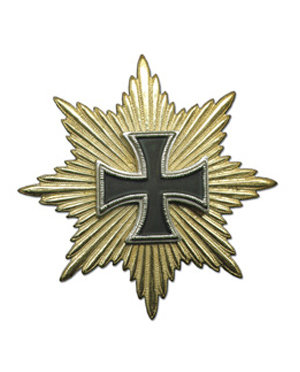
The Star of the Grand Cross of the Iron Cross (Nazi)

The Star of the Grand Cross of the Iron Cross was the highest military decoration of the Kingdom of Prussia and the German Empire. 

The Star of the Grand Cross of the Iron Cross (or Stern zum Großkreuz des Eisernen Kreuzes in German) was the highest military decoration of the Kingdom of Prussia and the German Empire.

The Star of the Grand Cross of the Iron Cross was awarded to the most outstanding of generals who performed feats of leadership to the extreme benefit of the German state. It was awarded only twice, a century apart, to Field Marshal Gebhard von Blücher in 1815 for his victory over Napoleon at the Battle of Waterloo, and to Field Marshal Paul von Hindenburg in 1918 for his victory at the Battle of Tannenberg. The award is commonly known as “Blücher’s Star” (Blücherstern) after its first recipient.

Paul von Hindenburg received the Grand Cross of the Iron Cross (9 December 1916) to which the Golden Star added on 25 March 1918 (Star of the Grand Cross of the Iron Cross).

During the reign of Nazi Germany, Reichsmarschall Hermann Göring commissioned a new version of the medal, intending to award it to Adolf Hitler once Germany won the Second World War.

Since Germany was defeated in 1945, the award was never bestowed on the intended recipient. Following the Allied victory in May 1945, the US Army seized the only known prototype, which had been stored in a bunker. It is now a part of the collection of the Museum of the United States Military Academy in West Point, New York.

The Star of the Grand Cross of the Icon Cross Design

The design of the Star of the Grand Cross of the Iron Cross is similar to that od the Grand Cross of the Iron Cross, but with a golden crown and a swastika symbol.

More Variations of the Iron Cross

The Iron Cross, a prestigious German military decoration, has undergone several variations since its inception. For example, the Iron Cross 1813 was instituted during the Napoleonic Wars by King Frederick William III of Prussia, the Iron Cross 1914 was awarded during World War I, it was reinstated by Kaiser Wilhelm II, and the Iron Cross 1939 was revived by Adolf Hitler for World War II, with modifications including a swastika.

Find the Iron Cross Medal Online

Right Now on eBay 
Clicking a link to eBay may result in a referral commission being paid if a purchase is made.
Loading...

Further Reading About the Iron Cross

Discover the stories behind the Iron Cross with these compelling books and delve into the rich history and significance of this prestigious military decoration.

The Star of the Grand Cross of the Iron Cross

The Star of the Grand Cross of the Iron Cross was the highest military decoration of the Kingdom of Prussia and the German Empire. 

The Star of the Grand Cross of the Iron Cross (or Stern zum Großkreuz des Eisernen Kreuzes in German) was a senior decoration to the Grand Cross of the Iron Cross and the highest military decoration of the Kingdom of Prussia and the German Empire. The award is commonly known as “Blücher’s Star” (Blücherstern) after its first recipient.

This award was given to the most outstanding of generals who had performed feats of leadership that had extremely benefited the German state.

The Star of the Grand Cross of the Iron Cross was awarded only twice, a century apart. The first time it was to Field Marshal Gebhard von Blücher in 1815, to recognize his victory over Napoleon at the Battle of Waterloo. The second was awarded to Field Marshal Paul von Hindenburg in 1918 for his victory at the Battle of Tannenberg. Paul von Hindenburg received the Grand Cross of the Iron Cross (9 December 1916) to which the Golden Star added on 25 March 1918 (Star of the Grand Cross of the Iron Cross).

The Star of the Grand Cross of the Iron Cross Design

During the reign of Nazi Germany, Reichsmarschall Hermann Göring commissioned a new version of the Star of the Grand Cross of the Iron Cross medal, with the intention of awarding it to Adolf Hitler once Germany had won the Second World War. Because Germany was defeated in 1945, the award was never bestowed on him.

After the Allied victory in May 1945, the US Army seized the only known prototype of this medal, which had been securely stored in a bunker. It is now a part of the collection of the Museum of the United States Military Academy in West Point, New York.

More Variations of the Iron Cross

The Iron Cross, a prestigious German military decoration, has undergone several variations since its inception. For example, the Iron Cross 1813 was instituted during the Napoleonic Wars by King Frederick William III of Prussia, the Iron Cross 1914 was awarded during World War I, it was reinstated by Kaiser Wilhelm II, and the Iron Cross 1939 was revived by Adolf Hitler for World War II, with modifications including a swastika.

Find the Iron Cross Medal Online

Right Now on eBay 
Clicking a link to eBay may result in a referral commission being paid if a purchase is made.
Loading...

Further Reading About the Iron Cross

Discover the stories behind the Iron Cross with these compelling books and delve into the rich history and significance of this prestigious military decoration.

The Knight’s Cross of the Iron Cross (EK 1939)

The Knight’s Cross of the Iron Cross was the highest military and paramilitary award for the forces of Nazi Germany during World War II. 

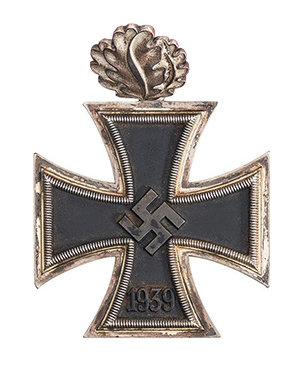
The Knight’s Cross of the Iron Cross (or Ritterkreuz des Eisernen Kreuzes in German, also known as the Knight’s Cross or Ritterkreuz), was the highest military and paramilitary award for the forces of Nazi Germany during World War II. The award was instituted on 1 September 1939, at the onset of the German invasion of Poland, although it had been initially created by King Friedrich Wilhelm III of Prussia on 17 March 1813 (EK 1813).

The Knight’s Cross was awarded across all ranks for a wide range of reasons like skilled leadership of troops in battle or single acts of military valor. It was awarded to members of the three military branches of the Wehrmacht (the Heer or army, the Kriegsmarine or navy, and the Luftwaffe, Waffen-SS, Reichsarbeitsdienst and Volkssturm), along with personnel from other Axis powers.

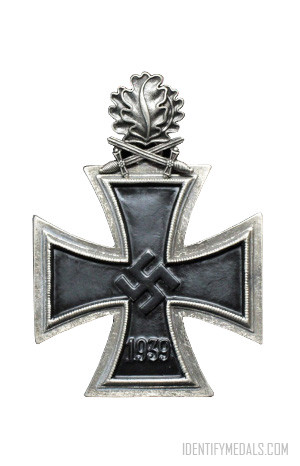
Several higher graded, like the Oak Leaves to the Knight’s Cross, the Knight’s Cross with Oak Leaves, Oak Leaves and Swords and with Oak Leaves, Swords and Diamonds between 1941 and 1944, when the final grade, the Knight’s Cross with Golden Oak Leaves, Swords and Diamonds, was created.

The Knight's Cross of the Iron Cross Design

The Iron Cross was established by the Prussian king Friedrich Wilhelm III at the beginning of the German campaign during the Napoleonic Wars. The design was a silver-framed cast iron cross on 13 March 1813.

The material utilized was iron, because it symbolised defiance and reflected the spirit of the age. To finance the Prussian state army repulse the French occupation, the king implored wealthy Prussians to turn in their jewels in exchange for a men’s cast-iron ring or a ladies’ brooch, each bearing the legend “Gold I gave for iron” (Gold gab ich für Eisen).

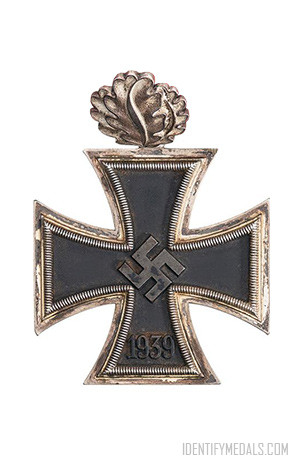
The Iron Cross was renewed in 1939 with the outbreak of World War II and with Adolf Hitler in his role as commander in chief of the German armed forces. A new grade of the series was introduced, the Knight’s Cross of the Iron Cross

Over 7,000 awards were made during the course of the war. Analysis of the German Federal Archives revealed evidence for 7,161 officially bestowed recipients: 863 awards of the Oak Leaves to the Knight’s Cross, 147 Swords and 27 Diamonds awards. The Golden Oak Leaves to the Knight’s Cross was awarded only once, to Hans-Ulrich Rudela German ground-attack pilot, on 29 December 1944.

More Variations of the Iron Cross

The Iron Cross, a prestigious German military decoration, has undergone several variations since its inception. For example, the Iron Cross 1813 was instituted during the Napoleonic Wars by King Frederick William III of Prussia, the Iron Cross 1914 was awarded during World War I, it was reinstated by Kaiser Wilhelm II, and the Iron Cross 1939 was revived by Adolf Hitler for World War II, with modifications including a swastika.

Find the Iron Cross Medal Online

Right Now on eBay 
Clicking a link to eBay may result in a referral commission being paid if a purchase is made.
Loading...

Further Reading About the Iron Cross

Discover the stories behind the Iron Cross with these compelling books and delve into the rich history and significance of this prestigious military decoration.

The Iron Cross (EK 1914)

The Iron Cross (Eisernes Kreuz or EK) is a military decoration established by King Friedrich Wilhelm III of Prussia in March 1813.
Time PeriodWorld War I
Institution: March 1813 (Iron Cross EK 1813)
Country: Germany

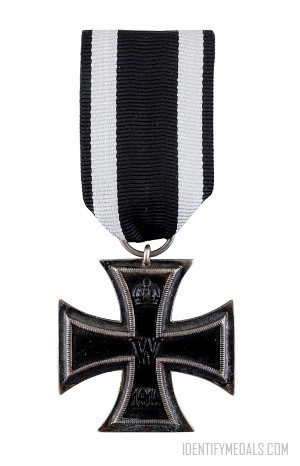
The Iron Cross (also known as Eisernes Kreuz or EK) is a military decoration established by King Friedrich Wilhelm III of Prussia in March 1813 normally awarded to military or to civilians for performing military functions.

Friedrich’s late wife Queen Louise was the first person to receive (posthumously) this award. The recommissioned medal was awarded during the Franco-Prussian War (EK 1870), World War I (EK 1914), and World War II (EK 1939, re-introduced with a swastika added in the center).

Emperor Wilhelm II reauthorized the Iron Cross on 5 August 1914, at the start of World War I. The Grand Cross was intended for senior generals of the Prussian or (later) the German Army. The Iron Cross 1st Class and the Iron Cross 2nd Class were awarded without regard to rank. 

The Iron Cross 1914 Design

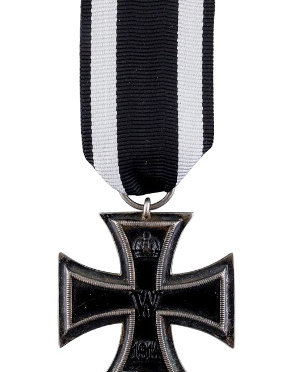
The design of the cross symbol is black with a white or silver outline, a derivation from the cross pattée of the Teutonic Order, which was sometimes used from the 13th century by knights.

The ribbon was black with two thin white bands, the colors of Prussia. The Iron Cross 1st Class employed a pin or screw posts on the back of the medal and was worn on the left side of the recipient’s uniform, like the original 1813 version. The Grand Cross was suspended from a neck ribbon and the 2nd Class from a ribbon on the chest.

During World War I, approximately 218,000 EKIs, 5,196,000 EKIIs and 13,000 non-combatant EKIIs were awarded.

What's the Meaning of The Iron Cross?

The Iron Cross held significant symbolism for the German armed forces and other German military personnel, as well as the nation as a whole.

It represented bravery, sacrifice, and loyalty to the Fatherland, serving as a powerful emblem of national pride and military prowess. You can learn more about the Iron Cross’ meaning here.

Iron Cross 1914 Recipients During WW1

Recipients of the Iron Cross were esteemed for their courage and dedication to the defense of Germany during World War I.

Here are ten famous individuals who received the Iron Cross EK 1914 during World War I:

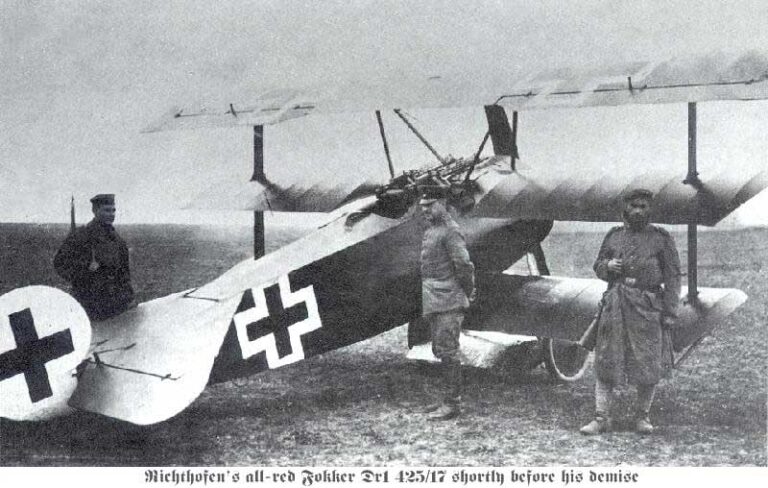
The red Fokker Dr1 of Manfred von Richthofen on the ground.
  1. Erwin Rommel – German field marshal: Rommel received the Iron Cross for his exceptional leadership and bravery during various battles, particularly in the Argonne Forest and at Caporetto.
  2. Manfred von Richthofen – German fighter pilot known as the “Red Baron”: Known as the “Red Baron,” Richthofen was awarded the Iron Cross for his remarkable success as a fighter pilot, credited with 80 aerial victories.
  3. Paul von Hindenburg – German military officer and later President of Germany: Hindenburg received the Iron Cross for his strategic brilliance in the Battle of Tannenberg, which resulted in a decisive victory over Russian forces.
  4. Hermann Göring – German politician and military leader: Göring earned the Iron Cross for his aerial combat achievements as a fighter pilot, including numerous successful engagements and his leadership of Jagdgeschwader 1.
  5. Ernst Jünger – German writer and soldier: Jünger was awarded the Iron Cross for his valor and resilience as an infantry officer, particularly noted in his memoir “Storm of Steel” which details his front-line experiences.
  6. Max Immelmann – German fighter pilot: Immelmann received the Iron Cross for his pioneering aerial combat tactics and his success as a fighter ace, with 15 confirmed kills.
  7. Erich Ludendorff – German general and politician: Ludendorff was awarded the Iron Cross for his critical role in various battles, including his strategic planning and execution during the Spring Offensive.
  8. Fritz Haber – German chemist and Nobel laureate: Haber received the Iron Cross for his contributions to the war effort, specifically his development of chemical weapons used during the conflict.
  9. Oswald Boelcke – German fighter pilot: Boelcke earned the Iron Cross for his extraordinary skills as a fighter pilot and his development of air combat tactics that became standard practice.
  10. August von Mackensen – German field marshal: Mackensen received the Iron Cross for his distinguished service as a field marshal, leading successful campaigns on the Eastern Front.

More Variations of the Iron Cross

The Iron Cross, a prestigious German military decoration, has undergone several variations since its inception. For example, the Iron Cross 1813 was instituted during the Napoleonic Wars by King Frederick William III of Prussia, the Iron Cross 1914 was awarded during World War I, it was reinstated by Kaiser Wilhelm II, and the Iron Cross 1939 was revived by Adolf Hitler for World War II, with modifications including a swastika.

Find the Iron Cross Medal Online

Right Now on eBay 
Clicking a link to eBay may result in a referral commission being paid if a purchase is made.
Loading...

Further Reading About the Iron Cross

Discover the stories behind the Iron Cross with these compelling books and delve into the rich history and significance of this prestigious military decoration.