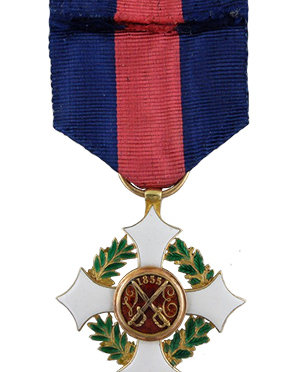
The Civil Order of Savoy

The Civil Order of Savoy was founded as an order of knighthood in 1831 by the King of Sardinia, Charles Albert, Duke of Savoy. 

The Civil Order of Savoy was founded as an order of knighthood in 1831 by the King of Sardinia, Charles Albert, Duke of Savoy.

The intention was to reward those virtues not belonging to the existing Military Order of Savoy, founded by Vittorio Emanuele I in 1815. The order has one degree, that of Knight (Cavalieri dell’Ordine civile di Savoia), and is limited to 70 members. Admission is in the personal gift of the head of the House of Savoy.

The civil order was continued on the unification of Italy in 1861, but has been suppressed by law since the foundation of the Republic in 1946. Umberto II did not abdicate his position as fons honorum however, and the now dynastic order remains under the Grand Mastership of the head of the former Royal house. While the continued use of those decorations awarded prior to 1951 is permitted in Italy, they no longer confer any right of precedence in official ceremonies. The military order on the other hand, was revived as the Military Order of Italy and remains a national order today

The Civil Order of Savoy Design

The insignia bears the inscription Al Merito Civile—1831; the letters C.A. on the reverse substituted for V.E. after the death of Charles Albert in 1849.
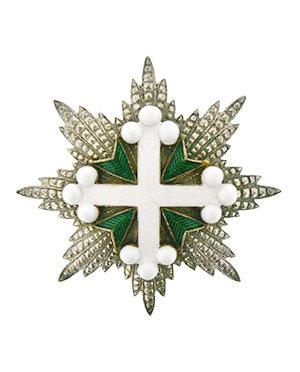
The Order of Saints Maurice and Lazarus

The Order of Saints Maurice and Lazarus is a Roman Catholic dynastic order of knighthood bestowed by the House of Savoy.

The Order of Saints Maurice and Lazarus (or Ordine dei Santi Maurizio e Lazzaro in Italian) is a Roman Catholic dynastic order of knighthood bestowed by the House of Savoy, founded in 1572 by Emmanuel Philibert, Duke of Savoy, through amalgamation approved by Pope Gregory XIII of the Order of Saint Maurice, founded in 1434, with the medieval Order of Saint Lazarus, founded circa 1119, considered its sole legitimate successor.

The order was formerly awarded by the Kingdom of Italy (1861–1946) with the heads of the House of Savoy as the Kings of Italy. Originally a chivalric order of noble nature, it was restricted to subjects of noble families with proofs of at least eight noble great-grandparents.

After the abolishment of the monarchy and the foundation of the Italian Republic in 1946, the legacy of the order is maintained by the pretenders of the House of Savoy and the Italian throne in exile.

The order is estimated to include about 2,000 members around the world.

The Order of Saints Maurice and Lazarus Medal Design

The badge of the order is in gilt, it displays a white-enameled cross bottony of the Order of Saint Maurice with a green-enameled Maltese Cross (the Cross of the Order of Saint Lazarus) placed between the arms of the cross botonny. The badge of each class except that of Knight and Dame is topped by a gilt crown.

The star of the Order is a silver faceted star, with eight points for Grand Cross and four points for Grand Officer, and with the badge (minus the crown) superimposed upon it.

The breast cross for the Commander “jus patronato” class is identical to the badge, minus the crown.

The ribbon of the Order is apple green, with slight variations for the several classes.

The Supreme Order of the Most Holy Annunciation

The Supreme Order of the Most Holy Annunciation was the pinnacle of the honors system in the Kingdom of Italy.

The Supreme Order of the Most Holy Annunciation (or Ordine Supremo della Santissima Annunziata in Italian) is a Roman Catholic order of knighthood, originating in Savoy.

It was the pinnacle of the honors system in the Kingdom of Italy, which ceased to be a national order when the kingdom became a republic in 1946.

The origins of the Supreme Order of the Most Holy Annunciation begin in 1362, when Amadeus VI, Count of Savoy (1343-1383) instituted the order’s earliest designation, under the title of Order of the Collar. Even at this time, the order was dedicated to the Blessed Virgin Mary, who is celebrated as “Our Lady of the Annunciation.” Thus, the order is a dynastic religious (or Catholic) order of chivalry. Under its first formulation, the order had fifteen knights.

Today, the order holds the following other regulations:

  • The number of knights of the Supreme Order of the most Holy Annunciation shall be, as in the past, twenty.
  • The right to appoint knights and officers of the Order appertains exclusively to the Sovereign Head. Nevertheless, when there are vacancies, the Sovereign Head meets with the Chapter of knights to hear their advice on the proposal of candidates whom he alone may select.
  • The knights shall be chosen from distinguished individuals in recognition of their eminent services in high military positions, as well as from those who have distinguished themselves in senior positions in the civil service, and from those who, as private citizens have brought distinction upon Italy as exemplary benefactors of the Nation or of Mankind, or have rendered particularly noteworthy services to the Royal House of Savoy.
  • Knights must have already been awarded the Order of Saints Maurice and Lazarus.
  • Knights must be Catholic. In rare occasions, a non-Catholic may be awarded the order. However, they may only be honorary members of the order.

The order has only one class, i.e. Knight. The full Italian title is Cavaliere dell’Ordine Supremo della Santissima Annunziata.

The Supreme Order of the Most Holy Annunciation Design

Although the order has only one class, it has two sets of insignia, the Piccola Collana and the Grande Collana. The two hold similar designs, though the Grande Collana has some different features than the Piccola Collana and is worn only on the most special of occasions.

The insignia of the order has the following regulations:

  • The large collar (Grande Collana) is worn on the first day of the year, on the feast of the Most Holy Annunciation, and on all of the principal national holidays and at important royal functions.
  • The small collar (Piccola Collana) is worn on every other occasion which necessitates the display of order insignia.
  • Knights also wear, on the left breast, a star badge bearing the image of Holy Mary of the Annunciation.

Today, the order continues as a dynastic order under the jurisdiction of the Head of the House of SavoyVittorio Emanuele, Prince of Naples, who is the order’s hereditary Sovereign and Grand Master.

The Military Order of Savoy

The Military Order of Savoy was a military honorary order of the Kingdom of Sardinia first, and of the Kingdom of Italy later.

The Military Order of Savoy was a military honorary order of the Kingdom of Sardinia first, and of the Kingdom of Italy later. Following the abolition of the Italian monarchy, the order became the Military Order of Italy.

The origin of the Military Order of Savoy can be traced back to the first honorary degrees granted by Victor Amadeus III of Sardinia to its soldiers. Later this degree went into disuse because of the Napoleonic regime in Italy and especially in Piedmont. On 1 April 1815 these honorary degrees were used by Victor Emmanuel I of Sardinia and abolished on the 14th of August of the same year.

Later, all of these honorary degrees become part of one, and became, the Military Order of Savoy. This order was to be granted to the soldiers who fought in the Italian army of Napoleon and became part of the Legion of Honor (or either obtained the honorary degree of Order of the Iron Crown) due to military merit. This honorary degree was conceded to everyone no matter what religion or rank the soldier was.

Following the foundation of the Republic, the order was renamed the Military Order of Italy in 1947; it continues to be awarded under that title today.

The Military Order of Savoy Design

The Military Order of Savoy medal is a silver Savoy cross, for the militants, and golden for all the other rankings.

The cross is covered with white and red enamel and surrounded with a laurel crown covered with green enamel. On top of the medal there is the royal crown of Sardinia.

Find This Medal

Right Now on eBay 
Clicking a link to eBay may result in a referral commission being paid if a purchase is made.
Loading...