The Dutch NSKK Honor Badge

The Dutch NSKK Honor Badge was awarded for exceptional service in the Motor W.A. (German Motorized Transport service).

The Honor Badge for Dutch volunteers in the “NSKK” was awarded for exceptional service in the Motor W.A.

The badge, available in bronze, silver, and gold, was awarded by Banleader Eman with input from the NSKK-Gruppe Luftwaffe liaison officer. bronze badges were typically awarded biannually on May 11 and November 9, while silver badges were reserved for exceptional cases and awarded at Christmas.

The Ggold badge is believed to have never been awarded.

The Dutch NSKK Honor Badge Design

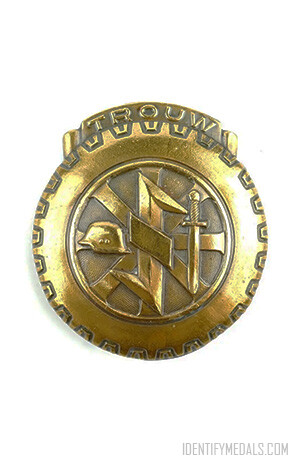
The badge, die-struck from a bronze-copper alloy, features the Dutch “wolf-hook” emblem, a German helmet, and a downward-facing sword, with “TROUW” (Loyalty) inscribed on a transport tire. The reverse has a Belgian-style “C” catch and pin. Measuring 46.8mm x 51.2mm, the badge is associated with those who served in Russia during the winter of 1941-1942, were wounded at Milorowo, or volunteered for guard duties in Makajewka.

The Gold class criteria remain unknown, and reproductions of the badge, identifiable by different attaching hardware, have surfaced.
The Schalburg Cross

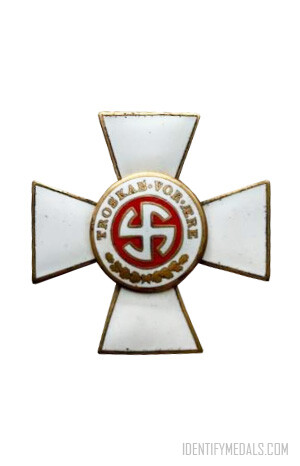
The Schalburg Cross was a military decoration for members of the Danish Schalburg Corps during World War II.

The Schalburg Cross, or Schalburgkors in Danish, was a military decoration for members of the Danish Schalburg Corps during World War II.

Named after Christian Frederik von Schalburg, the cross was produced by Heimbürger in Copenhagen. Although many were made, there is only one confirmed instance of it being awarded, posthumously. Instituted possibly after 1943, the cross recognized service against the Danish resistance and on the Eastern Front.

The cross was meant to be worn on the left breast pocket. Some unissued crosses were found at the Schalburg Corps HQ after the German retreat in May 1945 and were kept as souvenirs. They were even distributed to the public during the liberation celebrations in Copenhagen. Only a few enamelled versions are known to exist today.

The Schalburg Cross Design

The cross came in two classes: one for officers and NCOs, and another for enlisted men. Both versions measured 50mm x 50mm and featured a central medallion.

The enlisted version was off-white with golden edges and had the inscription “Our Honor is Loyalty” along with golden oak leaves.

The officer’s version was enameled with the same design but more intricate, with gilded oak leaves and enameled red background.

The Mussert Garde Pin 1939-1940

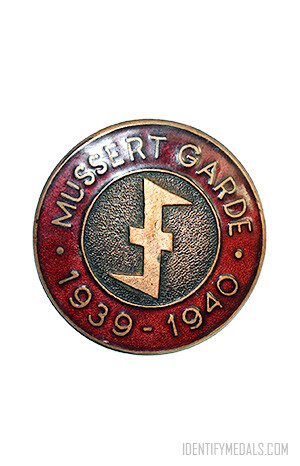
The Mussert Garde Pin, created in 1939-1940, was a symbol of loyalty and service to the National Socialist Movement in the Netherlands (NSB).

The Mussert Garde Pin, created in 1939-1940, was a symbol of loyalty and service to the National Socialist Movement in the Netherlands (NSB), led by Anton Mussert.

This pin was awarded to members of the Mussert Garde, an elite guard unit responsible for protecting NSB leaders and significant events. The design of the pin typically featured the NSB emblem, reflecting the organization’s ideology and dedication to the Nazi cause.

These pins are now rare historical artifacts, providing insight into the collaborationist activities in the Netherlands during World War II.

The Mussert Garde Pin Design

The badge features a central shield with a black Wolfsangel, a symbol used by the NSB, on a white background. This central element is surrounded by a red enamel border.

The Jarnkross or State Police Honor Cross

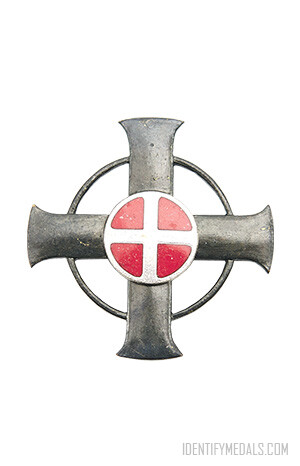
The State Police Honor Cross was a special decoration likely instituted in 1941 and awarded to frontline volunteers.

The Jarnkross, or “Rikspolitiets Hederstegn,” was a special decoration likely instituted in 1941.

It was awarded to frontline volunteers in the “Norwegen Polizei Kompanie” (Norwegian SS Police Companies), who briefly served with the “Legion Norwegen” and later the “SS-Skijager Btl ‘Norge’.”

The Norwegen Polizei Kompanie were paramilitary units formed during World War II, comprising Norwegian volunteers. These units were integrated into the German SS and served on the Eastern Front, participating in combat operations alongside German forces. Initially, they served with the “Legion Norwegen” and later with the “SS-Skijäger Battalion ‘Norge’.” 

The Jarnkross or State Police Honor Cross Design

The decoration was made of solid metal. The front side of the silver cross featured a shield, either enameled or painted, showing the “Saint Olaf’s” Cross, symbolizing the Norwegian Nazi Party “Hird.” The reverse was flat, with a thin needle pin and a small hinge, and variations in catch style.

Additionally, there was a 2nd class award with different ribbons: yellow and red for State and Border Police (Grepo/Stapo) and green for detectives, designated for police employees. 

The Mussert Bravery Cross

The Mussert Bravery Cross was a special award for NSB members serving in German forces. It was akin to the German Eastern Front Medal.

Officially referred to as the “Oostlanderskruis,” the Mussert Bravery Cross or “Mussertkruis” was instituted by the Dutch Nazi Party (NSB), led by Anton Mussert, as a special award for NSB members serving in German forces.

The award was akin to the German Eastern Front Medal and not a bravery award. It was issued in two classes: with swords for combatants and without swords for non-combatants.

Although the decoration was not authorized for wear on German uniforms, it was likely worn by recipients.

The Mussert Bravery Cross Design

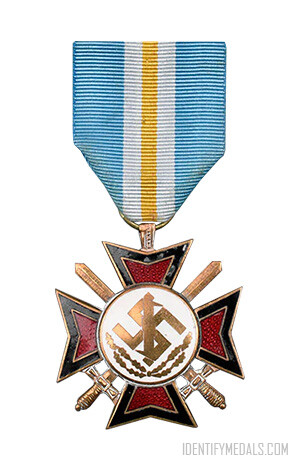
The NSB Mussert Bravery Cross is a gilded bronze Maltese cross with red and black enamel, featuring crossed swords between its arms.

The obverse center medallion displays a golden mobile swastika, Wolfsangel, and oak leaf stems on a white enamel background. The reverse center medallion bears the inscription “MUSSERT 1941” surrounded by “HOU EN TROU” and oak leaf branches.

Measuring 37.12 mm by 41.25 mm, the cross is suspended from a ribbon that displays the Dutch national colors.

The Front-Fighters Badge

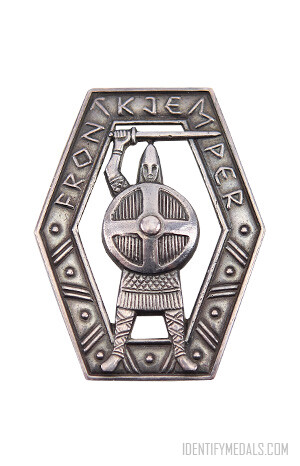
The Norwegian “Frontkjemper” (Front-Fighter) badge was awarded for bravery to Waffen-SS Norwegian legionnaires and German cadre.

The Norwegian “Frontkjemper” (Front-Fighter) badge was introduced in October 1943 by Vidkun Quisling, leader of the Norwegian collaborationist government during World War II. This badge was awarded to Norwegian legionnaires and German cadre members who demonstrated bravery while serving on the Eastern Front between 1941 and 1945.

The badge was awarded to Norwegian soldiers and German cadre for their participation in combat on the Eastern Front. Nurses who served on the Eastern Front were also eligible for the award. A miniature version was available for veterans to wear on civilian clothing. A special variant featuring a nurse helping a wounded soldier was produced, reflecting the contributions of medical personnel.

The Front-Fighters Badge Design

Manufactured by “Webeto” in Oslo, it was only issued in silver. The badge depicts a Nordic warrior with a shield and sword, framed by an archway inscribed with “FRONT KJEMPER” in pseudo runic script. Two types exist: an early high-quality version with sharp details and a later type with a standard “M” in “frontkjeMper”. Original badges feature the silver content “830S” and the maker’s mark “W”.

On the reverse, the badge displays a serial number, indicating its silver content. Authentic pieces have a thin needle, small hinge, and “C”-shaped catch, with patina in the relief’s deepest areas. Some post-war badges, made of zinc, were produced for veterans who lost their awards.

The Brave and Faithful Order or Quisling Cross

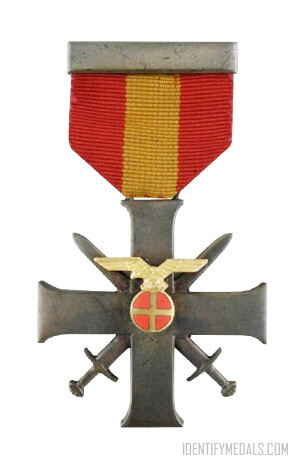
The Brave and Faithful Order was introduced by the Quisling Government to serve as the Norwegian equivalent of the German Iron Cross.

The Brave and Faithful Order was introduced by the Quisling Government to serve as the Norwegian equivalent of the German Iron Cross. The decoration was intended for Norwegian front-line fighters.

Few of these medals were produced before it was decided that Norwegian soldiers could wear the German Iron Cross.

The Brave and Faithful Order Design

In 1944, the Order was repurposed as a civilian Nazi Party award, featuring a Sun-Eagle instead of the original “1941.”

Known as the “Quisling Cross,” the reverse bears the inscription “Brave and Faithful.” It is very rare, as many recipients kept it secret after 1945.

The three grades differ in how they are worn: the I Class as a breast cross, the II Class on a ribbon, and the Knight’s Cross with a ribbon suspension.

The W.A. Military Sports Badge

The W.A. Military Sports Badge was awarded to members of the “Weer Afdeelingen” (Defense Sections) for military sporting events.

The W.A. Military Sports Badge was awarded to members of the “Weer Afdeelingen” (Defense Sections) or stormtroopers of the NSB. This decoration was instituted on 13 September 1941.

The National Socialist Movement in the Netherlands (Dutch: Nationaal-Socialistische Beweging in Nederland; NSB) was a Dutch fascist organization that evolved into a Nazi political party. Initially successful in the 1930s parliamentary elections, the NSB became the sole legal party under German occupation during most of World War II.

Military sporting events were held for W.A. troops and successful winners were awarded with the military sport badge.

The W.A. Military Sports Badge Design

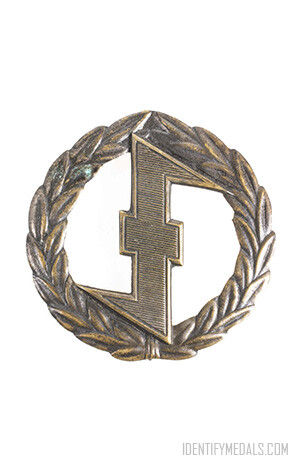
The sport badge shows in the background a Laurel with the NSB emblem “wolf hook” in front. The reverse is hollow with two small loop rings that holds the pin. This die stamped badge was awarded in two classes- silver and bronze gilt. The badge is very large it measures 53mm in diameter.

Note: I could only find limited information about this medal. If you know more, please use the contact form to let me know.

The SS Dutch Sports Badge

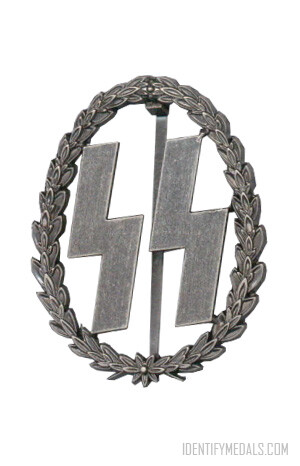
The SS Dutch Sports Badge was awarded to members of the Dutch SS for demonstrating athletic prowess and physical fitness.

The SS Dutch Sports Badge was awarded to members of the Dutch SS for demonstrating athletic prowess and physical fitness.

This badge was part of the efforts to promote physical conditioning among the SS members.

The design typically included elements symbolizing strength and athletic achievement, often incorporating Nazi insignia and symbols to reflect the regime’s ideology. These badges were awarded during World War II, making them historical artifacts of that era. Collectors value them for their historical significance and the insight they provide into the period’s propaganda and values.

Note: I could only find limited information about this medal. If you know more, please use the contact form to let me know.

The Germanic Proficiency Runes

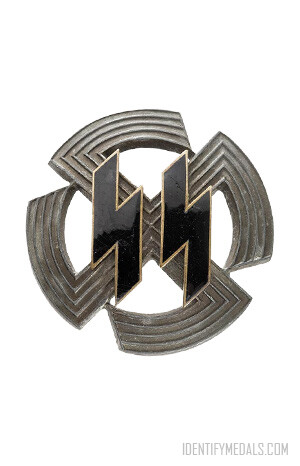
The Nazi regime introduced a sports badge for non-Germans who were part of the Germanic-SS and Waffen-SS, known as the runes.

The Germanic Proficiency Runes Badge, established on August 15, 1943, was awarded to non-German members of the Germanic-SS and Waffen-SS who demonstrated exceptional physical fitness and adherence to Nazi ideology.

The Germanic Proficiency Runes were awarded in two grades: bronze and silver. The distinction between these grades was based on the level of physical achievement demonstrated by the recipients.

The tests for these awards were similar to those required for the SA Sports Badge, ensuring a standardized measure of physical fitness across both German and non-German SS members.

The creation of the Germanic Proficiency Runes served several purposes. It was a tool for promoting physical fitness and readiness among non-German SS members. Additionally, it reinforced the ideology of the Germanic-SS, which sought to include ethnically Germanic volunteers from occupied and neutral countries in Europe.

The Germanic Proficiency Runes Tests

Recipients of the Germanic Proficiency Runes had to undergo rigorous physical tests that were on par with the requirements for the SA Sports Badge. These tests included a variety of athletic and endurance challenges designed to assess overall physical fitness, agility, strength, and stamina. The aim was to maintain a high level of physical preparedness among the SS troops, irrespective of their nationality.