The Order of the Zähringer Lion

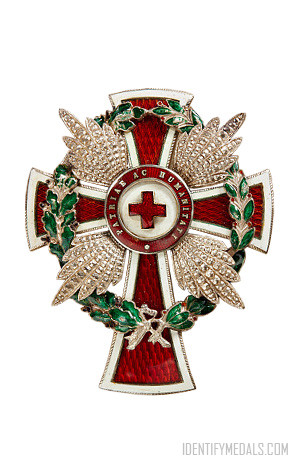
The Order of the Zähringer Lion was instituted on 26 December 1812 by the Grand Duke of Baden in memory of the Dukes of Zähringen.

The Order of the Zähringer Lion was instituted on 26 December 1812 by Karl, Grand Duke of Baden, in memory of the Dukes of Zähringen from whom he was descended.

It remains a very high-level award, sitting just above the Commander’s Cross (a neck order) and the Knight’s Crosses (1st and 2nd Class).

The Grand Duchy of Baden was formed in 1806 during the Napoleonic Wars. Its location on France’s southeastern border led to its devastation when it opposed the French Empire. Its two final Grand Dukes were Friedrich I (1826-1907), who reigned from 1856-1907 and his son, Friedrich II (1856-1928), who reigned from 1907 to the Empire’s end in 1918.

The Order of the Zähringer Lion was awarded in five classes:

  • Grand Cross;
  • Commander, First Class;
  • Commander, Second Class;
  • Knight, First Class; and
  • Knight, Second Class.

A total of 763 of this Order of the Zähringer Lion Grand Cross were awarded between 1815 and 1918.

The Order of the Zähringer Lion Design

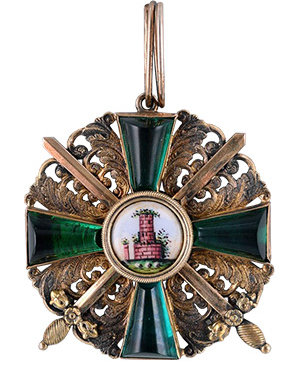
The order’s insignia measures 39.7 mm and consists of a green enameled cross with four arms of equal length, whose angles are filled out with golden clasps. The gold-edged medallion shows the tribal symbol of the Zähringers in coloured enamel. Around the circle is the order’s motto, FÜR EHRE UND WAHRHEIT (German for “FOR HONOUR AND TRUTH”). On the back, the Zähringer lion is portrayed on a red background. The order’s ribbon is green with orange-yellow stripes along the edges.

For special awards, the order was granted with oak leaves and from 1866, it could also be awarded with crossed swords for military services. The oak leaves originally carried an “L” cipher, which went out of use in 1866. Moreover, in exceptional cases, the grand cross award could also be covered in diamonds


The Württemberg Military Merit Order

The Military Merit Order (Militärverdienstorden) was a military order of the Kingdom of Württemberg, which joined the German Empire in 1871.

The Military Merit Order (or Militärverdienstorden in German) was a military order of the Kingdom of Württemberg, which joined the German Empire in 1871.

The order was one of the older military orders of the states of the German Empire. It was founded on February 11, 1759 by Karl Eugen, Duke of Württemberg as the Militär-Carls-Orden, and was renamed the Militärverdienstorden on November 11, 1806 by King Friedrich I. The order underwent several more revisions over the course of the 19th and early 20th centuries. It became obsolete with the fall of the Württemberg monarchy in the wake of Germany’s defeat in World War I.

The order came in three classes. Generally, the rank of the recipient determined which grade he would receive:

  • Grand Cross (Großkreuz)
  • Commander’s Cross (Kommandeurkreuz) and
  • Knight’s Cross (Ritterkreuz).

Between 1799 and 1919, there were an estimated 95 awards of the Grand Cross, 214 of the Commander’s Cross, and 3,128 of the Knight’s Cross, with the bulk of these awards made in World War I; the numbers may only cover native Württembergers.

The Württemberg Military Merit Order Design

The badge of the order was a white-enameled gold cross pattée with curved arms and slightly concave edges. Around the white-enameled center medallion was a blue-enameled gold ring bearing on both sides the motto “Furchtlos und trew” (“Fearless and loyal”).

On the obverse, the medallion bore a green-enameled gold laurel wreath. On the reverse, the medallion bore the monogram of the king of Württemberg at the time of award. The cross was the same size for the Grand Cross and the Commander’s Cross, and slightly smaller for the Knight’s Cross. The Grand Cross and Commander’s Cross, and from 1870 the Knight’s Cross, were topped with a crown. On September 25, 1914, the crown was removed from all grades.

The star of the order, awarded with the Grand Cross only, was a gold-rimmed silver eight-pointed star featuring the ringed medallion of the obverse of the cross.

The ribbon of the order was, until 1818 and after 1914, yellow with broad black stripes near each edge. After November 1917, when the ribbon was worn without the medal, the ribbon bore a green-enameled wreath to distinguish it from other Württemberg decorations on the same ribbon. The ribbon from 1818 to 1914 was blue.

Buy This Medal Online

Right Now on eBay 
Clicking a link to eBay may result in a referral commission being paid if a purchase is made.
Loading...

The Panzer Badge or Tank Battle Badge (Nazi Germany)

The Panzer Badge (or Panzerkampfabzeichen) was a World War II military decoration of Nazi Germany awarded to troops in armored divisions. 

The Panzer Badge (or Panzerkampfabzeichen in German) was a World War II military decoration of Nazi Germany awarded to troops in armored divisions.

If you know a thing or two about World War II, you might be aware that the German Panzers played one of the major roles, if not the most important one. Led by intrepid commanders such as Erich Von Manstein, Heinz Guderian, Erwin Rommel, and many more, the Panzers broke the front lines with speed, power and destruction following their paths. But the men who led the Panzers through the Russian Steppe or Northern France were the real “Heroes.”

To recognize the achievements of some of these Panzer crews, the OKW (OberKommando Wehrmacht, the German ground army HQ) decided to create a medal for these men. It was first awarded during World War I but was long forgotten since the Germans saw little action during the end of the war.

During the interwar period, a badge was issued for the veterans of the Condor Legion who participated in the Spanish Civil War. But as World War II was starting, the tank crews and their beloved tactics needed something, something to recognize their “Blitz” through the enemy lines.

Famous Recipients of The Panzer Badge

The most decorated generals of the Wehrmacht never got their grasp on this badge, even if their achievements were enormous. No, this badge was meant for the crewmen, those who gave their life for their country. Some of them never saw the end of the war, but some others did.

Otto Carius, per example, is one of the most decorated Panzer ace, having destroyed more than 150 enemy tanks, and most surprinsigly, a flying enemy plane. This particular enemy plane was “annoying” the gunner of the tank, Heinz Kramer, shooting its armor with its machine gun. As the sound of bullets hitting the armor was annoying more and more Mr Kramer, he asked permission to shoot down the plane, and after a first missed shot, shot down the plane. Probably the best tank shot ever. Carius lived until 2015 in Germany and was the last Panzer ace alive.

The most famous Panzer ace, Michael Wittmann, was also awarded with the highest class of the Badge. He was known to have destroyed at least 150+ tanks and more than 130 enemy canons (of any caliber). Unfortunately for him, he ultimately died in Normandy during Operation Overlord in his beloved Tiger. Nonetheless, his legend grew after the war when all of his achievements were discovered.

These folks are some of the most famous recipients of the Panzer Badge, but it would be wrong to forget about the 34,000 others that got the Badge in the different classes with around 22,000 getting the silver one.

There was definitely a lot of recipients during World War II but what is somehow “strange”, is that the Badge is still being given to members of Germany’s land Army, the Heer. If you are a badge “fanatic”, you can try to get one from the Internet but beware of forgeries, as some of them look very close to the original one.

The Panzer Badge Design

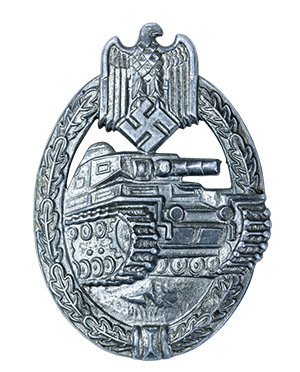
The obverse of the Panzer Badge shows a border of oak leaves with a tie at the base and a Panzerkampfwagen IV superimposed in the centre on grassy ground, with its left tank track extending over the edge of the badge. The reverse is plain with a vertical needle style pin, with an oval based hinge and catch.

The badge measures 42.05 mm (w) x 60.09 mm (h) and weights 27.6 grams.

The 50 and 100 engagement badges were struck in a lightweight zinc alloy; this was so that the larger pin did not pull inconveniently on the tunic. The 1957 de-Nazified version lost the eagle and the swastika, but was otherwise unchanged.

The Panzer Classes and Wear

Designed in 1939 by Ernst Peekhaus, the Panzer Badge was first issued in December 1939, when the chief of the OKW, Walter Von Brauchitsch, decided to create a medal dedicated to the sacrifice and the achievements of the Panzer’s crews. Two different classes of the badge were designed for those who received it during world war II. The first and “original” one was the silver Panzer Badge, designed to recognize solely the tank crews.

The “less original” one, the Bronze Panzer Badge, was designed to recognize the crews of armored vehicles (half tracks, trucks,…). As the war was still raging, it was decided that the Badge should evolve. In June 1943, four new classes were created, depending on the amount of engagement the recipent would have take part in: 25, 50, 75 and 100. Depending on which class and the amount of engagement you took part in, the metal used to design the medal and the color of it changed accordingly. 

After the war, it was frowned upon to wear this badge since there was a swastika on the top of it. Thus, West Germany decided in 1957 to authorize to wear the Panzer badge in public but only if the swastika was removed from it.

Note: As an eBay partner, I earn from qualifying purchases. This is all done automatically when you use a link and at no extra cost to you.

More Army/Waffen-SS War Badges

The Army/Waffen-SS war badges were military decorations awarded by Nazi Germany to members of the Army (Heer) and the Waffen-SS. Explore the complete collection below:

Buy a Panzer Badge

Right Now on eBay 
Clicking a link to eBay may result in a referral commission being paid if a purchase is made.
Loading...

The Medal of the Hellenic Red Cross

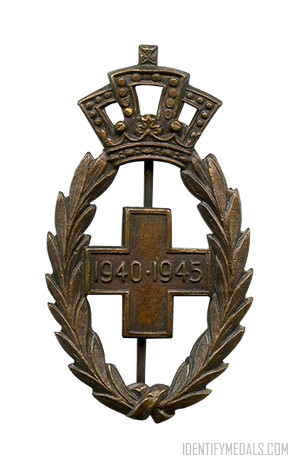
The Medal of the Hellenic Red Cross is medal for service in the ranks during the Italian invasion in 1940 until the Capitulation of Greece.

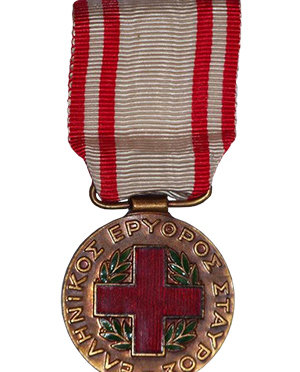
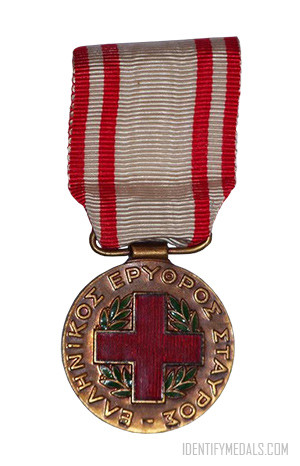
The Medal of the Hellenic Red Cross is a WW2 medal for service in the Hellenic Red Cross ranks during the Italian invasion in 1940 and until the Capitulation of Greece following the German invasion in April 1941 and the battle of Crete in May of the same year. The medal was awarded to both men and women.

The first initiative for the foundation of the Hellenic Red Cross took place in 1865 as the Kingdom of Greece participated in the 1st Geneva Convention. The Hellenic Red Cross was officially founded in 1877, with the active support of Queen Olga and it was recognized, the same year, by the International Red Cross Committee. Ever since it continues its humanitarian efforts both domestically and abroad whenever and wherever its aid is needed.

The Medal of the Hellenic Red Cross Design

The medal is made of bronze and enamels and measures 30.3 mm in diameter. The obverse depicts a large red cross in finely detailed red enamel, encircled by laurel branches in green enamel; on horizontal loop for suspension.

Find Red Cross Medals Online

More Red Cross Medals

The Scottish Territorial Red Cross Brigade Badge

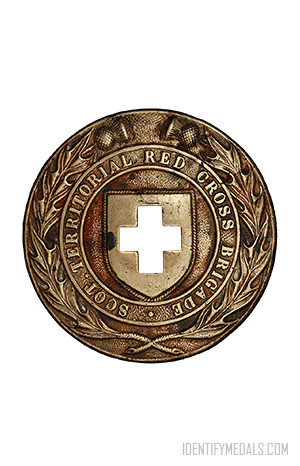
The Scottish Territorial Red Cross Brigade Badge is a WW1 cap badge made in brass-metal with a red felt backing to the central Geneva Cross.

The Scottish Territorial Red Cross Brigade Badge is a WW1 die-stamped cap badge to the Scottish Territorial Red Cross Brigade in brass metal with a red felt backing to the central Geneva Cross.

This organization was originally founded in 1908. The badge was approved by the War Office as the Scottish Branch of the British Red Cross Society and was intended as a formation of voluntary aid detachments for service in the event of war. It was only issued to registered members of detachments and had to be purchased by the member.

The Scottish Territorial Brigade was mobilized immediately after the proclamation of War in 1914. Sadly, there are no mentions of the Brigade after that – whether it changed name/structure – is not known. The Royal Scots (The Royal Regiment), once known as the Royal Regiment of Foot, was the oldest and most senior infantry regiment of the line of the British Army, having been raised in 1633 during the reign of Charles I of Scotland.

The Scottish Territorial Red Cross Brigade Badge Design

The Badge is made of brass with loops (lugs) and pin measuring 56mm in diameter. The back is red.

Find Red Cross Medals Online

More Red Cross Medals

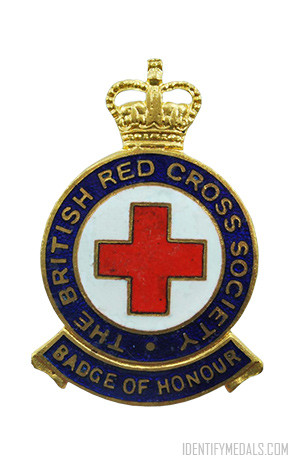
The British Red Cross Badge of Honor

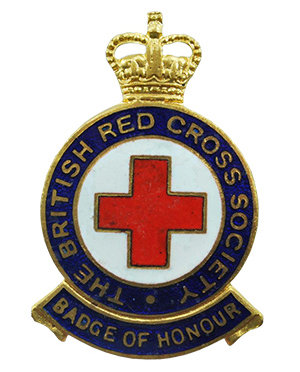
The British Red Cross Badge of Honor was instituted in 1958 and given to people who show exceptional service to the British Red Cross.

The British Red Cross Badge of Honour was instituted in 1958. It’s an award badge given to people who show exceptional service to the British Red Cross.

The Badge has 3 classes:

  • Class 1 “Badge of Honour for Devoted Service”
  • Class 2 “Badge of Honour for Distinguished Service”
  • Class 3 “Queens Badge of Honour”

Badge of Honour for Devoted Service

The award is given to volunteers and staff who have given devoted service to the Society. The Badge is accompanied by a Certificate, which is signed by the Chairman of the Board. The criteria for this award will include the demonstration of service above and beyond the call of duty and actions showing the nominee’s personal involvement and commitment over a longer period of time, furthermore, the recipient’s actions should include devoted and consistent service, showing loyalty and dependability, as well as a certain amount of self-sacrifice and determination.

As a general rule, a minimum period of five years of service should have been completed before receiving this award. Exceptional circumstances may arise when it would be acceptable to make the award sooner.

Badge of Honour for Distinguished Service

The award is given to volunteers and staff for distinguished or exceptional service to the Society. The Badge is accompanied by a Certificate, which is signed by the Chairman of the Board. The recipient should have shown an element of self-sacrifice in time and effort, and should also have demonstrated the ability to initiate innovative ideas, maintain enthusiasm and expand training and service to the community.

Queen’s Badge of Honour

This award may be awarded to any person by the Trustees, with the approval of The President of the Society, His Royal Highness The Prince of Wales, for exceptional service of the highest order to the Society or to the International Red Cross and Red Crescent Movement. The award is accompanied by a certificate, which is signed by The President. The award is limited to thirty holders at any one time.

Find Red Cross Medals Online

More Red Cross Medals

The Henry Dunant Medal

The Henry Dunant Medal is the highest award of the Red Cross. It was created in 1963 and named after the founder of the Red Cross Movement.

The Henry Dunant Medal is the highest award of the Red Cross Movement. It was created in 1963 and named after Henry Dunant, the founder of the Red Cross Movement. In 1963, the idea of creating a medal named in honor of the founder of the International Red Cross was submitted to and approved by the Council of Delegates. This coincided with the 100th anniversary of the Red Cross. In 1965, through the generosity of the Australian Red Cross, the Henry Dunant Medal was established by the International Red Cross Conference in Vienna. The first medals were presented in 1969.

The medal is awarded to “recognize and reward outstanding services and acts of great devotion, mainly of international significance, to the cause of the Red Cross/Red Crescent by any of its members“. 

The medal is presented every two years by the Standing Commission of the Red Cross and Red Crescent, the body that represents the International Committee of the Red Cross, the International Federation of Red Cross and Red Crescent Societies and the various National Red Cross and Red Crescent Societies. This body, representing all of the groups making up the Red Cross Movement, makes five awards of the medal every two years. These limits are placed to ensure the value and prestige of the medal as the highest honour the Red Cross Movement can bestow upon one of its members.

Regulations still allow for the posthumous award of the medal. However, the various groups of the movement have been encouraged to create recognition for those killed in service to the Red Cross. All posthumous nominations for the Henry Dunant Medal should be for, “truly exceptional cases.”

The Henry Dunant Medal Design

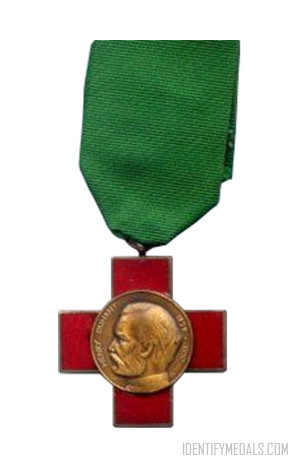
The Henry Dunant Medal is in the shape of a Geneva or Greek cross. The arms of the cross are colored with red enamel. In the center of the cross is a circular bronze medallion bearing effigy of Henry Dunant, facing left. Circumscribed around the effigy are the words HENRY DUNANT 1828-1910. The reverse of the medal is plain. To the top arm of the cross is attached a loop for ribbon suspension.

The ribbon is depicted as either solid green, or green with red edges.

Find Red Cross Medals Online

More Red Cross Medals

The Florence Nightingale Medal

The Florence Nightingale Medal was instituted in 1912 by the Red Cross as the highest distinction a nurse can achieve.

The Florence Nightingale Medal was instituted in 1912 by the International Committee of the Red Cross. It is the highest international distinction a nurse can achieve and is awarded to nurses or nursing aides for “exceptional courage and devotion to the wounded, sick or disabled or to civilian victims of a conflict or disaster” or “exemplary services or a creative and pioneering spirit in the areas of public health or nursing education“.

The assembled delegates of the Eighth International Conference of Red Cross Societies in London in 1907 decided to create a commemorative International Nightingale Medal to be awarded to those distinguished in the nursing field. It was initially set up to be awarded to six nurses annually, although the first 42 awards were only made in 1920 due to the disruption of the First World War. Among the first recipients were six American nurses: Florence Merriam JohnsonHelen Scott HayLinda K. MeirsMartha M. RussellMary E. Gladwin, and Alma E. Foerster.

The medal was restricted to female nurses until regulation changes in 1991. Under the new regulations, it is open to both women and men and is awarded every two years to a maximum number of fifty recipients worldwide. 

In 2007, the 41st set of medals were awarded to 35 recipients from 18 countries. In 2009, the 42nd set of medals were awarded to 28 recipients from 15 countries, including one for the first time to a nurse in Afghanistan. In 2011, the 43rd set of medals were awarded to 39 recipients from 19 countries, (including for the first time to two Kenyan nurses). In 2013, the 44th set of medals were awarded to 32 recipients from 16 countries, including one posthumously to a delegate from the British Red Cross. In 2015, the 45th set of medals were awarded to 36 recipients from 18 countries, including one posthumously to a Sierra Leonian nurse who had worked in an Ebola treatment center.

In 2017, the 46th set of medals were awarded to 39 recipients from 22 countries, including one to Rear Admiral Sylvia Trent-Adams, the Acting Surgeon General of the United States.

The medal and a diploma are usually presented by the Head of State at a ceremony in their own country, which is required to have “a formal character, in keeping with the founders’ wishes“.

The Florence Nightingale Medal Design

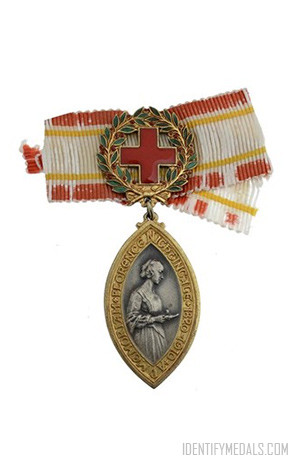
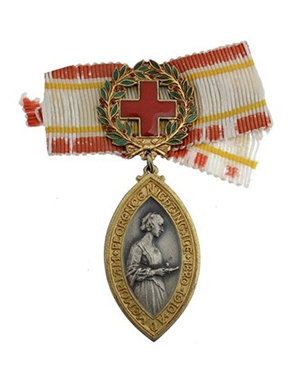
The vesica piscis-shaped medal is composed of gold and silver-gilt and bears, on the obverse, a portrait of Florence Nightingale surrounded by the words ‘Ad memoriam Florence Nightingale 1820-1910‘.

On the reverse, the name of the recipient and the date of the award are engraved, surrounded by the inscription ‘Pro vera misericordia et cara humanitate perennis décor universalis‘ (‘true and loving humanitarianism – a lasting general propriety‘).

The medal is attached to a white and red ribbon by a clasp featuring a red enamel cross encircled by a green laurel crown.

Recipients are also presented with a parchment diploma of the award and, from 1927, a miniature version of the medal that could be more easily worn. 

Find Red Cross Medals Online

More Red Cross Medals

The Legion of Merit

The Legion of Merit is a military award of the United States Armed Forces for exceptionally meritorious conduct and outstanding services.

The Legion of Merit (or LOM) is a military award of the United States Armed Forces given to members of the seven uniformed services of the U.S. and  to military and political figures of foreign governments for exceptionally meritorious conduct in the performance of outstanding services and achievements. It is typically awarded to Army, Marine Corps, and Air Force general officers and colonels, and Navy and Coast Guard flag officers and captains occupying senior command or very senior staff positions. Instances for officers of lesser rank are rare.

The award was created in December 24, 1941, when the Adjutant General formally requested action be initiated to create a Meritorious Service Medal and provide designs for the decoration. These were prepared by Bailey, Banks, and Biddle and given to Assistant Chief of Staff for Personnel by the QMG on January 5, 1942. An act of Congress (Public Law 671—77th Congress) established the Legion of Merit on July 20, 1942.

The Legion of Merit is seventh in the order of precedence of all U.S. military awards and the only U.S. military decoration that may be issued in award degrees. It’s also one of only two U.S. military decorations to be issued as a neck order (the other being the Medal of Honor). It is worn after the Defense Superior Service Medal and before the Distinguished Flying Cross.

The Legion of Merit in History

During the Second World War, Brazilian Army Brigadier General Amaro Soares Bittencourt became the first person awarded the Legion of Merit (Commander) in October 1942. A week later, Lieutenant, junior grade Ann A. Bernatitus, a U.S. Navy Nurse Corps officer, became the first woman and the first member of the United States Armed Forces to receive the Legion of Merit. A year later, General Dwight D. Eisenhower was presented the Legion of Merit by President Roosevelt on November 26.

From 1942 to 1944, the Legion of Merit was awarded for a wide range of achievements, because it was the only decoration below the Silver Star, awarded for combat valor, and the Distinguished Service Medal for meritorious noncombat service. That was, until the Bronze Star Medal was established in 1944.

After World War II, the Legion of Merit was awarded almost exclusively to senior officers in the rank Lieutenant Colonel (Army, Marine Corps and Air Force) or Commander (Navy and Coast Guard) (O-5), and above. In 1969, the Meritorious Service Medal was established as a junior version of the Legion of Merit.

The Legion of Merit Classes

  1. Chief Commander: For Heads of state or government.
  2. Commander: For the equivalent of a U.S. military chief of staff or higher position.
  3. Officer: For Generals or flag officers below the equivalent of a U.S. military chief of staff; colonels or equivalent rank or military attachés.
  4. Legionnaire: For all recipients not included above.

The Legion of Merit Design

Medal Obverse

The Chief Commander Degree of the Legion of Merit Medal is, on a wreath of green laurel joined at the bottom by a gold bow-knot (rosette), a domed five-pointed white star bordered crimson, points reversed with v-shaped extremities tipped with a gold ball. In the center, a blue disk encircled by gold clouds, with 13 white stars arranged in the pattern that appears on the Great Seal of the United States. Between each point, within the wreath are crossed arrows pointing outwards. The overall width is 2 1516 inches (75 mm).[/vc_column_text][vc_column_text]

The Commander Degree of the Legion of Merit Medal has a width of 2 14 inches (57 mm). In the center, a disk for engraving the name of the recipient surrounded by the words “ANNUIT COEPTIS MDCCLXXXII.” An outer scroll contains the words “UNITED STATES OF AMERICA.”

Medal Reverse

The reverse of all of the medals has the motto taken from the Great Seal of the United States, “ANNUIT COEPTIS” (“He [God] has favored our undertakings“) and the date “MDCCLXXXII” (1782), which is the date of America’s first decoration, the Badge of Military Merit, now known as the Purple Heart. The ribbon design also follows the pattern of the Purple Heart ribbon.

Ribbon

The ribbon for all of the decorations is 1 38 inches (35 mm) wide and consists of the following stripes: 116 inch (1.6 mm) white; center 1 14 inches (32 mm) crimson; and 116 inch (1.6 mm) white.

The Chief Commander Degree, a miniature of the decoration in gold on a horizontal gold bar is worn on the service ribbon. One in silver on a horizontal silver bar is worn on the service ribbon for the Commander Degree.

Buy a Legion of Merit

Note: As an eBay partner, I earn from qualifying purchases. This is all done automatically when you use a link and at no extra cost to you.

Right Now on eBay 
Clicking a link to eBay may result in a referral commission being paid if a purchase is made.
Loading...

The Bronze Star Medal

The Bronze Star Medal (also known as Bronze Star) is a United States decoration awarded for heroic achievement or service in a combat zone. 

The Bronze Star Medal (also known as Bronze Star) is a United States decoration awarded to members of the United States Armed Forces for either heroic achievement, heroic service, meritorious achievement, or meritorious service in a combat zone. Officers from the other Uniformed Services of the United States are eligible to receive this award, as are foreign soldiers who have served with or alongside a service branch of the United States Armed Forces. Civilians serving with U.S. military forces in combat are also eligible for the award.

The Bronze Star Medal was established by Executive Order 9419, 4 February 1944 (superseded by Executive Order 11046, 24 August 1962, as amended by Executive Order 13286, 28 February 2003). Colonel Russell P. “Red” Reeder conceived the idea of the Bronze Star Medal in 1943; he believed it would aid morale if captains of companies or of batteries could award a medal to deserving people serving under them.

The Bronze Star Medal Design

The Bronze Star Medal was designed by Rudolf Freund (1878–1960) of the jewelry firm Bailey, Banks & Biddle.

The medal is a bronze star 1 12 inches (38 mm) in circumscribing diameter. In the center is a 316 inch (4.8 mm) diameter superimposed bronze star, the center line of all rays of both stars coinciding. The reverse bears the inscription HEROIC OR MERITORIOUS ACHIEVEMENT with a space for the name of the recipient to be engraved.

The star hangs from its ribbon by a rectangular metal loop with rounded corners. 

When the medal is awarded by the Army and Air Force for acts of valor in combat, the “V” Device is authorized for wear on the medal. When the medal is awarded by the Navy, Marine Corps, and Coast Guard for acts of valor or meritorious service in combat, the Combat “V” is authorized for wear on the medal.

The following ribbon devices must be specifically authorized in the award citation in order to be worn on the Bronze Star Medal, the criteria for and wear of the devices vary between the services:

  • Oak leaf cluster – In the Army and Air Force.
  • 5/16 inch star – In the Navy and Marine Corps and Coast Guard.
  • “V” device.
  • Combat “V”.

The Bronze Star During WW2

Here are some examples of individuals receiving the Bronze Star Medal for their actions during World War II:

  • General Dwight D. Eisenhower: General Eisenhower, the Supreme Commander of the Allied Expeditionary Forces in Europe, was awarded the Bronze Star Medal for his leadership during the planning and execution of the D-Day invasion on June 6, 1944.

  • Sergeant Audie Murphy: Audie Murphy, a highly decorated soldier and later a famous actor, received the Bronze Star Medal for his valorous actions in combat. Murphy demonstrated extraordinary courage and leadership in various engagements throughout the war, including his single-handed stand against German forces in the Battle of Holtzwihr.

  • Lieutenant Colonel James H. Doolittle: Lieutenant Colonel Doolittle, an aviation pioneer, was honored with the Bronze Star Medal for leading the daring Doolittle Raid, the first U.S. air raid on the Japanese mainland. Despite challenging circumstances, his leadership and audacity boosted American morale and dealt a blow to Japan’s strategic capabilities.

  • Private First Class Desmond Doss: Desmond Doss, a conscientious objector and combat medic, was awarded the Bronze Star Medal for his selfless actions during the Battle of Okinawa. Despite being under heavy enemy fire, Doss repeatedly braved danger to rescue and treat wounded soldiers, saving numerous lives.

  • Lieutenant Colonel Benjamin O. Davis Jr.: Lieutenant Colonel Davis, an officer in the Tuskegee Airmen, received the Bronze Star Medal for his exceptional achievements as a fighter pilot. He overcame significant adversity and discrimination to become one of the most respected and highly decorated African American officers of World War II.
Right Now on eBay 
Clicking a link to eBay may result in a referral commission being paid if a purchase is made.
Loading...