The Commemorative Medal for the Victory Over Greece

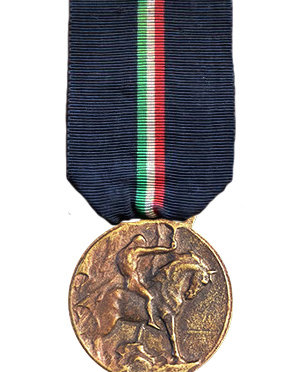
The Commemorative Medal for the Victory Over Greece was an Italian medal from the World War II period awarded after repelling their attack.

The Commemorative Medal for the Victory Over Greece is an Italian medal from the WW2 period.

Italy invaded Greece on 28 October 1940 from the Italian-occupied Albania. By April 1941, the Hellenic Army had repelled the attack and had pushed the Italians deep inside the Albanian territory. Trying to prevent the imminent Italian defeat, Germany attacked Greece and Yugoslavia, from/with Bulgaria, on 6 Apr. 1941 and forced the continental Greek Forces to capitulate 3 weeks later.

The Commemorative Medal for the Victory Over Greece Design

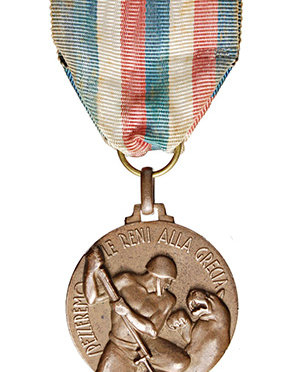
The medal shows on the obverse a dramatic scene of Italian soldier driving bayonette into a lioness. The medal measures 32.5mm in diameter. On the obverse there is the famous phrase of Mussolini “Spezzeremo le reni alla Grecia” (we will split the kidneys of Greece) during his speech on the radio on Nov. 19 1940.
The Commemorative Cross for the Expeditionary Corps in Russia

The Commemorative Cross for the Expeditionary Corps in Russia is an Italian medal given to the Italian Expeditionary Corps in Russia.

The Commemorative Cross for the Expeditionary Corps in Russia (also known as “Ice Cross”) is an Italian medal given to the Italian Expeditionary Corps in Russia – “C.S.I.R.” (Corpo di Spedizione Italiano in Russia).

During World War II, the Italian Expeditionary Corps in Russia was a corps-sized expeditionary unit of the Regio Esercito (Italian Army) that fought on the Eastern Front. In July 1942, the three divisions of the CSIR all became part of the Italian XXXV Army Corps.

The Commemorative Cross for the Expeditionary Corps in Russia Design

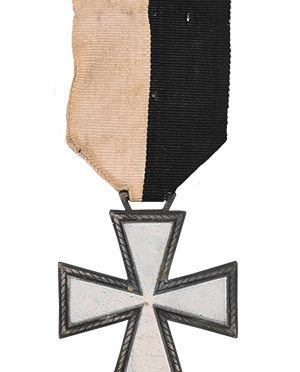
The Commemorative Cross for the Expeditionary Corps in Russia medal is made of zinc alloy and white enamels.

The medal measures 41.3 mm.

The Medal for the Fascist Campaign 1919-1922

The Fascist Campaign Medal was an Italian award distributed to all who participated in the Fascist Campaign of 1919-1922.

The Fascist Campaign Medal (also Medal for the Fascist Campaign 1919-1922, or “Medaglia per le campagne fasciste 1919-1922″ in Italian) is an Italian award distributed to all who participated in the Fascist Campaign of 1919-1922.

This period marks the rise of Fascism in Italy, culminating in the March on Rome, which brought Benito Mussolini and his Fascist Party to power. The medal honors those who supported the movement during its early, tumultuous years, recognizing their contributions to the establishment of the Fascist regime. The design typically features Fascist symbols and inscriptions commemorating the campaign and its significance in Italian history.

The Fascist Campaign Medal Design

The dimensions of the Medal for the Fascist Campaign 1919-1922 are 3,5 x 14 cm. The medal shows a dramatic equestrian scene on the obverse, and joined hands and inscription “Per L’Italia, Ora e Sempre” (For Italy, Now and Always) on its reverse.

The Commemorative Medal Marcia su Roma

The Commemorative Medal Marcia su Roma was designed by sculptor Eugenio Baroni and produced by FM Lorioli & Castelli-Milano.

The Commemorative Medal Marcia su Roma (or Medaglia commemorativa della Marcia su Roma in Italian) was designed by sculptor Eugenio Baroni and produced by FM Lorioli & Castelli-Milano.

The medal was awarded in gold to Benito Mussolini, to the quadrumviris and to the administrative secretary of the PNF Giovanni Marinelli; in silver to the 19 commanders of the columns of the teams organized to converge on Rome; and in bronze to all members of the National Fascist Party that had participated in the march between 27 October and 1 November 1922.

Through Royal Decree No. 273 of January 31, 1926, it was also authorized for members of the Volunteer Militia for National Security. A second provision, given on 1 November 1928, granted its use to those soldiers who on 28 October 1922 did not provide effective service in the Armed Forces of the State.

The full right to use the banner of all members of the FF.AA., was granted by Royal Decree No. 1179 of July 15, 1938.

The Commemorative Medal Marcia su Roma Design

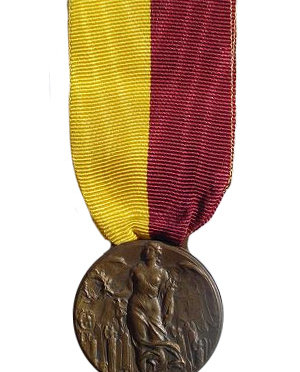
The ribbon colors of the Commemorative Medal Marcia su Roma are those of the city of Rome. It was coined made by Mussolini on the occasion of first Anniversary and distributed to all participants in this event that brought fascism to power in november 1, 1922.

The medal consists of a disk with a total diameter of 34 mm. and cambretta attachment. The obverse of the Commemorative Medal Marcia su Roma medal shows a winged victory holding a crown of oak with his right hand and holding a lictorian beam with his left hand. Behind the figure there are legionary signs, fasces and Roman daggers.

The reverse of the medal shows in the center an empty quadrangular space where the recipient could have his name engraved. At the base of the square space is the abbreviation FM Lorioli & Castelli Milano et EB Mod. Rip. Ris (incense). The square space is delimited by four lictor beams. Circularly the edge is bordered by a double circle in which the legends Marcia Su Roma are engraved on the top, and 27 October-1 November 1922 , at the bottom. Among the legends there are two small stars.

The Order of Saints Maurice and Lazarus

The Order of Saints Maurice and Lazarus is a Roman Catholic dynastic order of knighthood bestowed by the House of Savoy.

The Order of Saints Maurice and Lazarus (or Ordine dei Santi Maurizio e Lazzaro in Italian) is a Roman Catholic dynastic order of knighthood bestowed by the House of Savoy, founded in 1572 by Emmanuel Philibert, Duke of Savoy, through amalgamation approved by Pope Gregory XIII of the Order of Saint Maurice, founded in 1434, with the medieval Order of Saint Lazarus, founded circa 1119, considered its sole legitimate successor.

The order was formerly awarded by the Kingdom of Italy (1861–1946) with the heads of the House of Savoy as the Kings of Italy. Originally a chivalric order of noble nature, it was restricted to subjects of noble families with proofs of at least eight noble great-grandparents.

After the abolishment of the monarchy and the foundation of the Italian Republic in 1946, the legacy of the order is maintained by the pretenders of the House of Savoy and the Italian throne in exile.

The order is estimated to include about 2,000 members around the world.

The Order of Saints Maurice and Lazarus Medal Design

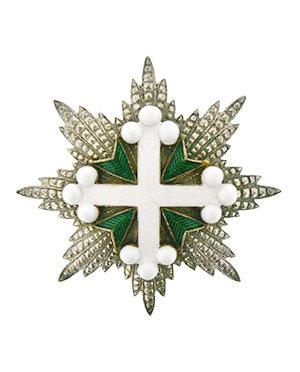
The badge of the order is in gilt, it displays a white-enameled cross bottony of the Order of Saint Maurice with a green-enameled Maltese Cross (the Cross of the Order of Saint Lazarus) placed between the arms of the cross botonny. The badge of each class except that of Knight and Dame is topped by a gilt crown.

The star of the Order is a silver faceted star, with eight points for Grand Cross and four points for Grand Officer, and with the badge (minus the crown) superimposed upon it.

The breast cross for the Commander “jus patronato” class is identical to the badge, minus the crown.

The ribbon of the Order is apple green, with slight variations for the several classes.

The Supreme Order of the Most Holy Annunciation

The Supreme Order of the Most Holy Annunciation was the pinnacle of the honors system in the Kingdom of Italy.

The Supreme Order of the Most Holy Annunciation (or Ordine Supremo della Santissima Annunziata in Italian) is a Roman Catholic order of knighthood, originating in Savoy.

It was the pinnacle of the honors system in the Kingdom of Italy, which ceased to be a national order when the kingdom became a republic in 1946.

The origins of the Supreme Order of the Most Holy Annunciation begin in 1362, when Amadeus VI, Count of Savoy (1343-1383) instituted the order’s earliest designation, under the title of Order of the Collar. Even at this time, the order was dedicated to the Blessed Virgin Mary, who is celebrated as “Our Lady of the Annunciation.” Thus, the order is a dynastic religious (or Catholic) order of chivalry. Under its first formulation, the order had fifteen knights.

Today, the order holds the following other regulations:

  • The number of knights of the Supreme Order of the most Holy Annunciation shall be, as in the past, twenty.
  • The right to appoint knights and officers of the Order appertains exclusively to the Sovereign Head. Nevertheless, when there are vacancies, the Sovereign Head meets with the Chapter of knights to hear their advice on the proposal of candidates whom he alone may select.
  • The knights shall be chosen from distinguished individuals in recognition of their eminent services in high military positions, as well as from those who have distinguished themselves in senior positions in the civil service, and from those who, as private citizens have brought distinction upon Italy as exemplary benefactors of the Nation or of Mankind, or have rendered particularly noteworthy services to the Royal House of Savoy.
  • Knights must have already been awarded the Order of Saints Maurice and Lazarus.
  • Knights must be Catholic. In rare occasions, a non-Catholic may be awarded the order. However, they may only be honorary members of the order.

The order has only one class, i.e. Knight. The full Italian title is Cavaliere dell’Ordine Supremo della Santissima Annunziata.

The Supreme Order of the Most Holy Annunciation Design

Although the order has only one class, it has two sets of insignia, the Piccola Collana and the Grande Collana. The two hold similar designs, though the Grande Collana has some different features than the Piccola Collana and is worn only on the most special of occasions.

The insignia of the order has the following regulations:

  • The large collar (Grande Collana) is worn on the first day of the year, on the feast of the Most Holy Annunciation, and on all of the principal national holidays and at important royal functions.
  • The small collar (Piccola Collana) is worn on every other occasion which necessitates the display of order insignia.
  • Knights also wear, on the left breast, a star badge bearing the image of Holy Mary of the Annunciation.

Today, the order continues as a dynastic order under the jurisdiction of the Head of the House of SavoyVittorio Emanuele, Prince of Naples, who is the order’s hereditary Sovereign and Grand Master.

The Womens Army Corps Service Medal

The Women’s Army Corps Service Medal is a United States Army military award created in 1943 by President Franklin Roosevelt.

The Women’s Army Corps Service Medal is a United States Army military award created on July 29, 1943 by Executive Order 9365 by President Franklin Roosevelt. The medal recognizes the service of women to the Army during the Second World War.

The Women’s Army Corps Service Medal was awarded to any service member of the Women’s Army Auxiliary Corps between July 10, 1942 and August 31, 1943 or the Women’s Army Corps between September 1, 1943 and September 2, 1945. The medal ranked in order of precedence below the American Defense Service Medal and above the American Campaign Medal.

The Women’s Army Corps Service Medal is considered obsolete as the United States Army is a combined service without separate service corps for women. The medal was issued as a once-awarded medal, and there are no devices authorized for additional presentations. 

The Women’s Army Corps Service Medal Design

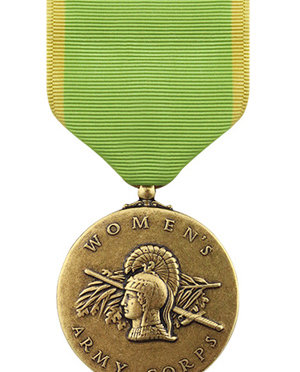
The profile featured on the medal is that of the goddess Pallas Athena; the same profile was used for the Women’s Army Corps branch insignia.

No devices are authorized to be worn on the medal.

Find This Medal Online

Right Now on eBay 
Clicking a link to eBay may result in a referral commission being paid if a purchase is made.
Loading...

The Navy Occupation Service Medal

The Navy Occupation Service Medal is a Navy military award bestowed to commemorate the services of Navy, Marine Corps and Coast Guard.

The Navy Occupation Service Medal is a United States Navy military award bestowed to commemorate the services of Navy, Marine Corps and Coast Guard personnel in the occupation of certain territories of the enemies of the U.S. during World War II”.

The Navy Occupation Service Medal also recognizes those personnel who participated in the European and Asian occupation forces during – and following World War II. The medal was additionally awarded to personnel who performed duty in West Berlin between 1945 and 1990.

No more than one Navy Occupation Service Medal may be awarded to an individual. The Navy Occupation Service Medal is the equivalent of the Army of Occupation Medal. No person could receive both awards.

The Navy Occupation Service Medal Design

The Navy Occupation Service Medal was designed by A. A. Weinman,  a German-born American sculptor and architectural sculptor.

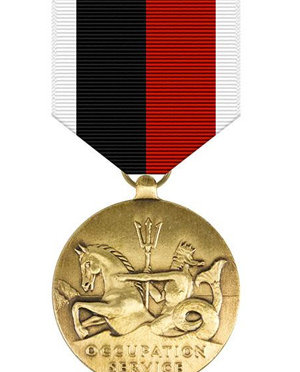
The obverse depicts Neptune riding a Hippocampus with the words “Occupation Service”. The reverse shows the words “United States Navy” (or “United States Marine Corps”) and is the same as that of the Dominican Campaign Medal.

The medal is authorized two service clasps: Europe and Asia. The clasps are rectangular with a rope border. If eligible, both clasps may be worn on the medal. The Berlin Airlift Device is also authorized to those who have served 90 days or more in support of the Berlin Airlift between 1948 and 1949.

Find This Medal Online

Right Now on eBay 
Clicking a link to eBay may result in a referral commission being paid if a purchase is made.
Loading...

The Medal for Humane Action

The Medal for Humane Action is a United States Armed Forces military award created in 1949 to recognize military service members.

The Medal for Humane Action is a United States Armed Forces military award created by an act (63 Stat. 477) of the United States Congress on July 20, 1949 to recognize military service members who performed extended duty in support of the Berlin Airlift.

This medal was created for the single purpose of recognizing service during the Berlin Airlift and was never issued again. To be awarded the Medal for Humane Action, a service member had to have performed over 120 days of duty within the geographical boundary of Berlin. Posthumous award was possible to any person who had lost his life while, or as a direct result of, participating in the Berlin airlift, without regard to the length of such service.

Those qualifying were also eligible for either the Army of Occupation Medal, or the Navy Occupation Service Medal, and both medals were authorized for simultaneous award and display.

The Medal for Humane Action Design

The medal is based on the design of the Berlin Airlift Device. It was designed by Thomas Hudson Jones a Buffalo-born sculptor of the Army Heraldic Section.

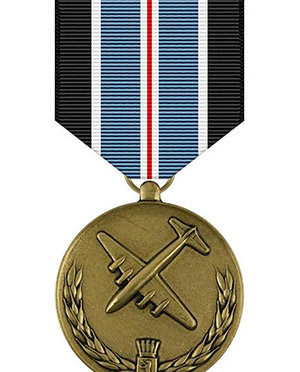
It’s made of bronze and round, and it measures 1.25 inches (32 mm) in diameter. On the obverse, it depicts a Douglas C-54 Skymaster over a wheat wreath. In the center of the wreath is the Coat of arms of Berlin. The reverse shows the eagle, shield, and arrows from the seal of the Department of Defense and reads “For Humane Action / To Supply Necessities of Life to the People of Berlin Germany“.

The medal is suspended by a ribbon of teal blue with black edges separated by thin white stripes. In the center is a red stripe with thin white stripes.

Find This Medal Online

Right Now on eBay 
Clicking a link to eBay may result in a referral commission being paid if a purchase is made.
Loading...

The European-African-Middle Eastern Campaign Medal

The European–African–Middle Eastern Campaign Medal is a United States Armed Forces military award first created in 1942.

The European–African–Middle Eastern Campaign Medal (originally known as the “EAME Ribbon”) is a United States Armed Forces military award first created on November 6, 1942 by Executive Order 9265 issued by President Franklin D. Roosevelt.

The medal recognizes military service members who had performed military duty in the European Theater (to include North Africa and the Middle East) during the years of the Second World War.

The European–African–Middle Eastern Campaign Medal is awarded for any service performed between December 7, 1941 and March 2, 1946, dates inclusive, provided such service was performed between the west and east boundaries.

The European–African–Middle Eastern Campaign Medal Design

The medal is made of bronze and measures 1 3/8 inches in width.

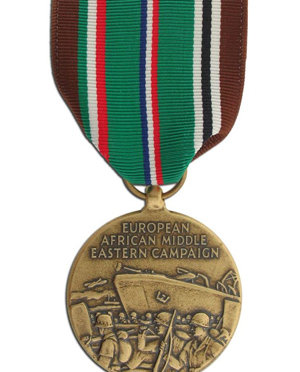
The medal’s obverse was designed by Mr. Thomas Hudson Jones, a U.S. sculptor for the Army’s Institute of Heraldry, based on General Eisenhower’s request that the medal includes an invasion scene. It displays an LST landing craft and troops landing under fire with an airplane in the background below the words EUROPEAN AFRICAN MIDDLE EASTERN CAMPAIGN.

The reverse side of the European–African–Middle Eastern Campaign Medal was designed by Adolph Alexander Weinman and is the same design as on the reverse of the Asiatic–Pacific and American Campaign Medals: An American bald eagle close between the dates 1941 – 1945 and the words UNITED STATES OF AMERICA.

The ribbon is 1 3/8 inches wide and shows a brown stripe that represents the sands of Africa, Irish green for the fields of Europe, white and scarlet for the Italian colors. The center is triparted Old Glory Blue, White and Scarlet.

Find This Medal Online

Right Now on eBay 
Clicking a link to eBay may result in a referral commission being paid if a purchase is made.
Loading...