The Asiatic-Pacific Campaign Medal

The Asiatic–Pacific Campaign Medal was awarded to any U.S. Armed Forces member who had served in the Asiatic-Pacific Theater during WW2.

The Asiatic–Pacific Campaign Medal is a military award from the United States during the Second World War. It was awarded to any member of the United States Armed Forces who had served in the Asiatic-Pacific Theater from 1941 to 1945.

The medal was created on November 6, 1942 by Executive Order 9265 issued by President Franklin D. Roosevelt. The Asiatic–Pacific Campaign Medal was first issued as a service ribbon in 1942. A full medal was authorized in 1947, the first of which was presented to General of the Army Douglas MacArthur.

The Asiatic-Pacific Campaign Medal Design

The Asiatic–Pacific Campaign Medal was designed by Thomas Hudson Jones, a U.S. sculptor for the Army’s Institute of Heraldry.

The reverse was designed by Adolph Alexander Weinman and is the same design as used on the reverse of the American Campaign Medal and European-African-Middle Eastern Campaign Medal.

There were 21 Army and 48 Navy-Marine Corps official campaigns of the Pacific Theater, denoted on the suspension by service stars also known as “battle stars“. Some Navy construction battalion units issued the medal with Arabic numerals.

The European Theater equivalent of the medal was known as the European-African-Middle Eastern Campaign Medal.

Buy an Asiatic-Pacific Campaign Medal

Note: As an eBay partner, I earn from qualifying purchases. This is all done automatically when you use a link and at no extra cost to you.

Right Now on eBay 
Clicking a link to eBay may result in a referral commission being paid if a purchase is made.
Loading...

The Army of Occupation Medal

The Army of Occupation Medal is a US military award established by the United States War Department in the aftermath of the Second World War.

The Army of Occupation Medal is a United States military award established by the United States War Department on 5 April 1946 in the aftermath of the Second World War. The medal recognizes those who had performed occupation service in either Germany, Italy, Austria, or Japan.

To be awarded the Army of Occupation Medal, a service member was required to have performed at least thirty consecutive days of military duty within a designated geographical area of military occupation.

The original Army of Occupation Medal was intended only for members of the United States Army, but it was expanded in 1948 to include the United States Air Force shortly after its creation. The Navy and Marine equivalent of the Army of Occupation Medal is the Navy Occupation Service Medal.

The Army of Occupation Medal Design

The Army of Occupation Medal is made of bronze and measures 1.25 inches across.

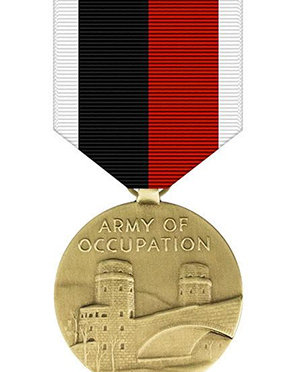
The obverse shows the abutments of the Remagen Bridge with the words “ARMY OF OCCUPATION” inscribed above. On the reverse is Mount Fuji, with a low hanging cloud over two Japanese junks above a wave and the inscribed date “1945”.

The medal was presented with a campaign clasp, denoting either European or Asian service. Campaign clasps were worn on the full sized medal only with no corresponding device when wearing the Army of Occupation Medal as a ribbon on a military uniform. A bronze clasp 0.125 inches wide and 1.5 inches in length with the word “GERMANY” or “JAPAN” is worn on the suspension ribbon of the medal to indicate service in Europe or the Far East.

The Army of Occupation Medal Design

The Army of Occupation Medal is made of bronze and measures 1.25 inches across.

The obverse shows the abutments of the Remagen Bridge with the words “ARMY OF OCCUPATION” inscribed above. On the reverse is Mount Fuji, with a low hanging cloud over two Japanese junks above a wave and the inscribed date “1945”.

The medal was presented with a campaign clasp, denoting either European or Asian service. Campaign clasps were worn on the full sized medal only with no corresponding device when wearing the Army of Occupation Medal as a ribbon on a military uniform. A bronze clasp 0.125 inches wide and 1.5 inches in length with the word “GERMANY” or “JAPAN” is worn on the suspension ribbon of the medal to indicate service in Europe or the Far East.

Find This Medal Online

Right Now on eBay 
Clicking a link to eBay may result in a referral commission being paid if a purchase is made.
Loading...

The American Campaign Medal

The American Campaign Medal is a United States Armed Forces military award created on November 6, 1942.

The American Campaign Medal is a United States Armed Forces military award created on November 6, 1942 and issued by President Franklin D. Roosevelt (Executive Order 9265 ). The first person to ever receive the American Campaign Medal was General George C. Marshall, Chief of Staff of the Army.

Who was awarded the American Campaign Medal?

The American Campaign Medal recognizes military members who have performed service in the American Theater of Operations during World War II. There is a similar medal, named the American Defense Service Medal, that was awarded for active duty service before the United States entered the Second World War.

What are the Requirements of the American Campaign Medal?

There are some specific requirements for the American Campaign Medal. These are as follows: Service within the American Theater between the dates of 7 December 1941 and 2 March 1946 under any of these conditions:

  1. On permanent assignment outside the continental limits of the United States.
  2. Permanently assigned as a member of a crew of a vessel sailing ocean waters for 30 consecutive days or 60 nonconsecutive days.
  3. Outside the continental limits of the U.S. in a passenger status or on temporary duty for 30 consecutive or 60 nonconsecutive days.
  4. In active combat against the enemy, and awarded a combat decoration or with a certificate by the commanding general of a corps, higher unit, or independent force that the Soldier actually participated in combat.
  5. Within the continental limits of the United States for an aggregate period of 1 year.

Who was Awarded the American Campaign Medal?

The American Campaign Medal recognizes military members who have performed service in the American Theater of Operations during World War II. There is a similar medal, named the American Defense Service Medal, that was awarded for active duty service before the United States entered the Second World War.

What are the Requirements of the American Campaign Medal?

There are some specific requirements for the American Campaign Medal. These are as follows: Service within the American Theater between the dates of 7 December 1941 and 2 March 1946 under any of these conditions:

  1. On permanent assignment outside the continental limits of the United States.
  2. Permanently assigned as a member of a crew of a vessel sailing ocean waters for 30 consecutive days or 60 nonconsecutive days.
  3. Outside the continental limits of the U.S. in a passenger status or on temporary duty for 30 consecutive or 60 nonconsecutive days.
  4. In active combat against the enemy, and awarded a combat decoration or with a certificate by the commanding general of a corps, higher unit, or independent force that the Soldier actually participated in combat.
  5. Within the continental limits of the United States for an aggregate period of 1 year.

The American Campaign Medal Design

The American Campaign Medal is made of bronze and measures 1 1/4 inches wide.

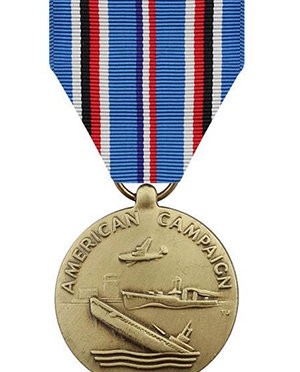
The obverse was designed by Thomas Hudson Jones, a U.S. sculptor for the Army’s Institute of Heraldry. It shows a Navy cruiser underway with a B-24 Liberator bomber flying overhead. In the foreground is a sinking enemy submarine, and in the background is the skyline of a city. At the top of the medal are the words AMERICAN CAMPAIGN.

The reverse of the American Campaign Medal, created by Adolph Alexander Weinman, is the same as used on both the Asiatic-Pacific Campaign Medal and the European-African-Middle Eastern Campaign Medal. It depicts an American bald eagle between the dates 1941 – 1945 and the words UNITED STATES OF AMERICA.

The American Campaign Medal ribbon is 1 3/8 inches wide and the colors are oriental blue in the center stripe divided into thirds of old glory blue (to represent the Americas), white, and scarlet (the continuance of American defense after Pearl Harbor). Between the center and the edges are stripes of white, black, scarlet and white. The white and black stripes represent the German part of the conflict on the Atlantic Coast, while the red and white stripes are for the Japanese colors and refer to that part of the conflict on the Pacific Coast.

The American Campaign Medal Campaign: For the Navy

Recipients of the American Campaign Medal need to have participated in the following escort, armed guard, antisubmarine, and special operations. They are to receive one campaign star for each participation:

The American Campaign Medal Campaign: For the Army

There is an authorized bronze service star for participation in antisubmarine operations (USS Asterion AK-100 and USS Frederick C. Davis DE-136). To qualify for them, individuals have to have been assigned to and present for duty with a unit having antisubmarine campaign credit.

Find This Medal Online

Right Now on eBay 
Clicking a link to eBay may result in a referral commission being paid if a purchase is made.
Loading...

The American Defense Service Medal

The American Defense Service Medal is a United States Armed Forces military award established by President Franklin D. Roosevelt in 1941.

The American Defense Service Medal is a United States Armed Forces military award established by President Franklin D. Roosevelt on June 28, 1941 (Executive Order 8808). The medal recognizes military service members who served on active duty between the dates of September 8, 1939 and December 7, 1941. There is a similar medal, called the American Campaign Medal, that was established in 1942 for operations during World War II

Members of the United States Army and the Army Reserve and Army National Guard could receive this medal for any length of service provided that they were on orders to active duty for at least twelve months or longer and had passed their initial physical examinations. The Navy excluded reservists that had been on duty for less than ten dates.

The American Defense Service Medal Authorized Devices

There are several devices authorized for the American Defense Service Medal. These include:

  • Foreign Service Clasp: For military service (Army) outside the continental limits of the U.S., including in Alaska. It’s a bronze bar 18 inch (3.2 mm) wide and 1+12 in (38 mm) long and has the words FOREIGN SERVICE inscribed.
  • Base Clasp: For service (Navy and Marine Crops) outside the continental limits of the U.S., including Alaska or Hawaii.
  • Fleet Clasp: For service (Coast Guard) on the high seas while regularly attached to any vessels of the Atlantic, Pacific, or Asiatic fleets or of Naval Transport Service and those operating directly under the Chief of Naval Operations. It’s a bronze bar 18 inch (3.2 mm) wide and 1+12 in (38 mm) long with the inscribed words FLEET.
  • Sea Clasp: For all other vessels and aircraft (Coast Guard) not qualifying for the Fleet Clasp but that conducted patrols at sea regularly.
  • “A” Device: For members of the Navy that served duty in actual or potential belligerent contact with Axis Powers between June 22 and December 7, 1941 in the Atlantic Ocean. The device could also be worn on the medal’s uniform ribbon.
  • Service star: Worn in lieu of clasps when wearing the medal as a ribbon on a military uniform.

The American Defense Service Medal Design

The service ribbon design was approved by the Secretary of War and the Secretary of Navy on January 7, 1942. The medal was designed by Mr. Lee Lawrie, a civilian sculptor from Easton, Maryland, and the model approved by the Commission of Fine Arts on May of the same year.

A similar medal, known as the American Campaign Medal, was established in 1942, for service in the American Theater during the World War II era.

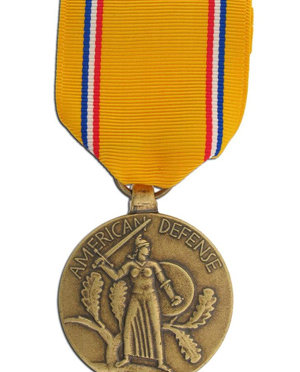
The bronze medal measures 1 1/4 inches in width. On the obverse is a female Grecian figure symbolic of defense, holding in her sinister hand an ancient war shield in reverse and her dexter hand brandishing a sword above her head, and standing upon a conventionalized oak branch with four leaves. Around the top is the lettering “AMERICAN DEFENSE”. The reverse is the wording “FOR SERVICE DURING THE LIMITED EMERGENCY PROCLAIMED BY THE PRESIDENT ON SEPTEMBER 8, 1939 OR DURING THE UNLIMITED EMERGENCY PROCLAIMED BY THE PRESIDENT ON MAY 27, 1941” above a seven-leafed spray of laurel.

Buy an American Defense Service Medal 

Note: As an eBay partner, I earn from qualifying purchases. This is all done automatically when you use a link and at no extra cost to you.
Right Now on eBay 
Clicking a link to eBay may result in a referral commission being paid if a purchase is made.
Loading...

The U.S. Medal of Honor

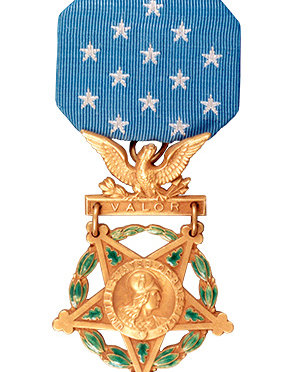
The Medal of Honor is the United States of America’s most prestigious personal military decoration, awarded for acts of valor.

The Medal of Honor is the United States of America’s highest and most prestigious personal military decoration. It may be awarded to recognize U.S. military service members who distinguished themselves by acts of valor and is normally awarded by the President of the United States in the name of the U.S. Congress. The Medal of Honor is the oldest continuously issued combat decoration of the United States armed forces.

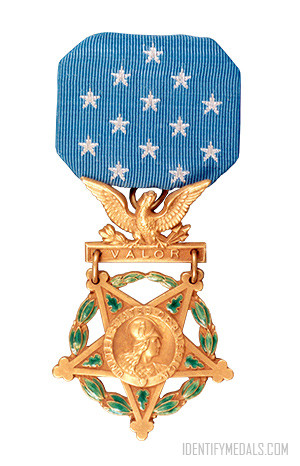
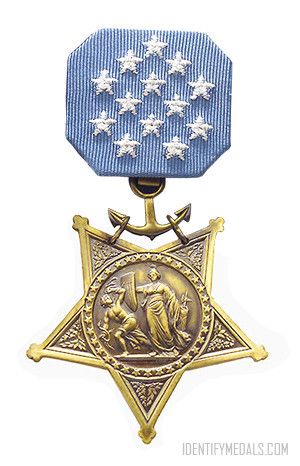
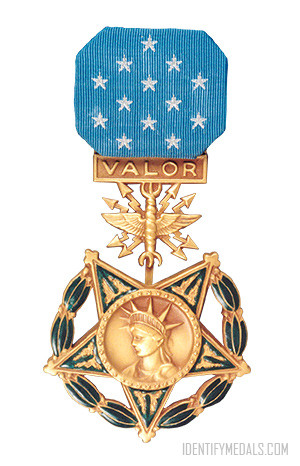
There are three versions of the Medal of Honor insignia. One for the Army, one for the Navy, and one for the Air Force. 

The History of the Medal of Honor

Signed into law by President Abraham Lincoln, a Navy Medal of Honor was first authorized on December 21, 1861 followed by an Army Medal of Honor, which was approved on July 14, 1862.

Over 40 percent of the Medals of Honor awarded to date—1,522 out of 3,464 medals—were bestowed during the Civil War. In fact, some Civil War Medals of Honor years after the end of the war, including Andrew Jackson Smith whose medal was awarded in 2001 and Alonzo Cushing in 2014. 

The first Medals of Honor were given to participants of Andrews’ Raid or the Great Locomotive Chase with Private Jacob Parrot as the first person ever to be awarded this medal of America. At least 32 Medals of Honor were awarded to African-Americans, and William Harvey Carney was the first. Born a slave in Virginia, he finally found freedom in Massachusetts. He volunteered to join the 54th Massachusetts Infantry Regiment, the first African-American unit in the northern states although it was led by white officers.

Tasked with taking Fort Wagner, a beachhead fortification that protected the southern Charleston Harbor, the 54th was chosen for the second attack. The Union flag bearer was killed as the soldiers stormed the fort, but Carney stepped in and held the flag for the remainder of the battle, never losing possession of the flag despite several injuries. Unfortunately, the 54th was forced to retreat, but, as Carney said after the battle, “the old flag never touched the ground.” Carney was awarded the Medal of Honor in 1900, thirty-five years after the end of the Civil War.

Individuals who have received two Medals of Honor are rare, and Thomas Ward Custer is a part of this elite group, receiving both medals for actions during the American Civil War

Personnel of the Marine Corps and Coast Guard receive the Navy version (it was created as a Navy version in 1861 named the “Medal of Valor”). According to the Medal of Honor Historical Society of the United States, 3,519 Medals of Honor have been awarded to the nation’s soldiers, sailors, airmen, Marines, and Coast Guardsmen since the medal’s creation. Less than half of them awarded for actions during the four years of the American Civil War.

American Medals and Awards: The Medal of Honor (Army Version)
The Medal of Honor: Army Version
American Medals and Awards: The Medal of Honor (Navy Version)
The Medal of Honor: Navy Version
American Medals and Awards: Medal of Honor (Airforce)
The Medal of Honor: Air Force Version

The Medal of Honor During World War I and World War II

During World War I and World War II, numerous individuals received the Medal of Honor for their extraordinary valor and heroism in combat.

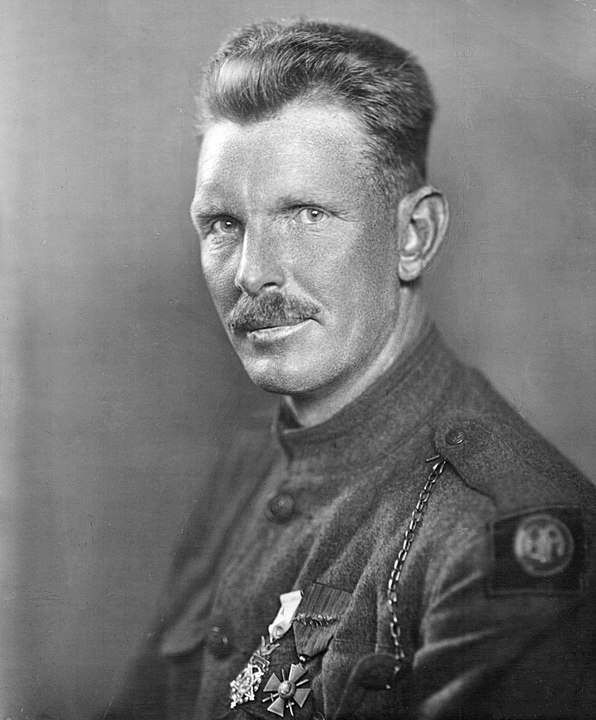
During World War I (1914-1918), the Medal of Honor was awarded for acts of bravery in various theaters of the war, including the Western Front in Europe, the Italian Front, and other areas of conflict. Recipients demonstrated exceptional courage in the face of enemy fire, often risking their lives to save their comrades or achieve critical objectives. One notable recipient during this world war was Sergeant Alvin York, who single-handedly captured 132 German soldiers during the Meuse-Argonne Offensive in 1918.

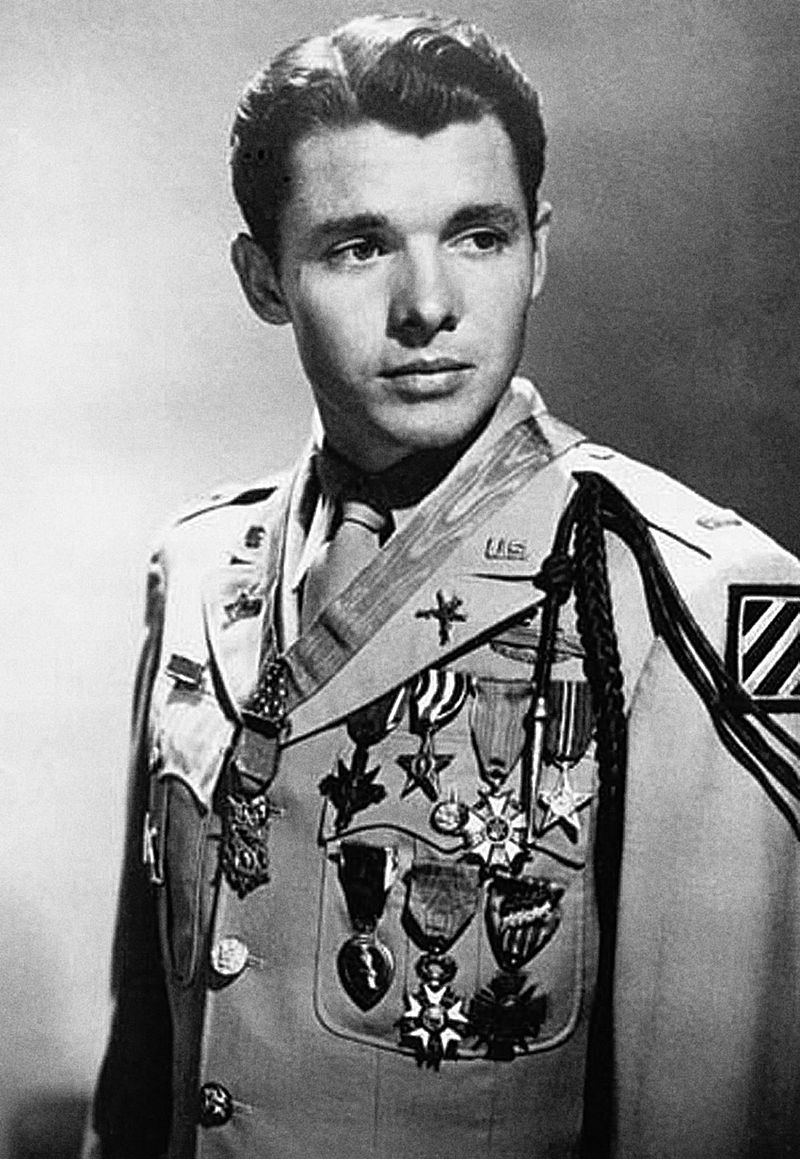
In World War II (1939-1945), the Medal of Honor continued to be awarded for acts of extraordinary heroism in combat. Recipients demonstrated exceptional bravery and selflessness in a wide range of theaters, including the Pacific, European, African, and Mediterranean theaters of war. One of the most celebrated recipients of the Medal of Honor during World War II was Sergeant Audie Murphy, who received the medal for his actions during the Battle of Holtzwihr in France, where he single-handedly repelled a German attack and called in artillery fire on enemy positions.

Alvin Cullum York (December 13, 1887 – September 2, 1964)
Alvin York in uniform, 1919, wearing the Medal of Honor and French Croix de Guerre with Palm.
Audie Murphy photographed in 1948 wearing the U.S. Army khaki "Class A" (tropical service) uniform with full-size medals. Source: Wikipedia.

The Medal of Honor Design

After World War I, the Navy decided to separate the Medal of Honor into two versions: One for combat and one for non-combat. The original upside-down star was designated as the non-combat version and a new pattern of the medal pendant, in cross form, was designed by the Tiffany Company in 1919.

It was to be presented to a sailor or marine who “in action involving actual conflict with the enemy, distinguish[es] himself conspicuously by gallantry and intrepidity at the risk of his life above and beyond the call of duty. 

Due to its prestige and status, the Medal of Honor is afforded special protection under U.S. law against any unauthorized adornment, sale, or manufacture, which includes any associated ribbon or badge.

Read more about the symbolism of the Medal of Honor:

Famous U.S. Medal of Honor Recipients

These individuals represent just a few of the many courageous recipients of the Medal of Honor who have demonstrated extraordinary bravery and selflessness in service to their country. Here are five famous recipients of the U.S. Medal of Honor:

  • Audie Murphy: Audie Murphy, a World War II veteran, is one of the most decorated American soldiers in history. He received the Medal of Honor for his actions during the Battle of Holtzwihr in France in 1945.

  • Alvin C. York: Alvin C. York was a World War I soldier and is renowned for his heroic actions during the Meuse-Argonne Offensive in 1918. He received the Medal of Honor for his bravery and leadership in capturing numerous German soldiers.

  • Desmond Doss: Desmond Doss, a conscientious objector during World War II, served as a combat medic. He was awarded the Medal of Honor for his extraordinary bravery and dedication to saving lives during the Battle of Okinawa.

  • Sal Giunta: Staff Sergeant Salvatore Giunta became the first living recipient of the Medal of Honor since the Vietnam War. He was honored for his actions during the War in Afghanistan in 2007 when he saved fellow soldiers from enemy fire.

  • Michael P. Murphy: Navy SEAL Lieutenant Michael P. Murphy was posthumously awarded the Medal of Honor for his courageous actions during Operation Red Wings in Afghanistan in 2005. He sacrificed his life while attempting to call for reinforcements to rescue his team.

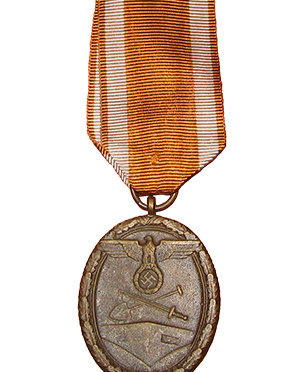
The West Wall Medal

The West Wall Medal was a decoration of Nazi Germany given to those who designed and built the fortifications on Germany’s western borders.

The West Wall Medal (or Deutsches Schutzwall-Ehrenzeichen in German) was a political decoration of Nazi Germany instituted on 2 August 1939.

The medal was given to those who designed and built the fortifications on Germany’s western borders, known as the West Wall or, in English, the Siegfried Line. It was also goven to the troops who served there between 15 June 1938 to 31 March 1939.

A total of 622,064 medals were awarded until 31 January 1941. In 1944, the medal was again re-instituted after the allied invasion and awarded to those who took part in the fortification of the western borders. By the end of the war, it had been awarded to over 800,000 men.

The West Wall Medal Design

The West Wall Medal is struck in bronze and of oval shape. It features on the obverse (from bottom to top) a bunker, a crossed sword and shovel, and the German Eagle. On the reverse it bore the inscription “Für Arbeit zum Schutze Deutschlands” (For Work on the Defenses of Germany).

The medal was designed by Professor Richard Klein, of Munich. The ribbon is golden brown with a white stripe towards each edge.

The Order of the German Eagle

The Order of the German Eagle, instituted by Hitler in 1937, was predominantly given to foreign diplomats during the German Nazi regime.

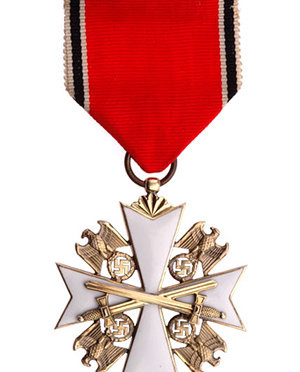
The Order of the German Eagle (or Verdienstorden vom Deutschen Adler, in German) was an award predominantly given to foreign diplomats during the German Nazi regime.

The Order was instituted on 1 May 1937 by Adolf Hitler and ceased to be awarded after the collapse of Nazi Germany at the end of World War II. This diplomatic and honorary award was given to prominent foreigners, particularly diplomats, who were considered sympathetic to Nazism.

In addition to awards to non-Germans, the Reich Foreign Minister and the Reich Protector of Bohemia and Moravia received a ‘Special Degree’ (Sonderstufe), with identical insignia to the Grand Cross of the Order.

The Order of the German Eagle Classes

From 1937 to 1943 the order was presented in six classes:

  1. Grand Cross of the Order of the German Eagle with star (Grosskreuz des Deutschen Adlerordens)
  2. Order of the German Eagle with Star (Deutscher Adlerorden mit Stern)
  3. Order of the German Eagle 1st Class (Deutscher Adlerorden, Erste Stufe)
  4. Order of the German Eagle 2nd Class (Deutscher Adlerorden, Zweite Stufe)
  5. Order of the German Eagle 3rd Class (Deutscher Adlerorden, Dritte Stufe)
  6. German Medal of Merit (Deutsche Verdienstmedaille)

A unique Grand Cross of the Order of the German Eagle in Gold with Diamonds (Grosskreuz des Deutschen Adlerordens in Gold und Brillanten) was also awarded to Benito Mussolini on 25 September 1937.

The Order of the German Eagle Design

The Cross is based on the Maltese Cross, with German Eagles at each corner carrying a swastika. The Order also featured crossed swords for military recipients.

The overall appearance and name of the Order was an imitation of the Prussian Order of the Black Eagle and Order of the Red Eagle.

The cross was suspended from a 46 mm red ribbon with black, red, and white stripes. In the first two classes, the award also came in the form of a silver or gold eight-pointed star accompanied by a white Maltese Cross and gold eagles centered.

Buy an Order of the German Eagle

Note: As an eBay partner, I earn from qualifying purchases. This is all done automatically when you use a link and at no extra cost to you.
Right Now on eBay 
Clicking a link to eBay may result in a referral commission being paid if a purchase is made.
Loading...

The German Cross (Post-WW2 Version)

The German Cross (or Deutsches Kreuz in German) was instituted by Adolf Hitler on 28 September 1941 and awarded in gold and silver.

The German Cross (also known as The War Order of the German Cross, or Der Kriegsorden Deutsches Kreuz in German) was instituted by Adolf Hitler on 28 September 1941 and awarded in gold and silver, depending on the division.

The German Cross in Gold (ranked higher than the Iron Cross First Class but below the Knight’s Cross of the Iron Cross) was awarded for repeated acts of bravery or achievement in combat. The German Cross in Silver, on the other hand (which ranked higher than the War Merit Cross First Class with Swords but below the Knight’s Cross of the War Merit Cross with Swords) was awarded for distinguished non-combat war service.

The German Cross Eligibility

In order to qualify for the German Cross, the recipient had to be a holder of the Iron Cross or the War Merit Cross.

Civilians were not eligible for this medal, although awards could be made to specific members of uniformed formations, such as railway workers or the police. In 1942, eligibility for the German Cross in Gold was also extended to the armed forces of allied countries.

The German Cross Design

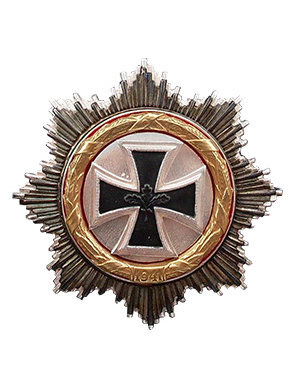
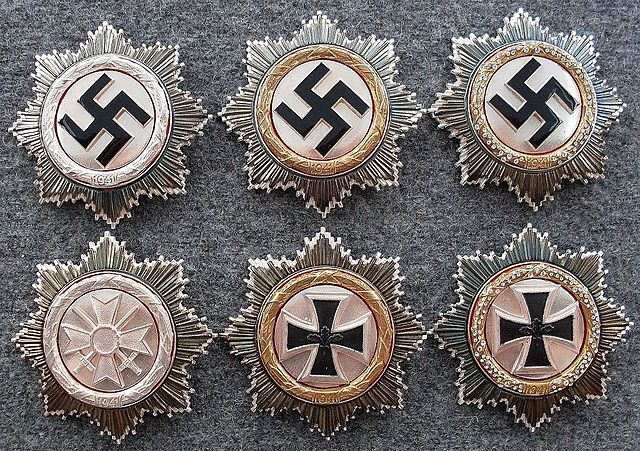
The original order consisted of a star badge with a swastika (in German a Hakenkreuz or “hooked cross”, hence the medal’s name). In 1957, however, alternative de-nazified replacement versions of the German Cross were authorized for wear by the Federal Republic of Germany. These medals replaced the swastika with a representation of the Iron Cross for the gold division, and the War Merit Cross with Swords for the silver division.

The German Cross has a diameter of 6.5 cm and was worn on the right-hand side of the tunic. If a recipient had been awarded both the silver and gold divisions, the gold division should be worn only.

German Cross in Silver, Gold, and with Diamonds. Post-war denazified versions shown below.

Find a German Cross 

Right Now on eBay 
Clicking a link to eBay may result in a referral commission being paid if a purchase is made.
Loading...

The German Cross (Nazi-Germany)

The German Cross (Deutsches Kreuz) was instituted by Adolf Hitler on 28 September 1941 and awarded in gold and silver.

The German Cross (or Deutsches Kreuz in German) was instituted by Adolf Hitler on 28 September 1941 and awarded in gold and silver.

The German Cross in Gold (ranked higher than the Iron Cross First Class but below the Knight’s Cross of the Iron Cross), was awarded for repeated acts of bravery or achievement in combat. The German Cross in Silver (ranked higher than the War Merit Cross First Class with Swords but below the Knight’s Cross of the War Merit Cross with Swords) was awarded for distinguished non-combat war service.

The German Cross Classes

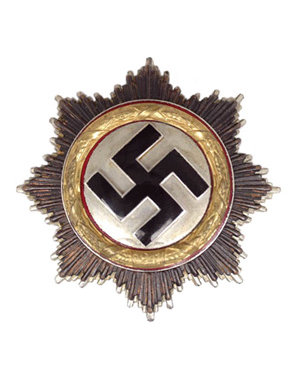
The German Cross was available in two versions: gold and silver, distinguished by the color of the laurel wreath surrounding the swastika.

  • The Gold German Cross: The gold version was conferred upon military personnel for repeated acts of bravery in combat or for exceptional military leadership, typically requiring 6–8 such acts.
  • The Silver German Cross: The silver version was awarded for multiple distinguished services to the war effort and served as a continuation of the War Merit Cross with swords. When a recipient was awarded both versions, only the gold version was authorized for wear.

The German Cross Design

The order consists of a star badge with a swastika (in German a Hakenkreuz or “hooked cross”, hence the medal’s name). The German Cross has a diameter of 6.5 cm and was worn on the right-hand side of the tunic. If a recipient had been awarded both the silver and gold divisions, the gold division should be worn only.

In 1957 alternative de-nazified replacement versions of the German Cross were authorized for wear by the Federal Republic of Germany. These medals replaced the swastika with a representation of the Iron Cross for the gold division, and the War Merit Cross with Swords for the silver division.

Colonel Hans von Luck called the German Cross “Hitler’s fried egg“, in response to its gaudiness.

German Cross in Silver, Gold, and with Diamonds. Post-war denazified versions shown below.

Find a German Cross 

Note: As an eBay partner, I earn from qualifying purchases. This is all done automatically when you use a link and at no extra cost to you.
Right Now on eBay 
Clicking a link to eBay may result in a referral commission being paid if a purchase is made.
Loading...

The Anschluss Commemorative Medal

The Anschluss Commemorative Medal was a decoration of Nazi Germany instituted on 1 May 1938 and awarded during the interwar period. 

The Anschluss Commemorative Medal (or Die Medaille zur Erinnerung an den 13. März 1938 in German) was a decoration of Nazi Germany instituted on 1 May 1938 and awarded during the interwar period.

The medal commemorated the annexation of Austria to the German Reich, or Anschluss. The move was the first in Hitler’s quest for Lebensraum, and it strengthened German flanks while weakening those of Czechoslovakia.

The medal, known as the “Anschluss medal“, was awarded to all those Austrians who contributed to or participated in the annexation as well as the members of the Austrian National Socialism movement. It was also awarded to German State officials and members of the German Wehrmacht and SS who marched into Austria.

The Anschluss Commemorative Medal Design

The Anschluss Commemorative medal is round, highly detailed, die-struck and based on the 1938 Party Day Badge and designed by Professor Richard Klein.

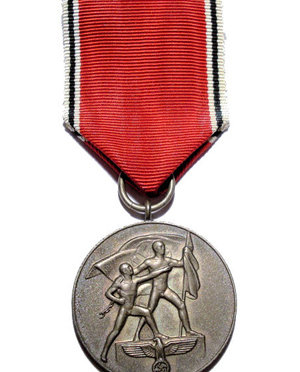
On the obverse of the medal, symbolic of Austrian adhesion to the German realm, a man holding the Nazi flag stands on a dais bearing the emblem of the “Third Reich”; he assists onto the dais a second man, on whose right hand a broken shackle still may be seen. On the reverse is the inscription “13. März 1938” (13 March 1938), the date of the Anschluss; the date is surrounded by the words, “Ein Volk, Ein Reich, Ein Führer” (“One People, One Empire, One Leader”).

The Anschluss Commemorative Medal was awarded until 31 December 1940, and a total of 318,689 medals were awarded.