The Order of Merit of the Federal Republic of Germany

The Order of Merit of the Federal Republic of Germany was created by the first President of the Federal Republic of Germany in 1951.

The Order of Merit of the Federal Republic of Germany (or Verdienstorden der Bundesrepublik Deutschland ni German) was created by the first President of the Federal Republic of Germany, Theodor Heuss, on 7 September 1951, and has been awarded to over 200,000 individuals in total, both Germans and foreigners. It’s the only federal decoration of Germany.

The creation decree, which was co-signed by the President Heuss and Chancellor Konrad Adenauer as well as the Minister of the Interior, Robert Lehr, signed, states: “Desiring to visibly express recognition and gratitude to deserving men and women of the German people and of foreign countries, on the second Anniversary of the Federal Republic of Germany, I establish the Order of Merit of the Federal Republic of Germany. It is awarded for achievements that served the rebuilding of the country in the fields of political, socio-economic and intellectual activity, and is intended to mean an award of all those whose work contributes to the peaceful rise of the Federal Republic of Germany.”

The Order of Merit of the Federal Republic of Germany Design

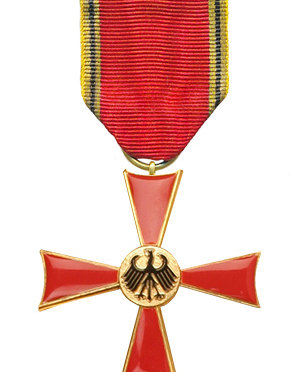
Except for the lowest class, the badge is the same for all classes, with slightly different versions for men and women (the badge and ribbon are smaller for women): The badge’s obverse is a golden cross enameled in red, with a central disc bearing a black eagle. The star is a golden star with straight rays, its size and points vary according to class, with the badge superimposed upon it.
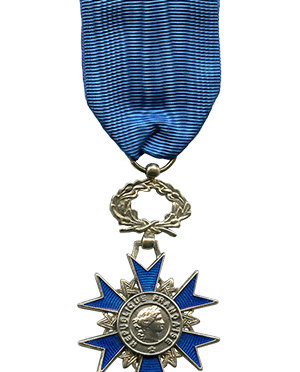
The National Order of Merit (France)

The National Order of Merit (or Ordre national du Mérite in French) is an order of merit with membership established to replace the large number of ministerial orders previously awarded by the ministries and to create an award that can be given at a lower level than the Legion of Honour, which is generally reserved for French citizens.

The National Order of Merit was awarded by the President of the French Republic, founded on 3 December 1963 by President Charles de Gaulle. It comprises about 187,000 members worldwide. The President of the French Republic is the Grand Master of the order and appoints all its members by convention on the advice of the Government of France.

The order has a common Chancellor and Chancery with the Legion of Honour. Every Prime Minister of France is made a Grand cross of the order after 24 months of service.

The National Order of Merit Design

The medal of the order is a six-armed Maltese asterisk in gilt enamelled blue, with laurel leaves between the arms.

The obverse central disc of the National Order of Merit medal features the head of Marianne, surrounded by the legend République française (French Republic). The reverse central disc has a set of crossed tricolores, surrounded by the name of the order and its foundation date. The badge is suspended by a laurel wreath.

The Order has five classes:

  • Three ranks:
    • Knight (Chevalier): to be of a minimum age of 35, minimum of 10 years of public service and “distinguished merits”;
    • Officer (Officier): minimum of 5 years in the rank of Knight;
    • Commander (Commandeur): minimum of 5 years in the rank of Officer;
  • Two dignities:
    • Grand Officer (Grand Officier): minimum 3 years in the rank of Commander; and
    • Grand Cross (Grand-Croix): minimum 3 years in the rank of Grand Officer.

The Order of Liberation

The Order of Liberation (or “Ordre de la Libération” in French) is a high honor Order awarded to heroes of the Liberation of France during World War II. It is second only after the Légion d’Honneur (Legion of Honour). The Order of Liberation was established by General de Gaulle in order n° 7, signed in Brazzaville on November 16, 1940 to “reward people, of the military or civilian communities, who will have distinguished themselves in the task of liberating France and her Empire”.

Very few people, military units and communes were ever awarded it, and only for their deeds during World War II. There were no restrictions as to age, sex, rank, origin or nationality; nor about the nature of the deeds, other than their exceptional quality.

The Order has a single rank, the title of Compagnon de la Libération (“Companion of the Liberation”). General de Gaulle, founder of the Order, was the only Grand Maître (“Grand Master”) of the Order.

The Order of Liberation Design

The medal of the Order or Croix de la Libération (“Cross of Liberation”), measures 31 mm wide by 33 mm high and is made of a rectangular bronze shield bearing a 60 mm high vertical gladius on its obverse.

On the blade of the gladius: a black enamelled Cross of Lorraine. On the reverse, a relief inscription in bold letters and in Latin reads, on four rows, “PATRIAM SERVANDO VICTORIAM TULIT” (“By serving the Fatherland, he/she achieved Victory”).

A total of 1061 Crosses of Liberation were awarded: 1038 to individuals, 18 to units of the Army, Air Force and Navy and five to cities: Nantes, Grenoble, Paris, Vassieux-en-Vercors, and l’Île de Sein.

The Legion of Honor

The Legion of Honor (or Ordre national de la Légion d’honneur in French) is the highest French order of merit for military and civil merits.

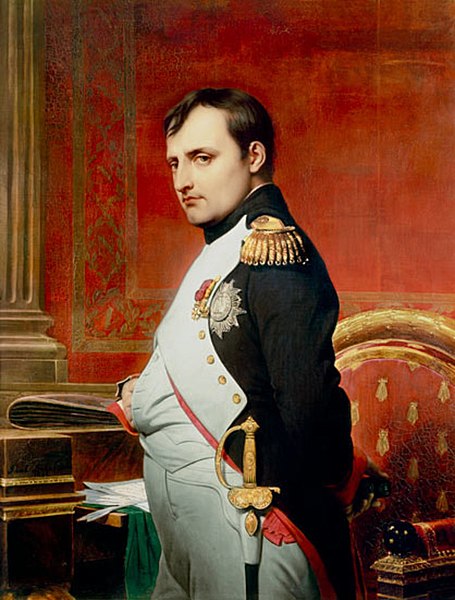
The Legion of Honour (National Order of the Legion of Honour; or Ordre national de la Légion d’honneur in French) is the highest French order of merit for military and civil merits. The Legion of Honour was established in 1802 by Napoleon Bonaparte and retained by all the divergent governments and regimes later holding power in France.

The Légion d’honneur is a body of men and not an order of chivalry, for Napoleon believed that France wanted a recognition of merit rather than a new system of nobility. The order’s motto is Honneur et Patrie (“Honour and Fatherland”), and its seat is the Palais de la Légion d’Honneur on the left bank of the River Seine in Paris.

Since the establishment of the Legion, the Grand Master of the order has always been the Emperor, King or President of France. 

The Legion of Honor Degrees or Classes

The order is divided into five degrees of increasing distinction: ChevalierOfficierCommandeur, Grand-officier, and Grand-croix.

  • Chevalier (Knight): The lowest rank of the Legion of Honor is awarded to individuals who have made notable contributions to French society or who have shown exceptional dedication and service to their profession. Recipients are entitled to wear the insignia badge.
  • Officier (Officer): The next rank is bestowed upon individuals who have demonstrated significant achievements or leadership in their field of expertise. Officers wear the same insignia but with a small rosette on the ribbon.
  • Commandeur (Commander): The third degree is awarded to individuals who have distinguished themselves through exceptional contributions to French society, culture, or the nation. Commanders wear the same insignia with the addition of a larger rosette on the ribbon.

  • Grand Officier (Grand Officer): This higher degree is reserved for individuals who have achieved extraordinary accomplishments or held high-ranking positions of responsibility. Recipients wear a badge with a silver star suspended from the ribbon.
  • Grand Croix (Grand Cross): The highest and most prestigious degree of the Legion of Honor, this rank is reserved for heads of state, senior government officials, and individuals who have rendered exceptional services to France or humanity. Grand Cross recipients wear a badge with a silver star and a sash over the right shoulder.

The Legion of Honor Design

The badge of the Légion is a five-armed “Maltese Asterisk” in gilt (made in silver for chevalier) enameled white, with an enameled laurel and oak wreath between the arms.

The obverse of the Legion of Honour medal central disc is in gilt, featuring the head of Marianne, surrounded by the legend République Française on a blue enamel ring. The reverse central disc is also in gilt, with a set of crossed tricolores, surrounded by the Légion’s motto Honneur et Patrie (Honour and Fatherland) and its foundation date on a blue enamel ring. The badge is suspended by an enameled laurel and oak wreath.

The star (or plaque) is worn by the Grand Cross (in gilt on the left chest) and the Grand Officer (in silver on the right chest) respectively; it is similar to the badge, but without enamel, and with the wreath replaced by a cluster of rays in between each arm. 

As Emperor, Napoleon always wore the Cross and Grand Eagle of the Legion of Honor.

Find This Medal

Right Now on eBay 
Clicking a link to eBay may result in a referral commission being paid if a purchase is made.
Loading...

The War Cross for Military Valor

The War Cross for Military Valor is a decoration for military valor established in 1922. The cross may only be awarded in times of war.

The War Cross for Military Valor (or Croce di guerra al valor militare in Italian) is a decoration for military valor that was established in 1922.

It was created to honor acts of valor in combat by Italian soldiers, recognizing extraordinary bravery and heroism in the face of the enemy. The medal is awarded for individual acts of courage, whether during wartime or in significant military operations. It serves as a testament to the recipient’s gallantry and dedication to duty, reflecting Italy’s rich military tradition and commitment to honoring its courageous service members.

The cross may only be awarded in time of war.

The War Cross for Military Valor Design

The medal is a Greek cross made of copper.

Inscribed on the horizontal arms, in the obverse, is Al Valore Militare (For Military Valor). On the top arm of the cross is the monogram of the Italian Republic. The bottom arm depicts a Roman sword sheathed in bay leaves.

The reverse of the cross depicts a five-pointed star, with rays radiating from behind that star out to the arms of the cross. The cross is suspended from a solid blue ribbon.

The Order of Vittorio Veneto

The military Order of Vittorio Veneto was founded as national order by Giuseppe Saragat in 1968 to express the gratitude of the nation.

The military Order of Vittorio Veneto was founded as a national order by the fifth President of the Italian Republic, Giuseppe Saragat, in 1968, “to express the gratitude of the nation” to those decorated with the Medal and Cross of War for Military Valour who had fought for at least six months in World War I and earlier conflicts.

Awarded in the single degree of Knight, a small annuity was granted in favor of those recipients who did not enjoy an income above their tax allowance, payable to the widow or minor children on death. The allowance was also granted to those that fought in the former Austro-Hungarian armed forces who became Italian citizens after annexation.

The order was bestowed by decree of the President of the Republic, its head, on the recommendation of the Minister of Defence. A Lieutenant General chaired the council, which screened applications made by eligible parties to the municipality of residence. With the death of the last surviving Knights of Vittorio Veneto in 2008, the order fell into abeyance and in 2010, it was formally wound up by repeal of the original legislation.

The Order of Vittorio Veneto Medal Design

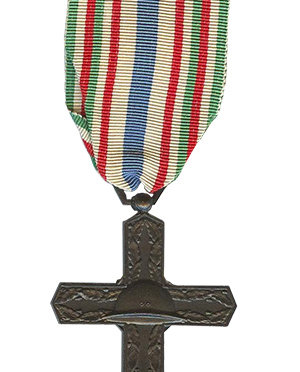
The Order of Vittorio Veneto Medal is made of bronze and shaped like a Greek cross with pointed ends to the arms.

The obverse shows a circular central medallion bearing the five-pointed star of the Italian Republic circumscribed ‘ORDINE VITTORIO VENETO’, the arms decorated with oak leaves.

The reverse is a circular central medallion bearing an Adrian helmet, the arms decorated with laurel leaves; on original ribbon.

Find This Medal

Right Now on eBay 
Clicking a link to eBay may result in a referral commission being paid if a purchase is made.
Loading...

The Silver Medal of Military Valor

Institution: 21 May 1793
Country: Italy

The Silver Medal of Military Valor (or Medaglia d’argento al valor militare in Italian) is a medal for gallantry.

Italian medals for valor were first instituted by Victor Amadeus III of Sardinia on 21 May 1793, with a gold medal, and, below it, a silver medal. These were intended for junior officers or common soldiers who had distinguished themselves in combat.

Although these medals fell into disuse during the period of Napoleonic domination, they were reinstated on 1 April 1815, by Victor Emmanuel I of Sardinia, who replaced them with the Military Order of Savoy (l’Ordine militare di Savoia), now known as the Military Order of Italy.

In 1833, Charles Albert of Sardinia re-instituted the medals for valor (gold and silver) as awards for noble acts performed by soldiers in both war and peace. During World War I, the medal was awarded to military personnel, units above the level of company and civilians for exceptional valor in the face of the enemy. During World War I, the medal was given out some 38,614 times for individual acts of heroism (compared to 368 Gold Medals and 60,244 Bronze medals). Thus, the Italian Silver Medal for Military Valor is equivalent in frequency and prestige to the British Military Cross, which was awarded some 40,253 times during World War I.

The Silver Medal of Military Valor Design

The Italian Silver Medal of Military Valor is made of silver. The medal measures 33.5 mm in diameter. On the obverse is engraved “VICARIOTTO CLAUDIO” in the centre, surrounded by the engraved inscription “COSTONE DI QUOTA 1940 – KONITZA (FRONTE GRECO) 14 NOV. 1940 XIX” on the reverse.

The Sardinian Crimea Medal 1855-1856

The Sardinian Crimean War Medal is a campaign medal issued by King Victor Emmanuel II for those who participated in the Crimean War.

The Sardinian Crimean War Medal (or Medaglia d’Argento al Valor Militare per la spedizione d’Oriente 1855-1856 in Italian) is a campaign medal issued by King Victor Emmanuel II for those who participated in the Crimean War (1854-1856) against the Russian Empire.

In addition to awards to Sardinians and other allied soldiers, the medal was awarded to 450 specially selected officers and men of the Royal Navy and British Army. Queen Victoria gave permission for the medal to be worn by British servicemen in uniform.

The Sardinian Crimean War Medal Design

The medal is made in silver with a blue watered ribbon. The obverse shows a crown with laurel and palm branch surrounding the arms of Savoy, with the inscription “Al Valore Militare“. In the reverse is inscribed “Spedizione d’Oriente 1854-1856”.

The Order of the Roman Eagle

The Fascist Order of the Roman Eagle was founded in 1942 with civil and military divisions, and abolished in Italy in 1944.

The Fascist Order of the Roman Eagle was founded in 1942 with civil and military divisions and abolished in Italy in 1944 – although it continued to be awarded by Benito Mussolini in the short-lived Italian Social Republic until 1945.

A self-styled order of the same name was founded by Romano Mussolini, fourth and youngest son of Benito Mussolini, in 1997. The separate Order of the Patron Saints of Italy (Ordine dei Santi Patroni d’Italia), St. Francis of Assisi and St. Catherine of Siena, was also conferred by the so-called Republic of Salò between February and April 1945. An organisation of this name was also founded by Romano Mussolini in 1997.

The Fascist Order of the Roman Eagle Design

The medal measures 32 mm diameter.

The Order Insignias consist of a golden Roman Eagle on purple background; the Eagle is fixed on various crosses from Knight to Grand Officer, while it is a plaque for Knights Grand Cross.

On the obverse there are three Fasces. Military medals have two crossed Roman swords behind the image on the foreground, while military crosses have two crossed Roman swords with blade pointing high and passing between the crosses arms.

For the Knight: the Cross is 35 mm and is hanging by a ribbon; it is worn on the chest, left side; Officer: the Cross is 35 mm and is hanging by a ribbon; it is worn on the chest, left side; the ribbon has a rosette; Commander: the Cross is 50 mm and is hanging by a ribbon worn around the neck; Grand Officer: the Cross is 50 mm and is suspended by the ribbon worn around the neck; the Grand Officer also has a 65 mm four-pointed plaque-star. Knight Grand Cross (Gold and Silver): the Cross is 50 mm and is hanging by a band worn over the shoulder, from right to left. Alongside the band, there is a 80 mm eight-pointed plaque-star.

The Military Order of Savoy

The Military Order of Savoy was a military honorary order of the Kingdom of Sardinia first, and of the Kingdom of Italy later.

The Military Order of Savoy was a military honorary order of the Kingdom of Sardinia first, and of the Kingdom of Italy later. Following the abolition of the Italian monarchy, the order became the Military Order of Italy.

The origin of the Military Order of Savoy can be traced back to the first honorary degrees granted by Victor Amadeus III of Sardinia to its soldiers. Later this degree went into disuse because of the Napoleonic regime in Italy and especially in Piedmont. On 1 April 1815 these honorary degrees were used by Victor Emmanuel I of Sardinia and abolished on the 14th of August of the same year.

Later, all of these honorary degrees become part of one, and became, the Military Order of Savoy. This order was to be granted to the soldiers who fought in the Italian army of Napoleon and became part of the Legion of Honor (or either obtained the honorary degree of Order of the Iron Crown) due to military merit. This honorary degree was conceded to everyone no matter what religion or rank the soldier was.

Following the foundation of the Republic, the order was renamed the Military Order of Italy in 1947; it continues to be awarded under that title today.

The Military Order of Savoy Design

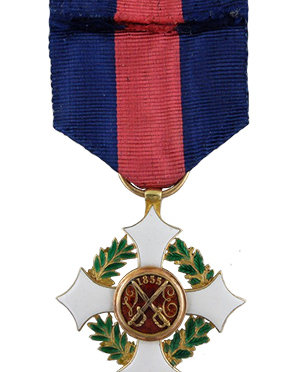
The Military Order of Savoy medal is a silver Savoy cross, for the militants, and golden for all the other rankings.

The cross is covered with white and red enamel and surrounded with a laurel crown covered with green enamel. On top of the medal there is the royal crown of Sardinia.

Find This Medal

Right Now on eBay 
Clicking a link to eBay may result in a referral commission being paid if a purchase is made.
Loading...