The Military Order of Italy

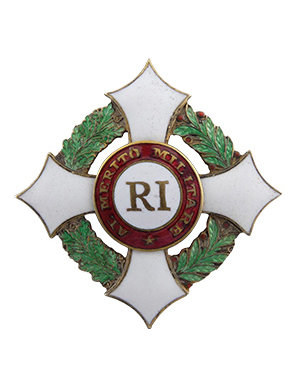
The Military Order of Italy (originally of Savoy) is the highest military order of the Italian Republic and the former Kingdom of Italy.

The Military Order of Italy (or Ordine Militare d’Italia in Italian) is the highest military order of the Italian Republic and the former Kingdom of Italy.

It was founded as the Military Order of Savoy, a national order by the King of Sardinia, Vittorio Emanuele I, Duke of Savoy in 1815.

The order is awarded in five degrees for distinguished wartime conduct of units of the armed forces or individual personnel that has “proven expertise, a sense of responsibility and valour.” The order was continued on the unification of Italy in 1861 and was revived, under its new name, following the foundation of the Republic in 1946.

The Military Order of Italy Design

The badge is a golden matuna cross, enameled in white, with a wreath of green-enameled laurel and oak leaves between the arms of the cross.

The obverse during the monarchy was red enamel with a white enamel cross (the current version is in white enamel with the letters R.I. for Repubblica Italiana). The disc is surrounded by a red enamel ring bearing the inscription Al Merito Militare.

The reverse is in red enamel with crossed swords. During the monarchy it had the letters V.E. (for Vittorio Emanuele) on the sides of the sword and the year 1855 above it. The current version has no cypher but has the additional year 1947, the date of the promulgation of the Italian constitution, below the swords. The badge for the three higher classes are suspended by a wreath of green-enamelled laurel and oak leaves; the Officer’s badge is suspended by a golden trophy of arms instead and the Knight’s badge has neither emblems.
The Medal of Aeronautic Valor (Post WW2)

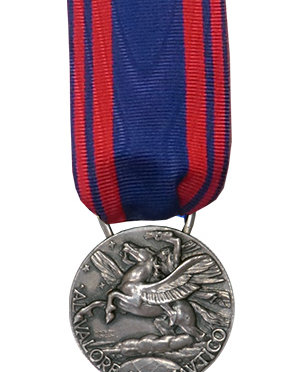
The Medal of Aeronautic Valor is a medal awarded for acts and enterprises of singular courage and skill aboard an aircraft in flight.

The Medal of Aeronautic Valor (or Medaglia al valore aeronautico in Italian) is a medal awarded “for acts and enterprises of singular courage and skill aboard an aircraft in flight.

Proposals for a medal awarded to aviators had begun as early as 1913 but were put on hold with the outbreak of World War I. The medal was finally instituted by Victor Emmanuel III of Italy‘s decree of 27 November 1927. The criteria for conferral remained virtually unchanged until 1939, when a decree restricted its award solely to members of the Italian military. In 2010, the medal was absorbed into the Italian Military Code. The principal change was the restoration of eligibility to civilians.

Prior to the outbreak of World War II, the recipients were primarily those who had distinguished themselves in air races or had set speed and distance records. However, the medal was also awarded for participation in daring air rescues.

The Medal of Aeronautic Valor Design

From 1927 to 1945 the Obverse of the medal shows a winged horse surrounded by the words “Al Valore Aeronautico”.

The Reverse shows two oak branches with the name of the recipient and the place and date of the award engraved between them.

The Medal of Aeronautic Valor (Kingdom of Italy)

The Medal of Aeronautic Valor was awarded for acts and enterprises of singular courage and skill aboard an aircraft in flight.

The Medal of Aeronautic Valor (or Medaglia al valore aeronautico in Italian) is a medal awarded “for acts and enterprises of singular courage and skill aboard an aircraft in flight.

Proposals for a medal awarded to aviators had begun as early as 1913 but were put on hold with the outbreak of World War I. The medal was finally instituted by Victor Emmanuel III of Italy‘s decree of 27 November 1927. The criteria for conferral remained virtually unchanged until 1939, when a decree restricted its award solely to members of the Italian military. In 2010, the medal was absorbed into the Italian Military Code. The principal change was the restoration of eligibility to civilians.

The Medal of Aeronautic Valor Criteria

Instituted in 1927, it is awarded at three levels: Gold, Silver and Bronze. The medal may be conferred on both Italian and foreign persons and entities and on both civilians and members of the Italian armed forces. It can also be awarded posthumously.

Prior to the outbreak of World War II, the recipients were primarily those who had distinguished themselves in air races or had set speed and distance records. However, the medal was also awarded for participation in daring air rescues.

The Medal of Aeronautic Valor Design

From 1927 to 1945 the Obverse of the medal shows The Savoy Cross surmounted by an eagle with spread wings. Above the eagle is the Crown of Savoy. The Reverse shows Two fasces with the name of the recipient and the place and date of the award engraved between them.

The Maurician Medal

The Maurician medal is an honorary degree granted to a soldier after 50 years of service in the Italian army.

The Maurician medal is an honorary degree granted to a soldier after 50 years of service in the Italian army.

The medal was established by Carlo Alberto di Savoia, on 19 July 1839 on the decree of the Regie Magistrali Patenti, with the name of “Maurician Medal to the Military Merit of Ten Lustrums”. It became official with royal decree of 21 December 1924.

The people who can receive this medal are the officers and non-commissioned officers belonging to the Carabinieri armed forces, the Italian Navy, the Italian Army, the Italian Air Force, the custom officers of Italy, and the Italian Police forces. 

The Maurician medal Design

General officers and flag officers receive a medal with a diameter of 52 millimeters (2 inches), while other recipients receive a medal with a diameter of 32 millimeters (1¼ inches).

The Colonial Order of the Star of Italy

The Colonial Order of the Star of Italy was founded as a colonial order of knighthood on 18 June 1914 by King Victor Emmanuel III.

The Colonial Order of the Star of Italy (or Ordine coloniale della Stella d’Italia in Italian) was founded as a colonial order of knighthood on 18 June 1914 by King Victor Emmanuel III.

It was awarded to soldiers deployed to the colony of Libya. The order had fallen into abeyance by 1943, when Allied forces conquered the colonies of Italian North Africa. This marked the end of Italy’s colonial ambitions and the order’s active issuance.

The Colonial Order of the Star of Italy Medal Design

The Colonial Order of the Star of Italy medal is shaped like a star, with white, green and red enamel. The obverse shows the initial EV and the year 1911.

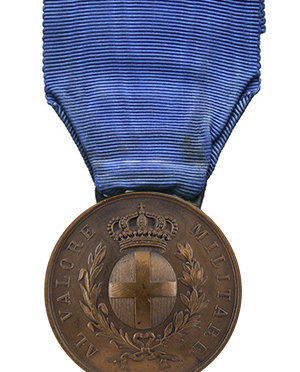
The Bronze Medal of Military Valor

Time Period: Pre World War I, World War I

Institution: 26 March 1833
Country: Italy

The Bronze Medal of Military Valor (or Medaglia di bronzo al valor militare in Italian) is a medal given for gallantry.

It was established by Charles Albert of Sardinia on 26 March 1833, along with the higher ranking Gold and Silver Medals for Military valor. Their purpose is defined as “To distinguish and publicly honor the authors of heroic military acts, even ones performed in time of peace, provided that the exploit is closely connected with the purposes for which the Armed Forces are constituted, whatever may be the condition or quality of the author.”

These medals, as well as the “Croce di Guerra al Valor Militare” (War Cross of Military Valor – which can only be awarded in time of war) are established by the Royal Decree of 4 November 1932.

During the First World War, the medal was given out some 60,244 times for individual acts of heroism (compared to 38,614 Silver medals and 368 Gold Medals).

The Bronze Medal of Military Valor Design

The Bronze Medal of Military Valor is shaped like an oval, with a blue ribbon. The medal is made of bronze.

The Commemorative Medal for the Italo-Turkish War 1911-1912

The Commemorative Medal for the Italo-Turkish War 1911-1912 was  instituted by Vittorio Emanuele III of Savoy on 21 November 1912.

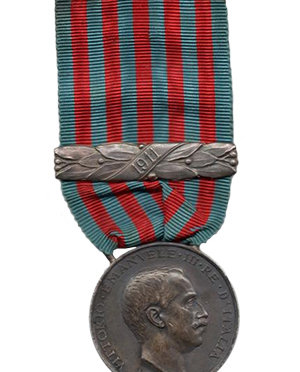
The Commemorative Medal for the Italo-Turkish War 1911-1912 was instituted by Vittorio Emanuele III of Savoy on 21 November 1912 for all civilian personnel and Italian and colonial troops who fought against the Ottoman Empire in the Italo-Turkish War of 1911 to 1912.

The Italo-Turkish or Turco-Italian War (or Trablusgarp Savaşı, “Tripolitanian War” in Turkish and Guerra di Libia, “Libyan War” in Italian) was fought between the Kingdom of Italy and the Ottoman Empire from September 29, 1911, to October 18, 1912. As a result of this conflict, Italy captured the Ottoman Tripolitania Vilayet (province), of which the main sub-provinces (sanjaks) were Fezzan, Cyrenaica, and Tripoli itself. These territories together formed what became known as Italian Libya.

The Commemorative Medal for the Italo-Turkish War Design

The medal is shaped like an oval and struck in bronze.

The obverse shows the profile of King Vittorio Emanuele III. The reverse of the Turkey Medal bears the inscription “GUERRA ITALO-TURCA 1911-12”. The reverse of the Libya Medal bears the inscription, “LIBIA”. The medal can have the “1911-12” bar for the Turkish campaign, and a “1912” and/or “1913”, or “1912-13” bar for the Libyan campaign.

The ribbon consists of blue and red stripes.

The Recusants Insignia

The Recusant’s Insignia is a French medal to honor French citizens who had evaded the Compulsory Work Service in Germany.

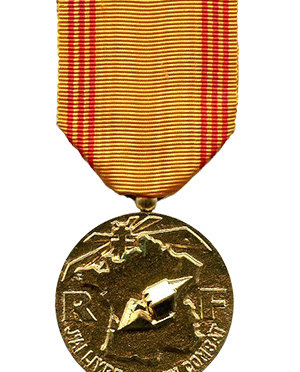
The Recusant’s Insignia is a French medal to honour French citizens who had evaded the Compulsory Work Service (S.T.O.) in Germany and who had therefore participated in the fight against the invader.

The law of August 22, 1950, establishing the status of “recusant”, stated in its first article: “The Republic, grateful to those who accepted all the risks in their fight against the enemy’s war potential, considering the suffering and the prejudice that this courageous and patriotic attitude caused them, proclaimed and determined the right to reparation for recusants and their successors“.

The Recusant’s Insignia Design

The design of the Recusant’s Insignia was decided by a contest opened by a decree of 17 July 1961 and won by artist engraver M. Hollebecq.

The Recusant’s Insignia measures 36 mm in diameter, is circular and struck from bronze or gilt bronze. Its obverse bears the relief image of a map of France, a broken anvil at its center symbolizes the refusal to work. Above the map, a Cross of Lorraine symbolizing hope and support for the oppressed. On either side, the relief initials “R” and “F” for République Française, and at the bottom the relief semi-circular inscription J’AI LIVRÉ UN BON COMBAT. On the reverse, the circular relief inscription along the top ¾ of the medal circumference AUX RÉFRACTAIRES GUERRE 1939 – 1945.

See also:

The Political Internment Medal

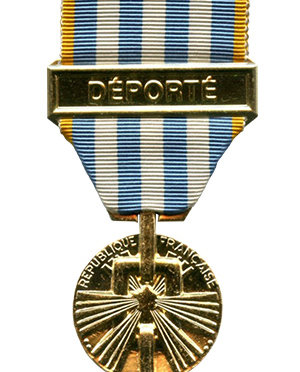
The Political deportation and internment medal is a commemorative medal awarded by the Ministry for veterans and war victims.

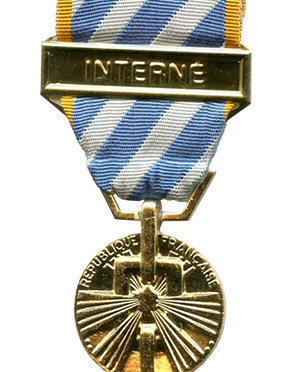
The Political deportation and internment medal (or Médaille de la déportation et de l’internement politique) is a commemorative medal awarded by the Ministry for veterans and war victims of the French Republic to its citizens who were deported or interned by the German occupation forces during World War 2.

Created by a law on 9 September 1948, the medal defines the status of political deportees and internees, declaring in its opening article “The Republic, grateful to those who contributed to the salvation of the country, bowed before them and before their families, determined the status of political deportees and internees, proclaim their rights and those of their successors”.

The title of political internee giving the right to wear the Political deportation and internment medal with political internee ribbon was bestowed to French citizens living in France or abroad, interned by the enemy or the Vichy government, for any reason other than for common or criminal offenses. These were interned for a legitimate act accomplished for the cause of the liberation of France; for an administrative or judicial measure resulting in deprivation of freedom; and French citizens living in France or abroad, who were executed by the enemy for any reason other than for common or criminal offenses.

The Political Deportation and Internment Medal Design

Designed by French artist engraver Arthus Bertrand, the medal measures 30 mm in diameter, is circular and struck from bronze or gilt bronze.

Its obverse bears the relief image of four vertical chain links protruding from the medal circumference. It also shows a small relief image of the map of France with six rays of light protruding out to the medal’s outer edges and the inscription RÉPUBLIQUE FRANÇAISE. The reverse bears the same chain links but without the map of France or the rays, and the years “1940” and “1945” in relief instead. Along the circumference it says MÉDAILLE DE LA DÉPORTATION ET DE L’INTERNEMENT).

The Political Deportation Medal

The Political deportation and internment medal is a commemorative medal awarded by the Ministry for veterans and war victims.

The Political deportation and internment medal (or Médaille de la déportation et de l’internement politique) is a commemorative medal awarded by the Ministry for veterans and war victims of the French Republic to its citizens who were deported or interned by the German occupation forces during World War 2.

Created by law on 9 September 1948, the medal defines the status of political deportees and internees, declaring in its opening article “The Republic, grateful to those who contributed to the salvation of the country, bowed before them and before their families, determined the status of political deportees and internees, proclaim their rights and those of their successors”.

The Title of political deportee was bestowed to French citizens living in France or abroad, who were, apart from being interned for common or criminal offenses and for a period of at least three months: Transferred by the enemy from the national territory and then incarcerated or interned in a prison or concentration camp; incarcerated or interned by the enemy in the camps or prisons of Bas-RhinHaut-Rhin and Moselle; incarcerated or interned by the enemy in any other territories exclusively administered by the enemy, in particular Indochina. 

The three-month minimum period was waived for persons having successfully escaped or that contracted an illness or infirmity during their internment arising in particular from torture.

The Political Deportation and Internment Medal Design

Designed by French artist engraver Arthus Bertrand, the medal measures 30 mm in diameter, is circular and struck from bronze or gilt bronze. Its obverse bears the relief image of four vertical chain links protruding from the medal circumference. It also shows a small relief image of the map of France with six rays of light protruding out to the medal’s outer edges and the inscription RÉPUBLIQUE FRANÇAISE. The reverse bears the same chain links but without the map of France or the rays, and the years “1940” and “1945” in relief instead. Along the circumference it says MÉDAILLE DE LA DÉPORTATION ET DE L’INTERNEMENT).