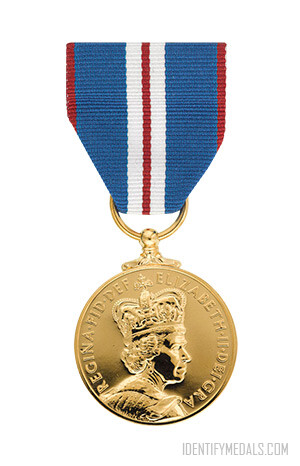
The Queen Elizabeth II Golden Jubilee Medal

The Queen’s Golden Jubilee Medal is a commemorative medal created in 2002 to mark the 50th anniversary of Queen Elizabeth II’s accession.

The Queen Elizabeth II Golden Jubilee Medal (or Médaille du jubilé d’or de la Reine Elizabeth II in French), also known as the Queen’s Golden Jubilee Medal, was created in 2002 to commemorate the 50th anniversary of Queen Elizabeth II’s accession in 1952.

In Canada, the medal was awarded to individuals who made significant contributions to public life. In the UK, the Queen’s Golden Jubilee Medal was given to active personnel in the British Armed Forces and emergency personnel who had completed five years of qualifying service.

The Queen Elizabeth II Golden Jubilee Medal Design

The Canadian and British medals had different designs:

United Kingdom

The medal is made of cupronickel with a gilt finish. The obverse depicts the Queen wearing St. Edward’s Crown, surrounded by the inscription “ELIZABETH • II • DEI • GRA • REGINA • FID • DEF.” The reverse features the shield of the Royal coat of arms of the United Kingdom, flanked by the years 1952 and 2002.

Canada

The medal is a gold-plated bronze with a thin raised edge. The obverse features an effigy of Queen Elizabeth II, crowned with the George IV State Diadem, circumscribed by the words “QUEEN OF CANADA • REINE DU CANADA.” The reverse displays a stylized maple leaf with “CANADA” at the bottom and the years 1952 and 2002 on either side of the Royal Cypher and crown.

Both medals were issued unnamed and are suspended from the same broad royal blue ribbon with red outer stripes and, at the center, double white stripes with a red stripe between.
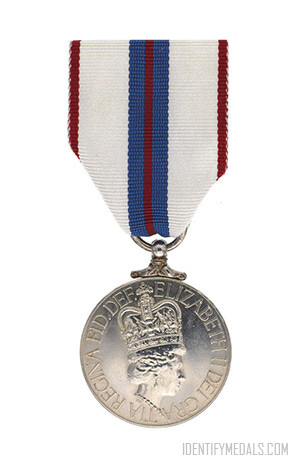
The Queen Elizabeth II Silver Jubilee Medal

The Queen Elizabeth II Silver Jubilee Medal was established in 1977 to commemorate the 25th anniversary of Queen Elizabeth II’s accession.

The Queen Elizabeth II Silver Jubilee Medal (or Médaille du jubilé d’argent de la reine Elizabeth II in French) was created in 1977 to commemorate the 25th anniversary of Queen Elizabeth II’s accession in 1952.

The medal is identical across all realms where it was awarded, with the exception of Canada, which features unique elements. As an internationally distributed award, the Queen Elizabeth II Silver Jubilee Medal occupies a distinct position in each country’s order of precedence for honors.

The Queen Elizabeth II Silver Jubilee Medal was established by a Royal Warrant from the Queen.

Prior to 1977, the practice for coronation and jubilee medals involved the United Kingdom authorities deciding on the total number of medals to be produced and then allocating quantities to each Dominion and possession across the British Empire, and later, to each Commonwealth country. Starting in 1977, the distribution of the medals was at the discretion of each national government. Consequently, 30,000 medals were distributed in Britain, 1,507 in New Zealand, 6,870 in Australia, and 30,000 in Canada.

The Queen Elizabeth II Silver Jubilee Medal Design

The Queen Elizabeth II Silver Jubilee Medal in the UK was designed by David Wynne. It is a 32 millimeter (1.3 inch) diameter silver disc.

The obverse features the inscription “ELIZABETH II DEI GRA. REGINA FID. DEF.” (Latin for “Elizabeth II, by the Grace of God, Queen, Defender of the Faith”) surrounding an effigy of Queen Elizabeth II, symbolizing her role as the fount of honor. The reverse side displays a crown atop a wreath containing the words “THE 25th YEAR OF THE REIGN OF QUEEN ELIZABETH II 6 February 1977” arranged in six lines.

The Queen Elizabeth II Coronation Medal

The medal, established in 1953, was given as a personal memento from the Queen to members of the Royal Family and selected officers of state.

The Queen Elizabeth II Coronation Medal is a commemorative medal established on 2 June 1953 and instituted to celebrate the coronation of Queen Elizabeth II.

This medal was given as a personal memento from the Queen to members of the Royal Family and selected officers of state, including members of the Royal Household, government officials, mayors, public servants, local government officials, and members of the navy, army, air force, and police in Britain, as well as her colonies and Dominions. It was also awarded to members of the Mount Everest expedition, two of whom reached the summit four days before the coronation. The medal was struck at the Royal Mint and distributed immediately after the coronation.

For Coronation and Jubilee medals, up until 1977, the practice was for the authorities in the United Kingdom to decide on the total number to be produced and then allocate a proportion to each of the Commonwealth countries, Crown dependencies, and other possessions of the Crown. The government of each territory had the discretion to decide who would receive a medal and for what reasons.

In total, 129,051 medals were awarded, including:

  • 11,561 to Australians.
  • 12,500 to Canadians.

The Queen Elizabeth II Coronation Medal Design

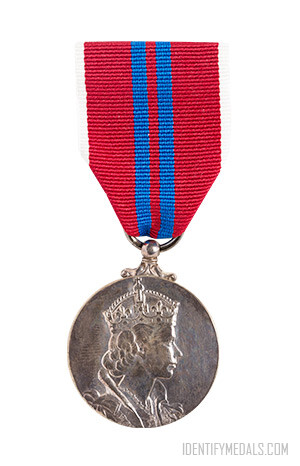
The Queen Elizabeth II Coronation Medal is a silver disk measuring 1.25 inches in diameter. The obverse features a crowned effigy of Queen Elizabeth II, facing right, adorned in a high-collared ermine cloak and wearing a Tudor Crown along with the Collar of the Garter and Badge of the Bath. It lacks a raised rim and any inscriptions.

The reverse displays the Royal Cypher “EiiR” topped by a large crown, with the inscription “QUEEN ELIZABETH II CROWNED 2nd JUNE 1953” around the edge. The medal was designed by Cecil Thomas.

The dark red ribbon is 1.25 inches (32 mm) wide, featuring 2 mm wide white edges and two narrow dark blue stripes in the center, each 2 mm wide and 1.6 mm apart.

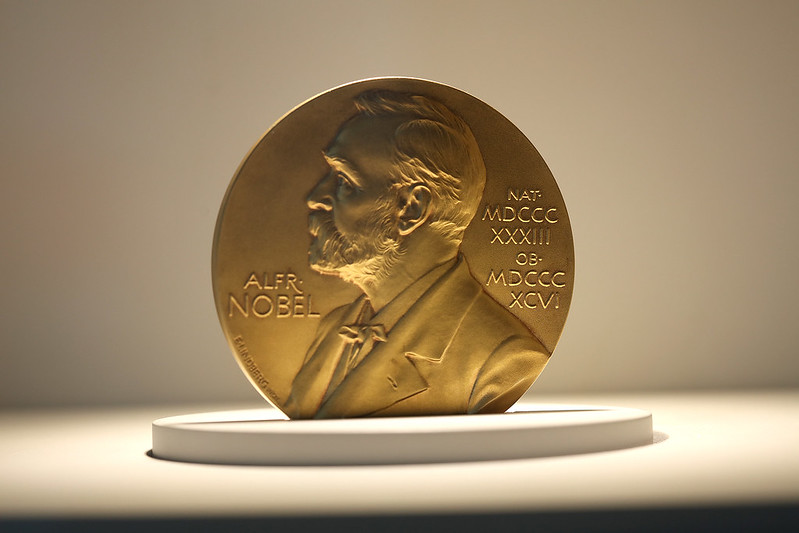
Exploring the Nobel Prize Medal

The Nobel Prize medal is a prestigious award given annually for contributions to humanity. Here’s everything about its medal.

The Nobel Prize is one of the most esteemed awards bestowed upon individuals and organizations for their remarkable contributions to humanity across various fields. Established by Alfred Nobel, a Swedish inventor and philanthropist, the Nobel Prize recognizes excellence in Physics, Chemistry, Medicine, Literature, Peace, and Economic Sciences.

Winners of the Nobel Prize, known as laureates, are selected through a rigorous process and awarded a medal, diploma, and substantial monetary prize. This esteemed recognition serves as a testament to their outstanding achievements and profound impact on society.

The Importance of the Nobel Prize Award

The Nobel Prize has a profound impact on society and the world at large. Laureates often address pressing issues and challenges facing humanity, such as scientific advancements, peace efforts, literature, and economic development. Their work has the potential to inspire positive change and shape the course of history.

The Nobel Prize celebrates groundbreaking discoveries, advancements, and innovations that push the boundaries of human knowledge and understanding. By highlighting and rewarding excellence in research, literature, and peace efforts, the Nobel Prize promotes further exploration and innovation in these areas. The Nobel Peace Prize, in particular, recognizes individuals and organizations that have made significant contributions to promoting peace, resolving conflicts, and advancing human rights. 

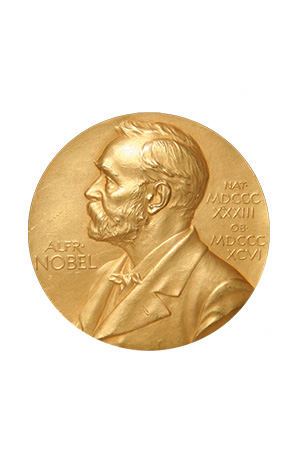
The Nobel Prize Medal

A Short History of the Nobel Prize

Born in 1833 in Stockholm, Sweden, Alfred Nobel was a man of many talents—an inventor, scientist, engineer, and industrialist. His inventions, including dynamite and other explosives, revolutionized industries such as mining and construction, but they also brought him considerable wealth and success.

However, Nobel’s legacy was forever altered by a singular event: the premature publication of his obituary. Upon reading his own obituary, which condemned him as the “merchant of death,” Nobel was deeply troubled by how he would be remembered after his passing. Determined to leave behind a more positive legacy, Nobel decided to bequeath the bulk of his fortune to establish the Nobel Prizes.

In his will, written in 1895, Nobel directed that his fortune be used to create prizes in five categories: Physics, Chemistry, Medicine, Literature, and Peace. He believed that by rewarding individuals who had made significant contributions to humanity in these fields, he could help promote peace, progress, and intellectual advancement.

The first Nobel Prizes were awarded in 1901, in accordance with Nobel’s wishes. Since then, the Nobel Prizes have evolved and expanded to include additional categories, such as Economic Sciences, which was established by the Swedish central bank in 1968 to commemorate the 300th anniversary of its founding.

Nobel Prize Awardees

Here are some examples of Nobel Prize winners across different categories that you might be familiar with:

  • Physics: Albert Einstein (1921) for his explanation of the photoelectric effect, and Marie Curie (1903) for her pioneering research on radioactivity.

  • Chemistry: Marie Curie (1911) for her discovery of radium and polonium, and Linus Pauling (1954) for his research into the nature of chemical bonds.

  • Medicine: Alexander Fleming (1945) for the discovery of penicillin, and Tu Youyou (2015) for her discoveries concerning a novel therapy against malaria.

  • Literature: Gabriel García Márquez (1982) for his novels and short stories, and Toni Morrison (1993) for her novels exploring the African American experience.

  • Peace: Martin Luther King Jr. (1964) for his nonviolent resistance to racial prejudice in America, and Malala Yousafzai (2014) for her advocacy of education for girls in Pakistan.

  • Economic Sciences: Milton Friedman (1976) for his achievements in the fields of consumption analysis, monetary history and theory, and for his demonstration of the complexity of stabilization policy.

The Nobel Prize Medal Design

Designed by Swedish artist Gustav Vigeland, the medal features an image of Alfred Nobel, the founder of the Nobel Prize, along with symbols representing the respective fields of the laureates.

Each medal is unique and crafted from 18-carat gold, bearing an inscription of the laureate’s name and the year of the award.

The Legacy of the Nobel Prize

Today, the Nobel Prize is widely regarded as one of the highest honors one can receive in their respective field. Each year, laureates are selected through a rigorous process of nomination, review, and selection by committees of experts in each category. The awards are presented annually on December 10th, the anniversary of Alfred Nobel’s death, in ceremonies held in Stockholm, Sweden, and Oslo, Norway.

Find More About This Medal Online

Right Now on eBay 
Clicking a link to eBay may result in a referral commission being paid if a purchase is made.
Loading...

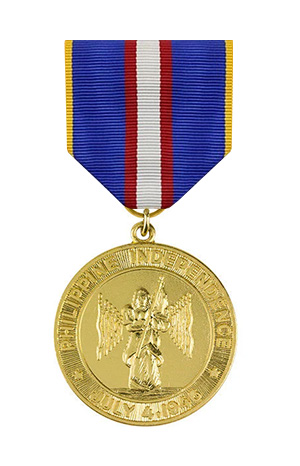
The Philippine Independence Medal

The Philippine Independence Medal is a military award for members of the military who participated in military operations during WW2.

The Philippine Independence Medal is a military decoration established by the Philippine Army Headquarters on July 3, 1946, initially as the Philippine Independence Ribbon.

The addition of the medal occurred in 1968. It honors individuals who served in various Philippine Commonwealth military operations during World War II.

The Philippine Independence Medal Criteria

To qualify for the Philippine Independence Medal, a service member must have previously been awarded both the Philippine Defense Medal and the Philippine Liberation Medal. The eligibility for wearing these awards must have been recorded before November 24, 1954. This criterion effectively encompassed individuals who participated in the initial resistance against Japanese invasion and contributed to the campaigns to liberate the Philippines from Japanese occupation between October 1944 and September 1945.

The decoration was also open for authorization to the United States and other foreign military personnel, resulting in several retroactive awards presented between 1945 and 1948. Notably, General of the Army Douglas MacArthur was among the distinguished American recipients.

Initially, the Philippine Independence Medal was bestowed as a service ribbon only. It wasn’t until 1968 that President Ferdinand Marcos authorized the addition of a full-sized medal.

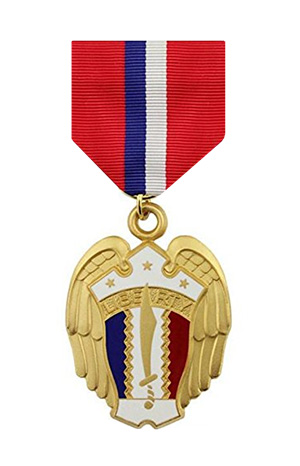
The Philippine Liberation Medal

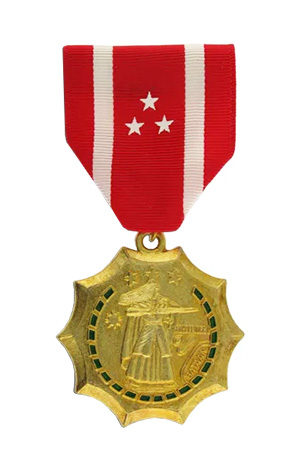
The Philippine Liberation Medal was created in 1944 and presented to those who participated in the liberation of the Philippine Islands.

The Philippine Liberation Medal, a military honor of the Republic of the Philippines, was established by an order from the Commonwealth Army of the Philippines Headquarters on December 20, 1944, initially known as the Philippine Liberation Ribbon. This decoration was bestowed upon any service member, whether from the Philippine Commonwealth or allied militaries, who partook in the liberation of the Philippine Islands spanning from October 17, 1944, to September 2, 1945. A full-sized medal was later authorized and introduced on July 22, 1945.

The purpose of the Philippine Liberation Medal is to acknowledge military service during the final eleven months of World War II, marked by the expulsion of the Japanese military from the Philippines preceding their surrender in September 1945.

The Philippine Liberation Medal Criteria

To qualify for the Philippine Liberation Medal, a service member must have fulfilled one of the following conditions:

  1. Participation in the initial landing operation of Leyte and adjacent islands occurring from October 17 to 20, 1944. This entails being part of the landing forces on Leyte or adjacent islands, serving aboard a vessel in Philippine waters, or being a crew member of an aircraft that flew over Philippine territory during that period.
  2. Engagement in any combat against hostile Japanese forces on Leyte and adjacent islands throughout the Philippine Liberation Campaign from October 17, 1944, to September 2, 1945.
  3. Participation in any combat against hostile Japanese forces on islands beyond the aforementioned ones during the Philippine Liberation Campaign from October 17, 1944, to September 2, 1945.
  4. Service in the Philippine Islands or aboard ships in Philippine waters for a minimum of 30 days within the specified period.

Individuals awarded the medal for their involvement in any of the above operations are entitled to add a bronze 3⁄16″ service star to the Philippine Liberation Medal for each additional qualifying action.

Members of the United States Armed Forces, including the Philippine Commonwealth Army and Philippine Constabulary, were also eligible for the Asiatic-Pacific Campaign Medal, often accompanied by a service star, for their participation in the liberation of the Philippines.

The Philippine Defense Medal

The Philippine Defense Medal is a military decoration awarded to recognize the initial resistance against Japanese invasion 1941-1942.

The Philippine Defense Medal, a military decoration of the Republic of the Philippines, acknowledges the initial resistance against the Japanese invasion spanning from December 8, 1941, to June 15, 1942.

Initially established as the Philippine Defense Ribbon in December 1944, it was later upgraded to a full-sized medal in July 1945.

The Philippine Defense Medal was awarded to United States and Philippine Commonwealth troops who defended the Philippines at Bataan and subsequently endured the Bataan Death March.

The Philippine Defense Medal Criteria

The Philippine Defense Medal is bestowed upon any service member, whether from the Philippine military or an allied armed force, who took part in defending the Philippine Islands during the specified period. This includes engagement against the enemy on Philippine territory, in Philippine waters, or in the airspace above. Individuals qualify if they:

(A) Participated in any engagement against the enemy, such as:

  1. Serving in the defense garrison of the Bataan Peninsula or fortified islands at the entrance to Manila Bay.
  2. Being present with a unit under enemy fire or air attack.
  3. Serving on a ship under enemy fire or air attack.
  4. Being a crewmember or passenger in an aircraft under enemy aerial or ground fire.

(B) Were assigned or stationed in Philippine territory or waters for at least 30 days during the period.

(C) Those meeting the conditions of (A) and (B) are authorized to wear a bronze service star on the ribbon.

The Armed Forces Conduct Medal (Philippines)

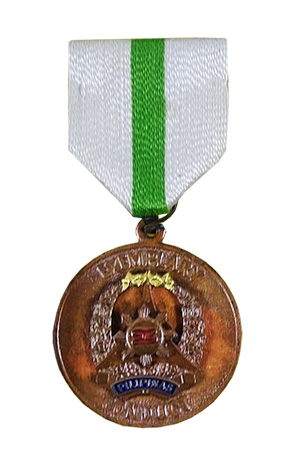
The Armed Forces Conduct Medal is a military decoration warded to enlisted personnel of the Armed Forces for serving two successive terms.

The Armed Forces Conduct Medal is a military honor conferred by the Armed Forces of the Philippines.

It is granted to enlisted members who have completed two consecutive terms of service without any disciplinary infractions on their record.

The Military Commendation Medal (Philippines)

The Military Commendation Medal is a military decoration presented for exemplary execution of military duty.

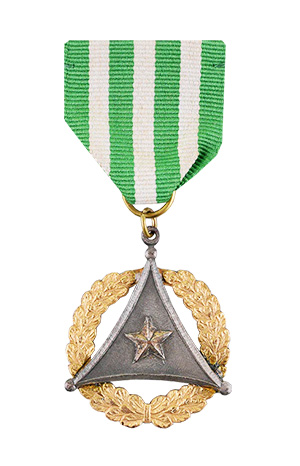
The Military Commendation Medal is bestowed upon members of the Armed Forces of the Philippines in recognition of their outstanding performance of military duties.

As for its design, the medal takes the form of an upward-pointing, bronze-colored three-pointed star, with a small five-pointed star positioned at its center. Adorning the bottom of the star is a golden wreath, which extends upwards, passing under and appearing between the arms of the star.

It is worn suspended from a green ribbon featuring three wide central stripes in white.

The Military Civic Action Medal

The Military Civic Action Medal is a military decoration awarded for meritorious achievement in the conduct of humanitarian civic actions.

The Military Civic Action Medal, a distinction within the Armed Forces of the Philippines, acknowledges commendable efforts in executing humanitarian civic actions that directly support military operations.

This medal is conferred upon both military and civilian members of the Armed Forces of the Philippines, and may extend to allied foreign nationals. It recognizes outstanding achievements in civic action either as part of duty responsibilities or in direct aid to military operations.

Awarding Authority Recipients of the Military Civic Action Medal are selected by the Chief of Staff of the Armed Forces of the Philippines, Area Commanders, Armed Forces of the Philippines-Wide Support and Separate Units, as well as Commanders of the Philippine Army, Philippine Navy, or Philippine Air Force. Division and Brigade commanders, along with their counterparts in the Philippine Air Force and Navy, also possess the authority to bestow this honor.

The Military Civic Action Medal Design

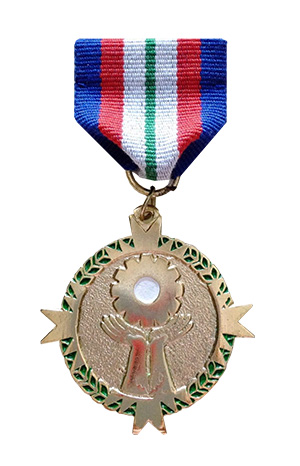
The medal features a golden disc depicting a stylized image of a gear held aloft by a pair of hands, encircled by a green wreath on its front. Behind the medal, four rays extend in the cardinal directions, overlapping the wreath.

It hangs from a blue ribbon, featuring a central green stripe flanked on either side by equal stripes of white and red