The Foreign Operational Theaters Commemorative Medal

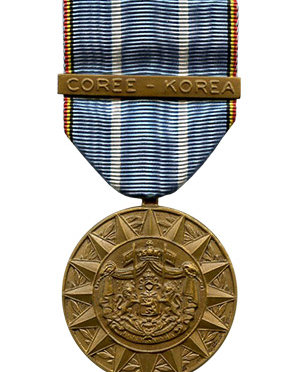
The Foreign Operational Theaters Commemorative Medal (Médaille Commémorative des Théatres d’Opérations Extérieurs / Herinneringsmedaille voor Buitenlandse Operaties) was promulgated by Royal Decree of 26 September 1951 and signed by King Baudouin. The medal could be awarded posthumously.

The medal was awarded to Belgian citizens and entitled foreigners who served with Belgian Units in the Korean theatre of operations, for one day or more, between 18 December 1950 and 29 July 1953.

There are several clasps and emblems, worn to show each of the theatres involved.

  • COREE-KOREA – all volunteers of the Bataillon Belge who qualified for the medal are entitled to this clasp.
  • IMJIN – for soldiers of the first Belgian contingent (1951-2) who participated in the fighting in April 1951.
  • HAKTANG-NI – for soldiers of the first contingent (1951-2) who participated in the fighting in October 1951.
  • CHATKOL for soldiers of the second contingent (1952-3) who participated in the fighting along the bank of the Imjin River in April 1953.

The Foreign Operational Theaters Commemorative Medal Design

The medal measures 5mm in diameter and is circular and struck in bronze.

The obverse bears the emblem with the lion of Belgium in relief. A single red enameled cross is worn by those wounded in action and granted an injury chevron, and a 5 pointed silver star by servicemen returning to duty in Korea after being wounded in action.
The Medal of Belgian Gratitude 1940-1945

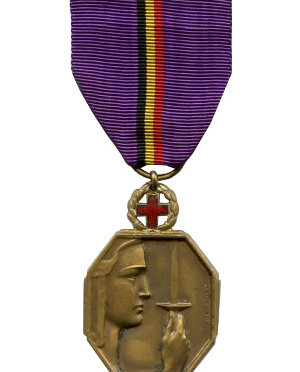
The Medal of Belgian Gratitude 1940-1945 (Médaille de la Reconnaissance Belge 1940–1945 / Erkentelijkheidsmedaille 1940–1945) is a Belgian medal instituted on 1 August 1945 by the Prince-Regent Karel, in three classes: gold, silver and bronze.

The medal was awarded to civilians, Belgian or foreign alike, who during the war had shown their patriotism in the humanitarian field by acts of courage. A good example of an award to non-Belgians is the gold medal to the Dutch village of Vught, given in recognition of the inhabitant’s attitude towards the Belgian prisoners held in the German concentration camp there.

The Medal of Belgian Gratitude 1940-1945 Design

The medal measures 34 mm in diameter and is octagonal and struck in silver.

The obverse depicts a veiled woman (representing Belgium) facing to the right, with a rapier in her right hand, raised in salute. The reverse bears the inscription “PATRIA GRATA 1940 1945” with a decorative pattern on either side of the inscription. Above the medal is a laurel wreath.

The ribbon has central stripes of black, yellow, and pink flanked by purple.

Red Cross members who qualified were awarded a medal with a red enamel cross in the open laurel wreath of the medal’s suspension.

The Commemorative Medal of the War 1940-1945

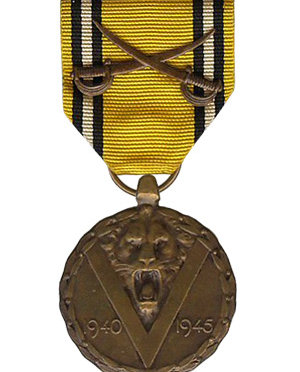
The Commemorative Medal of the 1940–45 War (Médaille Commémorative de la Guerre 1940–45 / De Herinneringsmedaille van de Oorlog 1940–1945) is a military decoration of Belgium established on 16 February 1945 by royal decree of the Prince Regent to recognize Belgian servicemen and women who served during the Second World War.

The medal was also awarded to members of the Belgian Resistance and members of Belgium’s Merchant Navy on the side of the Allies. Later decrees allowed for its award to foreign recipients of the Belgian Croix de Guerre.

The Commemorative Medal of the War 1940-1945 Design

The medal measures 38mm in diameter and is circular and struck in bronze.

The obverse bears a large V for Victory sign with a relief roaring lion in the V, at the lower left was the relief year “1940”, at the lower right the relief year “1945”. A 3mm wide laurel wreath encircled the entire medal on both the obverse and reverse. On the reverse, within a 5mm wide raised circle, the relief inscriptions “MEDAILLE COMMEMORATIVE” within the upper half and “HERINNERINGSMEDAILLE” in the lower half. In the center of the circle, two 3mm high raised horizontal bars positioned 8mm apart bear the relief inscriptions “DE LA GUERRE” / “VAN DER OORLOG“, at the center, between the two horizontal bars, the relief years “1940–1945”.

The ribbon is 37mm wide yellow silk moiré with 8mm wide edge stripes composed of 2mm wide stripes of yellow, black, white and black, the yellow being closest to the edges. The medal is suspended by a ring through a lateral suspension loop.

The Medal of the Recruiting Centers 1940

The Medal of the Recruiting Centers 1940 (Médaille des Centres de Recrutement 1940 / Medaille van de Recruteringscentra van het Belgisch Leger 1940) is a decoration of the Kingdom of Belgium created by royal decree on

 granted to any man between the ages of sixteen and thirty-five who responded to the order, given in  by the Government, to join the recruiting centers of the Belgian army in France from  and whose period of absence from their home must count at least 10 days and have taken place before .

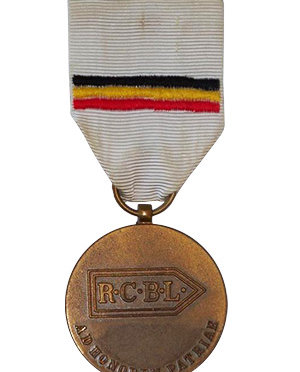
The medal exists in three versions according to the linguistic affiliation of the beneficiary: With the inscription in relief “CRAB” for French speakers, “RCBL” for Dutch speakers and “RZBH” for German speakers.

The Medal of the Recruiting Centers 1940 Design

The medal measures 37 millimeters in diameter and is struck in patinated bronze.

The obverse bears the inscription “CRAB” and “AD HONOREM PATRIAE” in relief and the reverse the year “1940” in relief. The medal is suspended by a ring passing laterally in a suspension barrel at the top of the medal, to a white silk ribbon with a width of 38 mm, in its center horizontally 3 bands of 2 mm, red, yellow and black symbolizing the Belgian flag.

The Medal for Resistance against Nazism in the Annexed Territories

The Medal for Resistance against Nazism in the Annexed Territories (Médaille du Résistant contre le Nazisme dans les Territoires Annexées / Medaille voor Weerstand tegen het Nazisme in de Geannexeerde Gebieden) was established very late, on April 16, 1985.

It was intended for the inhabitants of the German region in Belgium (annexed after the 1st World War) who had actively resisted Nazism during the Second World War: political prisoners, prisoners of war, members of the resistance, saboteurs, and members of the underground press, those who, between May 10, 1940 and January 1, 1943, had – for patriotic reasons – left the region or been expelled from it, those who had forced to enter service with the German army or the labor force in Germany and who had deserted their post before June 6, 1944, etc.

The Medal for Resistance against Nazism in the Annexed Territories Design

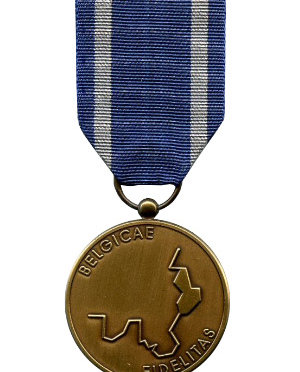
The medal is circular and struck in bronze. The obverse bears the inscription “BELGICAE FIDELITAS” and the reverse “1940-1945”.

There are three different ribbons to indicate the category to which the decorated person belonged: to the deserters of the German service the medal with the blue ribbon with yellow bands, with those which had left the region or were expelled with the ribbon with red bands, with the others that with the ribbon white stripes was awarded.

The Escapees’ Cross 1940-1945

The Escapees’ Cross 1940–1945 (Croix des Évadés 1940–1945 / Kruis der Ontsnapten 1940–1945) is a Belgian war service medal established by the Belgian government in exile in London on 25 February 1944.

The medal was awarded to all Belgian citizens who, during the Second World War escaped from occupied Belgium (or from another occupied land or Germany) and that, following it, had proven their patriotism by joining and serving with a resistance group. It was also awarded for being imprisoned for a minimum of three months following an act of patriotism, or for having traveled clandestinely to participate in a Belgian action aimed at promoting the war against the enemy. 

The medal’s statute was later amended to include those who had escaped also from non-occupied territories and made their way to the United Kingdom in order to continue fighting the enemy (such as those that left the beaches of Dunkirk, non-occupied France or French North Africa).

The Escapees’ Cross 1940-1945 Design

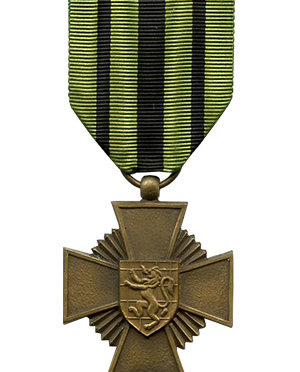
The medal is a cross pattée measuring 39mm wide, with four 7mm long rays radiating outwards between its arms.

The obverse bears a 14mm wide by 18mm high shield bearing a lion rampant superimposed over prison bars. The medal is a single face, and the reverse is bare.

The ribbon is 37mm wide green silk moiré, with a longitudinal 6mm wide central black stripe and narrow 3mm black stripes 6mm from the ribbon edges. The award was suspended by a ring through a suspension loop.

The Prisoner of War Medal 1940-1945

The Prisoner of War Medal 1940–1945 (Médaille du Prisonnier de Guerre 1940-1945 / Krijgsgevangenenmedaille 1940-1945) is a Belgian war service medal established on 20 October 1947 by royal decree.

The medal was awarded to all members of the Belgian Armed Forces imprisoned by Axis Forces during the Second World War.

The Prisoner of War Medal 1940-1945 Design

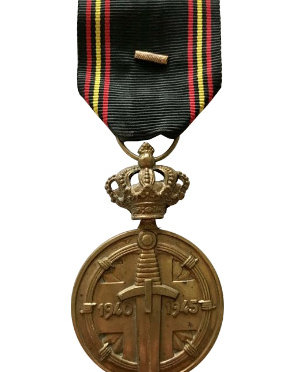
The medal measures 38 mm in diameter and is circular and struck in bronze. It’s surmounted by a three-dimensional 25 mm high royal crown mounted on a pin giving the entire assembly (medal and crown) a height of 64 mm.

The obverse bears a broadsword pointing down superimposed over a Greek cross with slightly flared ends and the years “1940” and “1945” inscribed in relief on the lateral cross arms. Two triangular laurel leaves protrude from between the cross arms fanning out and a ring of barbed wire encircles the cross along the circumference and 3mm from the medal’s edge. The reverse bears a guard tower and prison camp fence surrounded by a chain along the circumference and 3mm from the medal’s edge.

The ribbon is 37 mm wide black silk moiré with narrow longitudinal 1 mm red/black/yellow/black/red stripes 2 mm from the edges. The medal was suspended by a ring through the crown’s orb. The years of imprisonment were denoted on the ribbon by small striated metal bars.

The Political Prisoner’s Cross 1940-1945

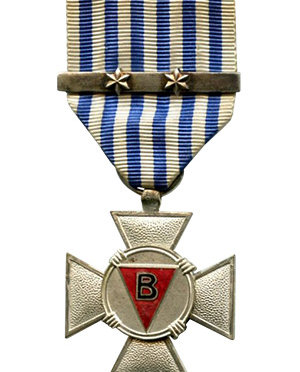
The Political Prisoner’s Cross 1940–1945 (Croix du Prisonnier Politique 1940–1945, / Politieke Gevangenkruis 1940–1945) is a Belgian war medal established on 13 November 1947 by royal decree of the Regent and awarded to Belgian citizens arrested and interned by the Germans as political prisoners during the Second World War.

The award’s statute also included provisions for posthumous award should the intended recipient not survive detention, and the right of the widow (the father or the mother of the deceased) to wear the cross.

The Political Prisoner’s Cross 1940-1945 Design

The medal is a cross pattée measuring 37mm wide and is struck in silver.

Its obverse bears a 2 cm in diameter central medallion surrounded by barbed wire with an inverted red enameled triangle with a black capital “B” at its center, representing the insignia internees had to wear on their prisoners’ uniforms that identified them as Belgian political prisoners. The reverse also bears a central medallion but enameled in black and bearing the years “1940 1945” in silver numerals.

The ribbon is 38mm wide white silk moiré with six 3mm wide longitudinal blue stripes 3mm apart from each other, the colors representing the striped prisoners’ uniforms. The cross was suspended by a ring through a suspension loop.

Silver bars with up to four small five or six-pointed stars on them could be worn on the ribbon, each one denoting a period of six months of internment. Many veterans opted instead for small individual silver stars directly affixed to the ribbon. In the case of a posthumous award, a black enameled bar was worn on the ribbon above the others.

The Civilian Disobedience Medal

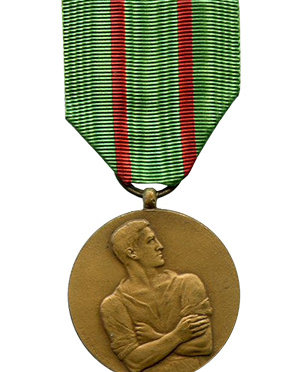
The Civilian Disobedience Medal (Médaille du Réfractaire / Werkweigeraarsmedaille) is a war service medal of the Kingdom of Belgium established on 12 February 1951 by royal decree and awarded to Belgian citizens refusing to support the German war effort during the Second World War.

The Civilian Disobedience Medal Design

The medal measures 37mm in diameter, and is circular and struck in bronze.

The obverse bears the relief torso of a civilian male with his arms crossed and his face turned away to the right in defiance. The reverse bears the relief inscription on two lines in Latin “FORSAN VICTI NUNQUAM SERVI” roughly translating into “MAYBE DEFEATED BUT NEVER SLAVES“. The years “1940-1945” are inscribed along the reverse’s upper circumference.

The ribbon measures 38mm wide and is silk moiré green, with two 3mm wide longitudinal stripes located 1cm from the edges, the stripes came in three different colors depending on the reason for bestowal:

  • yellow stripes indicated a refusal to serve in the German armed forces;
  • white stripes indicated a refusal to work for the Germans;
  • red stripes indicated a refusal to return to Germany by a forced laborer following leave at home in Belgium.

The medal is suspended by a ring through a suspension loop.

The Civilian Resistance Medal

The Civilian Resistance Medal was established in 1951 and awarded to all members of the Belgian civilian resistance during World War II.

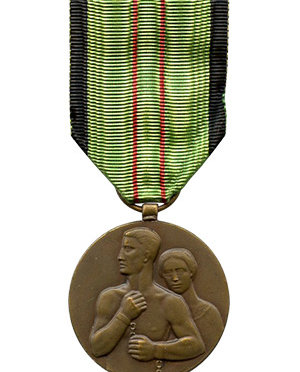
The Civilian Resistance Medal (Médaille du résistant civil / Burgerlijke Weerstandsmedaille) is a war service medal of the Kingdom of Belgium established on 21 March 1951 by royal decree and awarded to all members of the Belgian civilian resistance during the Second World War who were recognized as such by the law of 24 September 1946.

The Civilian Resistance Medal Design

The medal measures 39mm in diameter and is circular and struck in bronze. The obverse bears the relief image of the torso of a man breaking free of chains around his wrists, a woman stands behind him and slightly to his left. The reverse bears the relief inscription in Latin “RESTITERUNT” meaning “THEY RESISTED” with the years “1940” above and “1945” below. The reverse has a slightly raised border.

The ribbon masures 37 mm wide and is light green silk moiré, with two central 1 mm wide red stripes 5 mm apart and 4 mm black edge stripes. The colors of the ribbon are symbolic, the black denoting the dark days of the German occupation and/or the clandestine nature of the resistance, the green stands for the hope of liberation and the red for the spilled blood of the resistance members. The medal is suspended by a ring through a suspension loop.