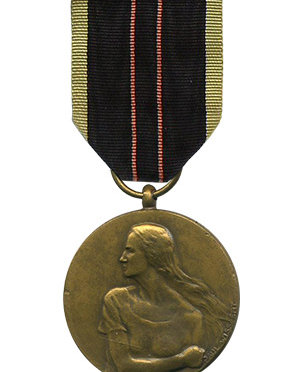
The Medal of the Armed Resistance 1940-1945

The Resistance Medal 1940–1945 (Médaille de la Résistance 1940–1945 / Medaille van de Weerstand 1940–1945) is a Belgian war medal established on 16 February 1946 by royal decree of the Regent and awarded to all members of the Belgian armed resistance during the Second World War.

The medal was also awarded to members of the intelligence service who operated in occupied territories and participated in combat actions aimed at the liberation of Belgium.

The Medal of the Armed Resistance 1940-1945 Design

The medal measures 39mm in diameter and is circular and struck in bronze.

The obverse bears the upper body of a young woman facing left in defiance with her right fist clenched. The reverse bears the relief inscription in Latin on three lines “1940 RESISTERE 1945” superimposed over a laurel wreath.

The ribbon measures 37 mm wide and is black silk moiré, with two central 1 mm wide red stripes 5 mm apart and 4 mm light green edge stripes. The colors of the ribbon are symbolic, the black denoting the dark days of the German occupation and/or the clandestine nature of the resistance, the green stood the hope of liberation and the red for the spilled blood of the resistance members. The medal is suspended by a ring through a suspension loop.
The Commemorative Medal of the Ethiopian Campaign

The Commemorative Medal of the Ethiopian Campaign (Médaille Commémorative de la Campagne d’Ethiopie / Herinneringsmedaille van de Ethiopische Veldtocht) was established by royal decree in January 1947 and awarded for participation in the campaign in Abyssinia for at least one year between 6 March and 3 July 1941.

On 11 March 1941, Belgian forces, together with elements of the British King’s African Rifles attacked Asosa, defeating the occupying Italians before moving on to Gambela and Saio. The Belgian forces besides defending the Belgian Colonies of Congo or Ruanda/Urundi served also in Madagascar, Ethiopia, Nigeria, Libya, Egypt, Sudan and Palestine.

This medal is very rare, as the Belgian forces that participated in the campaign were less than 3000 men. There were possibly fewer than 500 medals actually awarded.

The Commemorative Medal of the Ethiopian Campaign Design

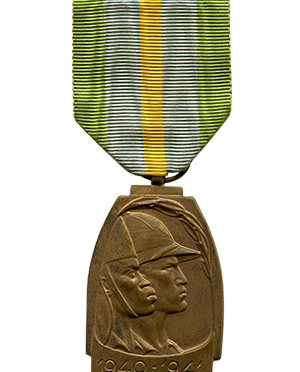
The medal was designed by the sculptor Arthur Dupagne. Struck patinated bronze, of trapezoidal form, it measures 45mm high by 31mm wide and has two curved sides.

The obverse depicts the overlapping right-facing profiles of the head of a European and an African soldier with the date “1940-1941” at the base. The reverse bears the names of the three major actions of the campaign: SAIO, GAMBELA, and ASOSA, with a star above and below.

The ribbon is light blue with green edges and a yellow central stripe.

The claspNigeria” was awarded to the expeditionary force of 13.000 men of the Force Public (Gendarmery and Military force of Belgian Congo consisted of native Congolese troops under the command of Belgian officers and NCOs) who served under British command from 1942 to 1943 in Nigeria – 9.000 of these troops served in Egypt and Palestine and received also the “Middle East” clasp.

The 1940-1945 Colonial War Effort Medal

The 1940–1945 Colonial War Effort Medal (Médaille de l’Effort de Guerre Colonial 1940-1945 / Medaille voor de Koloniale Oorlogsinspanning 1940-1945) is a Belgian war service medal established on 30 January 1947 by royal decree of the Regent and awarded to government civil servants, magistrates, volunteer members of the female auxiliary service, missionaries, civilian agents of the different departments and civilians who served honorably for at least one year in the Belgian Congo or Ruanda-Urundi colonies of the Kingdom of Belgium in Africa between 10 May 1940 and 7 May 1945.

Those eligible for the award of both the 1940–1945 Colonial War Effort Medal and the 1940–1945 African War Medal could only receive one of the two, usually the one earned for the longest service.

The 1940-1945 Colonial War Effort Medal Design

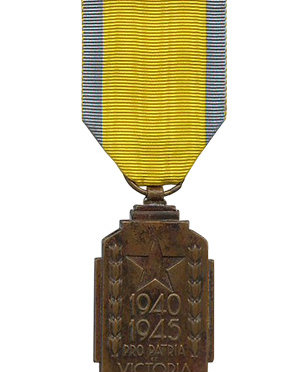
The medal measures 31mm wide by 52mm high, and is struck bronze. It’s rectangular with sloping upper corners.

The obverse bears, at its upper center, an embossed five-pointed star above the relief inscription on five rows “1940” “1945” “PRO PATRIA” “ET” “VICTORIA” between vertical laurel leaves. The reverse is plain.

The ribbon is 37mm wide yellow silk moiré with 5mm wide light blue edge stripes. The medal is suspended by a ring through a lateral suspension hole.

The 1940-1945 African War Medal

The 1940–1945 African War Medal (Médaille de la Guerre Africaine 1940-1945 / Afrikaanse Oorlogsmedaille 1940-1945) is a Belgian war service medal established on 30 January 1947 by royal decree of the Regent and awarded to officers and soldiers for at least one year’s service in the Force Publique between 10 May 1940 and 7 May 1945.

Those eligible for the award of both the 1940–1945 Colonial War Effort Medal and the 1940–1945 African War Medal could only receive one of the two, usually the one earned for the longest service.

The service was not limited to the Belgian colonies of the Congo and Ruanda-Urundi. The following four clasps were issued for wear on the ribbon inscribed in French:

  • NIGERIE (for six months service in Nigeria)
  • MOYEN-ORIENT (for six months service in the Middle East)
  • MADAGASCAR (for six months service in Madagascar)
  • BIRMANIE (for six months service in Burma)

The 1940-1945 African War Medal Design

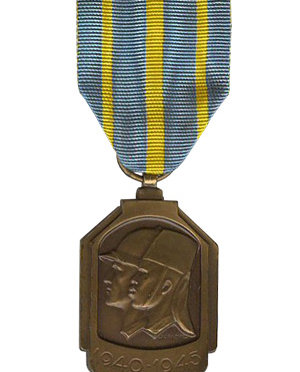
The medal measures 52mm high (including the suspension) by 33mm wide and is rectangular and struck from bronze. It has sloped upper shoulders and rounded lower corners.

The obverse bears the relief images of the left profiles of a native African soldier wearing a fez and of a pith-helmeted Belgian soldier, both within a recessed central area. Under the recess, the embossed years “1940 – 1945”. The reverse is plain.

The Volunteer’s Medal 1940-1945

The Volunteer’s Medal 1940–1945 (Médaille du Volontaire 1940–1945 / Medaille van de Oorlogsvrijwilliger 1940–1945) is a Belgian war medal established on 16 February 1945 by royal decree of the Regent and awarded to Belgian and foreign civilians who voluntarily enlisted in the Belgian Armed Forces during the Second World War.

The medal could also be awarded to volunteers serving in the Belgian units of the Royal Air Force, Royal Navy or British merchant navy.

The Volunteer’s Medal 1940-1945 Design

The medal measures 38 mm in diameter and is circular and struck in bronze.

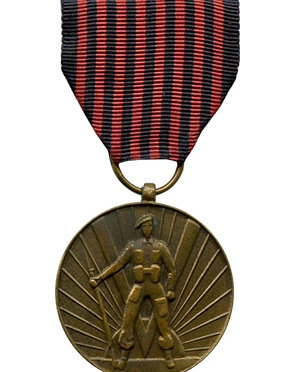
The obverse bears the relief image of a soldier standing at ease holding a rifle with a bayonet, with the soldier is superimposed over a large capital letter V in front of a rising sun. The reverse bears the relief image of the Flemish lion rampant below the inscription in Latin “VOLONTARIIS“, and the inscription of the dates “1940” and “1945“.

The medal was suspended by a ring through the suspension loop from a 38 mm wide silk moiré ribbon composed of fifteen 2 mm wide alternating red and blue stripes and two 4 mm wide blue edge stripes.

The 1940-1945 Military Combatant’s Medal

The 1940–1945 Military Combatant’s Medal (Médaille du Combattant Militaire de la Guerre 1940–1945 / Medaille van de Militaire Strijder 1940–1945) is a Belgian war medal established on 19 December 1967 by royal decree and awarded to all members of the Belgian Armed Forces who fought from England during the Second World War.

The 1940-1945 Military Combatant’s Medal Design

The medal measures 38mm wide is Greek cross struck in bronze, with semi-circular protrusions filling the gaps between the arms up to 3mm from the cross arms’ ends.

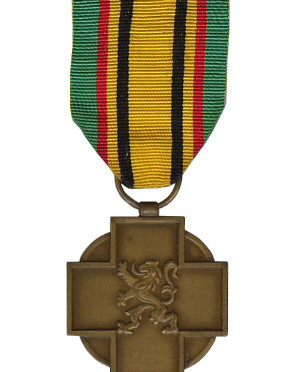
The obverse bears the relief image of a lion rampant at the center of the cross. The reverse bears a vertical broadsword bisecting the years “1940” and “1945” inscribed in relief.

The ribbon is 36mm wide silk moiré with the colors divided as follows from the left to the right edge: 6mm green, 2mm red, 3mm yellow, 2mm black, 1 cm yellow, 2mm black, 3mm yellow, 2mm red, 6mm green. The medal is suspended by a ring through a suspension loop.
The Maritime Medal 1940-1945

The Maritime Medal 1940–1945 (Médaille Maritime 1940–1945 / Maritieme Medaille 1940–1945) is a Belgian bravery award of World War II, established on 17 July 1941 by Royal Decree and awarded to members of the Belgian Navy, merchant navy or fishing fleet (later also all naval personnel for service of two years onboard an allied warship and those shipwrecked twice due to combat action) for acts of heroism in the saving of ships or lives during action against the enemy.

The Maritime Medal 1940-1945 Design

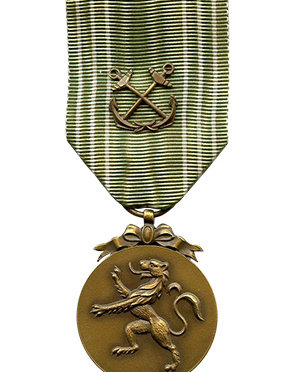
The medal measures 38mm in diameter and is circular and struck in bronze. Its obverse bears the relief image of a lion rampant. The reverse bears the royal cipher of King Leopold III

The ribbon is 38mm wide ocean green silk moiré. There are six 1mm wide white stripes, three at left and three at right separated by 3mm each starting 3mm from the ribbon’s edges. The medal is suspended by a ring through the suspension loop. Miniature crossed bronze sea anchors are affixed to the ribbon, sizes vary greatly depending on the maker.
The 1940-1945 Belgian Red Cross Decoration

The 1940-1945 Belgian Red Cross Decoration (Décoration de la Croix Rouge Belge 1940–1945 / Ereteken van het Belgische Rode Kruis 1940–1945).

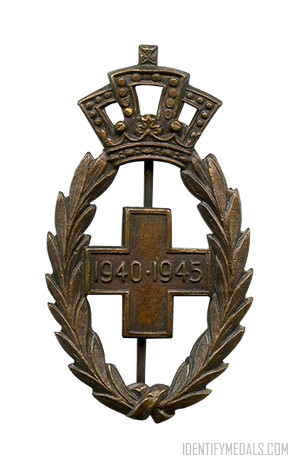
The 1940-1945 Belgian Red Cross Decoration (Décoration de la Croix Rouge Belge 1940–1945 / Ereteken van het Belgische Rode Kruis 1940–1945) is a Belgian Red Cross decoration.

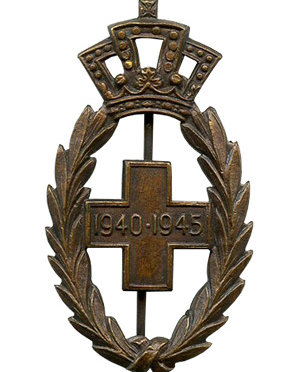
It consists of a gilding metal pin-back badge of 60mm max height in the form of an openwork crowned pair of vertically elongate palms. The palms support the Greek Red Cross symbol in the center, which bears the dates ‘1940 -1945’ across the horizontal arms.

Find Red Cross Medals Online

More Red Cross Medals

The Blood Donor’s Medal

The Blood Donor’s Medal (Médaille de Donneur de Sang / Bloeddonor Medaille) is a Red Cross Belgian medal awarded for blood donations.

The Blood Donor’s Medal (Médaille de Donneur de Sang / Bloeddonor Medaille) is a Red Cross Belgian medal.

A circular bronze badge was awarded for 25 to 40 blood donations, a bronze medal for 40 to 60 donations and a silver medal for 60 to 80 donations.

Find Red Cross Medals Online

More Red Cross Medals

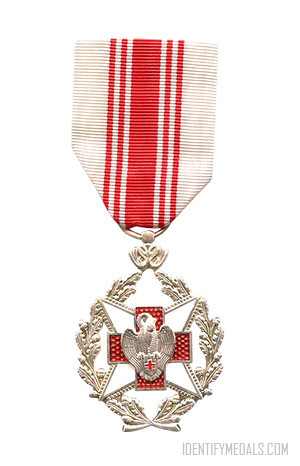
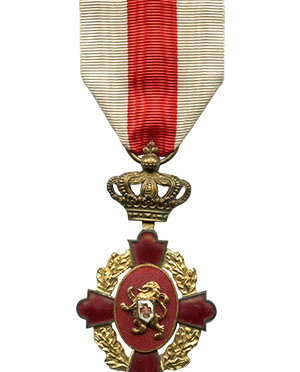
The Order of the Belgian Red Cross

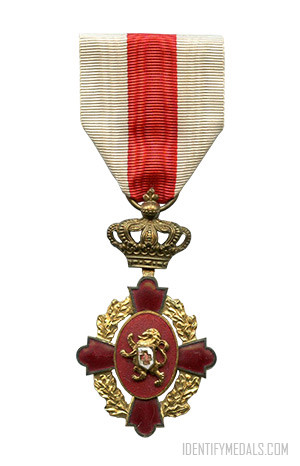
The Order of the Belgian Red Cross (Ordre de la Croix Rouge Belge / Orde van het Belgische Rode Kruis) was established in 1880.

The Order of the Belgian Red Cross (Ordre de la Croix Rouge Belge / Orde van het Belgische Rode Kruis) was established in 1880.

The award was produced in two classes: 1st class (gilt finish), and 2nd class (silver finish).

The Order of the Belgian Red Cross Design

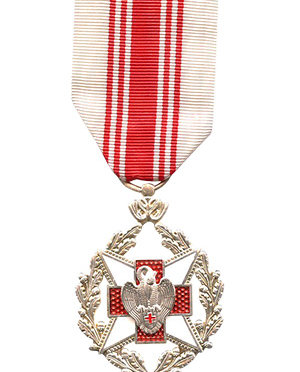
The medal is a red enamel cross patonce 37mm wide with an oak wreath set within the arms. The obverse bears a vertically elongate oval central medallion in red enamel bears the Belgian lion, with the red cross emblem on a small white shield superimposed. The reverse is similar, but with a plain central medallion in gilt or silver, suitable for engraving of the recipient’s details.

The ribbon measures 37 mm wide with a 12mm wide red central stripe for the 1st class award, or with two narrow red central stripes for the 2nd class award.

Find Red Cross Medals Online

More Red Cross Medals