The Royal Victorian Order

The Royal Victorian Order is a dynastic order of knighthood established in 1896 by Queen Victoria for distinguished service to the monarch.

The Royal Victorian Order is a dynastic order of knighthood established in 1896 by Queen Victoria to recognize distinguished personal service to the monarch of the Commonwealth realms, members of the monarch’s family, or to any viceroy or senior representative of the monarch. There is no limit on the number of individuals honored at any grade, and admission remains at the sole discretion of the monarch.

The reigning monarch is at the apex of the Royal Victorian Order as its Sovereign, followed by the Grand Master. The Order has five grades and one medal with three levels representing different levels of service. All those honored may use the prescribed styles of the order. The order’s motto is Victoria, and its official day is 20 June and its chapel is the Savoy Chapel in London.

The grades are as follows:

  • Knight / Dame Grand Cross.
  • Knight / Dame Commander.
  • Commander.
  • Lieutenant.
  • Member.

The Royal Victorian Order Design

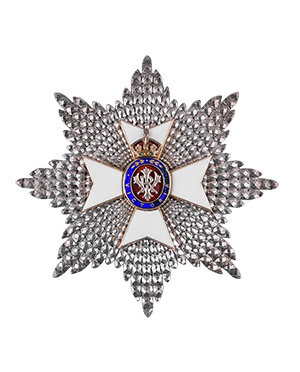
The badge of the Order is a Maltese cross with a central medallion depicting on a red background the Royal Cypher of Queen Victoria, surrounded by a blue ring bearing the motto of the order—VICTORIA—and surmounted by a Tudor crown and worn on a sash depending on the grade. For Knights and Dames Grand Cross, Commanders, and Lieutenants, the Maltese cross is rendered in white enamel with gold edging, while that for Knights and Dames Commander and Members is in silver. The size of the badge also varies by rank, that for the higher classes being larger.

The medal bears the effigy and name of the reigning sovereign at the time of its awarding, as well as the phrase DEI • GRATIA • REGINA (or REX) • F.D. (by the grace of God, Queen (or King), Defender of the Faith), and on the reverse is the Royal Cypher upon an ornamental shield within a laurel wreath.

The ribbon is blue with red-white-red stripe edging, and at formal events, or collar days, Knights and Dames Grand Cross wear the Royal Victorian Order’s livery collar, consisting of an alternating string of octagonal gold pieces.
The Medal for the Liberation of Kuwait (Canada)

The Gulf and Kuwait Medal as a Canadian medal created in 1990 to recognize the Canadian Forces who had directly participated in the Gulf War.

The Gulf and Kuwait Medal (or Médaille du Golfe et du Koweït in French) was a Canadian campaign medal created in 1990 by the monarch-in-Council to recognize members of the Canadian Forces who had directly participated in the Gulf War, either in the hostilities themselves or during the troop build-up prior to the invasion of Iraq.

The medal is, within the Canadian system of honors, the third highest of the war and operational service medals. Queen Elizabeth II, on the advice of her Cabinet under Prime Minister Brian Mulroney, created the medal to recognize members of the Canadian Forces. To qualify for the medal, individuals had to have served for 30 consecutive days between 2 August 1990 and 27 June 1991 in the region of the Persian Gulf, and those who for a minimum of one day engaged in direct combat with the enemy during the offensive that lasted from 16 January to 3 March 1991 were entitled to receive the additional medal bar.
In total, 4,436 medals were issued, along with 3,184 bars.

The Medal for the Liberation of Kuwait (Canada) Design

The medal was designed by Bruce W. Beatty. It measures 36 millimeters (1.4 in) diameter and is a rhodium plated tombac disc.

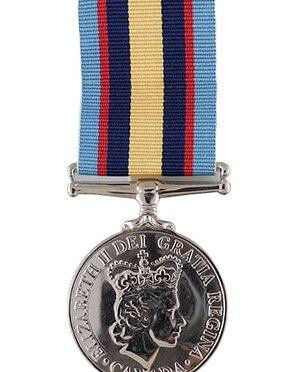
The obverse bears the Latin words ELIZABETH II DEI GRATIA REGINA (Elizabeth II, by the Grace of God, Queen) and CANADA surrounding an effigy of Queen Elizabeth II, symbolizing her roles as both fount of honor and Commander-in-Chief of the Canadian Forces. On the reverse is a laurel wreath with a maple leaf at its base encircling the words: GULF AND KUWAIT • 1990-1991 • LE GOLFE ET KUWAIT.
This medallion is worn at the left chest, suspended on a 31.8mm wide ribbon colored with vertical stripes in light blue, scarlet and dark blue, symmetrically flanking a sand colored central stripe. Originally, the Gulf and Kuwait medal was to have coincidentally had the same ribbon as the British Gulf Medal.

Should an individual already possessing a Gulf and Kuwait Medal be awarded the medal cupro-nickel and bearing a maple leaf bar for combat service, for wear on the ribbon from which the original medal is suspended.

The Air Force Cross and Medal (United Kingdom)

The Air Force Cross is a British military decoration awarded to officers for “acts of exemplary gallantry while flying against the enemy”

Time Period: WW1 The Great War
Year of Institution: 3 June 1918
Country: Great Britain

The Air Force Cross (or AFC) is a military decoration awarded to officers for “an act or acts of exemplary gallantry while flying, though not in active operations against the enemy“. Since 1993 it’s also given to other ranks, of the United Kingdom Armed Forces, and formerly also to officers of the other Commonwealth countries.
The award was established on 3 June 1918, shortly after the formation of the Royal Air Force (RAF). It was originally awarded to RAF commissioned officers and Warrant Officers, but was later expanded to include Royal Navy and army aviation officers. Recipients of the Air Force Cross are entitled to use the post-nominal letters “AFC”.

Between 1919 and 1932 the AFC was also awarded to civilians, on the same basis as for RAF personnel. The AFC had also been awarded by Commonwealth countries but by 1990’s most, including Canada, Australia, and New Zealand, had established their own honors systems and no longer recommended British honors.

The Air Force Cross and Medal Design

The Cross

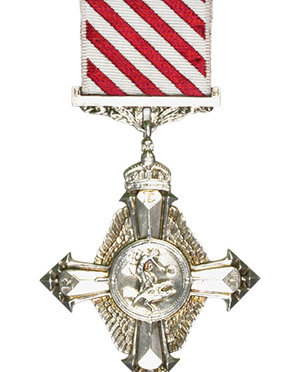
The Air Force Cross is a silver cross measuring 60 millimeters (2.4 in) in height and 54 millimeters (2.1 in) in width, representing aircraft propeller blades, with wings between the arms. It was design by Edward Carter Preston.

The obverse depicts Hermes, riding on the wings of a hawk holding a laurel wreath. At the top of the upper arm is the royal crown, while the other three arms bear the royal cipher of the reigning monarch at the time of issue. The reverse is plain, except for a central roundel bearing the reigning monarch’s cipher and the date ‘1918’. Originally awarded unnamed, from 1939 the year of issue was engraved on the reverse lower limb of cross, and since 1984 it has been awarded named to the recipient.

The suspender is straight and decorated with laurel wreaths. The ribbon bar denoting a further award is silver, with the Royal Air Force eagle in its centre. Bars awarded during World War II have the year of award engraved on the reverse. The 32 mm (1.25 inch) ribbon was originally white with red broad horizontal stripes, but changed in July 1919 to the current white with red broad diagonal stripes at a 45-degree angle.

The Medal

The Air Force Medal is an oval struck in silver and measures 42 mm tall and 32 mm wide. It has a laurel border and features, on the obverse, the sovereign’s effigy. The reverse Hermes mounted on a hawk bestowing a laurel wreath.

The medal is suspended by a pair of wings from a straight bar. The ribbon, originally with horizontal narrow stripes or white and crimson, changed in 1919 to diagonal ones of the same colors.

The Royal Red Cross

The Royal Red Cross is a military decoration established by Queen Victoria and awarded for exceptional services in military nursing.

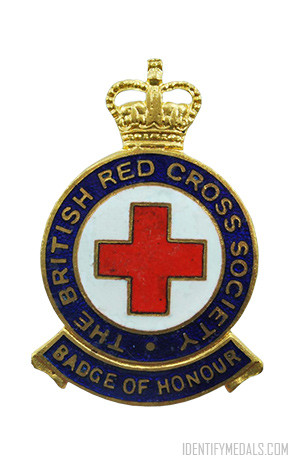
The Royal Red Cross is a military decoration awarded in the United Kingdom and Commonwealth for exceptional services in military nursing. It was established on 27 April 1883 by Queen Victoria.

The Royal Red Cross has a single class of Member and it was first awarded to the founder of modern nursing, Florence Nightingale. A second and lower class, Associate, was added during World War I in 1917.

The award is awarded to a fully trained nurse of an officially recognized nursing service, military or civilian, who has shown exceptional devotion and competence in the performance of nursing duties, over a continuous and long period, or who has performed an exceptional act of bravery and devotion at her or his post of duty.

The decoration was conferred exclusively to women until 1976.  Recipients of the Royal Red Cross are entitled to use the post-nominal letters “RRC” or “ARRC” for Members and Associates respectively.

The Royal Red Cross Medal Design

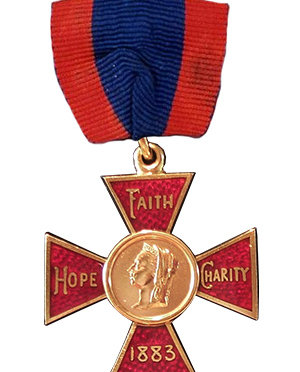
The badge for RRC is shaped like a golden cross. It measures 1.375 inches (or 3.49 cm) wide.

The obverse is enameled red, with a circular medallion (now bearing an effigy of the reigning monarch) at its centre. The words “Faith“, “Hope” and “Charity” are inscribed on the upper limbs of the cross, and the year “1883” in the lower limb.

The reverse is plain except a circular medallion bearing the Royal Cypher of the reigning monarch.

The ribbon for both grades is dark blue with crimson edge stripes. To recognise further exceptional devotion and competency in the performance of nursing duties or exceptional act of bravery and devotion at her or his post of duty, a bar may be awarded to a recipient of the RRC. The bar is linked to the cross and is made of red enamel. A rosette is worn on the ribbon in undress to denote a bar to the RRC.

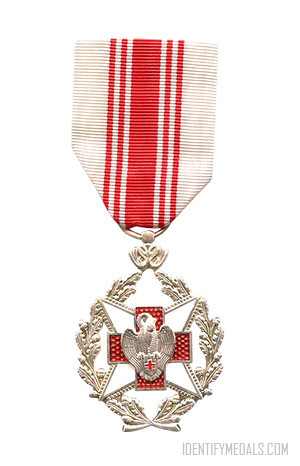
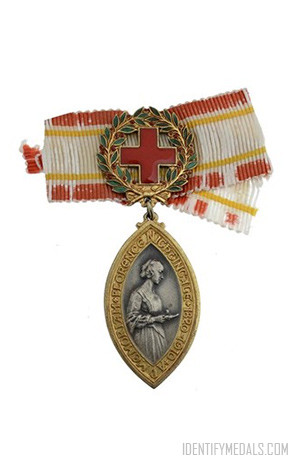
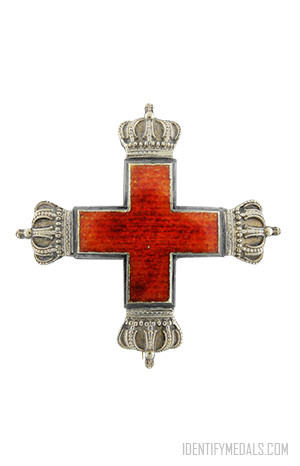
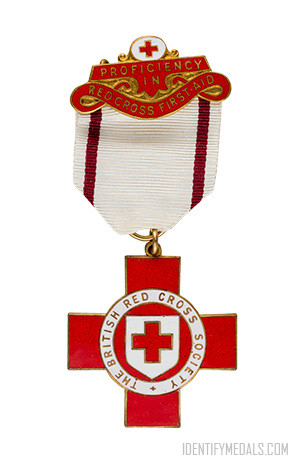
Find Red Cross Medals Online

More Red Cross Medals

The Korea Medal

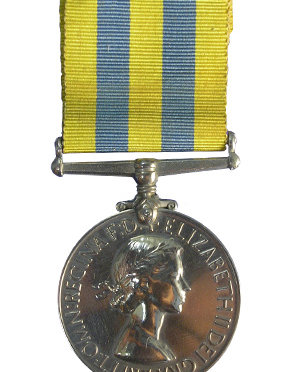
The Korea Medal (or Médaille de Corée in French), also known as the Queen’s Korea Medal, was a campaign medal created in 1951 to recognize troops from Australia, Canada, New Zealand, and the United Kingdom who had given 28 days service offshore during the Korean War, or at least one day’s service in an air sortie over Korea.

The Korean War was the first event in which United Nations (UN) armed forces took on a combat role in a multinational effort to stop the North Korean takeover of the Republic of Korea. It involved the participation of 20 UN member states, the Republic of Korea and Italy.

Except for Canada, the medal was identical in all countries where it was awarded, and holds a different place in each country’s order of precedence for honors.

The Korean War Medal Design

Designed by Edward Carter Preston, a Liverpool artist, sculptor and medallist, the Korea Medal measures 36 millimetres (1.4 in) and is a disc. All medals were made of cupro-nickel, except for the Canadian version that was made of silver.

On the Korean War medal obverse is an effigy of Queen Elizabeth II, surrounded by an inscription that symbolizes her roles as both fount of honour and Commander-in-Chief of her various forces. At the time of the medal’s creation, King George VI was monarch. However, he died on 6 February 1952 and so the image of his daughter was placed on the obverse of the medal, uncrowned.

There are three versions of the inscription surrounding the Queen’s head:

  • ELIZABETH II DEI GRA. BRITT. OMN. REGINA F.D. (Elizabeth II, by the Grace of God Queen of all the Britons, Defender of the Faith).
  • ELIZABETH II DEI GRATIA REGINA F.D. (Elizabeth II, by the Grace of God Queen, Defender of the Faith), later awards omitting BRITT. OMN..
  • ELIZABETH II DEI GRATIA REGINA CANADA (Elizabeth II, by the Grace of God Queen of Canada), awarded to Canadian participants.

On the reverse is a depiction of Hercules wrestling the Hydra—a symbolic representation of communism—with the word KOREA below.

The recipient’s name, rank and regimental number is impressed on the medal’s rim.

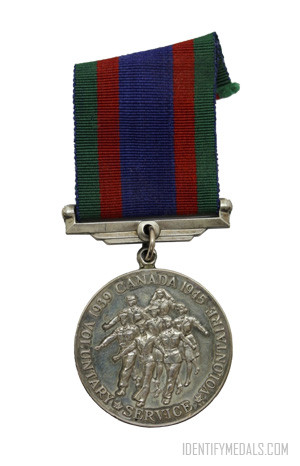
The Canadian Volunteer Service Medal

The Canadian Volunteer Service Medal is a British medal granted to persons of any rank in the Naval, Military or Air Forces of Canada.

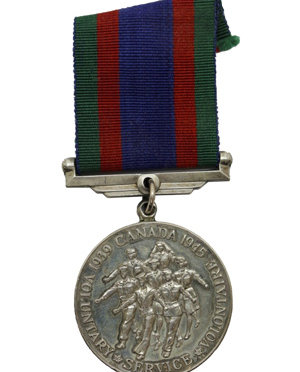
The Canadian Volunteer Service Medal is a British medal granted to persons of any rank in the Naval, Military or Air Forces of Canada who voluntarily served on Active Service from September 3, 1939, to March 1, 1947.

Members of the Naval, Military or Air Forces of Canada were eligible if they had voluntarily served on Active Service and honourably completed eighteen months (540 days) total service.

The Canadian Volunteer Service Medal Design

The medal is circular and made of silver (.925 fine silver). It measures 1.42 inches (36 mm) in diameter.

The obverse depicts seven marching figures, representing men and women of the army, air force, navy and nursing service. Around the rim is the inscription 1939 CANADA 1945 VOLUNTARY SERVICE VOLONTAIRE. The seven marching figures were based on real people taken from the National Defence photographs. The reverse shows the coat of arms of CanadaMedals were issued unnamed. The medal was designed by the war artist Major Charles Comfort.

A total of 650,000 medals were awarded.

Find This Campaign Medal

Right Now on eBay 
Clicking a link to eBay may result in a referral commission being paid if a purchase is made.
Loading...

More WW2 British Campaign Medals

During World War II (1939–1945) British campaign medals were awarded to members of the British Armed Forces and civilians for active service in specific military campaigns or operations. These included:

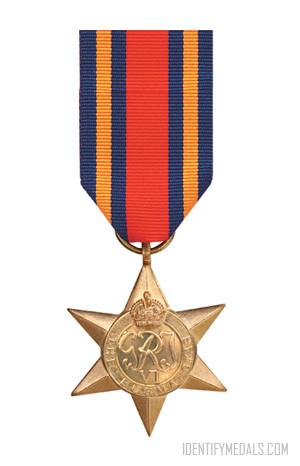
WW2 Medals and Awards: The Burma Star

The Burma Star

The Burma Star is a military campaign medal for award to subjects of the British Commonwealth who served in the Burma Campaign.

Read More »
WW2 Medals and Awards: The Italy Star

The Italy Star

The Italy Star is a military campaign medal, instituted by the United Kingdom in May 1945 for service in the Italian Campaign 1943 to 1945.

Read More »
WW2 Medals and Awards: The Pacific Star

The Pacific Star

The Pacific Star is a British military campaign medal instituted by the United Kingdom in 1945 for those who served in the Pacific Campaign.

Read More »
WW2 Medals and Awards: The Arctic Star

The Arctic Star

The Arctic Star is a military campaign medal which was instituted for service on the Arctic Convoys north of the Arctic Circle in WW2. 

Read More »

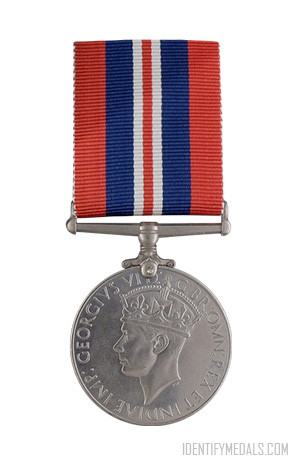
The War Medal 1939-1945

The War Medal 1939–1945 is a British campaign medal instituted by the United Kingdom on 16 August 1945. The medal was awarded to subjects of the British Commonwealth who had served full-time.

The War Medal 1939–1945 is a British campaign medal instituted by the United Kingdom on 16 August 1945. The medal was awarded to subjects of the British Commonwealth who had served full-time (28 days of service) in the Armed Forces or the Merchant Navy for at least 28 days between 3 September 1939 and 2 September 1945.

The medal was also available for subjects commissioned or enlisted into British Forces who had not received a similar award from their own Governments. Also eligible were full-time paid members of the specially approved colonial and other military forces, militarised police and militarised civilian bodies.

Personnel who were eligible for a campaign star but had had their service cut short by death, wounds or capture by the enemy, still qualified for the War Medal 1939-1945.

The War Medal 1939–1945 Design

The War Medal 1939–1945 is made of silver or cupro-nickel in the shape of a disk. It measures 36 millimeters (1.42 inches) in diameter. While the British issue medals were struck in cupro-nickel, those awarded in Canada were done in silver.

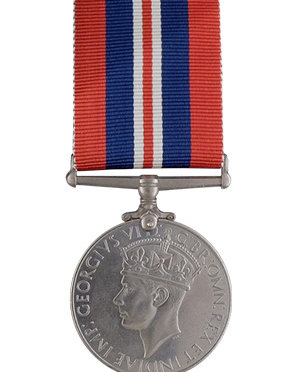
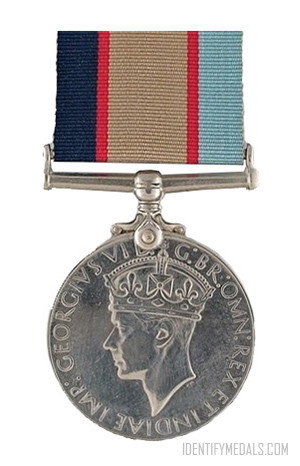
The obverse shows the crowned coinage effigy of King George VI, facing left and signed “PM” below the truncated neck of the effigy. Around the perimeter is the legend “GEORGIVS VI D:G:BR:OMN:REX ET INDIAE IMP:”.

The reverse shows a lion standing wanton on the body of a double-headed dragon. The dragon’s heads are those of an eagle and a dragon, to signify the principal occidental and oriental enemies during the Second World War. At the top, just to the right of center are the years “1939” and “1945” in two lines.

As with the other Second World War campaign medals, a no-engraving policy was applied by all but four British Commonwealth countries.

The ribbon features the colours of the British Union Jack and measures 32 millimetres wide (with a 6½ millimetres wide red band, a 6½ millimetres wide blue band and a 2 millimetres wide white band, repeated in reverse order and separated by a 2 millimetres wide red band).

Find This Campaign Medal

Right Now on eBay 
Clicking a link to eBay may result in a referral commission being paid if a purchase is made.
Loading...

More WW2 British Campaign Medals

During World War II (1939–1945) British campaign medals were awarded to members of the British Armed Forces and civilians for active service in specific military campaigns or operations. These included:

The War Medal 1939-1945 Obverse

The War Medal 1939-1945

The War Medal 1939–1945 is a British campaign medal instituted by the United Kingdom on 16 August 1945. The medal was awarded to subjects of the British Commonwealth who had served full-time.

Read More »
WW2 Medals and Awards: The Pacific Star

The Pacific Star

The Pacific Star is a British military campaign medal instituted by the United Kingdom in 1945 for those who served in the Pacific Campaign.

Read More »
WW2 Medals and Awards: The Italy Star

The Italy Star

The Italy Star is a military campaign medal, instituted by the United Kingdom in May 1945 for service in the Italian Campaign 1943 to 1945.

Read More »

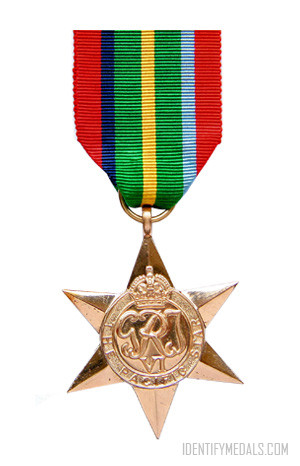
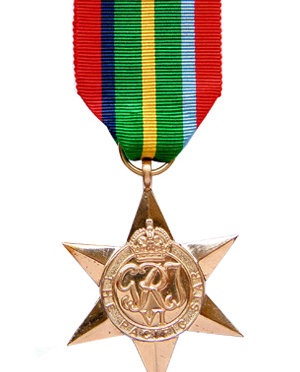
The Pacific Star

The Pacific Star is a British military campaign medal instituted by the United Kingdom in 1945 for those who served in the Pacific Campaign.

The Pacific Star is a military campaign medal of the British Commonwealth nations, including the United Kingdom, Australia, and New Zealand. It was established in 1945 to recognize service in the Pacific Theater during World War II.

The Pacific Star was awarded to members of the British and Commonwealth forces who served in specified territories and operational areas in the Pacific region between December 7, 1941, and September 2, 1945. These areas included Southeast Asia, the Pacific Ocean, and the Indian Ocean.

The Pacific Star serves as a symbol of recognition for the bravery, dedication, and sacrifices made by military personnel who served in the challenging and often harsh conditions of the Pacific Theater during World War II. It honors their contributions to the Allied efforts in the region.

The Pacific Star Design

The set of nine campaign stars was designed by the Royal Mint engravers. They are six–pointed stars, struck in yellow copper zinc alloy to fit into a 44 millimetres diameter circle.

The obverse has a central design of the Royal Cypher “GRI VI”, surmounted by a crown and the inscription “THE PACIFIC STAR”.

The reverse is plain and follows a no-engraving policy.

The ribbon of the Pacific Star medal consists of three equal vertical stripes of color: The left and right stripes of the ribbon are dark blue, representing the vast expanse of the Pacific Ocean, and the central stripe is light blue, symbolizing the tropical skies and waters of the Pacific Theater.

The combination of dark and light blue stripes on the ribbon represents the unique and challenging environment in which military personnel served during the Pacific campaign of World War II.

Find This Campaign Medal

Right Now on eBay 
Clicking a link to eBay may result in a referral commission being paid if a purchase is made.
Loading...

More WW2 British Campaign Medals

During World War II (1939–1945) British campaign medals were awarded to members of the British Armed Forces and civilians for active service in specific military campaigns or operations. These included:

WW2 Medals and Awards: The Burma Star

The Burma Star

The Burma Star is a military campaign medal for award to subjects of the British Commonwealth who served in the Burma Campaign.

Read More »
The War Medal 1939-1945 Obverse

The War Medal 1939-1945

The War Medal 1939–1945 is a British campaign medal instituted by the United Kingdom on 16 August 1945. The medal was awarded to subjects of the British Commonwealth who had served full-time.

Read More »
WW2 Medals and Awards: The Arctic Star

The Arctic Star

The Arctic Star is a military campaign medal which was instituted for service on the Arctic Convoys north of the Arctic Circle in WW2. 

Read More »

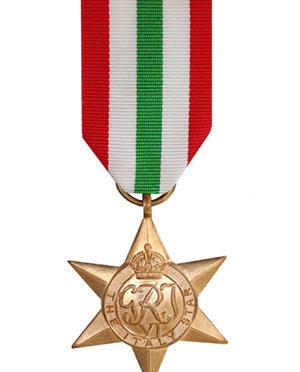
The Italy Star

The Italy Star is a military campaign medal, instituted by the United Kingdom in May 1945 for service in the Italian Campaign 1943 to 1945.

The Italy Star is a military campaign medal, instituted by the United Kingdom in May 1945 for award to subjects of the British Commonwealth who served in the Italian Campaign from 1943 to 1945.

After their victory in North Africa, the Allies used their positions in Tunisia and Malta to invade Sicily (from 10 July to 17 August 1943). After this swift victory, the Allies pressed on into Italy and, when the Italian Campaign began on 3 September 1943, became the first Allied forces to land back on mainland Europe since the Canadian-led Dieppe Raid on 19 August, 1942. They also invaded Italian occupied Greece, Yugoslavia, Corsica and Sardinia. The campaign in Italy itself continued until the end of the war in Europe on 8 May 1945.

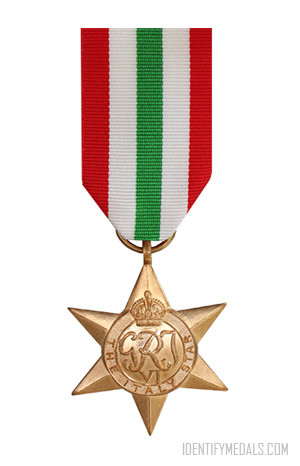
The set of nine campaign stars was designed by the Royal Mint engravers. They are six–pointed stars, struck in yellow copper zinc alloy to fit into a 44 millimetres diameter circle. The obverse has a central design of the Royal Cypher “GRI VI”, surmounted by a crown and the inscription “THE ITALY STAR”. The reverse is plain and follows a no-engraving policy.

The Italy Star Design

The set of nine campaign stars was designed by the Royal Mint engravers. They are six-pointed stars, struck in a yellow copper zinc alloy to fit into a 44 millimeters diameter circle. All of them all have a ring suspender which passes through an eyelet above the uppermost point of the star.

The obverse has a central design of the Royal Cypher “GRI VI”, surmounted by a crown and the inscription “THE ITALY STAR”. The reverse is plain and follows a no-engraving policy.

The ribbon measures 32 millimeters wide, with a 7 millimeters wide red band and a 6 millimeters wide white band, repeated in reverse order and separated by a 6 millimeters wide green band (representing the Flag of Italy).

Find This Campaign Medal

Right Now on eBay 
Clicking a link to eBay may result in a referral commission being paid if a purchase is made.
Loading...

More WW2 British Campaign Medals

During World War II (1939–1945) British campaign medals were awarded to members of the British Armed Forces and civilians for active service in specific military campaigns or operations. These included:

WW2 Medals and Awards: The Africa Star

The Africa Star

The Africa Star is a military campaign medal awarded to those who served in the Second World War specifically in North Africa. 

Read More »
The War Medal 1939-1945 Obverse

The War Medal 1939-1945

The War Medal 1939–1945 is a British campaign medal instituted by the United Kingdom on 16 August 1945. The medal was awarded to subjects of the British Commonwealth who had served full-time.

Read More »

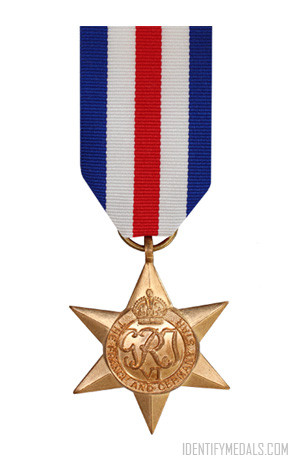
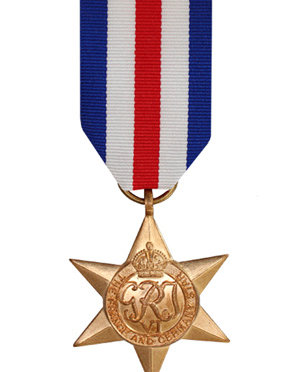
The France and Germany Star

The France and Germany Star is a military campaign medal awarded to subjects of the British Commonwealth who served during WW2.

The France and Germany Star is a military campaign medal established by the United Kingdom in May 1945 and awarded to subjects of the British Commonwealth that had served between 6 June 1944 and 8 May 1945 in France, Belgium, Luxembourg, the Netherlands or Germany and adjacent sea areas.

The Allies launched their final campaign in Northwest Europe on D-Day on 6 June 1944. Over the next eleven months, the allied forces advanced across Western Europe and liberated German-occupied France, Belgium, and the Netherlands.

Personnel who qualified for the France and Germany Star, the Atlantic Star or the Air Crew Europe Star were awarded only that star for which they first qualified and a clasp in respect of the first earned of the other two stars.

The France and Germany Star Design

The set of nine campaign stars was designed by the Royal Mint engravers. They are six-pointed stars, struck in a yellow copper zinc alloy to fit into a 44 millimeters diameter circle. All of them all have a ring suspender which passes through an eyelet above the uppermost point of the star.

The obverse of the medal has a central design of the Royal Cypher “GRI VI“, surmounted by a crown and the inscription “THE FRANCE AND GERMANY STAR“. The reverse is plain and follows a no-engraving policy (the British Honours Committee decided that WW2 campaign medals would be issued unnamed, except for Indians, South Africans and Australians).

Find This Campaign Medal

Right Now on eBay 
Clicking a link to eBay may result in a referral commission being paid if a purchase is made.
Loading...

More WW2 British Campaign Medals

During World War II (1939–1945) British campaign medals were awarded to members of the British Armed Forces and civilians for active service in specific military campaigns or operations. These included:

WW2 Medals and Awards: The Africa Star

The Africa Star

The Africa Star is a military campaign medal awarded to those who served in the Second World War specifically in North Africa. 

Read More »