The Médaille Militaire (France)

The Médaille Militaire (or French Military Medal) was established in 1952 and awarded for meritorious service and acts of bravery.

The Médaille Militaire (or Military Medal) is a distinguished military decoration of France, awarded for acts of bravery and meritorious service in action against an enemy. Reserved for non-commissioned ranks, it stands as the third-highest honor in the French Republic, following the Legion of Honour, which serves both civil and military purposes, and the Order of Liberation, an order established solely for the Second World War. This makes the Médaille militaire the highest exclusively military decoration still awarded in France.

During World War I, over 230,000 Médaille militaire honors were conferred, a testament to the sacrifices made, with 1.4 million French soldiers killed and 3 million wounded. By comparison, the British Military Medal was awarded approximately 115,000 times, and the Victoria Cross, the UK’s highest military decoration, was awarded to 627 recipients.

Established in 1852 by Louis-Napoléon Bonaparte, then-President of France, the award may have drawn inspiration from a similar medal created by his father, Louis Bonaparte, King of Holland. Following World War I, the Médaille militaire was briefly awarded to soldiers wounded in combat, adding a unique dimension to its legacy.

The Médaille Militaire Design

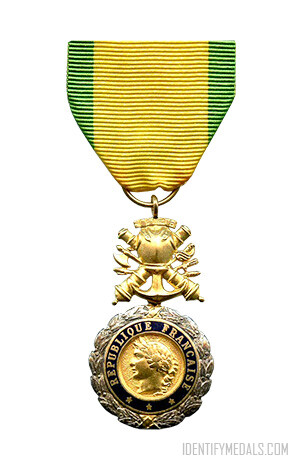
The Médaille militaire is a distinguished silver medal adorned with a laurel wreath, measuring 28 mm (1.1 in) across, encircling a central gold medallion. The medallion displays the left-facing profile of Marianne, symbolizing the French Republic, although earlier versions from the Second Empire featured Emperor Napoleon III’s profile instead. Encircling the medallion is a blue enamel ring inscribed in gold with “RÉPUBLIQUE FRANÇAISE” (“FRENCH REPUBLIC”), accompanied by a small gold star at the bottom. The number of stars varies by era, with one star for the Fourth Republic version and three stars for the Fifth Republic; the Third Republic medal bore the year “1870,” while the Second Empire version included “LOUIS-NAPOLEON” instead of “RÉPUBLIQUE FRANÇAISE” and floral embellishments beside the star.

Originally, the medal was topped with a silver imperial eagle, while later versions are adorned with a design combining a breastplate over crossed cannons, an anchor, sabres, swords, and battle axes, with a looped ring for attaching the ribbon. The reverse of the medal remains consistent across all versions, displaying the inscription “VALEUR ET DISCIPLINE” (“VALOUR AND DISCIPLINE”) in relief, surrounded by the blue enamel ring.

The Médaille militaire ribbon is 37 mm (1.5 in) wide, yellow with green edges measuring 6 mm (0.24 in) each. This ribbon design was inspired by the Order of the Iron Crown, which the Médaille militaire succeeded in France.

The Order of the Lion (France)

The Order of the Lion was an Order of Knighthood established by Enguerrand I of Coucy, to immortalize his killing of one such dangerous animal.

The Order of the Lion was an Order of Knighthood established by Enguerrand I of Coucy (some sources say it was actually his son Enguerrand II who created it) to immortalize his killing of one such dangerous animal.

Enguerrand I was the Lord of Coucy from 1086 until 1116 when he died. He was a man of ‘many scandals,’ including adultery and divorce. He’s also said to have kidnapped Sibyl of Château-Porcien, wife of Godfrey I, Count of Namur.

This Order of Knighthood was described by Gustav Adolph Ackermann, who mentions it as part of the historical orders of France.

The Order of the Rooster and the Dog

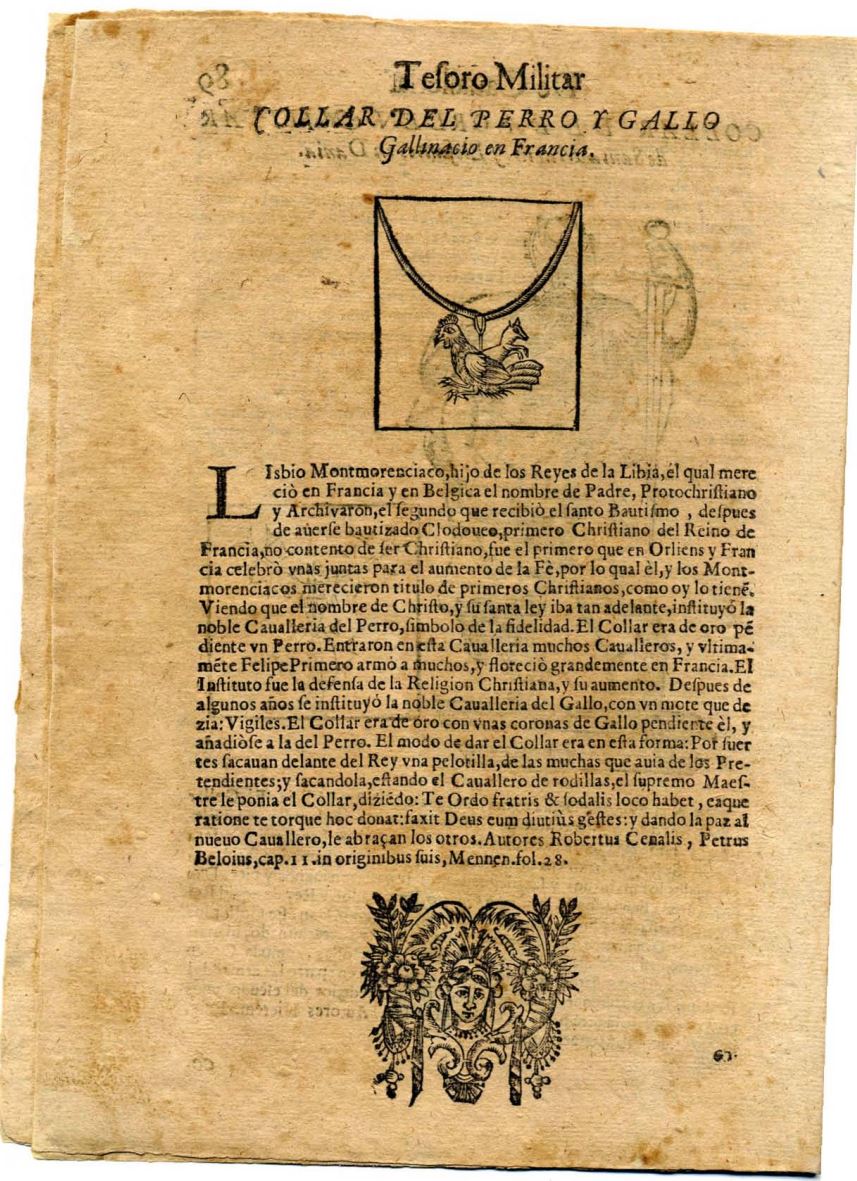
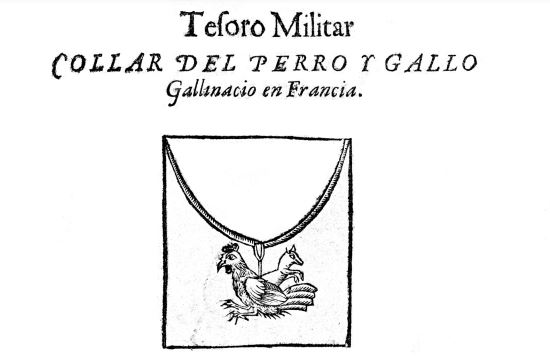
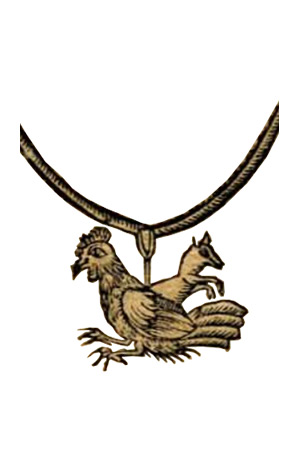
The Order of the Rooster and the Dog is an order of legendary origins in France. It’s not clear whether it actually existed or not.

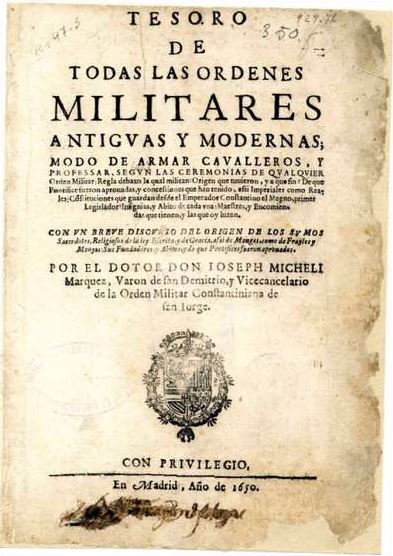
The Order is mentioned in the book “Tesoro de todas las ordenes militares antiguas y modernas” (Treasures of all Old and Modern Military Orders), published in 1650 and held by the Pitts Theology Library. You can see this book at Europeana and the Biblioteca Virtual de Defensa.

This is a description I translated from the original book:

“Lisbio Montmorenciaco, son of the Kings of Libya, who was called after his father in France and Belgium, baptized Clodoueo, first Christian in the Kingdom of Orliens and France (…) he was the first to celebrate in Orleans and France mass?. Seeing how the name of Christ and his holy faith were ahead, he instituted the noble “Cavalleria del Perro” (Knighthood of the Dog) as a symbol of fidelity. The collar was solid gold, and the pendant had a dog. Many knights were part of it, and ultimately Philip I armed many, and [the order] flowered in France. After some years, they instituted the Noble Knighthood of the Rooster, which had a gold necklace, and added the dog.”

Original source:

The Dunkirk Medal

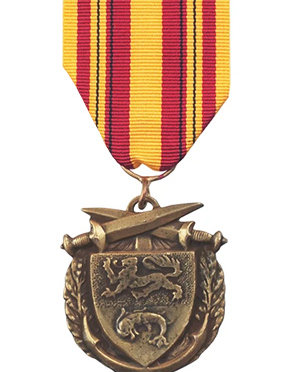
The Dunkirk Medal is an unofficial commemorative medal established om 1 May 1960 and created by the town of Dunkirk for the area’s defense.

The Dunkirk Medal is an unofficial commemorative medal established on 1 May 1960 and created by the town of Dunkirk to commemorate the defense of the area during May and June 1940.

The allocation of the award was managed by the French National Association of Veterans of the Fortified Sector of Flanders and Dunkirk (and later administrated by the now-disbanded Dunkirk Veterans Association).

The award was initially awarded to only French service personnel (with approximately 30,000 medals issued). In 1970 it was also awarded to any Allied member involved in Operation Dynamo, the evacuation of Allied forces from the Dunkirk area between 29 May and 3 June and those soldiers evacuated from the beaches.

All British servicemen from the Royal Navy, Royal Air Force, Merchant Navy, and the civilian little ship volunteers were eligible to receive the award. For citizens of the United Kingdom, the medal may be worn on the right breast, but as it is not designated an official medal it is not to be mounted with other British official medals and awards.

The History of the Dunkirk Medal

The Dunkirk evacuation, also known as Operation Dynamo, took place between May 26 and June 4, 1940. During this operation, a vast number of British, French, and other Allied troops were evacuated from the French coast as they faced encirclement by German forces. The operation involved a large-scale mobilization of various naval vessels, merchant ships, and civilian boats that braved enemy fire to rescue the stranded troops.

The unofficial Dunkirk Medal was created by private organizations or individuals to recognize the courage and sacrifice of those involved in the evacuation. These commemorative medals are often privately produced and are not officially sanctioned or recognized by the UK government. They may be available for purchase or awarded by certain veterans’ organizations as a way to honor the memory of the Dunkirk evacuation and the servicemen and civilians involved.

A Note About Unofficial Medals

It’s important to note that unofficial commemorative medals do not hold the same status as official military awards and decorations. They do not carry the same level of recognition or entitlements as official honors, such as the campaign medals and service medals awarded by the UK government.

The Dunkirk Medal Design

The Dunkirk Medal is struck in bronze and is 44mm high and 36mm wide.

The medal’s obverse depicts a shield bearing the arms of Dunkirk (a fish and in chief, a lion passant) superimposed on an anchor and laurel wreath, crossed swords above. The reverse features a burning oil lamp over a tablet with the inscription: DUNKERQUE 1940.

Beneath the ribbon suspension of the medal are crossed swords. A named certificate was issued with each medal though the medal itself was not inscribed. The medal ribbon measures 36mm wide and has a wide central chrome yellow stripe with one wide and one thin red stripe each side with two further chrome yellow bars and two very thin black stripes.

Right Now on eBay 
Clicking a link to eBay may result in a referral commission being paid if a purchase is made.
Loading...
]

The Battle of Verdun Medal

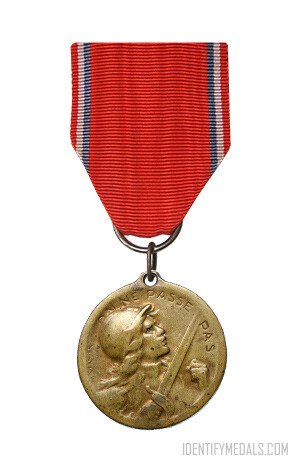
The Medal of Verdun was issued for those serving on the Argonne and St Mihiel sectors between 1914 and 1918 during the Battle of Verdun.

Created in late 1916 and even before the end of the battle, the Medal of Verdun was made for soldiers who, for several months under intense pressure from infantry attacks and heavy artillery pounding, held their ground during the WW1 Battle of Verdun.

Around 70% of all the French soldiers that were engaged in World War I participated to the battle of Verdun. Six or seven different designs were put forward for the medal but none were approved by the French Government and all remained unofficial awards that could not be worn on military uniform.

Originally intended to be “awarded to those who served on the Verdun front between 21 February 1916 and 2 November 1916″, the medal was, in fact, awarded to those who served anywhere on the Argonne and St Mihiel sectors between 31 July 1914 and 11 November 1918.

The Battle of Verdun Medal Design

The obverse shows the head of the Republic (a symbol of the Third French Republic) and the famous sentence pronounced by Robert Nivelle: “Ils ne passeront pas”, translated as: “They will not break through”. The reverse bears a French soldier and the inscription “EN AVANT S. QU AU BOUT” (“Forward, always forward” or “Forward until the end.”) The “S” stands for “sans,” which means “without,” so it could be interpreted as “Forward, without stopping, until the end.” Another reverse shows a twin castle gate with the inscriptions “VERDUN” and “21 FEVRIER 1916”.

The medal is fitted with a loose ring suspender and a piece of 37 mm red ribbon that has blue-white-red edges.

The original, and most commonly found, version was by Vernier but since supplies of this medal were inadequate, others created Verdun medals and at least seven versions of varying rarity are known. It is relatively common medal to find but it was an immense measure of respect in the civil life. It was carried with pride to show that these soldiers participated in the biggest attack France had to suffer in its history.

The Republic of Vietnam Campaign Medal

The Republic of Vietnam Campaign Medal is a military decoration issued to American troops who aided South Vietnam in a conflict.

The Republic of Vietnam Campaign Medal is a military decoration issued to American troops who aided South Vietnam in a conflict. First introduced during the First Indochina War, the Republic of Vietnam Campaign medal was authorized for wear on American service members as of December 1966 for their service in Vietnam.

In order to receive this medal, military members must have served in the Republic of Vietnam for six months between March 1, 1961 and March 28, 1973 or served outside Vietnam but gave combat support for six months or served less than six months but was wounded, captured and escaped enemy forces, or was killed in action.

The Republic of Vietnam Campaign Medal Design

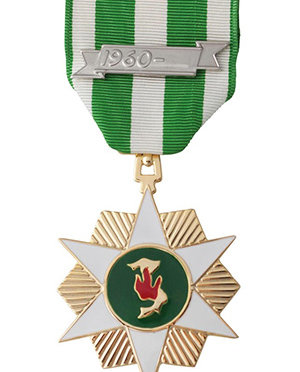
What’s unique about the medal is that it comes with a default device, known as the 1960 device. It reads, “1960-”. Because they were produced and awarded during the war, it reads the start date of the conflict, but no end date was added.

Its design helps to tell the story of the Vietnam War with the colors of the medal—green and white—to represent freedom and purity respectively. In addition, the medallion is made of a gold-colored metal in the shape of a 36 mm wide six-pointed white enamel star, six golden rays between each point in the star, and a map of Vietnam in the center of the medallion. The putative red flames on the map represent the locations of the war.

On the reverse of the medal is a circle bearing the inscription Chiến Dịch (Campaign) above and Bội Tinh (Medal) below the word VIET-NAM in the center. The suspension ribbon and service ribbon of the medal is green (to represent freedom) with three vertical white (to represent purity) stripes.

The Cross for the French Intervention

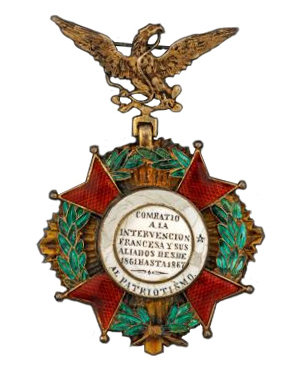
The Cross for the French Intervention is part of several medals created during the occupation of Mexico by French troops between 1862 and 1867.

On July 12 1859, Juárez decreed the first regulations of a new reform: “The Law of Nationalization of the Ecclesiastical Wealth.” The civil war between Liberals and Conservatives that followed (Civil War of the Reform) severely damaged Mexico’s infrastructure and crippled its economy. In view of the government’s desperate financial straits, Juárez canceled, in 1861, repayments of interest on foreign loans that had been taken out by the defeated conservatives.

Spain, Britain and France, angry over unpaid Mexican debts, sent a joint expeditionary force that seized the Veracruz Customs House in December 1861. Spain and Britain soon withdrew after they realized that the French Emperor Napoleon III intended to overthrow the Juárez government and establish a Second Mexican Empire, with the support of the remnants of the Conservative side in the Reform War.

Faced with US opposition to a French presence and a growing threat on the European mainland from Prussia, French troops began pulling out of Mexico in late 1866.

The Medal for the Battle of the Cinco de Mayo

The Medal for the Battle of the Cinco de Mayo is part of several medals created during the occupation of Mexico by French troops between 1862 and 1867.

On July 12 1859, Juárez decreed the first regulations of a new reform: “The Law of Nationalization of the Ecclesiastical Wealth.” The civil war between Liberals and Conservatives that followed (Civil War of the Reform) severely damaged Mexico’s infrastructure and crippled its economy. In view of the government’s desperate financial straits, Juárez canceled, in 1861, repayments of interest on foreign loans that had been taken out by the defeated conservatives.

Spain, Britain and France, angry over unpaid Mexican debts, sent a joint expeditionary force that seized the Veracruz Customs House in December 1861. Spain and Britain soon withdrew after they realized that the French Emperor Napoleon III intended to overthrow the Juárez government and establish a Second Mexican Empire, with the support of the remnants of the Conservative side in the Reform War.

Faced with US opposition to a French presence and a growing threat on the European mainland from Prussia, French troops began pulling out of Mexico in late 1866.

The Medal for Acultzingo

The Medal for Acultzingo is part of several medals created during the occupation of Mexico by French troops between 1862 and 1867.

On July 12 1859, Juárez decreed the first regulations of a new reform: “The Law of Nationalization of the Ecclesiastical Wealth.” The civil war between Liberals and Conservatives that followed (Civil War of the Reform) severely damaged Mexico’s infrastructure and crippled its economy. In view of the government’s desperate financial straits, Juárez canceled, in 1861, repayments of interest on foreign loans that had been taken out by the defeated conservatives.

Spain, Britain and France, angry over unpaid Mexican debts, sent a joint expeditionary force that seized the Veracruz Customs House in December 1861. Spain and Britain soon withdrew after they realized that the French Emperor Napoleon III intended to overthrow the Juárez government and establish a Second Mexican Empire, with the support of the remnants of the Conservative side in the Reform War.

Faced with US opposition to a French presence and a growing threat on the European mainland from Prussia, French troops began pulling out of Mexico in late 1866.

The Medal for the French Intervention – Oaxaca

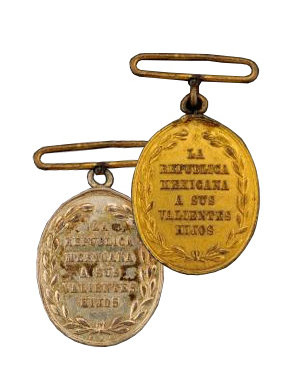
The Medal for the French Intervention is part of several medals created during the occupation of Mexico by French troops between 1862 and 1867.

On July 12 1859, Juárez decreed the first regulations of a new reform: “The Law of Nationalization of the Ecclesiastical Wealth.” The civil war between Liberals and Conservatives that followed (Civil War of the Reform) severely damaged Mexico’s infrastructure and crippled its economy. In view of the government’s desperate financial straits, Juárez canceled, in 1861, repayments of interest on foreign loans that had been taken out by the defeated conservatives.

Spain, Britain and France, angry over unpaid Mexican debts, sent a joint expeditionary force that seized the Veracruz Customs House in December 1861. Spain and Britain soon withdrew after they realized that the French Emperor Napoleon III intended to overthrow the Juárez government and establish a Second Mexican Empire, with the support of the remnants of the Conservative side in the Reform War.

Faced with US opposition to a French presence and a growing threat on the European mainland from Prussia, French troops began pulling out of Mexico in late 1866.