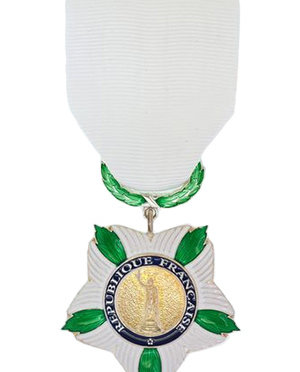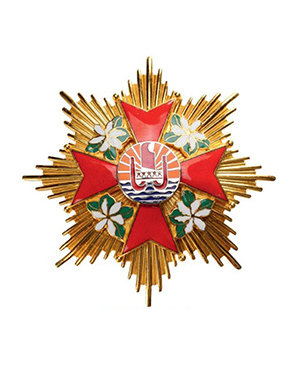
The Order of Tahiti Nui

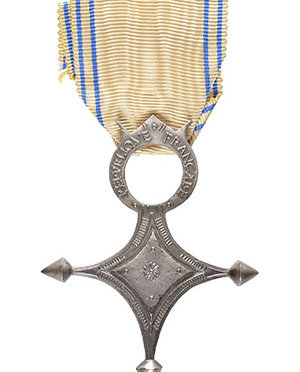
The Order of Saharan Merit (or Ordre du Mérite Saharien) was established in 1958 and rewards services for the development of Saharan regions.

The Order of Saharan Merit (or Ordre du Mérite Saharien) was established in 1958 as a reward for social, scientific, economic or administrative services rendered by French or foreign persons who participated in the development of Saharan regions.

The medal is fashioned in the form of the Agadez cross, a traditional emblem of the Tuareg clans inhabiting the area of the former Sultanate of Agadez in Agadez, Niger.

The order was deprecated by decree on 3 December 1963, and superseded by the Ordre National du Mérite. Extant members of the order are permitted to wear their original decorations.

The Order has three classes:

  • Commandeur (Commander)
  • Officier (Officer)
  • Chevalier (Knight)

The Order of Saharan Merit

The Order of Saharan Merit (Ordre du Mérite Saharien) was established in 1958 for social, scientific, economic or admin services in Sahara.

The Order of Saharan Merit (or Ordre du Mérite Saharien) was established in 1958 as a reward for social, scientific, economic or administrative services rendered by French or foreign persons who participated in the development of Saharan regions.

The medal is fashioned in the form of the Agadez cross, a traditional emblem of the Tuareg clans inhabiting the area of the former Sultanate of Agadez in Agadez, Niger.

The order was deprecated by decree on 3 December 1963, and superseded by the Ordre National du Mérite. Extant members of the order are permitted to wear their original decorations.

The Order has three classes:

  • Commandeur (Commander)
  • Officier (Officer)
  • Chevalier (Knight)

The Medal for Internal Security

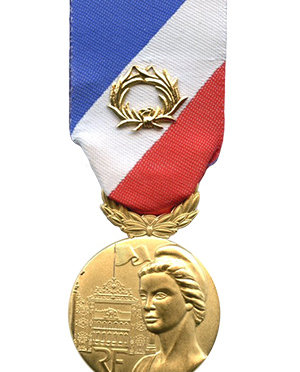
The Medal for internal security (or Médaille de la sécurité intérieure) is a French civil and military medal established on 28 March 2012.

The Medal for internal security (or Médaille de la sécurité intérieure) is a French civil and military medal established by Decree No. 2012-424 of 28 March 2012.

The Medal for internal security is awarded to by the Ministry of the Interior without regard to rank or position and is typically awarded on 1 January and 14 July. However, award may be made at other times for exceptional circumstances. Approved missions may have taken place in France or abroad.

Nominations for award of the medal are reviewed by a committee of eight members representing the Minister of the Interior, General Directorate of Local Authorities, General Directorate of National Police, General Directorate of National Gendarmerie, General Directorate for Internal Security, General Directorate of Civil Security and Crisis Management, and the General Secretariat of Immigration and Integration.

The following individuals are eligible for the medal:

  • Personnel under the Ministry of the Interior
  • Civilian and military personnel, professional or voluntary, placed under the authority of the Ministry of the Interior
  • The Municipal Police officers
  • Volunteers working in associations for homeland security missions
  • Any person, French or foreign, who has distinguished himself or herself by an act relating to internal security.

The National Medal of Recognition for Victims of Terrorism

The National Recognition Medal for Victims of Terrorism is a national medal of France awarded to French victims of terrorism.

The National Recognition Medal for Victims of Terrorism (or Médaille nationale de reconnaissance aux victimes du terrorisme) is a national medal of France awarded to French victims of terrorism.

Established by presidential decree on July 12, 2016, it may be awarded to French or foreign nationals who are victims of terrorism in France or abroad. The medal may be awarded to a retroactive date of January 1, 2006.

The medal was created to give a proper recognition to the sacrifice of terrorism victims while still maintaining the award criterion of existing national honors such as the Legion of Honor.

The Military Health Service Honor Medal

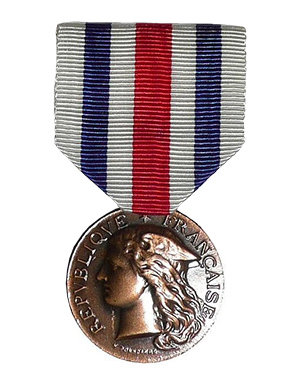
The Military Health Service honour medal (or “Médaille d’honneur du service de santé des armées”) is a French decoration created 30 August 1962.

The medal recognizes individuals who have contributed or lent their support to the French Defence Health service and were particularly marked by their services or their dedication. It is presented in four different levels: gold, vermeil, silver, and bronze. It may be awarded to members of the military as well as civilians.

The four levels are awarded under the following conditions:

  • Bronze Medal for 10 years service;
  • Silver Medal for 15 years of service and the Bronze Medal
  • Vermeil Medal for 20 years of service and the Silver Medal;
  • Gold Medal which is awarded only in exceptional cases.

On the occasion of exceptional circumstances, especially during epidemic periods, nominations could be made for people that do not meet the length of service conditions.

The Medal for the War Wounded

The Medal for the War Wounded (Médaille des blessés de guerre) was a ribbon insignia awarded for wounds received in the line of duty.

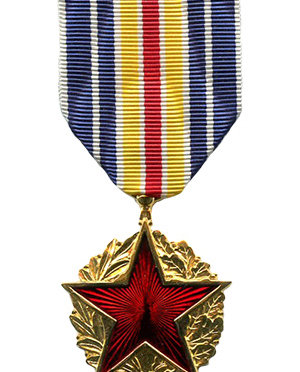
The Medal for the War Wounded (or Médaille des blessés de guerre) was originally a mere insignia in the form of a ribbon awarded for wounds received in the line of duty while facing an enemy.

The insignia was established by the law of 11 December 1916, based on an idea by the nationalist writer Maurice Barrès. Although originally established as a temporary measure, the insignia survived for a century in some form or another. It could be awarded to wounded soldiers, prisoners of war, to World War II deportees and internees from the French resistance and to soldiers wounded in more recent conflicts.

A variety of unofficial medals in the form of a red enameled star suspended by the same ribbon appeared very early on and although tolerated for wear by the authorities, were not official until recently.

The Medal for the War Wounded can be worn by:

  • Military personnel suffering from a physical or mental war wound, ascertained by the army health service and approved by the Minister of Defence;
  • Prisoners of war, physically or psychologically wounded during their detention.

The Medal for the War Wounded Design

The Medal for the War Wounded is made of gilded bronze with a 30 mm diameter. It is mainly composed of a large bright red enameled five-pointed star atop a crown of half laurels (left) and half oak leaves (right).

The medal is suspended by a ring from a 35 mm wide silk moiré ribbon composed of vertical stripes in the following colors: white 1 mm – blue 5 mm – white 1 mm – blue 4 mm – white 1 mm – yellow 3 mm – white 1 mm – beginning ou the outer edge on both sides of a 3 mm wide central red stripe.

Small enamel red five pointed stars are added to the medal ribbon and undress ribbon for each additional wound.

The National Defense Medal

The National Defence Medal (or “Médaille de la Défense nationale”) is a French military decoration. It was created by Charles Hernu, Minister of Defence and established by decree on April 21, 1982.

It rewards particularly honorable service rendered by military personnel for their participation in operational activities. The medal has three levels: Gold, Silver and Bronze.

The award is made by decision of the military hierarchy, but the recipients must have achieved a personal minimum of:

  • For the Bronze level: 1 year of service and accumulated 90 points;
  • For the Silver level: 5 years of service (minimum 2 years in the Bronze level) and accumulated 600 points;
  • For the Gold level: 10 years of service (minimum 2 years in the Silver grade) and accumulated 800 points.

The yearly quota of Gold and Silver level awards are set by the minister of defence. Points are earned through participation in exercises, operations, proficiency, initiative, awards received, etc. People who had been awarded the ordre de la Légion d’honneur or the ordre du mérite can not receive the Médaille for military service.

The National Defense Medal Design

The National Defence Medal is a 36 mm in diameter circular medal struck from bronze, the gold level is gilt, the silver award is silvered.

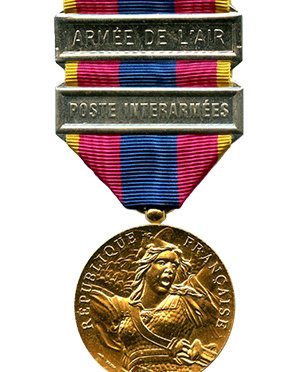
The obverse bears the relief image of Rude’s Marseillaise with the relief inscription along the upper circumference “FRENCH REPUBLIC” (RÉPUBLIQUE FRANÇAISE). The reverse bears the relief image of a Phrygian cap over a laurel branch and the inscription along the medal circumference in the upper half “ARMY” and “NATION”, in the lower half “NATIONAL DEFENSE” (“ARMÉE” “NATION” “DÉFENSE NATIONALE”), the upper and lower inscriptions being separated by a relief five-pointed star on each side.

The medal hangs from a ring through the medal’s suspension loop. The bronze grade award’s ribbon is a 36 mm wide red silk moiré ribbon with a 12 mm wide central blue stripe. The ribbon for the silver grade award is similar with the addition of 3 mm wide white edge stripes, the edge stripes are yellow for the gold grade award.

The Medal for Voluntary Military Service

The Medal for voluntary military service (or “Médaille des services militaires volontaires”) is a French military decoration established on 13 March 1975 by decree 75-150. It was established in three grades to recognize voluntary military service in the reserves.

During World War I, the reserves served as an important part of the defense of France. Between the abolition of the Order of military merit in 1963 and the creation of the Medal for voluntary military service in 1975, no award existed to adequately recognize reservists.

The Medal for voluntary military service is awarded to military personnel not in the full-time regular army serving honorably part-time in information, training and improvement of reserves, recruiting, military preparedness as well as activities within special associations. It may be exceptionally awarded to military personnel of either the reserves or regular army who distinguished themselves by the exceptionally high quality of their service. For award to a member of the regular army, this service must have been carried out outside of normal working hours and for no pay. The medal may be awarded posthumously.

The Medal for Voluntary Military Service Design

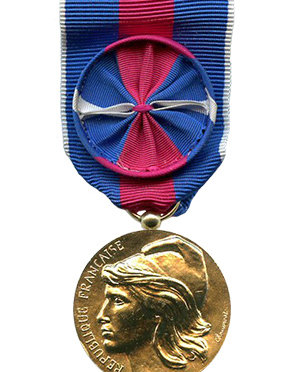
The Medal for voluntary military service is a 32mm in diameter circular medal struck from bronze, it is silvered for the silver grade or gilt for the gold grade.

Its obverse bears the left profile of the effigy of the Republic wearing a Phrygian cap with the relief semi circular inscription “RÉPUBLIQUE FRANÇAISE” (“French Republic”) along the left circumference.

The reverse bears the relief image of a vertical sword superimposed over two crossed naval anchors themselves superimposed over air force wings, at the bottom along the medal circumference, the relief inscription “SERVICES MILITAIRES VOLONTAIRES” (“Voluntary Military Services”).

The medal hangs from a ribbon passing through a suspension ring itself passing through a ball shaped suspension loop at the top of the medal. The 37mm wide silk moiré ribbon differs according to the grade of the award. The ribbon of the bronze grade award is blue with an 11 mm central red stripe; the silver grade ribbon only differs from the bronze grade in the addition of white 2mm edge stripes; a rosette in the colors of the silver grade ribbon is added for the gold grade award.

The Overseas Medal

The Overseas Medal (or Médaille d’Outre-Mer) is a commemorative or campaign medal issued to members of the French Armed Forces for participating in operations outside national territory. It replaced the French Colonial Medal by decree on 6 June 1962.

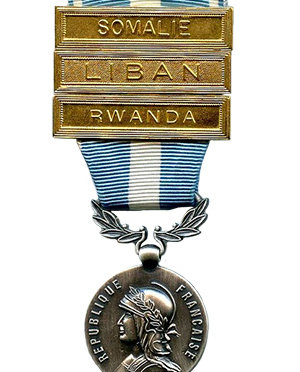
The areas of service are indicated by a gilt silver campaign clasp, there are currently 13 available:

  • Cambodge (Cambodia)
  • Liban (Lebanon)
  • Tchad (Chad), awarded to all French personnel, military or otherwise, who served in Chad regardless of the length of service from March 15, 1960 to January 27, 2008 . As of January 28, 2008, the campaign clasp is awarded for fifteen days of consecutive service or a cumulative equivalent of non-consecutive days.
  • Mauritanie (Mauritania), awarded to all French personnel, military or otherwise, who served in Mauritania from November 1977 to July 1990, regardless of length of service.
  • Moyen-Orient (Middle East)
  • Ormuz (Hormuz)
  • République centrafricaine (Central African Republic)
  • République de Côte d’Ivoire (Republic of Côte d’Ivoire)
  • République démocratique du Congo (Democratic Republic of Congo)
  • République du Congo (Congo)
  • Rwanda (Rwanda)
  • Somalie (Somalia)
  • Zaïre (Zaire)
  • Sahel (Mali)

The Overseas Medal Design

The medal’s design is the work of engraver Georges Lemaire, and it’s made in silver. The obverse shows a helmeted allegorical effigy of a woman as the personification of the French Republic, circled by the words “République française“. The reverse shows a terrestrial globe on top of trophies of military conquest with the words “MEDAILLE D’OUTRE-MER“.

The ribbon is sky blue and has three vertical white bands, the two side ones of 2mm and the central one of 7mm. The link is a silver laurel branches and the bars are gilt, showing the territory where the campaign occurred.

The Aeronautical Medal

The Aeronautical Medal (“Médaille de l’Aéronautique”) is a French decoration awarded to military personnel and civilians for outstanding aeronautics.

The Aeronautical Medal (or “Médaille de l’Aéronautique”) is a state decoration of France established by the decree of 14 February 14. It is awarded to both military personnel and civilians for outstanding accomplishments related to the field of aeronautics.

Originally envisioned before the Second World War, it was intended as an equal to the Order of Maritime Merit. The intent was to create an aerial order of merit intended for civilian and military personnel working in aeronautics. The war temporarily put an end to the project until February 1945.

Recipients are chosen by a council presided by a member of the office of the secretary of state for the armed forces (air) that will be composed of:

  • the chief of staff of the air force,
  • the director of the aeronautical administration control department,
  • the technical and industry director to the secretary of state for the armed forces (air),
  • a member named by decree of the minister for public works, transport and tourism, representing the ministry,
  • a representative of the aerial navigation companies named for two years by decree of the minister for public works, transport and tourism,
  • a personality with a history of exceptional services in aeronautics named for two years by decree of the secretary of state for the armed forces (air).

The Aeronautical Medal is limited to no more than 275 new recipients per year, it is awarded twice annually on 1 January and 14 July.

The Aeronautical Medal Design

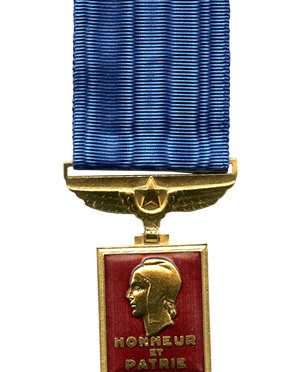
The medal is rectangular and of gilt metal. The obverse bears the gilt left profile of Marianne from the 1940s representing France, below Marianne, the gilt inscription “Honneur et Patrie” (Honour and Country). The reverse bears the inscription on four lines “MÉDAILLE DE L’AÉRONAUTIQUE 1945” (AERONAUTICAL MEDAL 1945).

The medal is enameled in red except for Marianne, the inscription and a 2 mm exterior border. The medal is suspended to a 37 mm wide royal blue silk moiré ribbon by a wing shaped pendant with a relief five pointed star at its center and an horizontal slot to receive the ribbon.