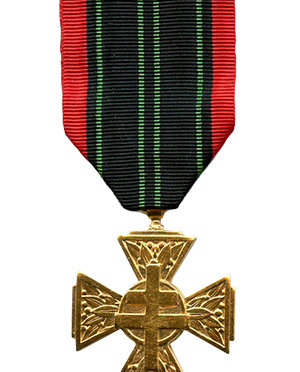
The Cross of the Resistance Volunteer Combatant

The Cross of the Resistance Volunteer Combatant (“Croix du combattant volontaire de la Résistance”) is a decoration for the French resistance.

The Cross of the resistance volunteer combatant (or “Croix du combattant volontaire de la Résistance”) is a French decoration that recognizes, as its name implies, those who fought in one of the resistance groups, or who were deported or interned for acts of resistance, or who were killed or injured while taking parts in acts of resistance against the German occupation forces during World War II.

This award was created by a special law in 1954 and awarded to those who had been designated and issued cards certifying them as voluntary resistance fighters. It was issued to all cardholders of voluntary resistance fighter created in 1949, which itself is obtained using the following criteria:

  • Holders of the a card Resistant-Deported or Interned-Resistant.
  • Those executed, killed or injured in an act of resistance.
  • Those who were members of a resistance group, recognized as a fighting unit and who actually fought at least 90 days in the French Forces Combattantes (FFC) or French Forces of the Interior ( FFI) or the French Resistance Interior (RFI).
  • The people who have belonged for 90 days before June 6, 1944, the FFC, FFI, or RFI in an area occupied by the enemy, and have affidavits from two persons well known for their activity in the French Resistance.

The Cross of the Resistance Volunteer Combatant Design

The Cross of the resistance volunteer combatant, a design of engraver Frédéric de Vernon, is a 36 mm wide cross pattée made of gilt bronze.

On the obverse, over the central medallion of the cross, a relief Cross of Lorraine overflowing onto the four cross arms which are covered in laurel leaves. On the reverse, the relief inscription on three lines on the central medallion COMBATTANT VOLONTAIRE RÉSISTANCE.

The cross is suspended by a ring through a suspension loop which is an integral part of the top of the upper cross arm. It hangs from a 36 mm wide black silk moiré ribbon with 5 mm wide red vertical edge stripes, it is further divided by four vertical 1 mm wide green stripes, two at center spaced 2 mm apart and one on each side 2 mm from the red edge stripes.
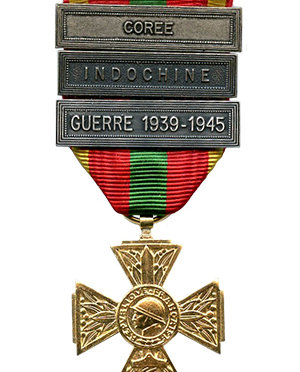

The Volunteer Combatant’s Cross

The Volunteer combatant’s cross (Croix du combattant volontaire) was a French decoration for volunteers that served during World War II.

The Volunteer combatant’s cross (or “Croix du combattant volontaire”) was a French decoration that originally recognized those who volunteered to serve in a combat unit during World War II. It is the equivalent of the “1914–1918 Volunteer combatant’s cross“.

This decoration is equivalent to that awarded to the soldiers of the First World War. At the request of the associations of veterans the state fixed by Act of 4 February 1953, accompanied by a decree of 19 November 1955, the award Croix du Combattant Volontaire 1939–1945, designated for those who volunteered to serve. Additional revisions of the act establishing this award in 1995 and 2007 have added a total of five clasps:

  • Guerre 1939–1945
  • Indochine
  • Corée
  • Afrique du Nord
  • Missions extérieures

The Volunteer combatant’s cross was created to honor those who voluntarily participated in an armed conflict, during which they put their lives at risk.

In this spirit, the candidate for this distinction must provide proof from what he has done is a voluntary act of serving in a combat unit, so that because of his age or his circumstances, he was compelled to any “service obligation” (read “no obligation such “). From what he has in fact been present in a unit recognized fighter, during a specified time.

The Volunteer Combatant's Cross Design

A cross with four arms in bronze, 36 mm wide. Engraved by Frédéric de Vernon.

On the obverse is a round central medallion with the legend surrounding REPUBLIQUE FRANCAISE. An effigy of a helmeted Poilu (World War I infantryman), on a sword drawn vertically on the arms of the cross which is covered with laurel leaves and oak leaves in relief.

On the reverse is, inside the central medallion, a branch of laurel is surrounded by the inscription: COMBATTANT VOLONTAIRE 1939–1945. The reverse of the 1983 version has no date. The cross arms are covered with leaves of laurel and oak forming relief.

Find This Medal

Right Now on eBay 
Clicking a link to eBay may result in a referral commission being paid if a purchase is made.
Loading...

The Resistance Medal

The Resistance medal (Médaille de la Résistance) was a decoration bestowed by the French Committee of National Liberation during World War II.

The Resistance medal (or Médaille de la Résistance) was a decoration bestowed by the French Committee of National Liberation, based in the United Kingdom, during World War II.

It was established by a decree of General Charles de Gaulle on 9 February 1943 “to recognize the remarkable acts of faith and of courage that, in France, in the empire and abroad, have contributed to the resistance of the French people against the enemy and against its accomplices since 18 June 1940“.

The Resistance medal was awarded to approximately 38,288 living persons and 24,463 posthumously. These awards were both for membership in the Free French forces and for participation in the metropolitan clandestine Resistance during the German occupation of France in World War IIThe medal was also awarded to 18 communities and territories, 21 military units, and to 15 other organizations including convents, high schools, and hospitals that particularly distinguished themselves.

The Resistance Medal Design

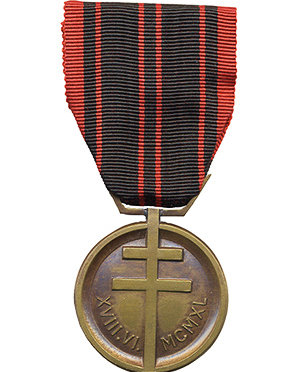
The Resistance medal is a 37mm in diameter circular medal struck from bronze. Its slightly concave obverse bears at center a vertical Cross of Lorraine with the relief semi circular inscription of the date of General de Gaulle’s appeal of 18 June 1940 in Roman numerals “XVIII.VI.MCMXL” (18.06.1940) bisected by the lower part of the cross.

The reverse bears the relief image of an unfurling ribbon bearing the relief inscription in Latin”PATRIA NON IMMEMOR” translating into “THE NATION DOES NOT FORGET”. The suspension is cast as an integral part of the medal.

The medal hangs from a 36mm wide black silk moiré ribbon with six vertical red stripes of varying widths, 3mm wide edge stripes, two 1mm wide central stripes 2mm apart, and two 1mm wide stripes 6mm from the central stripes. A 28mm in diameter rosette is on the ribbon of the Officer of the Resistance medal.

The Medal of the Gendarmerie Nationale

The Medal of the National Gendarmerie or Federal Police (Médaille de la Gendarmerie nationale) is a military decoration created in 1949.

The Medal of the National Gendarmerie or Federal Police (or Médaille de la Gendarmerie nationale) is a French military decoration created on 5 September 1949 on the proposition of the then Minister of Defence, mister Paul Ramadier.

It was originally created in a single grade for award to officers and NCOs of the Gendarmerie nationale who were cited in the orders of the entire service. Such a citation in the orders of the entire service, and all potential subsequent ones would be denoted by a grenade device on the ribbon as the medal could, and can still only be awarded once to any potential recipient.

The medal could also be exceptionally awarded to persons not members of the service for important services rendered to the gendarmerie or for help during special missions. These presentations were made without a citation and thus without any ribbon device.

The ribbon of the medal will be adorned by a device denoting the degree of the award as described in its accompanying citation:

  • Bronze palm when cited to the entire service;
  • Gilt star when cited to its relevant army corps;
  • Silver star when cited to its relevant division;
  • Bronze star when cited to its relevant brigade or division.

The medal may be awarded posthumously.

The Medal of the Gendarmerie Nationale Design

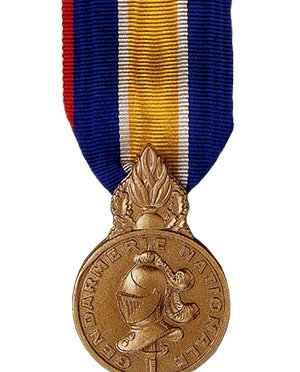
The Médaille de la Gendarmerie nationale is a 36 mm in diameter circular gilt bronze medal. At its top, also in gilt bronze and hiding the ribbon suspension loop, is affixed a grenade with flames between laurel leaves.

The obverse bears the relief image of a plumed close helmet resting on a sword pointing upward, it bears the circular inscription along its circumference “GENDARMERIE NATIONALE”. The reverse bears a laurel wreath with the relief inscription “COURAGE DISCIPLINE” on two lines at the top, the center being reserved for the inscription of the recipient’s name.

The Médaille de la Gendarmerie nationale is suspended by a 37 mm wide silk moiré ribbon divided by vertical stripes in the following colors:

  • 10 mm wide yellow central stripe representing the color of the old “Maréchaussée”, the military service charged with police and jurisdictional duties under the old regime;
  • 2 mm wide white stripes bordering the central stripe, they represent the two subdivisions of the service, the police service and the Republican Guard;
  • these central stripes are themselves bordered by 9,5 mm wide blue vertical stripes representing the color of the police service;
  • 2 mm wide bright red edge stripes represent the Republican Guard.

The War Cross 1939-1945

The War Cross 1939–1945 (Croix de guerre 1939–1945) is a French military decoration to honor those who fought with the Allies during WW2.

The War Cross 1939–1945 (or Croix de guerre 1939–1945) is a French military decoration, a version of the Croix de guerre created on September 26, 1939, to honor people who fought with the Allies against the Axis forces at any time during World War II.

Due to the large extent of the war zone, recipients included those who fought during, with, at, or in the following:

  • Battle of France
  • French Forces of the Interior
  • Free French Forces
  • Western Front
  • Middle East Theater
  • Mediterranean Theater
  • African campaigns

The War Cross 1939-1945 Design

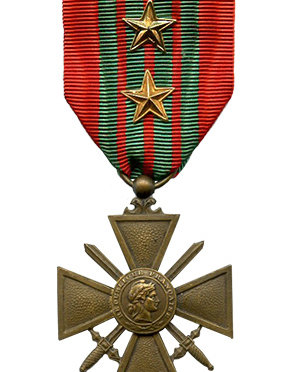
The Croix de Guerre was designed by the sculptor Paul-Albert Bartholomé. The medal measures 37 mm in size and is made in the shape of a Maltese cross with two swords crisscrossed through the center.

In the center of the obverse is the profile of the French Republic crested by a Phrygian cap. Around this portrait are the words “République française” (“French Republic”). On the reverse of the medal are the dates of the conflict: 1939–1940, 1939–1945, or simply 1940.

The suspension and service ribbon of the medal has a red background crossed with four green lines in its center.

On every medal and ribbon, there is at least one ribbon device, either in the shape of a palm or of a star, and fashioned from either bronze, silver, or gilded silver (gold).

The French Croix represents a mention in dispatches awarded by a commanding officer. An individual could be awarded the decoration several times, for different actions, and from different sources. The devices are:

  • A bronze star for those who were mentioned at the regiment or brigade level.
  • A silver star, for those who were mentioned at the division level.
  • A silver-gilt (gold) star for those who were mentioned at the corps level.
  • A bronze palm for those who were mentioned at the army level.
  • A silver palm stands for five bronze ones.
  • A silver-gilt (gold) palm for those who were mentioned at the Free French Forces level (World War II only).

Find This Medal

Right Now on eBay 
Clicking a link to eBay may result in a referral commission being paid if a purchase is made.
Loading...

The Royal Order of Cambodia

The Royal Order of Cambodia (Ordre Royal du Cambodge) was a colonial chivalric order in French Cambodia and is still in use in the present day.

The Royal Order of Cambodia (គ្រឿងឥស្សរិយយសព្រះរាជាណាចក្រកម្ពុជា; or Ordre royal du Cambodge) was a French colonial chivalric order in French Cambodia and is still in use in present-day Cambodia.

For French appointments, the recipient had to be at least 29 years old and enter the Order first as a knight, to be promoted to a higher grade after a certain period. In 1948 France ceased granting the order. Formally it remained a French colonial policy, but it was now only granted by the King of Cambodia.

On September 1, 1950 the (colonial) French medal system was reformed. The Order of the Star of Anjouan and the Order of the Black Star were formalized as French Overseas Orders. In 1955, Cambodia became independent. The order was approved by King Norodom Sihanouk during his government and also granted during his exile in Beijing. Even after the restoration of the Khmer dynasty, it remained the highest Cambodian distinction.

The Royal Order of Cambodia Design

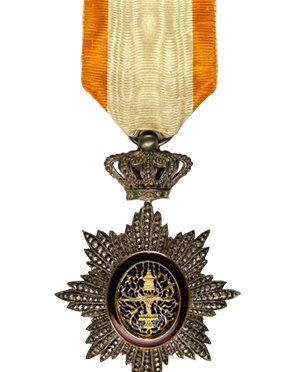
The medal of the order comes in many different forms, as a slightly elongated silver or gold star surmounted by a Cambodian crown and with an image of the king’s crown and coat of arms in gold on a violet-blue background and surrounded by a red circle. The reverse of the medal is left rough. To promote the order if it was awarded by the French, the Cambodian crown was replaced with a European one surmounted by a small cross, and in the early years, the order was even awarded without any crown.

The central image on the star of the order is the same as the medal, though the crown is missing and the rays are usually smooth. The star is elongated, with the vertical rays longer than the horizontal rays. The regalia of Knights is in silver, whilst those of the higher grades are gold. The medal and star are equally for civilians and soldiers. The ribbon of the order was originally green with a red border, changing in 1899 to white with an orange border (in the same year the French government changed the colours of the ribbons of all five colonial orders), before reverting to the original black ribbon when it became a purely Cambodian order again.

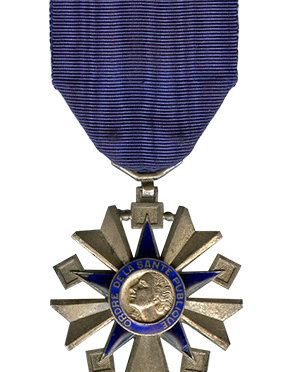
The Order of Public Health

The Order of Public Health (or Ordre de la Santé publique) was a French order of merit, created by presidential decree of President Albert Lebrun on 18 February 1938 and amended on 22 May 1954, and awarded for services to the public health and protection of children.

The Order had three classes, and was only awarded to people who was minimum 30 years old.

  • Commander (40 awards)
  • Officer (170 awards)
  • Knight (806 awards)

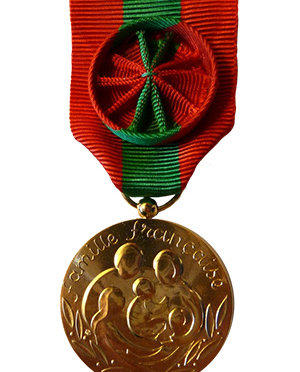
The Medal of the French Family

The Medal of the French Family (or Médaille de la Famille française) is a decoration awarded by the government of France to honor those who have successfully raised several children with dignity.

The decoration was created by a decree of May 26, 1920, under the name Médaille d’honneur de la famille française (Medal of Honour of the French Family) with the aim of honoring mothers of large families.

The text of the decree underwent several changes before being completely reformed by a decree of October 28, 1982, which renamed the decoration Médaille de la Famille française (Medal of the French Family). The reform opened the award of the decoration to fathers or anyone else who had raised several children in an appropriate way: for example, the Catholic priest Père Mayotte was granted the award in recognition of his raising the six children of his housekeeper, a widow who died suddenly.

Recommendations or applications for the award must be deposited at the local town hall. An inquiry into the family is then conducted. If the inquiry reports positively, the final decision on whether to grant the award belongs to the prefect of the department.

The Medal of the French Family Design

Three classes of this medal exist: bronze for those raising four or five children, silver for parents of six or seven children, and gold for those with eight or more children.

A bronze medal is also granted to widowed mothers of three children whose husbands have been killed in action. The recipient’s eldest child must be at least sixteen years old. The medal is decorated with the words “Famille Française” (“French Family”) and a modernistic image of a couple and their children. The words “République Française” (“French Republic”) are inscribed on the reverse side.

The ribbon is divided vertically into three equal parts, the outer two being red and the inner green. Recipients of silver and gold medals are also granted a rosette in the same colours.

The War Cross for Foreign Operational Theaters

The War Cross for Foreign Operational Theaters or TOE is a French military award denoting citations earned in combat in foreign countries.

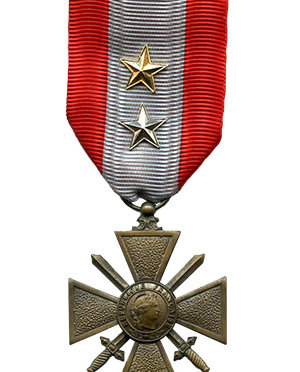
The War Cross for Foreign Operational Theaters (or Croix de guerre des théâtres d’opérations extérieurs), also called the Croix de Guerre TOE for short, is a French military award denoting citations earned in combat in foreign countries.

The Armistice of November 11, 1918 ended the war between France and Germany, but French soldiers continued fighting in theaters outside metropolitan France. Combat operations continued in Syria, Palestine, Constantinople, Morocco, French West Africa and French Equatorial Africa.

A law was passed on April 30, 1921 establishing the new Croix de guerre for “Théâtres d’opérations extérieurs” (TOE). It was intended to commemorate the individual citations awarded during operations carried out since November 11, 1918 or that would occur in the future, for war service directly related to an expeditionary force used outside of the borders of France.

The War Cross for Foreign Operational Theaters Design

The Croix de guerre des théâtres d’opérations extérieures is a bronze 37 mm wide cross pattée, between the arms, two crossed swords pointing upward.

It was designed by the sculptor Albert Bartholome. On the obverse in a circular medallion, the effigy of the Republic wearing a cap decorated with a laurel wreath, surrounded by a ring bearing the legend: “RÉPUBLIQUE FRANÇAISE”. On the reverse, in the circular medallion the inscription: “THÉÂTRES D’OPÉRATIONS EXTÉRIEURS”.

The cross is suspended by a ring through the suspension loop to a 38 mm wide grey silk moiré ribbon with 10 mm wide red edge stripes. The Croix de guerre TOE is worn on the left side of the chest and when in the presence of other medals of France, is located immediately after the Croix de guerre 1939 – 1945.

The Insignia for Wounded Civilians

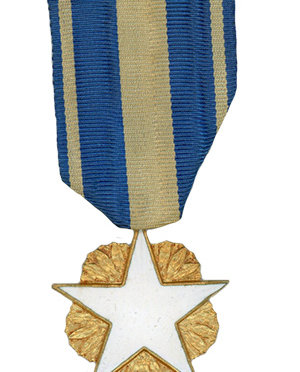
The Insignia for wounded civilians (Insigne des blessés civils) is a French distinction for civilians injured or maimed as a result of war.

The Insignia for wounded civilians (or Insigne des blessés civils) is a French distinction for civilians, irrespective of age or sex, who have been injured or maimed as a result of war.

It was Maurice Barres, defender of the National Federation of the Disabled and President of the League of Patriots, to whom the idea of the creation of the Badge Wounded. In 1915, he launched a first call in the columns of the newspaper “L’Echo de Paris” on 28 March and another in the issue of June 10, for the creation of this distinctive insignia to designate the eyes of all “un homme dont les blessures, l’infirmité, la maladie proviennent d’un fait de guerre” (“a man whose injury, disability, illness comes from an act of war”).

On July 18, 1918, a decree made at the initiative of Minister of the Interior, which instituted a lapel pin for civilian victims of war. This award is presented:

  • for World War I 1914-1918, by order of the Minister of Interior after consulting a board meeting at Head of the department of residence of the candidate.
  • for World War II 1939-1945, by the Minister of Veterans and War Victims, the candidate must be a pensioner or civilian casualties of war.

La Grande Chancellerie de la Légion d’honneur does not recognize this medal, or the military version, as an official decoration, therefore it is not mentioned on any order of precedence list. However, in view of the importance it can have many of its owners, it is widely worn.

The Insignia or Wounded Civilians Design

Currently, the most commonly worn medal is uniface of gilt bronze, 30 mm in diameter and consists of a white enamel star encircled by a wreath of oak and laurel leaves.

The medal hangs from a ribbon of blue and yellow. When the ribbon bar is worn alone it containts a white star clasp.