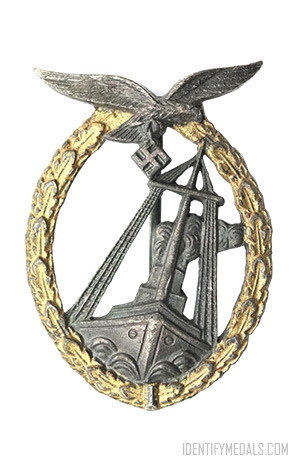
The Sea Battle Badge of the Luftwaffe

The Sea Battle Badge was a German award instituted in 1944 and given to crews of Luftwaffe supply ships, air/sea rescue launches, and vessels.

The Sea Battle Badge was a German award instituted in 1944 and given to crews of Luftwaffe supply ships, air/sea rescue launches, and other special vessels (working on the surface). It’s worth mentioning that Germany had no aircraft carriers or a navy air branch. 

The eligibility criteria were quite broad: Any military or civilian Luftwaffe personnel as eligible – as long as they were not also awarded another badge. There were a number of days at sea required, however:

  • Leaders and crew of supply ships: 60 days in the North or East sea, between 5 and 20 degrees longitude and south of the 60th degree of latitude or 20 days in the Mediterranean, including the Aegean and the Black Sea.
  • Leaders and crew of air and sea rescue boats: 20 days with a minimum of one rescue attempt or a three-hour sea duration each day, or 10 days with a successful rescue.

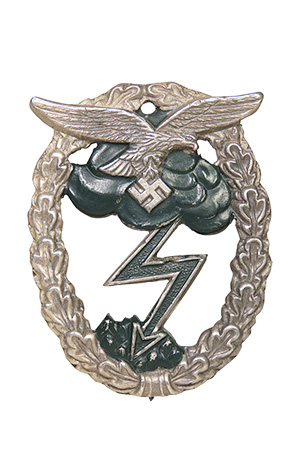
The badge has the Luftwaffe eagle and a swastika with a 30-degree-tilted sea vessel in the center, all surrounded by a gilt wreath made of oak leaves. 

More Luftwaffe War Badges

Awarded to members of the German Luftwaffe for their achievements and contributions to air warfare, the Luftwaffe War Badges symbolized excellence, courage, and skill in aerial combat and support roles. Explore the complete collection below:

The Glider Badge of the Luftwaffe

The Glider Badge of the Luftwaffe was a German award instituted in 1940 and awarded to pilots who had done the glider training course.

The Glider Badge of the Luftwaffe was a German award instituted in 1940 and awarded to pilots who had done the glider training course. 

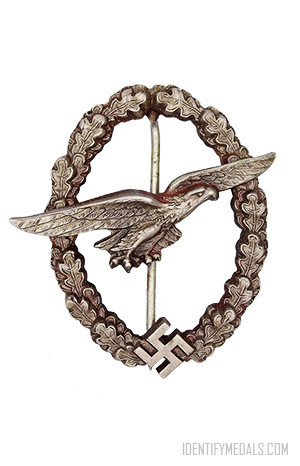
The badge consists of an eagle in flight, with wings spread and spanning the full width of the insignia, and a swastika on top of a circular wreath made of silver oak leaves (unlike other Luftwaffe badges, it’s only oak ones). The Glider Badge was usually made of aluminum, nickel-silver, zinc, or tombak. There was also a cloth version of it. 

More Luftwaffe War Badges

Awarded to members of the German Luftwaffe for their achievements and contributions to air warfare, the Luftwaffe War Badges symbolized excellence, courage, and skill in aerial combat and support roles. Explore the complete collection below:

The Radio Operator Badge of the Luftwaffe

The Radio Operator Badge of the Luftwaffe was a German award given to radio and gunner qualified personnel with training or operations.

The Radio Operator Badge of the Luftwaffe was a German award given to radio operators, gunners, and mechanics (qualified personnel) that had succeeded in the training course (two months at least) and had at least five operational flights. These criteria was shortened if the recipient had been wounded in action.

This badge was later replaced by the Gunner and Flight Engineer Badge of the Luftwaffe. 

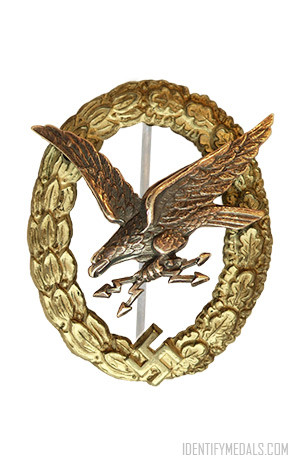
The badge is shaped like an oval and shows an eagle carrying two crossed lightning bolts in its claws. There is also a swastika and a wreath made of oak and laurel leaves. The Radio Operator badges were usually made of different metals such as tombak, silver-nickel, pot metal, and zinc. There was also a cloth version authorized later that has silver wire embroidery. 

More Luftwaffe War Badges

Awarded to members of the German Luftwaffe for their achievements and contributions to air warfare, the Luftwaffe War Badges symbolized excellence, courage, and skill in aerial combat and support roles. Explore the complete collection below:

The Air Gunner and Flight Engineer Badge of the Luftwaffe

The Air Gunner and Flight Engineer Badge was a German award given to Luftwaffe flight engineers, air gunners, and aircrew meteorologists.

The Air Gunner and Flight Engineer Badge was a German award given to (and worn by) Luftwaffe flight engineers, air gunners, and aircrew meteorologists. The requirement was to complete two months of training or to have participated in five operational flights. 

The badge could be awarded at an earlier stage if the recipient had suffered wounds during an operational flight. 

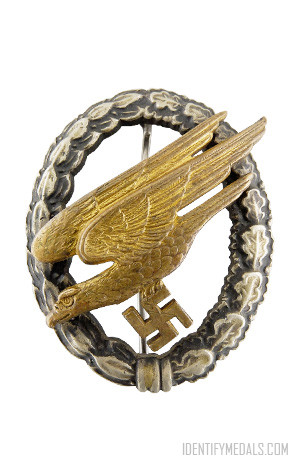
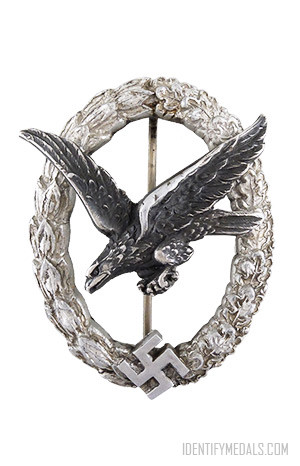
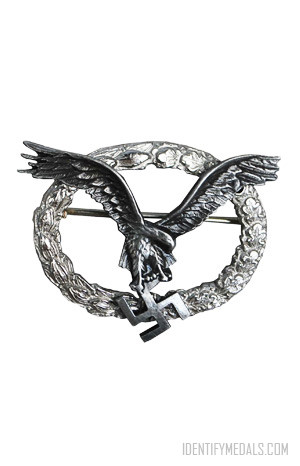
The badge shows an eagle in flight. At the bottom is a swastika. The design is surmounted by a wreath of laurel leaves and oak leaves (the wreath is made of silver). 

The first Air Gunner badges were made in tombak, although there are also examples in kreigsmetal and zinc. The eagle was sometimes made of aluminum and the wreath zinc. 

More Luftwaffe War Badges

Awarded to members of the German Luftwaffe for their achievements and contributions to air warfare, the Luftwaffe War Badges symbolized excellence, courage, and skill in aerial combat and support roles. Explore the complete collection below:

The Observer Badge of the Luftwaffe

The Observer Badge of the Luftwaffe was a German award for qualifying service established in 1935 and instituted in 1936.

The Observer Badge of the Luftwaffe was a German award for qualifying service established in 1935 (provisions) and instituted in 1936. It was one of the first set of badges for which Reichsmarchall Göring gave specifications. 

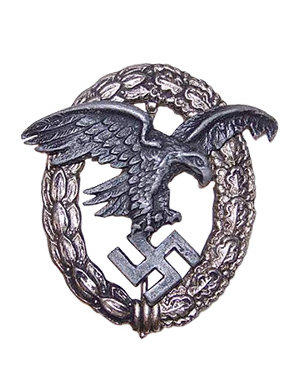
The badge was awarded after completing two months of qualifying service and five operational flights as an observer, or if the recipient was wounded while posted as an observer (before completing the 5 flights). 

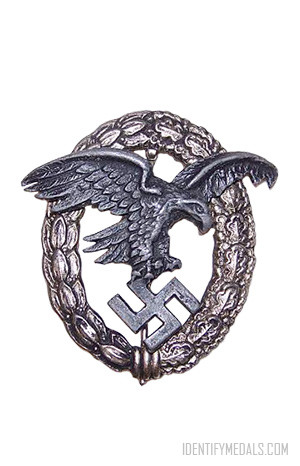
It’s not known how many Observer badges were awarded. The shape is oval and slightly convex. An eagle is over-imposed on a wreath of laurel leaves (on the right) and oak leaves (on the left). The material used for the Observer badge were tombac, aluminum, and zinc. Measures can vary slightly according to the manufacturer.

More Luftwaffe War Badges

Awarded to members of the German Luftwaffe for their achievements and contributions to air warfare, the Luftwaffe War Badges symbolized excellence, courage, and skill in aerial combat and support roles. Explore the complete collection below:

The Retired Pilot Badge of the Luftwaffe

The Retired Pilot Badge of the Luftwaffe was a German award given to personnel honorably discharged from their flying duties.

The Retired Pilot Badge of the Luftwaffe was a German award given to personnel honorably discharged from their flying duties. The badge was instituted on 26 March 1936 as the Flyer’s Commemorative Badge by the Minister of Aviation and the Commander in Chief of the Luftwaffe. 

The badge was awarded to pilots, observers, air gunners, and paratroopers of the Luftwaffe. It’s estimated that only 800 of these badges were created. They were awarded only before the outbreak of the war. 

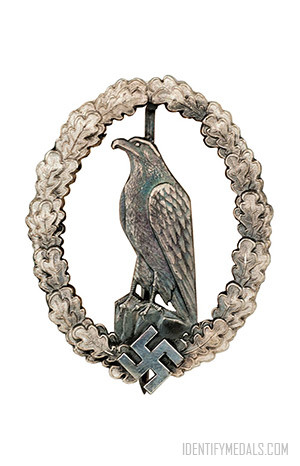
The Retired Pilot Badge features an eagle perched on top of a large rock and it surmounted o a wreath of oak leaves. While the wreath was usually polished silver, the eagle had an oxidized look and was darker. Earlier badges were produced in silver and aluminum, with lower quality ones issued as replacements (these are not official, however). 

Retired Pilot Badge Design

The Retired Pilot Badge features an eagle perched on top of a large rock and it surmounted o a wreath of oak leaves. While the wreath was usually polished silver, the eagle had an oxidized look and was darker.

Earlier badges were produced in silver and aluminum, with lower quality ones issued as replacements (these are not official, however). 

More Luftwaffe War Badges

Awarded to members of the German Luftwaffe for their achievements and contributions to air warfare, the Luftwaffe War Badges symbolized excellence, courage, and skill in aerial combat and support roles. Explore the complete collection below:

The Pilot Badge of the Luftwaffe

The Pilot Badge of the Luftwaffe was a WW2 German award instituted in 1935 by Reichsmarchall Hermann Göring.

The Pilot Badge of the Luftwaffe was a German award instituted in 1935 by Reichsmarchall Hermann Göring. 

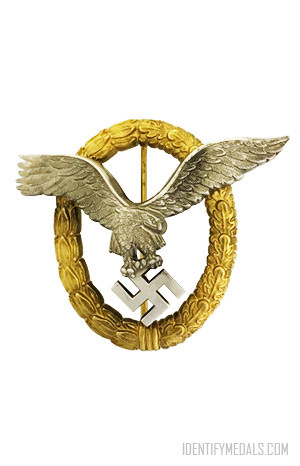
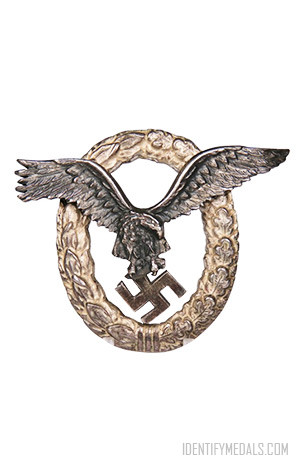
The badge can be found made in several different materials; for example, nickel-silver, aluminium, plated allow, lacquered zinc, etc. The versions made before the ear (and in the early stages of it) tend to be of higher quality, while the later Pilot badges are made of alloys and aluminium (the ones made of this material, which was deemed inadequate, are rarer and more valuable). 

The Pilot Badge shows a massive swooping eagle that is clutching a swastika in its talons. Both are superimposed on a wreath made of laurel leaves on the left and oak leaves o the right. 

More Luftwaffe War Badges

Awarded to members of the German Luftwaffe for their achievements and contributions to air warfare, the Luftwaffe War Badges symbolized excellence, courage, and skill in aerial combat and support roles. Explore the complete collection below:

The Air Crew Badge of the Luftwaffe

The Air Crew Badge of the Luftwaffe was a WW2 German award and one of the earliest flight related badges of the air program.

The Air Crew Badge was a German award and one of the earliest flight-related badges in the country. The badge was used in the infancy of Germany’s air program. It rewarded pilots and crew members of the German Air Sports Association. It’s hard to tell when the badge was implemented, exactly, but it has been in use since 1933.

Because the Luftwaffe was banned by the Versailles treaty, the Association became a cover to the banned German Air Force until April 1st, 1935. That’s when the Luftwaffe gained official sanction.

The Air Crew Badge became the official Pilot-Observer badge of the Luftwaffe on January 19th, 1935 and was soon replaced by a newer version and then removed from circulation.  This makes it one of the most difficult and rarest of all the Luftwaffe badges. 

More Luftwaffe War Badges

Awarded to members of the German Luftwaffe for their achievements and contributions to air warfare, the Luftwaffe War Badges symbolized excellence, courage, and skill in aerial combat and support roles. Explore the complete collection below:

The Warsaw Shield

The Warsaw Shield (Ärmelschild Warschau) is a German military decoration for those who took part in the suppression of the Warsaw uprising.
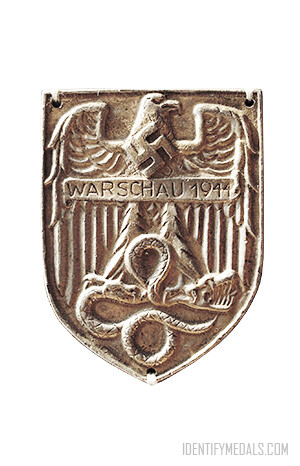
The Warsaw Shield (or Ärmelschild Warschau in German) is a World War II military decoration of Nazi Germany, awarded to Wehrmacht and Waffen-SS servicemen who took part in the suppression of the 1944 Warsaw uprising. The Warsaw uprising lasted 63 days from 1 August 1944. Polish resistance attempted to liberate Warsaw as German forces withdrew. However, the approaching Red Army temporarily halted outside the city, enabling the Germans to regroup and defeat the uprising. 

Although authorized, approved and announced (the Warsaw Shield was  instituted on 10 December 1944 by Adolf Hitler, with full award regulations published in the Reich Law Gazette), production had not begun prior to the end of the war and the award was never issued. Dies were prepared, but were destroyed in an air-raid and no shields were actually produced before the end of the war. However, some sample matrices for the shield survived and have been used as the basis for the post-war manufacture of unofficial examples.

The Warsaw Shield Design

The award was designed by Benno von Arent. It was going to be a 50 × 62 mm bronze-colored shield with a large Wehrmacht-style eagle with folded wings grasping a writhing snake. A mobile swastika is superimposed on the eagle’s neck with, immediately below, a narrow banner with the legend WARSCHAU 1944

The shield was to be worn on the left upper arm of the uniform. 

More Nazi Germany Shields (Ärmelschilde)

These campaign shields were awarded to members of the Wehrmacht (the unified armed forces of Nazi Germany from 1935 to 1945). They were given for participation in specific battles or campaigns and worn on the left upper arm of the uniform jacket.

The Crimea Shield - German WW2 Medals, Badges and Awards

The Crimea Shield

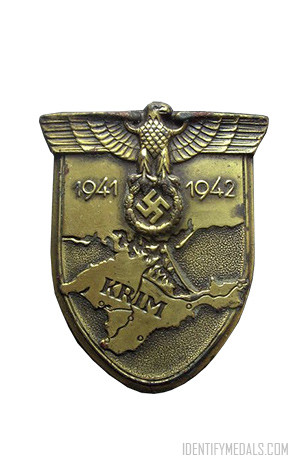
The Crimea Shield (Krimschild) is a WW2 German military decoration awarded to military personnel who fought against Soviet Red Army forces.
Read More »
The Narvik Shield - German WW2 Medals, Badges and Awards

The Narvik Shield

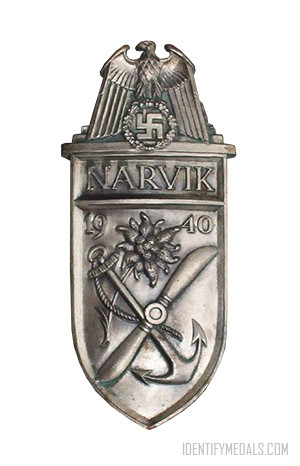
The Narvik Shield (Narvikschild) is a WW2 German military decoration awarded to German forces that took part in the battles of Narvik.

Read More »

The Tank Combat Badge of the Luftwaffe

The Tank Combat Badge of the Luftwaffe is a Third Reich / Nazi Germany Luftwaffe War Badge awarded during the Second World War.
The Tank Combat Badge of the Luftwaffe (Or Luftwaffe Panzer Badge, Panzerkampfabzeichen der Luftwaffe German) was a World War II German military decoration instituted on 3 November 1944 by Reichsmarshall Goring to honor the panzer troops of the Luftwaffe field divisions (until then, qualified Luftwaffe personnel were awarded the Heer Panzer Badge).

The badge had two designs:

  • All Silver: Awarded to tank commanders, gunners, drivers, radiomen, repair crews and their medical personnel.
  • Silver with Black Wreath: Awarded to Panzer grenadiers, armored reconnaissance units, and the medical personnel attached to them.

Both badge styles were awarded for three combat engagements on three different days.

The Tank Combat Badge of the Luftwaffe Design

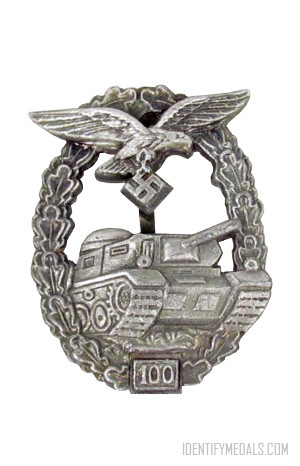
The badge is an oval wreath composed of eight oak leaves on the left and seven oak leaves on the right. The first design was entirely silver and the second had a black wreath.

The badge was presented in a paper packet with the name of the award printed on the outside. 

More Luftwaffe War Badges

Awarded to members of the German Luftwaffe for their achievements and contributions to air warfare, the Luftwaffe War Badges symbolized excellence, courage, and skill in aerial combat and support roles. Explore the complete collection below: