The Belisario Domínguez Medal of Honor

The Belisario Domínguez Medal (Medalla Belisario Domínguez del Senado de la República in Spanish) is the highest decoration that the Mexican Senate gives to eminent citizens.

The name honors Belisario Domínguez, a Chiapas Senator who opposed the Dictatorship of  Victoriano Huerta – a position that cost him his life. He was murdered on October 7th, 1913.

Every year, on Octobre 7th, the Senate and the President of Mexico awards the Belisario Domínguez Medal. Since its inception, the decoration has been given 69 times – eight of them posthumously.

The award includes the medal and a diploma.

The Belisario Domínguez Medal Design

The medal is struck in bronze. The obverse bears the inscriptions “Belisario Domínguez” on the top and “Ennobleció la Patria” (“Made the country more noble“) at the bottom. On the sides of the Belisario Domínguez portrait are the words “Octubre 7” (October 7) and “de 1953” (of 1953).

The Miguel Hidalgo Order

The Miguel Hidalgo Order (Condecoración “Miguel Hidalgo” or Miguel Hidalgo Decoration) is the highest award that the Mexican State gives to its citizens. The Order forms part of the Mexican Honor System.

The Miguel Hidalgo Order is awarded for eminent or distinguished merits, relevant services rendered unto the Nation or to Mankind, exemplar conduct or life’s work, or heroic acts.

The Order is named after Miguel Hidalgo y Costilla (1753-1811), a Mexican Catholic priest and main leader of the Mexican War of Independence. The award was officially issued in 1975 by  President Luis Echeverría and the Executive Branch of the Government of Mexico.

The Miguel Hidalgo Order Design

The Order consists of four classes, which are represented by a collar, a cross, a band, and a plaque. The Collar is awarded for heroic acts and exemplary conduct, and for services rendered unto the Nation or to Humanity that are of a transcendent and extremely beneficial nature. The cross is awarded for eminent merits,  outstandingly exemplar conduct, and heroic acts which would not merit a collar. The Band is given for distinguished merits and exemplary that warrants making it public knowledge. The plaque is awarded for merits not contemplated by the previous grades.

The badge of the Order is a cross in silver and gold with an eagle on the obverse.

The (Mexican) War Cross

The Mexican War Cross was instituted in 1949 in three classes to be awarded to military in time of war or armed conflict for acts of bravery. 

The War Cross (or Cruz de Guerra in Spanish) was instituted by Presidential Decree on 25 July 1949 in three classes to be awarded to military in time of war or armed conflict for acts of bravery.

Cuauhtémoc was an early 16th Century Aztec ruler who fought heroically against the Spanish conquistadors and was tortured and then unjustly executed by Cortés. Today, Cuauhtémoc is revered in Mexico whilst the world has largely forgotten the victorious Cortés.

The War Cross Design

The medal is a gilt and deep red enamel cross pattée with concave stepped ends to the arms and a loop for ribbon suspension.

The obverse shows the gilt head of Cuauhtémoc in eagle war headdress imposed on a circular central deep red enamel medallion within a gilt ring inscribed in red letters ‘CRUZ DE GUERRA PRIMERA CLASE’ (War Cross First Class). The reverse is plain, with a ribbon with laurel-decorated gilt top bar mounted for wear.

The Decoration for Heroic Valor

The Decoration of Heroic Valor (or Condecoración al Valor Heroico in Spanish) is a Mexican award given to military personnel for exceptional acts of heroism at risk of their own life. The medal may be awarded in both war and peace.

There are three classes:

  • 1st class – solid red ribbon
  • 2nd class – five equal stripes, three red and two white
  • 3rd class – white ribbon with medium width red edges

The Decoration for Heroic Valor Design

The medal is a gilt-edged red-enameled “Lancer Cross” (equilateral cross whose arms resemble lance heads) resting on a gilt “star” of multiple rays that resembles a square with points at the cardinal points.

The oval red central medallion has the number 12, or 3 according to class, surrounded by a white band inscribed Valor Heroico in gold, wit the word Valor in the upper part and Heroico on the bottom, separated by a dash. Between the cross’ arms, and covering the space between them, are four aces that coincide with the square where the inscription is written. The remaining aces augment in longitude towards the center.

The plaque is slightly convex in the exterior part. It has a ring for hanging it and a sixteen-side star in the reverse with the legend Creada en 1926 (Created in 1926) en highlighted uppercase letters.

The medal is suspended from a red and white ribbon (three vertical bands o 10 millimeters each) according to class, with a gilt bar at top inscribed Mexico.

The Mexican Legion of Honor

The  Mexican Legion of Honor is an order of merit awarded to soldiers, veterans, and others who have made outstanding contributions to Mexico.

The modern Mexican Legion of Honor (or Legión de Honor Mexicana in Spanish) is an order of merit awarded to soldiers, veterans, and others who have made outstanding contributions to the national defense, security, or sovereignty of Mexico.

An earlier, post-revolutionary version was organized as a military reserve force, a forerunner to the modern Legion that was founded in 1917 under President Venustiano Carranza to provide an “honorable location for excess officers of the Constitutional Army.” It was available for use as a reserve force in case of national emergency, and also provided training for new recruits.

The modern Mexican Legion of Honor was created in a 1949 decree by President Miguel Alemán Valdés to “honor soldiers during their lifetime” who had contributed to the national defense, or who had contributed in some form to the social achievements enshrined in the Constitution. Eligibility changes included admission for those who had served the country, or completed at least thirty years of active military service.

A 1994 amendment to the original act established some organizational changes, including an official name change to Legión de Honor Militar Mexicana, and added eligibility to those who had “participated in the most preeminent events” of Mexican history, carried out “heroic actions“, or in some way contributed to the military defense of the nation, to guaranteeing national security, or to maintain national sovereignty and independence.

The 1949 reorganization opened the membership first to civilians, and then to women. Although some women were recognized as members, without recognizing either their military rank or their pensions.

The Imperial Order of Guadalupe

The Imperial Order of Guadalupe (originally known as “National Order of Our Lady of Guadalupe”) was established by Emperor Agustín I of Mexico in the fall of 1821 – although its statutes would not be published until February 1822.

The order was originally divided into two classes: Grand Cross and Numerary Member. After the death of the Agustin I, the Order fell out of use and remained inactive for 30 years until Antonio López de Santa Anna convinced Pope Pius IX to recognize it in 1854. It fell into disuse again in August of that same year after the successful Ayutla Revolution and the ousting of Santa Anna from government.

The third and last period of the Order began on June 30, 1863, before the arrival of Maximilian I, by decree of the Provisional Imperial Government. Maximilian I modified the statutes of the Order for the last time on April 10, 1865, renaming the order “Imperial” (instead of “National”) and divided it into four ranks, each with civilian and military divisions:

  • Grand Cross, limited to 30 recipients.
  • Grand Officer, limited to 100 recipients.
  • Commander, limited to 200 recipients.
  • Knight, limited to 500 recipients.

The Order of the Aztec Eagle

The Order of the Aztec Eagle is the highest Mexican order awarded to foreigners in the country and forms part of the Mexican Honours System.

The Order of the Aztec Eagle (or Orden Mexicana del Águila Azteca in Spanish) is the highest Mexican order awarded to foreigners in the country and forms part of the Mexican Honours System. It’s awarded for services to the Mexican nation or to humanity, and it’s reciprocally given to Mexican public service providers living abroad.

The order was created by decree on December 29, 1933 by President Abelardo L. Rodríguez although it is based on the temporal Aztec Eagle decoration, which was created on September 30, 1932. This award had a light blue ribbon and was given as a thank you to foreigners, in particular to ministers from the Chilean Foreign Issues Office.

It corresponds to similar distinctions given to Mexican citizens such as the Miguel Hidalgo Order or the Belisario Domínguez Medal of Honor. It is given by the office of the foreign minister on the instructions of a Council established for this purpose headed by the President.

The Order of the Aztec Eagle Design

There is some design similarity of the order with the coat of arms of Mexico, particularly the golden eagle holding a rattlesnake, which is associated with the Aztec civilization.

Prior to the 2011 reform, the classes were, in descending order:

  1. MEX Order of the Aztec Eagle 1Class BAR.png Collar (“Collar”), awarded to heads of state;
  2. MEX Order of the Aztec Eagle 2Class BAR.png Grand Cross (“Cruz”), awarded to prime ministers and heads of government
  3. MEX Order of the Aztec Eagle 3Class BAR.png Sash (“Banda”), awarded to government ministers, secretaries and ambassadors
  4. MEX Order of the Aztec Eagle 4Class BAR.png Medal (“Medalla”), awarded to government undersecretaries, plenipotentiary ministers, as well to those whose category is tantamount to the previous;
  5. MEX Order of the Aztec Eagle 5Class BAR.png Placard (“Placa”), awarded to ad hoc business representatives, colonels and lieutenant colonels, captains of a ship, equivalent servants of embassies in Mexico), as well to those whose category is tantamount to the previous;
  6. MEX Order of the Aztec Eagle 5Class BAR.png Venera (a type of insignia), awarded to ad interim business representatives and other members of diplomatic missions;
  7. MEX Order of the Aztec Eagle 5Class BAR.png Insignia proper, awarded under the Council’s discretion; and
  8. MEX Order of the Aztec Eagle 5Class BAR.png Honorable Mention (“Mención Honorífica”).

Since the reform of March 2011, the classes are :

  1. MEX Orden del Aguila Azteca 2011 Collar BAR.svg Collar (“Collar”), awarded to heads of state;
  2. MEX Orden del Aguila Azteca 2011 Banda Especial BAR.svg Sash of Special Category (“Banda en Categoría Especial”), awarded to prime ministers and heads of government, hereditary princes(ses), consorts of heads of state, or to people whose category is tantamount to the previous;
  3. MEX Orden del Aguila Azteca 2011 Banda BAR.svg Sash (“Banda”), awarded to government ministers, secretaries, members of royal families, ambassadors, or individuals whose category is tantamount to the previous;
  4. MEX Orden del Aguila Azteca 2011 Placa BAR.svg Plaque (“Placa”), awarded to government undersecretaries, plenipotentiary ministers, consuls general, brigadier generals, rear admirals, as well to those whose category is tantamount to the previous;
  5. MEX Orden del Aguila Azteca 2011 Venera BAR.svg Venera (a type of insignia), awarded to ad hoc business representatives, colonels and lieutenant colonels, captains of a ship, equivalent servants of embassies in Mexico, as well to those whose category is tantamount to the previous;
  6. MEX Orden del Aguila Azteca 2011 Insignia BAR.svg Insignia, awarded to ad interim business representatives and other members of diplomatic missions; captain, navy lieutenant, as well to those whose category is tantamount to the previous and to those cases the Council considers pertinent.

All grades except the collar may be awarded, under the Council’s discretion, to distinguished foreigners.

The Cross for Loyalty to the Assassinated President Venustiano Carranza

The Cross for Loyalty to Carranza is a medal issued during 1910 and 1920 when control of Mexico’s government was attempted by several parties. 

The Cross for Loyalty to the Assassinated President Venustiano Carranza is a medal issued during the early years of the twentieth century, between 1910 and 1920 when control of Mexico’s government was attempted by several parties.

The United States involvement in the Mexican Revolution was varied and seemingly contradictory, first supporting and then repudiating Mexican regimes during the period 1910-1920. For both economic and political reasons, the U.S. government generally supported those who occupied the seats of power, whether they held that power legitimately or not.

When Francisco I. Madero was elected president in October 1911, the U.S. president was a lame duck. The U.S. Ambassador to Mexico, Henry Lane Wilson was initially sympathetic to the new regime, but quickly came into conflict with it. Ambassador Wilson conspired with General Victoriano Huerta to oust Madero.

The United States government under newly inaugurated president Woodrow Wilson refused to recognize Huerta’s government and sent troops to occupy Veracruz. President Wilson’s government recognized the government of Venustiano Carranza in 1915.

The Cross for Loyalty to the Assassinated President Venustiano Carranza Design

The Cross for Loyalty is typically designed in the shape of a cross, which is a common motif for many military medals and decorations. At the center of the cross, there is usually a circular medallion. This medallion features a depiction of President Venustiano Carranza. The image of Carranza may vary in detail but typically includes his profile or bust.

Around the outer edge of the central medallion, there may be an inscription. This inscription may include Carranza’s name, title, and dates of birth and death, as well as the words “Por la Lealtad” (For Loyalty) or similar phrases. The cross often has arms that radiate outward from the central medallion, creating a cross-like shape. These arms are usually plain but may sometimes feature decorative elements or symbols.

The medal is typically suspended from a ribbon that allows it to be worn around the neck or pinned to a uniform. The ribbon’s color and design may vary but often incorporate the national colors of Mexico, which are green, white, and red.

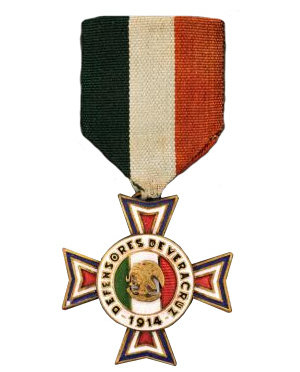
The Cross for the Defenders of Veracruz

The Cross for the Defenders of Veracruz is a medal issued 1910-1920 when control of Mexico’s government was attempted by several parties. 

The Cross for the Defenders of Veracruz is a medal issued during the early years of the twentieth century, between 1910 and 1920 when control of Mexico’s government was attempted by several parties.

The United States involvement in the Mexican Revolution was varied and seemingly contradictory, first supporting and then repudiating Mexican regimes during the period 1910-1920. For both economic and political reasons, the U.S. government generally supported those who occupied the seats of power, whether they held that power legitimately or not.

When Francisco I. Madero was elected president in October 1911, the U.S. president was a lame duck. The U.S. Ambassador to Mexico, Henry Lane Wilson was initially sympathetic to the new regime, but quickly came into conflict with it. Ambassador Wilson conspired with General Victoriano Huerta to oust Madero.

The United States government under newly inaugurated president Woodrow Wilson refused to recognize Huerta’s government and sent troops to occupy Veracruz. President Wilson’s government recognized the government of Venustiano Carranza in 1915.

The Cross for the Defenders of Veracruz Design

Like many Mexican military decorations, the Cross for the Defenders of Veracruz is typically designed in the shape of a cross. The cross shape is a common motif for such awards. At the center of the cross, there is usually a circular medallion. This medallion often features the image of a Mexican soldier or a patriotic symbol associated with the defense of Veracruz. The image may vary in detail but generally represents the valor and dedication of those who defended the city.

Around the outer edge of the central medallion, there may be an inscription. This inscription typically includes the words “Defensores de Veracruz” (Defenders of Veracruz) or similar phrases, highlighting the purpose and significance of the decoration. The cross often has arms that radiate outward from the central medallion, creating a cross-like shape. These arms are usually plain but may sometimes feature decorative elements or symbols.

The medal is typically suspended from a ribbon that allows it to be worn around the neck or pinned to a uniform. The ribbon’s color and design may vary but often incorporate patriotic colors, such as green, white, and red, which are the national colors of Mexico. At the top of the medal, there is a small ring or loop through which a ribbon or chain is threaded to allow for wearing or display.

The Cross for Revolutionary Merit 1913-14

The Cross of Revolutionary Merit is a medal issued during 1910 and 1920 when control of Mexico’s government was attempted by several parties. 

The Cross of Revolutionary Merit is a medal issued during the early years of the twentieth century, between 1910 and 1920 when control of Mexico’s government was attempted by several parties.

The United States involvement in the Mexican Revolution was varied and seemingly contradictory, first supporting and then repudiating Mexican regimes during the period 1910-1920. For both economic and political reasons, the U.S. government generally supported those who occupied the seats of power, whether they held that power legitimately or not.

When Francisco I. Madero was elected president in October 1911, the U.S. president was a lame duck. The U.S. Ambassador to Mexico, Henry Lane Wilson was initially sympathetic to the new regime, but quickly came into conflict with it. Ambassador Wilson conspired with General Victoriano Huerta to oust Madero.

The United States government under newly inaugurated president Woodrow Wilson refused to recognize Huerta’s government and sent troops to occupy Veracruz. President Wilson’s government recognized the government of Venustiano Carranza in 1915.