The Order of the Gold Lion of the House of Nassau

The Order of the Gold Lion of the House of Nassau is a chivalric order shared by the two branches of the House of Nassau.

The Order of the Gold Lion of the House of Nassau (or Huisorde van de Gouden Leeuw van Nassau in Dutch) is a chivalric order shared by the two branches of the House of Nassau (the Ottonian and Walramian lines). The order may be awarded to sovereigns, princes of sovereign houses and heads of state for meritorious service to Luxembourg and the Grand Duke.

In the context of the younger Ottonian line, this order is a house order of the Dutch Royal House of Orange-Nassau and is awarded as a personal gift by the King of the Netherlands on a person who has rendered special service to the Royal House.

The order was founded by royal grand-ducal decree on 31 March 1858 by King-Grand Duke William III. The order originally included only one grade (i.e. “Knight”), but this was increased to four by William III in 1873:

  1. Grand Cross
  2. Grand Officer
  3. Officer
  4. Knight

The further rank of Commander was introduced in 1882. Nowadays, the order is conferred only on rare occasions in the Netherlands or Luxembourg.

Princes who are sons or brothers of the heads of the two lines of the House of Nassau are born knights of the order. In 1984, Queen Beatrix and Grand Duke Jean made an agreement that princesses (daughters of the heads of the two lines of the House of Nassau) may be admitted when they reach the age of majority (18).

The Order of the Gold Lion o the House of Nassau Design

The badge of the order is a white-enameled golden Maltese Cross, with the golden monogram “N” between the arms of the cross. The obverse central disc is in blue enamel, bearing the Gold Lion of the House of Nassau. The reverse central disc is also blue enameled, with the motto Je maintiendrai (“I will maintain”) in gold.

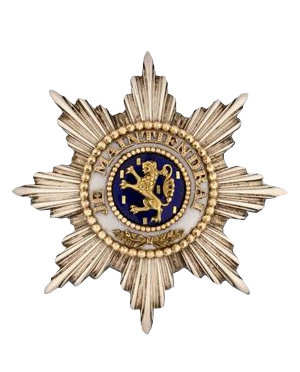
The plaque is an 8-pointed star with straight silver rays; the same obverse of the badge of the order appears at its centre, surrounded by the motto Je maintiendrai in gold letters on white enamel. The ribbon of the sash of the order is yellow-orange moiré with a small blue stripe at each edge.

A knight wears the order’s badge on a sash on the right shoulder, and the plaque (breast star) of the order on the left chest.
The Order of Orange-Nassau

The Order of Orange-Nassau is a civil and military Dutch order of chivalry founded on 4 April 1892 by the Queen regent Emma.

The Order of Orange-Nassau (or Orde van Oranje-Nassau in Dutch) is a civil and military Dutch order of chivalry founded on 4 April 1892 by the Queen regent Emma, acting on behalf of her under-age daughter Queen Wilhelmina and open to “everyone who has earned special merits for society”.

These are people who deserve appreciation and recognition from society for the special way in which they have carried out their activities. The lower grades of the order are comparable with the ranks of the Order of the British Empire in the United Kingdom, but titles, prefixes or post-nominals (other than academic ones) are not used in the Netherlands.

During World War II, the Order of Orange-Nassau was bestowed upon both members of the Netherlands military and members of foreign services who had helped liberate the Netherlands from Nazi German occupation, and those who helped liberate the former Dutch colonies in the Pacific.

In the modern age, the Orange-Nassau is still the most active civil and military decoration of the Netherlands and ranks after the Order of the Netherlands Lion. The order is typically awarded each year on the Monarch’s official birthday with around 3500 appointments to the order made public.

The order is also used to honor foreign princes, ministers, dignitaries and diplomats. The King or Queen Regnant of the Netherlands is the Grand Master of the Order of Orange-Nassau.

The Order of Orange-Nassau Design

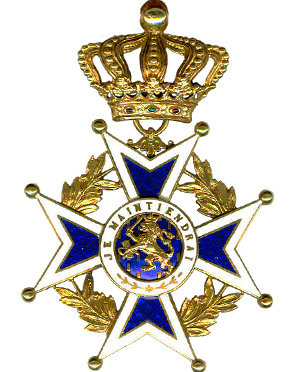
The Order of Orange-Nassau has two divisions, civil and military, the former denoted by a wreath of laurel on the badges, and the latter by crossed swords on both the badges and the stars.

The badge of the order is a blue-enameled, white enamel-bordered Maltese Cross, in gilt for the officers and above, in silver for knights and members. The obverse central disc displays the King’s coat of arms in gold and blue enamel, surrounded by a white enamel ring bearing the national motto Je Maintiendrai (I shall maintain). The reverse central disc has the crowned monogram “W” (for Queen Wilhelmina) surrounded by the motto God Zij Met Ons (God be with us). The badge hangs from a royal crown.

The star of the order is a silver star with straight rays, in 8 points for Grand Cross and in 4 points for Grand Officer; the central disc has the King’s arms in gold and blue enamel, surrounded by a white enamel ring bearing the Dutch national motto Je Maintiendrai. The military division has crossed swords.

Since 1996

In addition to the two divisions, since 1996 the Order of Orange-Nassau has been issued in six classes:

  1. Knight Grand Cross – badge may be worn on a sash on the right shoulder, plus an 8-pointed star on the left chest;
  2. Grand Officer – badge may be worn by men on a necklet, and by women worn on a ribbon tied as a bow at the left chest. Also a 4-pointed star is worn on the left chest;
  3. Commander – badge may be worn by men on a necklet, and by women worn on a ribbon tied as a bow at the left chest;
  4. Officer – wears the badge on a ribbon with a rosette on the left chest;
  5. Knight – wears the badge on a ribbon on the left chest;
  6. Member – wears a smaller badge on a ribbon on the left chest.

For the grades of Knight and Member, the badges are made of silver. For the other grades, the silver is gilded.

For the grades of Knight Grand Cross, Grand Officer and Commander, the badges have a diameter of 60 mm. For the grades of Officer and Knight, they have a diameter of 46 mm. For the grade of Member, a diameter of 35 mm.

After 1966

Until 1996, the Order of Orange-Nassau consisted of five grades. In addition, honorary medals were issued in Gold, Silver and Bronze, but these were only affiliated with the order; the bearers of the medal were not members of the order. Now no longer issued, these were replaced by the sixth grade: “Member”. Recipients wore the medal on a ribbon on the left chest.

The Order of the Netherlands Lion

The Order of the Netherlands Lion is a Dutch order of chivalry founded by King William I of the Netherlands on 29 September 1815.

The Order of the Netherlands Lion (also known as Order of the Lion of the Netherlands or De Orde van de Nederlandse Leeuw in Dutch and L’Ordre du Lion Néerlandais in French) is a Dutch order of chivalry founded by King William I of the Netherlands on 29 September 1815.

The Order of the Netherlands Lion was until recently awarded upon eminent individuals from all walks of life, including generals, ministers of the crown, mayors of large towns, professors and leading scientists, industrialists, high-ranking civil servants, presiding judges and renowned artists. Since 1980 the Order has been primarily used to recognize merit in the arts, science, sport and literature.

The Order ranks after the Military William Order, which is only awarded for military merit. The King of the Netherlands is the Grand Master of the Order.

The following classes and grades exist for the Order:

  1. Knight Grand Cross – Reserved for members of the Royal Family, foreign Heads of State and a select group of former prime ministers, princes and cardinals. Wears the badge on a sash on the right shoulder, plus the star on the left chest.
  2. Commander – Usually conferred upon Dutch Nobel Prize winners, a few distinguished artists, writers and politicians. Wears the badge on a necklet, plus an identical breast cross on the left chest.
  3. Knight – Wears the badge on a ribbon on the left chest.
  4. Brother – No longer issued; see section below. Wore the medal on a ribbon on the left chest.

The Order of the Netherlands Lion Design

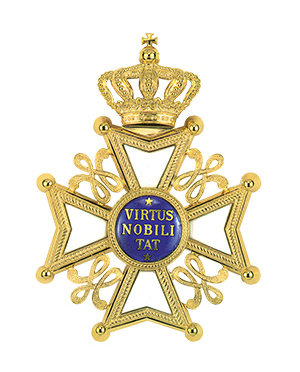
The badge of the Order is a gilt, white-enameled Maltese Cross, with the monogram “W” (for King William I) between the arms of the cross.

The obverse central disc is in blue enamel, bearing the motto Virtus Nobilitat (Virtue Ennobles). The reverse central disc is plain golden, with the lion from the Netherlands coat-of-arms. The badge hangs from a royal crown.

As with all honors awarded by the Netherlands, the insignia comprises a decoration, a miniature and optionally a breast star. The decoration and breast stars are only worn at formal occasions or while in state office. While wearing a smoking, it is allowed to wear the miniature. Decorations are not worn on any other type of clothing.

The badge of honour for Brothers was a silver medal, with the lion from the Netherlands coat of arms on the obverse, and the motto Virtus Nobilitat (English: Virtue Ennobles) on the reverse. The ribbon for Brothers was blue with a single orange central stripe.

The Military Order of William

The Military William Order (Militaire Willems-Orde in Dutch, MWO) is the oldest and highest honor of the Kingdom of the Netherlands.

The Military William Order (also known as Military Order of William or Militaire Willems-Orde in Dutch, abbreviated MWO), is the oldest and highest honour of the Kingdom of the Netherlands.

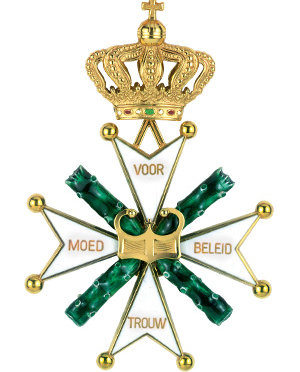
The Order’s motto is Voor Moed, Beleid en Trouw (For Bravery, Leadership and Loyalty). The chivalric order was established on 30 April 1815 by King William I and was presented for feats of excellent bravery on the battlefield and as a meritorious decoration to senior military officers. Comparable with the French Légion d’Honneur but far less often awarded, the Military William Order is a chivalry order of merit open to everyone regardless of rank and nobility, and not only to Dutch military but also foreigners. To date membership of the Order is extremely rarely awarded and only for excellent bravery in battle. Most knighthoods of the Military Order of William were awarded in 1815 and shortly afterwards to military of the Allies that fought Napoleon at the Battle of Waterloo, in total over 1,000 knighthoods were awarded at this time.

By 1945, the following classes of the Military William Order were in existence.

  • Knight Grand Cross – wears the badge on a sash on the right shoulder, plus the star on the left chest;
  • Commander – wears the badge on a necklet, plus an identical breast cross on the left chest;
  • Knight 3rd Class – wears the badge on a ribbon with rosette on the left chest;
  • Knight 4th Class – wears the badge on a ribbon on the left chest.

The oath to be taken by the accolade to the Military Order of William states: “I swear that I shall conduct myself as a faithful and valiant Knight, to stand ever ready to defend King and Country with my Life, and with all my Powers to always strive to be worthy of this Distinction, which the King has bestowed upon me. So help me God almighty.”

The Military Order of William Design

The badge of the Order is a white-enameled Maltese Cross, in silver for the 4th Class and in gilt for higher classes; a green enameled Burgundy Cross appears between the arms of the Maltese Cross.

The obverse bears a golden firesteel at the center, and the motto Voor Moed – Beleid – Trouw (For Bravery – Leadership – Loyalty) on the arms of the Maltese Cross. Both the Burgundy Cross and the firesteel were symbols of the House of Valois-Burgundy during their lordship of the Netherlands and probably are meant to recall its crucial unifying role in the history of the Netherlands. The reverse central disc bears a crowned monogram “W” (for King William I) surrounded by a laurel wreath. The badge hangs from a royal crown.

The star of the Grand Cross is a silver, 8-pointed star with straight rays; the obverse of the badge of the Order, minus the crown, appears at its centre. The breast cross of the Commander is completely identical to the obverse of the badge of the Order. The ribbon of the Order is orange (Royal House of Orange) with blue (Nassau-blue) stripes near the border.