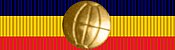
The Southern Cross of Honor

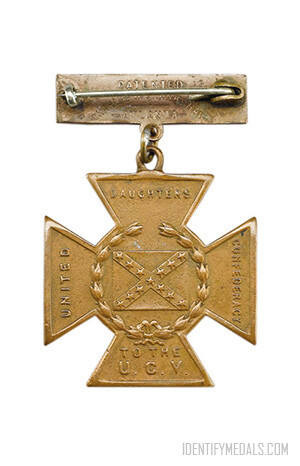
The Southern Cross of Honor a commemorative medal established by the United Daughters of the Confederacy to honor Confederate veterans.

The Southern Cross of Honor was a commemorative medal created in 1899 by the United Daughters of the Confederacy to recognize the service of Confederate veterans.

The idea for the Cross of Honor was conceived by Mary Ann Erwin in 1898 and designed by her and Sarah E. Gabbett. The first medal was issued on April 26, 1900, to Captain Alexander S. Erwin. Initially produced by Charles W. Crankshaw of Atlanta, Georgia, and later by Schwaab Stamp & Seal Co. and Whitehead & Hoag, the medal’s issuance was managed by Anna Davenport Raines until her death in 1913. The program, which began with the intention to end in 1913, continued until 1959, with at least 78,761 medals awarded.

Eligibility and Allocation

The Cross of Honor could only be awarded through the United Daughters of the Confederacy and was not available for purchase.

It was given to living Confederate veterans in recognition of their honorable service in any branch of the Confederate military.

The final medal was awarded posthumously in 1951 to Rear Adm. Raphael Semmes. Wearing the medal without entitlement is a Class 3 misdemeanor in Virginia, punishable by a fine of up to $500. The Cross of Honor, akin to the Union’s GAR Medal, was never authorized for wear on U.S. military uniforms.

The Southern Cross of Honor Design

The medal is a cross pattée, suspended from a metal bar designed for engraving, and lacks a cloth ribbon.

The obverse side features the Confederate battle flag at the center, encircled by a wreath. The arms of the cross bear the inscription “UNITED DAUGHTERS OF THE CONFEDERACY TO THE U. C. V.

The reverse displays the Confederate States’ motto “DEO VINDICE” (With God as our Vindicator) and the dates “1861 1865,” surrounded by a laurel wreath. The arms on this side are inscribed with “SOUTHERN CROSS OF HONOR.”
The Mexican Service Medal

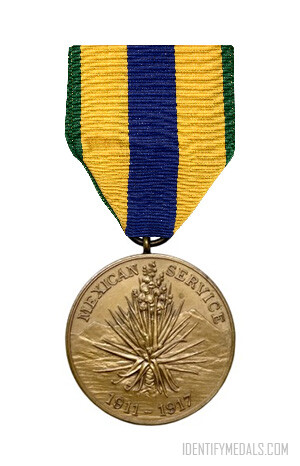
The Mexican Service Medal is an American award given for service in Mexico from 1911 to 1919. It was established in 1917.

The Mexican Service Medal is a United States military award recognizing service in Mexico from 1911 to 1919.

The Army version of the Mexican Service Medal was established on December 12, 1917, by General Orders from the United States War Department. The Navy version followed, established by Navy Department General Orders Number 365 on February 11, 1918, and later amended by General Orders No. 464 on April 27, 1919. This medal honors servicemen who participated in military actions against Mexican forces from April 12, 1911, to June 16, 1919.

To receive the Mexican Service Medal, servicemen had to engage in one of the specified military actions:

  • Veracruz Expedition: April 21 to November 23, 1914
  • Punitive Expedition into Mexico: March 14, 1916 to February 7, 1917
  • Buena Vista, Mexico: December 1, 1917
  • Aftermath of Brite Ranch raid, San Bernardino Canyon: December 26, 1917
  • La Grulla, Texas: January 8–9, 1918
  • Aftermath of Neville Ranch raid, Pilares, Chihuahua: March 28, 1918
  • Battle of Nogales, Arizona: November 1–26, 1915, or Ambos Nogales: August 27, 1918
  • Battle of Ciudad Juárez: June 15–16, 1919

The Navy also awarded the medal to those who served on U.S. naval vessels patrolling Mexican waters during the designated periods or who were involved in the above actions.

The medal was awarded only once, with no service stars for multiple engagements. Soldiers cited for gallantry could receive the Citation Star on their Mexican Service Medal. No additional devices were authorized for the Navy version.

The Mexican Service Medal Design

The medal is bronze and includes engravings that signify service and participation in the specified military engagements. The distinct designs for the Army and Navy versions reflect the different branches’ traditions and service contexts.

The designs are:

  • Army Version: Engraved with a yucca plant.
  • Navy Version: Depicts the San Juan de Ulúa fortress in Veracruz harbor. Both versions bear the inscription “1911 – 1917.”

The Antarctica Service Medal

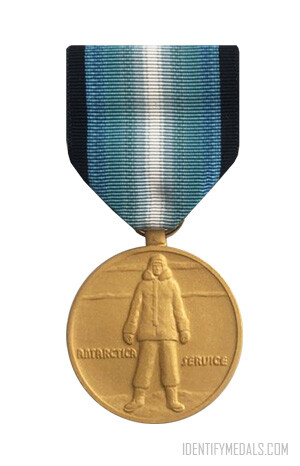
The Antarctica Service Medal was established in 1960 and intended as a military award for previous Antarctica expeditions from 1928 to 1941.

The Antarctica Service Medal (ASM) was established on July 7, 1960, by the United States Congress through Public Law 600 of the 86th Congress. This medal was created to serve as a military award, replacing several commemorative awards issued for prior Antarctic expeditions from 1928 to 1941. The medals made obsolete by the creation of the ASM include the Byrd Antarctic Expedition Medal, the Second Byrd Antarctic Expedition Medal, and the United States Antarctic Expedition Medal.

The ASM is a recognized award of the United States Armed Forces, authorized for wear on active duty uniforms and issued in the name of the U.S. Department of Defense. It can also be awarded to U.S. civilians and foreign citizens participating in U.S. Antarctic expeditions at the invitation of a U.S. agency, such as the National Science Foundation.

The Antarctica Service Medal Criteria

Eligibility for the Antarctica Service Medal requires personnel to train or serve for ten days on the Antarctic continent or on vessels in Antarctic waters (south of 60 degrees latitude). Flight crews qualify by performing transport missions to Antarctica, with one day of service credited for each mission within a 24-hour period. Civilians working in research facilities or on research vessels south of 60 degrees latitude for at least ten days (or thirty days before October 10, 2008) are also eligible, facilitated through the National Science Foundation.

The Antarctica Service Medal Design

The medal is a 1¼ inch bronze piece. The obverse features a polar landscape with a figure in Antarctic clothing, flanked by the words “ANTARCTICA” and “SERVICE.” The reverse displays a polar projection of Antarctica with geodesic lines, overlaid with the words “COURAGE,” “SACRIFICE,” and “DEVOTION,” encircled by penguins and marine life.

The service ribbon, 1⅜ inches wide, has a design symbolizing the Antarctic environment: black and dark blue edges represent five months of darkness, while the center, with colors grading from white to medium blue, symbolizes seven months of sunlight and the aurora australis.

Buy this Medal

Right Now on eBay 
Clicking a link to eBay may result in a referral commission being paid if a purchase is made.
Loading...

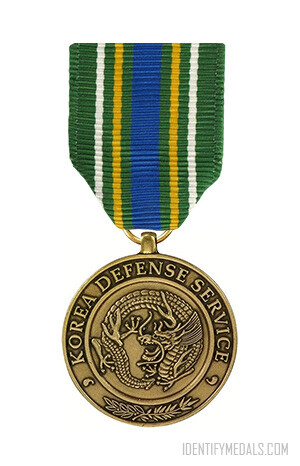
The Korea Defense Service Medal

The Korea Defense Service Medal is an American military service medal awarded to those who have served duty in South Korea in the 1950s.

The Korea Defense Service Medal (KDSM) is a military decoration of the United States Armed Forces, established in 2002 through legislation signed by President George W. Bush. The initiative to create this medal was led by Representative Elton Gallegly (R-CA) and Senator Jeff Bingaman (D-NM). John Sproston designed the final version of the medal.

Recipients of the KDSM are eligible for membership in veterans’ organizations such as the Veterans of Foreign Wars (VFW) and the American Legion.

The Korea Defense Service Medal Criteria

The KDSM is awarded to U.S. Armed Forces members who have served in South Korea in support of its defense post-Korean Armistice Agreement. To qualify, a service member must have served at least 30 consecutive days or 60 non-consecutive days in the South Korean theater. This includes reservists on annual training. Exceptions to the time requirement include participation in combat, injury in the line of duty requiring medical evacuation, or aircrew members who have logged over 30 days of sorties in South Korean airspace.

The medal is retroactive to service performed after July 28, 1954. The National Personnel Records Center verifies the entitlement for discharged members who served in South Korea before the KDSM’s creation. Additionally, service members can receive both the Armed Forces Expeditionary Medal and the KDSM for the same period between October 1, 1966, and June 30, 1974. Only one KDSM is awarded per individual, regardless of the length of service in South Korea.

The Korea Defense Service Medal Design

The KDSM is a bronze medal measuring 1¼ inches in diameter. The obverse features a Korean “circle dragon” with a scroll inscribed “KOREA DEFENSE SERVICE,” flanked by laurel and bamboo sprigs.

The reverse side displays the outline of the Korean Peninsula with two crossed swords.

The medal’s ribbon is mainly green with an ultramarine blue stripe in the center, flanked by golden yellow and white stripes.

Buy this Medal

Right Now on eBay 
Clicking a link to eBay may result in a referral commission being paid if a purchase is made.
Loading...

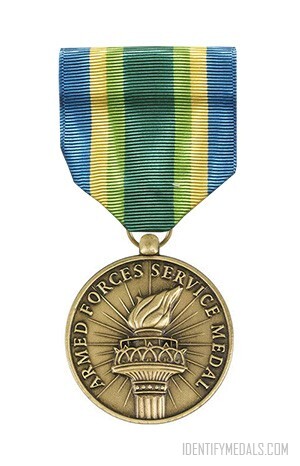
The Armed Forces Service Medal

The Armed Forces Service Medal is a military award presented for significant activity for which no other U.S. medal is authorized.

The Armed Forces Service Medal (AFSM) is a prestigious military award within the United States military, established on January 11, 1996, by President Bill Clinton through Executive Order 12985.

This medal is designated as a deployed service award and is presented to service members who participate in “significant activity” operations that do not qualify for any other U.S. campaign or service medal. The AFSM recognizes the efforts and commitment of those who engage in important missions or operations, highlighting their contributions to national and international objectives where specific campaign medals are not applicable.

The Armed Forces Service Medal is the non-combat equivalent of the Armed Forces Expeditionary Medal, which is typically awarded for combat operations and associated combat support missions.

The Armed Forces Service Medal Design

The Armed Forces Service Medal is a round bronze medal measuring 1+1⁄4 inches (32 mm) in diameter.

The obverse of the medal features a half-torch, reminiscent of the Statue of Liberty’s torch, with rays emanating from behind it. The inscription “ARMED FORCES SERVICE MEDAL” encircles the top. The reverse side displays the eagle from the United States Department of Defense seal, with a laurel wreath below and the inscription “IN PURSUIT OF DEMOCRACY” at the top.

The suspension and ribbon of the medal are 1+3⁄8 inches (35 mm) wide and include several edge stripes from the outside to the center: 1⁄16 inch (1.6 mm) goldenlight, 1⁄8 inch (3.2 mm) jungle green, 1⁄8 inch (3.2 mm) green, 1⁄8 inch (3.2 mm) mosstone green, and 1⁄8 inch (3.2 mm) goldenlight. The center stripe is 1⁄4 inch (6.4 mm) wide in bluebird.

Find This Medal Online

Right Now on eBay 
Clicking a link to eBay may result in a referral commission being paid if a purchase is made.
Loading...

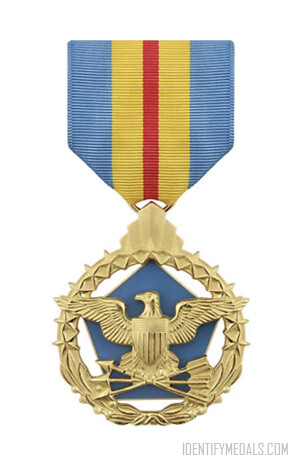
The Defense Distinguished Service Medal

The Defense Distinguished Service Medal is a military decoration of the USA presented for exceptionally distinguished performance of duty.

The Defense Distinguished Service Medal is a prestigious military decoration conferred by the United States Department of Defense. It is awarded to members of the United States Armed Forces in recognition of their exceptionally distinguished performance of duty, which significantly contributes to the national security or defense of the United States.

Established on July 9, 1970, by President Richard Nixon through Executive Order 11545, the first medal was presented on the same day to General Earle Wheeler. General Wheeler, retiring from the US Army after serving as Chief of Staff of the United States Army and Chairman of the Joint Chiefs of Staff, received this honor in acknowledgment of his exemplary service.

The Defense Distinguished Service Medal Design

The medal displays a gold hue, with its obverse showcasing a medium blue enameled pentagon with its point facing upwards. Overlaid on this pentagon is an American bald eagle with outspread wings facing left, clutching three crossed arrows in its talons, and bearing a shield of the United States on its breast.

Encircling the pentagon and eagle is a gold segmented circle adorned with 13 five-pointed stars in the upper half and a wreath of laurel on the left and olive on the right in the lower half. Suspended from the top is a five graduated gold rays suspender.

On the reverse side, the inscription “For Distinguished Service” is prominently raised at the top, while within the pentagon, the inscription “FROM THE SECRETARY OF DEFENSE TO” is also raised. Additional awards of the Defense Distinguished Service Medal are represented by oak leaf clusters.

Find This Medal Online

Right Now on eBay 
Clicking a link to eBay may result in a referral commission being paid if a purchase is made.
Loading...

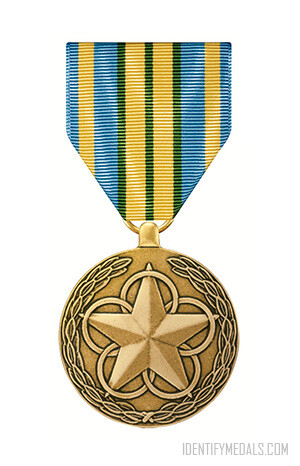
The Military Outstanding Volunteer Service Medal

The Military Outstanding Volunteer Service Medal is a USA award established by George H. W. Bush in 1993 for substantial volunteer service.

The Military Outstanding Volunteer Service Medal (MOVSM) was established by George H. W. Bush through Executive Order 12830 on January 9, 1993, and the design was created by the Institute of Heraldry. It was first awarded in December 1993.

This medal honors members of the military—active duty, reserve, and National Guard—who go above and beyond their required duties by contributing significant volunteer service to their local communities. The volunteer work must be sustained, direct, and produce tangible results that reflect positively on the military and the Department of Defense. The definition of volunteer service is intentionally broad, encompassing a wide range of activities such as Volunteer Emergency Services (e.g., Civil Air Patrol, Coast Guard Auxiliary, or volunteer firefighting/EMS/Rescue Squad), involvement with organizations like the Boy Scouts of America or Habitat for Humanity, and various community initiatives within local, state, or federal parks and forests.

There is no specific time requirement to qualify for the MOVSM, as approval authorities assess each case to determine if the service merits this special recognition. The medal is intended to recognize ongoing and substantial community support rather than a single act or achievement. Additionally, direct involvement in community activities is emphasized, while merely attending membership meetings or social events of a community service group does not count as qualifying service.

MOVSM Multiple Awards: The Service Ribbons

  • First award: service ribbon with no service stars.
  • Second award: service ribbon with one service star.
  • Third award: service ribbon with two service stars.
  • Fourth award: service ribbon with three service stars.
  • Fifth award: service ribbon with four service stars.
  • Sixth award: service ribbon with silver service star.
  • Seventh award: service ribbon with silver and bronze service stars.
  • Eighth award: service ribbon with silver and two bronze service stars.
  • Ninth award: service ribbon with silver and three bronze service stars.

The Military Outstanding Volunteer Service Medal Design

The medal is bronze and measures 1 1/8 inches in diameter. On the obverse side, it features five interlaced annulets behind a five-pointed star, all encircled by a laurel wreath. The reverse side depicts an oak sprig with three leaves and two acorns, with the inscription “OUTSTANDING VOLUNTEER SERVICE” above and “UNITED STATES ARMED FORCES” below.

The suspension and service ribbon is 1 3/8 inches wide and consists of various stripes: 1/8 inch bluebird, 1/8 inch goldenlight, 3/16 inch bluebird, 1/16 inch green, 5/32 inch goldenlight, center 1/16 inch green, 5/32 inch goldenlight, 1/16 inch green, 3/16 inch bluebird, 1/8 inch goldenlight, and 1/8 inch bluebird.

Additional awards are denoted by five-pointed bronze service stars (one per additional award) and five-pointed silver service stars (representing five awards each).

The Pearl Harbor Commemorative Medal

The Pearl Harbor Commemorative Medal was established by the United States Congress in 1990 and awarded for combat operations.

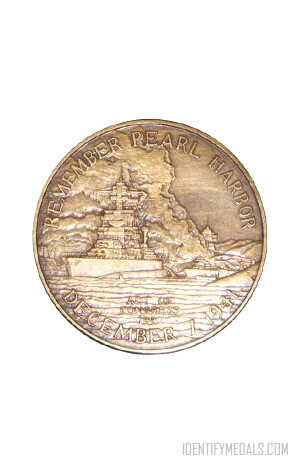
The Pearl Harbor Commemorative Medal, also referred to as the Pearl Harbor Survivor’s Medal, is a bronze commemorative medal established by the United States Congress on November 5, 1990 (P.L. 101-510, 104 Stat. 1721).

To qualify for the award, individuals must have been members of the Armed Forces of the United States present in Hawaii on December 7, 1941, and engaged in combat operations against Imperial Japanese military forces attacking Hawaii on that day. Those who were killed or wounded in the attack are considered to have participated in the combat operations.

Congress later expanded eligibility on September 23, 1996, allowing civilians who were present in Hawaii on December 7, 1941, and participated in combat operations against the attack to receive the award, regardless of their membership in the Armed Forces.

Next-of-kin of deceased individuals eligible for the award were permitted to apply for the medal, with one medal allotted per eligible person.

The Pearl Harbor Commemorative Medal Design

The medal is circular in shape and made of bronze. The obverse shows an mage of the harbor and an inscription reading “Remember Pearl Harbor – December 7 1941“. The reverse shows an eagle and the inscriptions “For Those Who Served” and “A Date Which Will Live in Infamy”.

measures 1.5 inches in diameter and is non-portable, meaning it is not intended to be worn on clothing.

The Medal for Merit (USA)

The Medal for Merit was created during World War II to award civilians for distinguished and exceptionally meritorious conduct.

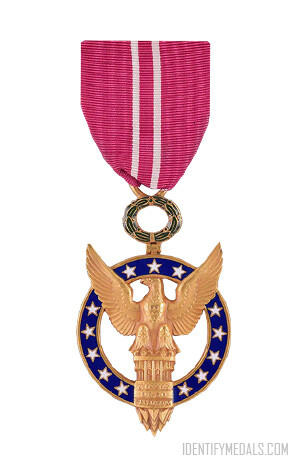
The Medal for Merit stood as the preeminent civilian honor within the United States, bestowed by the President. Originating in World War II, it was conferred upon individuals who showcased exceptional merit in rendering outstanding service during the war effort, following the declaration of emergency by the President on September 8, 1939. 

The medal could be awarded to:

“Civilians of the nations prosecuting the war under the joint declaration of the United Nations and of other friendly foreign nations”

Individuals from foreign nations were eligible to be honored with the award for exhibiting remarkable merit or bravery in support of the Allied war efforts against the Axis Powers, too. The inaugural non-American recipient of this distinction was Sir Edward Wilfred Harry Travis, Director of the British Government Code and Cypher School during World War II, recognized on January 12, 1946.

The Medal for Merit Design

The Medal for Merit is made of gold-finished bronze and decorated with enamel. It features a bold eagle and a circle of white stars on a dark blue background. 

The ribbon is red with two thin central white lines.

Right Now on eBay 
Clicking a link to eBay may result in a referral commission being paid if a purchase is made.
Loading...

The Presidential Unit Citation Award (PUC)

The Presidential Unit Citation or PUC was created by President Franklin D. Roosevelt on 26 February 1942 and awarded in various conflicts.

Time Period: Second World War, Post-WW2
Institution: 1941
Country: United States
 

The Presidential Unit Citation (or PUC) is a military award presented to units of the United States Armed Forces and those of allied countries for extraordinary heroism in action against an armed enemy.

It is one of the highest unit awards that can be bestowed upon a military organization and is considered a significant honor.

The PUC is awarded by the President of the United States in the name of the U.S. Congress. It is typically conferred upon units that have demonstrated exceptional gallantry, determination, and proficiency in combat operations, often under extremely challenging and hazardous conditions.

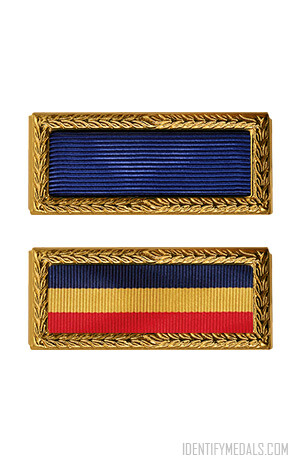
The Presidential Unit Citation Ribbon Designs

There are several variations of the Presidential Unit Citation, each denoted by a different ribbon or emblem. Recipients of the PUC are authorized to wear the appropriate ribbon or emblem on their uniforms as a symbol of their unit’s extraordinary achievements.

The variations are:

  1. Army Presidential Unit Citation: Awarded to U.S. Army units for extraordinary heroism in action against an armed enemy.

  2. Navy Presidential Unit Citation: Awarded to U.S. Navy units, Marine Corps units, and Coast Guard units when operating under the control of the Department of the Navy for extraordinary heroism in action against an armed enemy.

  3. Air Force Presidential Unit Citation: Awarded to U.S. Air Force units for extraordinary heroism in action against an armed enemy.

  4. Joint Meritorious Unit Award: Awarded to joint units of the U.S. Armed Forces for outstanding meritorious achievement or service in support of combat operations.

  5. Navy Unit Commendation: Awarded to U.S. Navy units, Marine Corps units, and Coast Guard units when operating under the control of the Department of the Navy for outstanding heroism in action against an armed enemy.

The Presidential Unit Citation Submarine Clasps

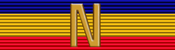
The Presidential Unit Citation Clasps are small emblems or devices worn on the ribbon of the Presidential Unit Citation to denote additional awards or significant achievements by a unit. The USS Nautilus (SSN-571) and USS Triton (SSRN-586) are two submarines that received the Presidential Unit Citation for their historic achievements.

The USS Nautilus (SSN-571) Clasp

Presidential Unit Citation - USS Nautilus (SSN-571) Clasp

The USS Nautilus was the world’s first operational nuclear-powered submarine and made history by completing the first submerged voyage to the North Pole in 1958. This groundbreaking achievement demonstrated the capabilities of nuclear propulsion in submarines and significantly advanced naval technology. As a result of this historic feat, the USS Nautilus was awarded the Presidential Unit Citation for extraordinary heroism and achievement.

The USS Triton (SSRN-586) Clasp

The USS Triton was another nuclear-powered submarine that made history by completing the first submerged circumnavigation of the Earth in 1960. This unprecedented voyage demonstrated the endurance and capabilities of nuclear-powered submarines and provided valuable data for future naval operations. In recognition of this remarkable achievement, the USS Triton was awarded the Presidential Unit Citation.