The Indian Wars Campaign Medal

The Indian Campaign Medal was a decoration established in 1907 for participants of the American Indian Wars against the Native Americans.

The Indian Campaign Medal is a distinguished decoration that was established through War Department General Orders 12 in 1907. This medal was bestowed retrospectively upon U.S. Army soldiers who had actively served in the American Indian Wars, engaging in conflicts with Native American tribes from 1865 to 1891. It recognizes the contributions and sacrifices made by those individuals during this significant period of American history.

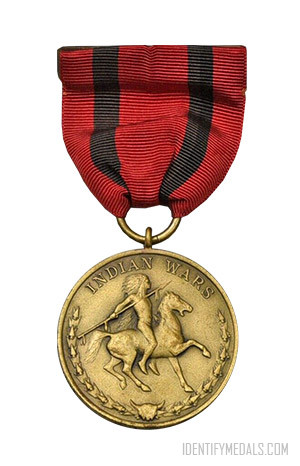
Originally, the medal featured an all-red ribbon; however, in December 1917, two black stripes were added to avoid confusion with the ribbon of the French Legion of Honor, which bore a similar appearance.

In addition to the medal itself, campaign streamers were authorized for units that participated in Indian Wars as early as 1790. These streamers, bearing the same design as the service ribbon, are displayed as recognition of a unit’s campaign credit. The inscriptions on the streamers that are displayed on the organizational flag correspond to the unit’s lineage and honors. For the Army flag, there are 14 prescribed inscriptions for the campaign streamers, which can be found in AR 840-10 and AR 600-8-22.

The Indian Campaign Medal Design

The bronze medal measures 1 ¼ inches in diameter. The obverse side showcases a mounted Indian facing to the left, adorned with a war bonnet and holding a spear in his right hand. Positioned above the horseman are the words “Indian Wars,” while below, a buffalo skull is flanked by arrowheads arranged in a conventional manner to complete the circle.

On the reverse side, a trophy is depicted, featuring an eagle perched on a cannon supported by crossed flags and rifles. Additional elements of the trophy include an Indian shield, spear, and quiver of arrows, a Cuban machete, and a Sulu kriss. Below the trophy, the words “For Service” are inscribed. Surrounding the design is a circular border with the words “United States Army” in the upper half, while the lower half is adorned with thirteen stars.

The medal is suspended by a ring and is worn with a silk moire ribbon measuring 1 ⅜ inches in length and 1 ⅜ inches in width. The ribbon consists of a red stripe measuring ¼ inch, followed by a black stripe measuring 3/16 inch. Next is a red band measuring ½ inch, again followed by a black stripe measuring 3/16 inch, and finally, a red stripe measuring ¼ inch.

The Air Force Cross

The Air Force Cross is the United States Air Force and the United States Space Force’s second-highest military decoration.

The Air Force Cross is a prestigious military decoration awarded by the United States Air Force. It is presented to members of the U.S. Air Force who have demonstrated extraordinary heroism and valor in combat situations. Established in 1960, the Air Force Cross is the second-highest military award specifically for Air Force personnel, ranking below the U.S. Medal of Honor.

The Air Force Cross recognizes acts of exceptional courage and bravery performed by individuals while involved in military operations against an enemy force. It honors those who have displayed selflessness, dedication, and extraordinary leadership in the face of great danger. The recipients of the Air Force Cross have often risked their lives above and beyond the call of duty to protect their fellow servicemembers and achieve mission objectives.

The Air Force Cross Medal Criteria

The criteria for receiving the Air Force Cross are stringent, requiring evidence of extraordinary heroism that is not quite at the level required for the Medal of Honor. The actions for which the Air Force Cross is awarded must be of great significance and involve personal risk, demonstrating bravery and valor beyond what is expected in the normal course of duty.

Similar to other military awards, the Air Force Cross is usually accompanied by a citation that describes in detail the recipient’s heroic actions. These narratives serve to honor the individual’s extraordinary deeds and provide a lasting tribute to their courage and commitment to duty.

The Air Force Cross Medal Design

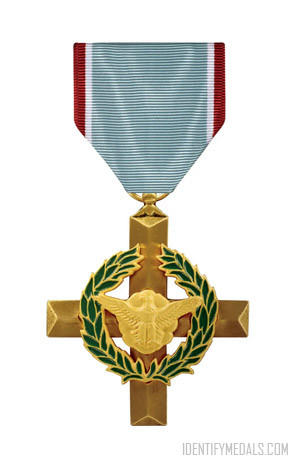
The Air Force Cross is composed of a bronze cross featuring an oxidized satin finish. Adorning the center of the cross, on the obverse, is a gold-plated American bald eagle, its wings displayed against a backdrop of clouds inspired by the crest of the Department of the Air Force Seal. The eagle is encompassed by a laurel wreath, delicately finished with green enamel. On the reverse side of the medal, there is no design, allowing for personalization through engraving. Recipients’ rank (abbreviated), first name, middle initial, last name, and branch of service can be engraved in capital letters.

The ribbon associated with the Air Force Cross, serving as both the decoration’s ribbon and service ribbon, displays a vibrant Brittany blue hue. The edges of the ribbon are adorned with a striking red border, while a slim white vertical stripe resides within the red edges. The ribbon closely resembles the one used for the Army’s Distinguished Service Cross, with the exception of a lighter blue center stripe. This subtle variation in color signifies the close connection between these distinguished awards.

Right Now on eBay 
Clicking a link to eBay may result in a referral commission being paid if a purchase is made.
Loading...

The New York City Police Department Combat Cross

The New York City Police Department Combat Cross is the second highest departmental award of the NYPD and awarded for heroism.

The New York City Police Department Combat Cross is the second highest departmental award of the NYPD. It was established in 14 Augusta, 1934, and awarded to police officers who, “having received Honorable Mention awards, successfully and intelligently perform an act of extraordinary heroism while engaged in personal combat with an armed adversary under circumstances of imminent personal hazard to life”.

The Police Combat Cross was first awarded July 19, 1934, to six members of the police department for heroic service in the previous year. More than two hundred members of the New York Police Department have been awarded the Police Combat Cross.

The New York City Police Department Combat Cross Design

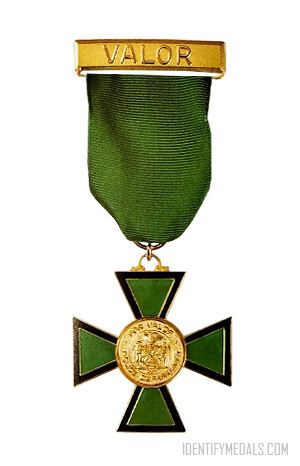
The medal is a gold Maltese Cross with the seal of New York City set in the center obverse and surrounded by the inscription, “For Valor, Police“. The name of the holder and the year of awarding are engraved on the reverse.

The cross is suspended by a ring from green silk ribbon. If the Combat Cross is awarded a second time, a gold palm leaf is set in the center of the ribbon.

More New York City Police Department Medals

NYPD medals are awards presented by the New York City Police Department to recognize and honor the bravery, service, and exceptional achievements of its officers. These medals serve as symbols of honor and pride within the NYPD, highlighting the commitment and sacrifice of its members in safeguarding the communities they serve. 

The New York City Police Department Medal of Valor

The New York City Police Department Medal of Valor is the department’s third highest medal, conferred for acts of outstanding bravery.

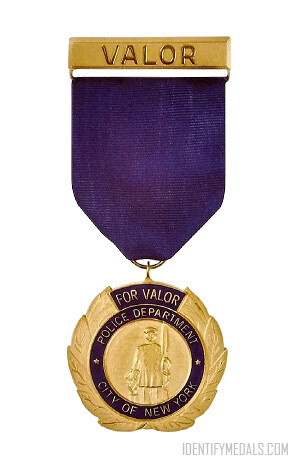
The New York City Police Department Medal of Valor is the department’s third highest medal, conferred for acts of outstanding personal bravery intelligently performed in the line of duty at imminent personal hazard to life under circumstances evincing a disregard of personal consequences.

Mayor Michael Bloomberg and NYPD Police Commissioner Raymond Kelly awarded the first 13 Medals for Valor at the 2006 Medal Day Ceremony in New York.

The NYPD Medal of Valor Design

The obverse of the medal bears the image of the Police Memorial Statue, representing the years of selfless service that New York City police officers have given to its citizens. Surrounding the center is a Mediterranean evergreen laurel leaves, representing honor and glory dating back to ancient Rome. The outer background and ribbon are police blue. The words “For Valor, Police Department City of New York” are written on the face of the medal in gold lettering. The two gold stars signify the level of importance associated with this recognition. The reverse bears the inscription of the recipient’s name.

The breast bar is a solid blue bar.

More New York City Police Department Medals

NYPD medals are awards presented by the New York City Police Department to recognize and honor the bravery, service, and exceptional achievements of its officers. These medals serve as symbols of honor and pride within the NYPD, highlighting the commitment and sacrifice of its members in safeguarding the communities they serve. 

The New York City Police Department Medal of Honor

The New York City Police Department Medal of Honor is the highest law enforcement medal of the NYPD and awarded for extraordinary bravery.

The New York City Police Department Medal of Honor is the highest law enforcement medal of the NYCPD and awarded for individual acts of extraordinary bravery performed in the line of duty at extreme risk and danger to life.

The NYPD Medal of Honor was created on October 23, 1973, although there are some earlier versions from as early as 1871. Back then, the decoration was known by a variety of names such as the “Police Silver Medal” and “Gold Medal of Valor“. These were first awarded on August 17, 1871 to Patrolman Bernard Tull of the 19th Precinct who arrested a burglar after being shot at. 

The New York City Police Department Medal of Honor was created in 1912 and was awarded until 1972, when it was redesigned.

The NYPD Medal of Honor Design

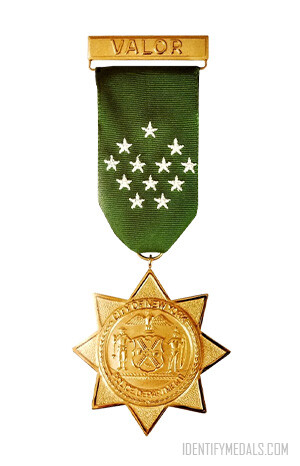
The initial medals were silver or gold and had the shape of the then shield of the department. On the obverse were the arms of the City of New York, the names of the police commissioners, and the words “Municipal Police”. On the reverse was an inscription describing the act for which the medal was awarded.

Later, the NYPD medal was changed to a silver medal in the shape of a police shield. On the obverse is the figure of a draped female placing a wreath upon the head of a police officer. On the reverse is an inscription of the act of bravery and the names of the city’s commissioners.

The medal hangs from a ring and suspender on which the letters “NY” are interlocked and attached to a top bar that is inscribed with the word “valor”.

The stars on the green ribbon commemorate the city’s original 12 police constables, who began to patrol in the 1700s.

More New York City Police Department Medals

NYPD medals are awards presented by the New York City Police Department to recognize and honor the bravery, service, and exceptional achievements of its officers. These medals serve as symbols of honor and pride within the NYPD, highlighting the commitment and sacrifice of its members in safeguarding the communities they serve. 

The 1957 Texas Rangers “Blue Bottle Cap” Badge

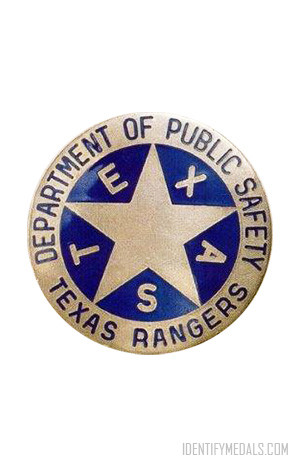
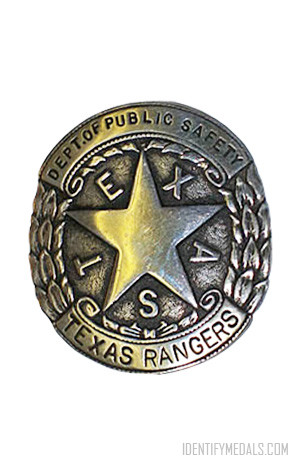
The 1957 Texas Rangers “Blue Bottle Cap” Badge was issued to the Rangers and featured blue enamel paint on polished metal.

The 1957 Texas Rangers “Blue Bottle Cap” Badge was issued to the Rangers and featured blue enamel paint on polished metal. The badge was created by the Texas Department of Public Safety. 

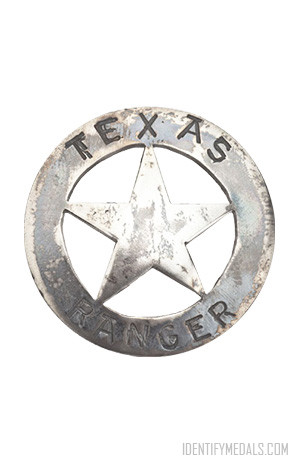
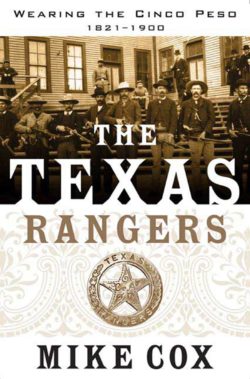
It’s said that most Rangers were not happy with the result because it was too severe a break from the traditional frontier designs. That’s probably why it was soon replaced by the 1962 Texas Rangers badge, which is actually based on a Cinco Peso Mexican silver coin. 

Other Texas Rangers Badges

Find Texas Rangers Badges Online

Right Now on eBay 
Clicking a link to eBay may result in a referral commission being paid if a purchase is made.
Loading...

Further Reading About the Texas Rangers

The 1962 Texas Rangers Badge

The 1962 Texas Rangers Badge was designed in 1961-62 and is a five-pointed star symbolizing the “Lone Star” of Texas.

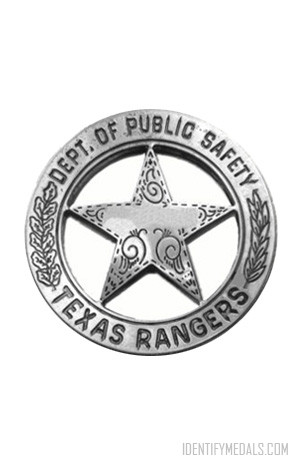
The 1962 Texas Rangers Badge was designed in 1961-62 and is a five-pointed star symbolizing the “Lone Star” of Texas. The badge was created by Ranger Hardy L. Purvis in honor of his late father, Ranger Captain Hardy B. Purvis, and his mother. When Purvis presented the badge to the Texas Department of Public Safety, he also gave the Dept enough Cinco Peso Mexican silver coins for the sixty-two rangers at the time. 

Colonel Homer Garrison, Jr., Director of the Texas Department of Public Safety and Chief of the Texas Rangers, announced in October 1962, that the Texas Rangers are going back to the tradition steeped in history of a Mexican silver badge worn by their predecessors during frontier days. The new official Ranger badge, issued to each of the 62 members of the Force, is a replica of the historic original badge which old-time Rangers carved out of a Mexican five-peso silver dollar.

Modern Texas Rangers receive two badges when they are promoted to the Ranger Service. The first is the silver badge made from a Mexican Cinco peso coin. The second a bronze, silver-plated badge to carry in their identification case. 

Other Texas Rangers Badges

Find Texas Rangers Badges Online

Further Reading About the Texas Rangers

The 1935 Texas Rangers Badge

The 1935 Texas Rangers Badge is a shield overlaid with a circle star. It was the first official badge by the Texas Dept. of Public Safety.

The 1935 Texas Rangers Badge is a shield overlaid with a circle star. It was the first official badge by the Texas Department of Public Safety.

Other Texas Rangers Badges

Find Texas Rangers Badges Online

Right Now on eBay 
Clicking a link to eBay may result in a referral commission being paid if a purchase is made.
Loading...

Further Reading About the Texas Rangers

The Texas Rangers Ira Aten Badge

The Texas Rangers Ira Aten Badge dates to the 1880s. It is the earliest surviving Texas Rangers badge known and belonged to Ira Aten.

The Texas Rangers Ira Aten Badge dates to the 1880s. It is the earliest surviving Texas Rangers badge known and belonged to Ira Aten. 

Ira Aten (September 3, 1862 – August 5, 1953) was a Texas Ranger born in Cairo, Illinois. Aten was assigned to the counties bordering the Rio Grande, and due to the rough nature of this area, he became involved in numerous dangerous encounters. He was inducted into the Texas Rangers Hall of Fame.

Other Texas Rangers Badges

Find Texas Rangers Badges Online

Right Now on eBay 
Clicking a link to eBay may result in a referral commission being paid if a purchase is made.
Loading...

Further Reading About the Texas Rangers

The South Vietnam Campaign Medal

The Republic of Vietnam Campaign Medal (or Chiến Dịch Bội Tinh), is a South Vietnamese military campaign medal created in 1949.

The Republic of Vietnam Campaign Medal (or Chiến Dịch Bội Tinh in Vietnamese), is a South Vietnamese military campaign medal created in 1949 and awarded for two different periods of service in Vietnam.

The medal was first awarded to French military personnel during the First Indochina War (from 8 March 1949 to 20 July 1954). During the Vietnam War (Second Indochina War), the South Vietnamese government awarded the Republic of Vietnam Campaign Medal with Device (1960– ) to members of the South Vietnamese military for wartime service and on March 24, 1966, to members of the U.S. military for support of operations in Vietnam. In May 1966, other allied foreign military personnel became eligible for the award.

On 30 April 1975, Saigon was captured by the North Vietnamese army and South Vietnam surrendered and disbanded. The medal was not awarded after 28 March 1973, when the last U.S. troops left South Vietnam in accordance with the Paris Peace Accords.

In the United States, Public Law 88–257 permits military personnel to accept the medal for service performed in Vietnam from 1 March 1961 to 28 March 1973, inclusive. Since March 1966, the medal may also be awarded to any service member who, while serving outside the geographical limits of the Republic of Vietnam, contributed direct combat support to the Republic of Vietnam Armed Forces for six months.

The Republic of Vietnam Campaign Medal was awarded to Australian military personnel for service in South Vietnam during the period 31 July 1962 to 28 March 1973. The medal was awarded to New Zealand Forces for service in Vietnam for six months between 1964 (arrived Vietnam June 1964) and 1973 (left Vietnam 22 December 1972).

The South Vietnam Campaign Medal Design

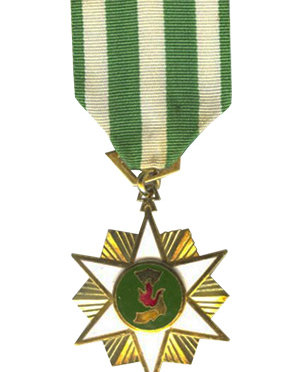
The medal is made of a gold-colored metal in the shape of a 36 mm wide six-pointed white enameled star with six-pointed gold rays between the arms of the star. During the Vietnam War, the Republic of Vietnam Campaign Medal with Device (1960–) was manufactured in the United States.

In the obverse, in the center of the star is an 18 mm green colored disc bearing a gold-colored map of Vietnam with three painted flames in red between North and South Vietnam, signifying the three regions of Vietnam. On the reverse of the medal is a circle bearing the inscription Chiến Dịch (Campaign) above and Bội Tinh (Medal) below the word VIET-NAM in the center.

The suspension ribbon and service ribbon of the medal is stripes in green (to represent freedom) with three vertical white (to represent purity).

Find This Medal Online

Right Now on eBay 
Clicking a link to eBay may result in a referral commission being paid if a purchase is made.
Loading...