The Cross of Valor (Poland)

The Cross of Valor is a military decoration from Poland first introduced in 1920 for deeds of valour and courage on the field of battle.

The Cross of Valour (or Krzyż Walecznych in Polish) is a military decoration from Poland. It was first introduced by the Council of National Defense on 11 August 1920 and it is awarded to an individual who “has demonstrated deeds of valour and courage on the field of battle.” It may be awarded to the same person up to four times.

The medal was introduced in 1920 at the height of the Polish-Soviet War, shortly before the Battle of Warsaw. Through 29 May 1923, when the last medal for the Polish-Soviet War was awarded, the Cross of Valour had been granted to some 60,000 soldiers.

Apart from individuals who had participated in the Polish-Soviet War, the medal had also been awarded retroactively to some soldiers of the Polish Legions, of World War I military units, of the Silesian Uprisings, of the Great Poland Uprising, and to members of the Polish Military Organization. It had been awarded, as well, to veterans of the January 1863 Uprising and to the city of Płock. On 20 September 1940, the President of Poland agreed to award the medal to eligible individuals who had already been awarded it four times during the Polish-Soviet War. In 1943, after the Battle of Lenino, General Zygmunt Berling awarded the Cross of Valour to several soldiers.

The medal itself was approved as a military decoration by order of the Home National Council on 22 December 1944. Until 1947, some 40,000 of the medals had been awarded to Polish soldiers fighting alongside the Red Army.

The medal is given only in wartime or shortly after.[/vc_column_text][vc_column_text css=”.vc_custom_1611843202750{padding-top: 24px !important;}”]

The Cross of Valour Design

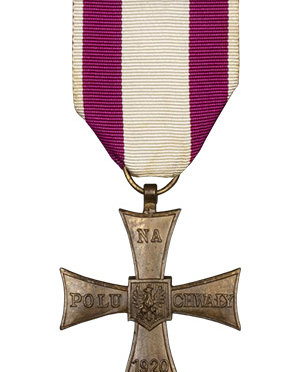
The award has the shape of a bronze cross.

On the obverse, in the center is a Polish crowned eagle with spread wings within a central shield. On the arms an inscription “Na Polu Chwały 1920” meaning “On the fields of Glory 1920”. The reverse bears an upright sword piercing a laurel wreath leaf crown with the inscription “Walecznym” meaning, “Valourious“.#

The cross is suspended from a purple and white ribbon.
The Order of Polonia Restituta

The Order of Polonia Restituta is a Polish state order conferred on military, civilians, or foreigners for outstanding achievements.

The Order of Polonia Restituta (or Order Odrodzenia Polski in Polish, Order of the Rebirth of Poland in English) is a Polish state order established in 1921 and conferred on both military and civilians as well as on foreigners for outstanding achievements in the fields of education, science, sport, culture, art, economics, national defense, social work, civil service, or for furthering good relations between countries.

The Order of Polonia Restituta was established on 4 February 1921 with Marshal Józef Piłsudski as first Grand Master. The Marshal awarded the first recipients on 13 July 1921. 

After World War II both the Polish government-in-exile and the Communist People’s Republic of Poland, aligned with the Warsaw Pact, awarded the order, though the versions differed slightly. The order was saved from abuse as it was simply passed over in favor of more traditional communist awards. During this time, the Order of Merit of Poland became the favored award for foreigners.

On 22 December 1990 the Polish government-in-exile returned the rights to its version of the order to the new Polish state. Invalid awards have been revoked and today the remaining communist versions of the order hold the same status as any other issues.

The Order of Polonia Restituta has five classes, categorized according to the Constitution of Poland, Article 138, as follows:

  • Grand Cross. Order of Polonia Restituta First Class, Krzyż Wielki, the Grand Cross, referred to as the Grand Cordon.
  • Commander’s Cross with Star. Order of Polonia Restituta Second Class, Krzyż Komandorski z Gwiazdą, the Commander’s Cross with Star. 
  • Commander’s Cross. Order of Polonia Restituta Third Class, Krzyż Komandorski, the Commander’s Cross.
  • Officer’s Cross. Order of Polonia Restituta Fourth Class, Krzyż Oficerski, the Officer’s Cross. 
  • Knight’s Cross. Order of Polonia Restituta Fifth Class, Krzyż Kawalerski, the Knight’s Cross.

The Order of Polonia Restituta Design

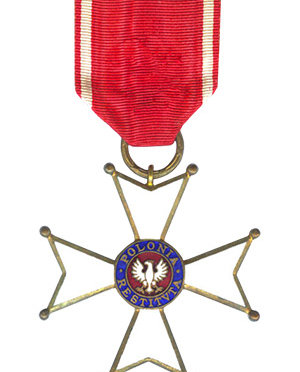
The badge of the Order of Polonia Restituta is a gold Maltese cross enameled in white.

The obverse central disc bears a white eagle on a red background, the Coat of Arms of Poland, surrounded by a blue ring bearing the words “Polonia Restituta“. The reverse central disc bears the year 1918 (for the People’s Republic of Poland version: 1944).

The badge is worn on a ribbon, red with a white stripe near the edges, as a sash on the right shoulder for Grand Cross, around the neck for Commander with Star and Commander, on the left chest with a rosette for Officer, and on the left chest without rosette for Knight.

The star of the order is an eight-pointed silver star with straight rays. The central disc is in white enamel, bearing the monogram “RP” (Republic of Poland) (for the People’s Republic of Poland, “PRL”) and surrounded by a blue ring bearing the Latin words “Polonia Restituta“.

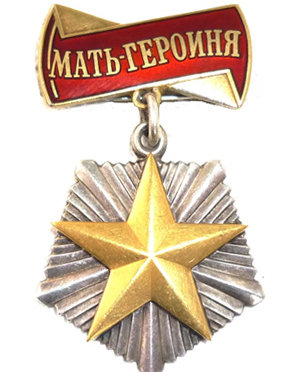
The USSR Mother Heroine Medal

The USSR Mother Heroine Medal was an honorary title established in 1944 and awarded to all mothers bearing and raising 10 or more children.

The USSR Mother Heroine Medal (or Мать-героиняMat’-geroinya in Russian) was an honorary title established on 8 July 1944 and awarded to all mothers bearing and raising 10 or more children.

The title was awarded upon the first birthday of the last child, provided that nine other children (natural or adopted) remained alive. Children who had perished under heroic, military, or other respectful circumstances were also counted. The title was accompanied by the bestowal of the Order “Mother Heroine” and a certificate conferred by the Presidium of the Supreme Soviet of the Soviet Union.

The state’s intent was not only to honor such large families but also to increase financial assistance for pregnant women, mothers of large families, and single mothers, and to promote an increased level of health in mother and child.

The award was established in 1944 and continued to exist until the fall of the Soviet Union in 1991. Approximately 430,000 women were awarded this title during its existence.

The USSR Mother Heroine Design

The medal is a solid gold star superimposed on a silver pentagon with rays facing outwards. It measures 30.74 mm in height including the eyelet and 27.27 mm in width. It weighs 12.1 gram without and 16.2 gram with suspension.

The suspension is a bar decorated in red enamel and bearing the words “Мать-героиня” (Mother Heroine).

The People’s Artist of the USSR Medal

The People’s Artist of the USSR Medal was an honorary title granted to artists of the Soviet Union for exceptional achievements in arts.

The People’s Artist of the USSR Medal (or Наро́дный арти́ст СССРNarodný artist SSSR in Russian) was an honorary title granted to artists of the Soviet Union. The title was introduced in 1936, replacing the earlier title of “People’s Artist of the Republic“.

The title was bestowed for exceptional achievements in the performing arts. Its recipients included many of the most acclaimed composers, dancers, singers, film and theatre directors, and actors of every Soviet republic.

Each Soviet Republic and the Autonomous Republics had a similar award held previously by virtually every receiver of the higher title of People’s Artist of the USSR.

Honorees were afforded certain privileges and would often receive commissions from the Minister of Culture of the Soviet Union. Accordingly, artists and authors who expressed criticism of the Communist Party were seldom granted such recognition, if not outright censored.

The first recipients of the title (6 September 1936) were Konstantin StanislavskiVladimir Nemirovich-DanchenkoIvan MoskvinAntonina NezhdanovaBoris ShchukinKulyash Baiseitova, and some other actors. In all, there were 1006 recipients of the award.

The People’s Artist of the USSR Medal Design

The medal was made of tombac and its shape was quadrangular with twisted corners. It measures 22.5 by 23.5 mm.

The central part is occupied by the inscription “Наро́дный арти́ст СССР” and, below, the hammer and sickle symbol. Both the symbol and inscription are embossed, with convex letters.

The medal is suspended to a single red silk fringe measuring 18 mm by 21 mm with an attached metallic buckle decorated with bay laurel leaves.

The USSR Marshal’s Star

The Marshal’s Star (or маршальская звезда in Russian) is a badge of rank worn by marshals of the armed forces of the Soviet Union.

The Marshal’s Star (or маршальская звезда in Russian) is a badge of rank worn by marshals of the armed forces of the Soviet Union (and then the Russian Federation). Officially their names have changed, depending on what ranks received the right to wear them, and are known as the large marshal’s star and the small marshal’s star.

Marshal’s stars were first awarded to the marshals and admirals of the fleet of the Soviet Union. In time, smaller stars were awarded to “marshals of an arm of service” and “chief marshals of an arm of service”, admirals of the fleet, and later generals of the army of the Soviet armed forces.

On the death of the recipient, the award is returned to the diamond fund for re-use. Approximately 200 of this type of marshal’s star were produced.

The USSR Marshal’s Star Design

The medal is a gold five-pointed star with smooth diagonal rays on the front side. In the center is a platinum, five-pointed star with diamonds. The diameter of the gold star is 44.5 millimeters (1.75 in) and the platinum stars are 23 millimeters (0.91 in) in diameter. The star has a depth of 8 millimeters (0.31 in).

The marshal’s star has a triangular eyelet in the upper beam which is connected to an oval eyelet measuring 14 millimeters (0.55 in). The diamonds in the center have a total weight of 2.62 carats and in the rays, there are 25 diamonds weighing a total of 1.25 carats. Between the edges of rays are 5 diamonds weighing a total of 3.06 carats. 

A Marshal of the Soviet Union’s star used a red satin ribbon suspension; ribbons for marshals of a branch varied accordingly: gold for artillery, light blue for aviation, burgundy for armored troops, crimson for engineers, blue for signals, and turquoise for the navy.

The armed forces of the former Soviet Union and the Russian Federation wear two insignia around neck when in parade uniform. There are two different sizes of stars. In 2013, new shoulder insignias were instituted for generals of the army, fleet admirals, and generals of the army. These insignias have one large marshal’s star on the board similar to the style worn by Soviet generals from the early 1970s through 1997.

The Territorial Efficiency Medal (1921)

The Territorial Efficiency Medal is a United Kingdom award for long service in the Territorial Army awarded for a minimum of 12 years service.

The Territorial Efficiency Medal (or TEM) is a United Kingdom award for long service in the Territorial Army established in 1921 and awarded to non-commissioned officers and men for a minimum of 12 years service in the Territorial Army – provided they attended 12 annual training camps.

Bars for further periods of 12 years service were intended but never issued since the medal was superseded by the Efficiency Medal after 9 years. Previous service in other part-time forces including the Territorial Force could count, while war service counted double. 

The award superseded the Territorial Force Efficiency Medal when the Territorial Force became the Territorial Army in 1921. It was superseded by the Efficiency Medal in 1930.

The Territorial Efficiency Medal (1921) Design

The medal is oval, struck in silver and measures 38 millimeters (1.5 inches) high and 31 millimeters (1.2 inches) wide.

The obverse shows the effigy of King George V in Field Marshall’s uniform facing left, circumscribed by the inscription “GEORGIVS V BRITT: OMN: REX ET IND: IMP:“. The reverse bears a raised rim and bears the inscription “TERRITORIAL EFFICIENCY MEDAL” on three lines.

The ribbon is 32 millimeters (1.26 inches) wide, plain dark green with yellow edges. The medal hangs from a ring suspension, attached to the medal by a claw fixing. The recipient’s service number, rank, name, and unit were impressed on the edge of the medal.

For members of the Honorable Artillery Company (HAC) the ribbon was half blue, half scarlet with yellow edges.

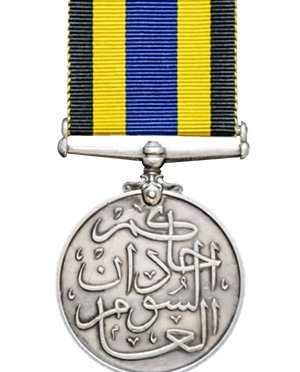
The Sudan Defence Force General Service Medal

The Sudan Defence Force General Service Medal is a campaign medal awarded for service in minor operations within the Anglo-Egyptian Sudan.

The Sudan Defence Force General Service Medal is a campaign medal instituted in 1933 and awarded for service in minor operations within the Anglo-Egyptian Sudan.

The medal superseded the Khedive’s Sudan Medal (1910) and was awarded on the recommendation of the Commandant of the Sudan Defence Force (SDF) to locally recruited personnel of the SDF, police and other approved Sudanese who served in minor operations classed by the Governor-General as of sufficient importance to warrant the grant of the medal.

About 9,000 SDF General Service Medals were issued. No further awards were made after 1945, with the medal becoming obsolete with Sudanese independence in 1956.

The Sudan Defence Force General Service Medal Design

The medal is circular, struck in silver and measures 36 millimeters in diameter.

The obverse shows the seal of the Governor-General of Sudan. The reverse bears a stationary group of Sudanese soldiers, with “The Sudan” in Arabic below.

The ribbon has a central stripe of royal blue, edged by two yellow stripes and two black stripes at the edges.

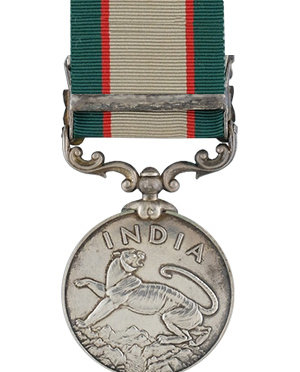
The India General Service Medal 1936-39

The Indian General Service Medal is a campaign medal approved in 1938 for issue to men of the British and Indian armies and of the RAF.

The Indian General Service Medal (or 1936 IGSM) is a campaign medal approved on 3 August 1938, for issue to officers and men of the British and Indian armies, and of the Royal Air Force.

The medal was awarded for minor military campaigns on the North-West Frontier of India between 1936 and 1939. Each campaign covered by the medal was represented by a clasp on the ribbon; two were sanctioned, both relating to operations in Waziristan:

  • North West Frontier 1936–37
  • North West Frontier 1937–39

Following the grant of Indian Independence in 1947 the medal became obsolete, although it could still to be worn in uniform by British, Indian and Pakistani servicemen.

The India General Service Medal 1936-39 Design

The medal is circular, struck in silver and measures 36 millimeters in diameter.

The obverse shows a crowned effigy of King George VI. The reverse bears a tiger with the word INDIA across the top.

The ribbon is stone colored flanked by narrow red stripes, with broad green stripes at the edges.

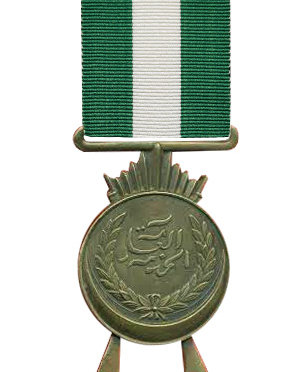
The Iraq Active Service Medal

The Iraq Active Service Medal, also known as the King Faisal’s War Medal, is a British campaign medal established in May 1926. 

The Iraq Active Service Medal, also known as the King Faisal’s War Medal, is a British campaign medal established in May 1926.

The medal was awarded to British Army and RAF personnel stationed in Iraq or serving with the Iraq Levis. It was originally issued without a clasp, but clasps denoted subsequent actions or periods of service.

From 1931 on, medals were issued with appropriate clasps from the outset.

The Iraq Active Service Medal Design

The medal is circular, struck in bronze and measures 38 millimeters in diameter.

The obverse shows a crescent forming the lower part, with an Arabic inscription above signifying “General Service” in two laurel branches. The medal is superimposed on crossed rifles, with rays in the arc between the muzzles.

The reverse bears the name of King Faisal I in Arabic and the date (AH) 1344 (1926).

The ribbon measures 31 millimeters and has equal stripes in green, white and green. The suspension is a flattened loop suspender.

The General Service Medal 1918-62

The General Service Medal (1918 GSM) was instituted in 1923 to recognize service in certain minor Army and Royal Air Force operations.

The General Service Medal (1918 GSM) was instituted in 1923 to recognize service in minor Army and Royal Air Force operations for which no separate medal was intended.

Local forces, including police, qualified for many of the clasps, as could units of the Indian Army prior to 1947.

A total of eighteen clasps were awarded, the medal never being awarded without a clasp. The clasps are:

  • S. Persia
  • Kurdistan
  • Iraq
  • N.W. Persia
  • Southern Desert Iraq
  • North Kurdistan
  • Palestine
  • S.E. Asia 1945–46
  • Bomb and Mine Clearance 1945–49
  • Bomb and Mine Clearance 1949–56
  • Palestine 1945–48
  • Berlin Airlift
  • Malaya
  • Canal Zone
  • Cyprus
  • Near East
  • Arabian Peninsula
  • Brunei

The General Service Medal 1918-62 Design

The medal is circular, struck in silver and measures 36 millimeters (1.4 in) in diameter. It was designed by E Carter Preston.

The obverse bears the crowned effigy of the reigning monarch: George V coinage head (1918-30), George V crowned and robed bust (1931-36), George VI Ind Imp (1937-49), George VI Fid Def (1949-52), ELizabeth II Br Omn (1952-54) and Elizabeth II Dei Gratia (1955-62).

The reverse shows the standing winged figure of Victory in a Corinthian helmet and carrying a trident, bestowing a wreath on the emblems of the Army (the sword) and the RAF (the wings).

The ribbon is 32 mm (1.3 in) wide and has three equal stripes of purple, dark green and purple.

The service number, rank, name and regiment or corps of the recipient are impressed on the rim of the medal in small block capitals. A bronze oak leaf emblem is worn on the ribbon of the medal to signify a mention in dispatches or King’s/Queen’s Commendation for a campaign for which the GSM was awarded.

The clasps consist of silver bars bearing the name of the relevant campaign or theatre of operations. They are attached to the medal’s suspension bar.