The Order of the Sacred Tripod

The Order of the Sacred Tripod or Pao Ting is a military award of the Rep. of China created in 1929 for contributions to national security.

The Order of the Sacred Tripod (or 寶鼎勳章 in Chinese), also referred to as the Order of the Precious Tripod or Pao Ting, is a military award of the Republic of China created on 15 May 1929 and awarded for significant contributions to national security.

The medal is the general medal of the three services of the Republic of China to commend those who defend against foreign aggression. Its rank is lower than the Blue Sky and White Sun Medal and higher than the Yun Yun Medal.

The order is organized into nine grades:

  • 1st, with Special Grand Cordon.
  • 2nd, with Grand Cordon.
  • 3rd, with Red Grand Cordon.
  • 4th, with Special Cravat.
  • 5th, with Cravat.
  • 6th, with Special Rosette.
  • 7th, with Rosette.
  • 8th, with Special Ribbon.
  • 9th, with Ribbon.

The grade received vary according to military rank. The first to fourth are awarded to general officers. The third to sixth ranks are awarded to school officers. The fourth to seventh ranks are awarded to lieutenants. Waiting officers, warrant officers, and soldiers are awarded the sixth to ninth class.

The Order of the Sacred Tripod Design

The central design of the order’s insignia is an image of a tripod surrounded by golden rays. The symbolism of this is that as the tripod is considered a national treasure, so too is the recipient of the order.
The National Security Voluntary Militia’s Long Service Cross

The National Security Voluntary Militia’s Long Service Cross was established in 1933 and awarded for 10 ys of good services in the militia.

The National Security Voluntary Militia’s Long Service Cross (or Milizia Volontaria per la Sicurezza Nazionale in Italian) is a medal established in Italy on 23 January 1933 by royal decree and awarded for 10 years of good services within the militia.

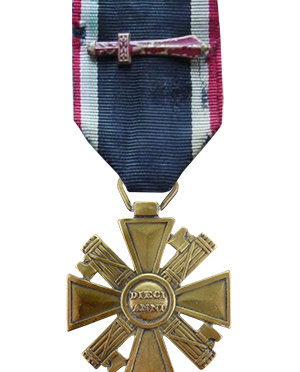
In 1943, it became necessary to also create a decoration for 20 years service. Due to the critical wartime situation, the decision was made to not strike a new cross with a 20 year reverse but instead to institute a ribbon device. This device, a Roman swords colored red, was instituted on 28 January 1943.

The National Security Voluntary Militia's Long Service Cross Design

The medal is a cross-pathée with fasces between the arms. It’s struck in bronze and measures 38 mm wide by 42.3 mm high. The suspension is a laterally-pierced ball.

The obverse shows the initials ‘MVSN’ for the Milizia Volontaria per la Sicurezza Nazionale (National Security Volunteer Militia), popularly referred to at the ‘Blackshirts’.

The reverse has the inscription “DIECI / ANNI” (Ten Years).

The Commemorative Medal for Rescue from Danger 1925-1933

The Commemorative Medal for Rescue from Danger 1925-1933 was instituted on 9 June 1925 for rescue from danger at the peril of rescuer’s life.

The Commemorative Medal for Rescue from Danger 1925-1933 was instituted on 9 June 1925 for rescue from danger at the peril of rescuer’s life. The medal was awarded very sparingly.

The Commemorative Medal for Rescue from Danger 1925-1933 Design

The medal is large and circular, and measures 48.72mm (1.92 inches) in diameter. Records show that it was originally manufactured in silver, however there are several examples struck in zinc alloy – perhaps manufactured at a time of material shortages and economic crisis or for collectors at the time.

The obverse has the Prussian eagle, head facing right, wings outstretched, and the inscription ‘REPUBLIK’ above and ‘PREUSSEN’ below. The reverse is inscribed ‘FÜR RETTUNG AUS GEFAHR’ (“For Rescue from Danger”) within an oak leaf border in relief.

The Cross of Independence (Poland)

The Cross of Independence had three versions and was awarded to individuals who had fought heroically for the independence of Poland.

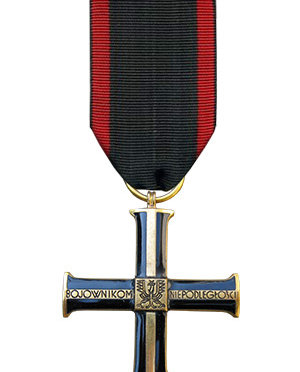
The Cross of Independence (or Krzyż Niepodległości in Polish) was awarded to individuals who had “fought heroically for the independence of Poland” and existed in three versions. It was the second highest Polish military decoration between World Wars I and II.

The Cross of Independence was established with a decree of the President of Poland of 29 October 1930. It was to be awarded to the people who laid foundations for the independence of the Fatherland before the World War or during it, as well as during the fights between 1818 and 1921, with the exception of the Polish-Russian War. After 1938 it was also awarded to people responsible for the reunification of Zaolzie with Poland.

Although the cross without the swords was awarded mainly to the civilians, all versions were considered to be military decorations.

The recipients of all grades of the Cross of Independence had a right to be elected to the Senate of the Republic of Poland, the right to travel by Polish State Railways free of charge and a right to send their children to the schools of their choice free of charge.

The Cross of Independence had three classes:

  1. Cross of Independence with Swords (1818 awarded by 1938)
  2. Cross of Independence (7917 awarded by 1938)
  3. Medal of Independence (51735 awarded all together)

The Cross of Independence Design

Both the Cross and the Medal were designed by professor Mieczysław Kotarbiński and most of the copies were made by Warsaw-based jeweler Wiktor Gontarczyk.

The cross measures 42 by 42 mm and is made of gilt bronze. The obverse has a rectangle shield with stylised eagle in bas-relief. The reverse is covered with black enamel and the motto “Bojownikom Niepodległości” (“To the Fighters for Independence”). The version with Swords had two golden swords crossed above the cross.

The medal of Independence is round, measures 35 mm in diameter, and is made entirely of bronze. On the obverse there is a symbolic depiction of three Hydras (symbolizing three partitioning Powers) stroke with two swords and surrounded by the motto “Bojownikom Niepodległości”. The reverse is plain with letters RP in the center (standing for Rzeczpospolita Polska).

The Volunteer Cross for War 1918-1921

Time Period: Interwar Period, WW1

Year of Institution: 15 June 1939
Country: Poland

The Volunteer Cross for War and the Volunteer Medal for War (or Krzyż i Medal Ochotniczy za Wojnę in Polish) were military decorations from Poland introduced just before the start of World War II and later awarded by the Polish government in exile.

The Volunteer Cross for the War could be awarded to volunteers serving in the years 1918-1921, if they met one of the following criteria:

  • Fallen or wounded on the battlefield,
  • Decorated with the Virtuti Militari Cross or the Cross of Valor,
  • They actively served 3 months, including at least 2 months in units fighting at the front or 6 months as instructors in military schools of weapons and school camps.

The Cross and the Volunteer Medal for War were introduced by an act of the Sejm on 15 June 1939. It was to be awarded to people who volunteered for duty in the years 1918 to 1921 and helped to strengthen the independence of the Polish Republic, covering mainly the Polish-Ukrainian War and Polish-Soviet war.

Because of the German invasion of Poland in 1939 and the outbreak of World War II no decorations were awarded at the time. It was only after 1945 that the Polish government in exile was able to award the decorations. The communist authorities of the People’s Republic of Poland refused to recognize the decoration. After the fall of communism, a very similar decoration, Krzyż za udział w Wojnie 1918-1921, was introduced.

The Volunteer Cross for War 1918-1921 Design

The medal has the form of a straight isosceles cross made of steel and measures 42 by 42 mm. It consists of four equal arms, extended at the ends, with a flattened octagonal cross-section and tied in the centre by a cube.

On the cross arms of the Cross, in the obverse, there is a horizontal inscription: “OCHOTNIKOWI WOJENNEMU”, and on the vertical arms the dates: 1918 and 1921. In the middle of the crossing of the arms there is an image of a white enamel eagle.

The cross and medal were to be worn on a 37 mm wide ribbon in red with two narrow white vertical stripes.

The Commemorative Medal For the War 1918-1921

The Commemorative Medal For the War 1918-1921 medal was awarded to military who served against Soviet Russian forces.

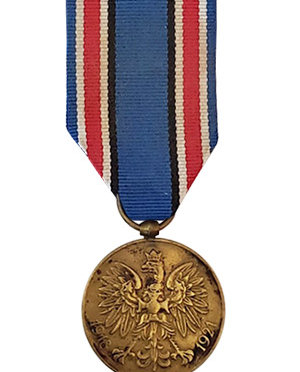
The Commemorative Medal For the War 1918-1921 medal was instituted on 21 September 1928 and awarded to military who served for a minimum of 3 months with a unit actively engaged against Soviet Russian forces during the war of 1918 to 1921.

For volunteers, the qualifying period was two months and for auxiliary units 5 months. There was no qualifying minimum period of service for those wounded in the conflict.

The Polish-Soviet war of 1918 to 1921 arose from the chaos at the end of World War I and the Russian Revolution of 1917, with Poland seeking to reinforce its independence after centuries of occupation and division and expand its frontiers eastward and Soviet forces attempting to take control of former Imperial Russian territories. The Treaty of Riga that ended the war in 1921 effectively divided the disputed area between the two combatants.

The Commemorative Medal For the War 1918-1921 Design

The medal is circular and struck in bronze. It has a laterally pierced cylinder suspension.

The obverse features a Polish eagle, the Order of Virtuti Militari imposed on its chest, and the inscription ‘1918 1921’. The reverse is inscribed ‘POLSKA SWEMV OBROŃCY’ (“Poland for her Defenders”) within an oak leaf border.

The central stripe of the ribbon is blue flanked by thinner stripes of black, white, purple, white and blue.

The Medal for Long Service

The Medal for Long Service is a decoration from Poland awarded in three classes to members of the Armed Forces and other uniformed services.

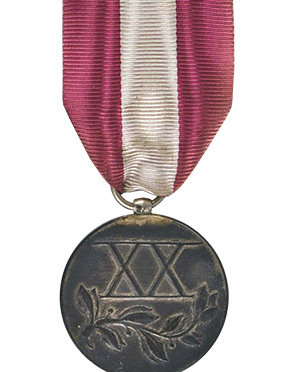
The Medal for Long Service (or Medal za Długoletnią Służbę in Polish) is a decoration established on January 8, 1938 and awarded in three classes (gold, silver, and bronze) to members of the Polish Armed Forces and other uniformed services, and to civil servants who have honorably completed 30, 20 or 10 years of service to the State.

After the outbreak of the Second World War the conferment was suspended, and after that, the medal was eventually discontinued. In 1951, it was replaced by the Medal of the Armed Forces in the Service of the Fatherland for members of the armed forces. The Medal for Long Service was revived by the Law of 14 June 2007, which amended the Act of 16 October 1992, concerning medals and decorations.

The original medal was awarded by the appointed minister to any member of the armed forces or other uniformed services, or to civilian employees of the government or local government following 30 (gold medal), 20 (silver medal), or 10 years (bronze medal) of continuous or cumulative service. The recipients of the medal were required to make a monetary payment for it.

Since 2007 the medal has been conferred by the President of Poland. Unlike its pre-World War II counterpart, the conferment is not automatic but is decided on an individual basis.

The Medal for Long Service Design

The medal is circular, measures 35 mm in diameter, and is made from gilded, silver-plated or bronze-patined metal.

The obverse depicts a Polish crowned eagle surrounded by rye ears and circumscribed “ZA DŁUGOLETNIĄ SŁUŻBĘ” (“FOR LONG SERVICE“). On the reverse are the Roman numerals “XXX” (30), “XX” (20) or “X” (10), with a laurel spray below.

The same numeral in gold, silver or bronze is attached to the ribbon bar. The ribbon has three stripes in red, white, and red.

The Medal for Sacrifice and Courage

The Medal for Sacrifice and Courage was established in 1960 and is awarded to those who, with disregard for their own life, help others.

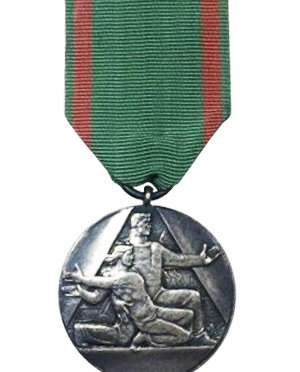
The Medal for Sacrifice and Courage (or Medal za Ofiarność i Odwagę in Polish) is a medal from Poland established on February 17, 1960. It is awarded to those who, with disregard for their own life, save people from drowning, aid the victims of natural disasters, fires, explosions, or other unfortunate circumstances, or protect the property of others during such events.

The Medal for Sacrifice and Courage Design

The medal is round and was designed in 1960 by Józef Gosławski. The obverse features an image of a man and woman framed by a triangular background.

The Cross of Merit (Poland)

The Cross of Merit is a civil state decoration of Poland established on June 23, 1923, to recognize services to the state.

The Cross of Merit (or Krzyż Zasługi in Polish) is a civil state decoration of Poland established on June 23, 1923, to recognize services to the state.

At the time of its establishment in 1923, the Cross of Merit was the highest civilian award in Poland. It was given to citizens who went beyond the call of duty in their work for the country and society as a whole.

The Order has three grades:

1. Gold Cross of Merit (Złoty Krzyż Zasługi)
2. Silver Cross of Merit (Srebrny Krzyż Zasługi)
3. Bronze Cross of Merit (Brązowy Krzyż Zasługi)

The Cross of Merit may be awarded twice in each grade to the same person.

The Cross of Merit Design

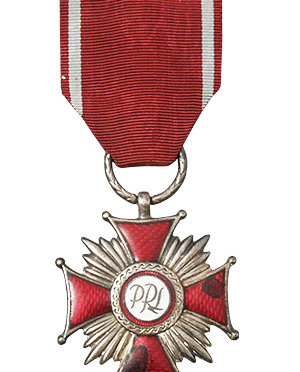
The medal is struck in silver or bronze (the first class with red and white enamels), measures 40.5 mm (w) x 40.5 mm (h) ad weighs approximately 24 grams. The shape is a cross with sunlight rays between the arms.

In the center medallion, in the obverse, are the initials RP (“Rzeczpospolita Polska” or Republic of Poland). The ribbon is red with white edges.

The medal was awarded with a molded box and a certificate.

The Cross of Merit for Bravery (Poland)

The Cross of Merit for Bravery is awarded for selfless bravery in the defense of the law, national borders, and life and property.

The Cross of Merit for Bravery (or Krzyż Zasługi za Dzielność in Polish) is a medal of Poland awarded for selfless bravery in the defense of the law, national borders, and the life and property of citizens in especially difficult circumstances.

The medal was established on March 7, 1928 as a military-grade of the Cross of Merit. The medal was awarded until World War II and was not recognized by the post-war government. On October 16, 1992 the medal was reintroduced and is currently awarded to police officers, firefighters, and several military and civilian agencies involved in intelligence or security.

The Cross of Merit for Bravery Design

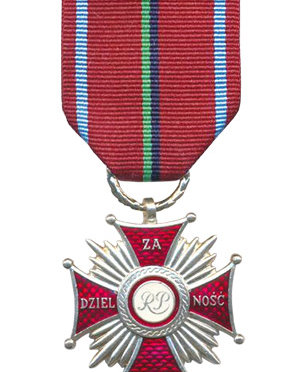
The obverse bears the words “Za Dzielność” (“For Bravery” in Polish) and the letters RP for the Republic of Poland.