The Naval General Service Medal 1909-62

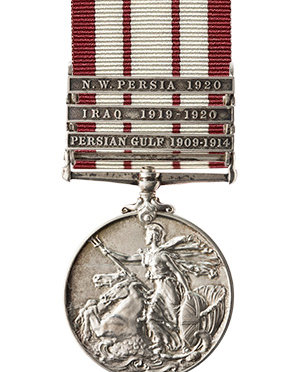
The Naval General Service Medal was instituted in 1915 to recognize service by the Royal Navy and Royal Marines in certain minor campaigns.

The Naval General Service Medal was instituted in 1915 to recognize service by the Royal Navy and Royal Marines in minor campaigns that would not otherwise earn a specific campaign medal.

The Army/Air Force equivalent was the General Service Medal (1918). Both these medals were replaced by the General Service Medal in 1962.

The medal was awarded with the following clasps:

  • MALAYA
  • BOMB & MINE CLEARANCE 1945-46
  • CANAL ZONE

The Naval General Service Medal 1909-62 Design

The medal is struck in silver and measures 36 millimeters in diameter.

It was awarded with one of five obverse designs:

  • George V (1915-36)
  • George VI Ind Imp (1936-49)
  • George VI Fid Def (1949-52)
  • Elizabeth II Br Omn (1952-53)
  • Elizabeth II Dei Gratia (1953-62)

The ribbon is white with broad crimson edges and two narrow crimson stripes towards the center.

The Ceylon Volunteer Service Medal

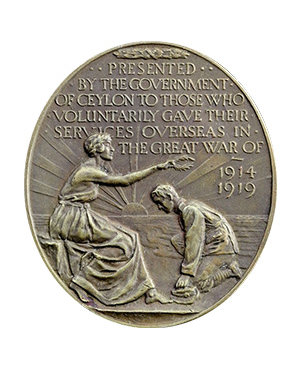
The Ceylon Volunteer Service Medal is a non-wearable campaign medal awarded by the Government of Ceylon during World War I.

The Ceylon Volunteer Service Medal is a non-wearable campaign medal awarded by the Government of Ceylon to all members of the Ceylonese armed forces that volunteered for overseas service during World War I.

The medal was the only one of its kind, Ceylon being the only British crown colony to issue a medal of its own for its citizens’ service in the war. Those awarded the medal were servicemen of either the Ceylon Defence Force, including the all-European Ceylon Planters’ Rifle Corps, or the Ceylon Royal Naval Volunteer Reserve.

Although the exact number of medals struck is disputed, sources cite numbers between 450 and 3000. 

The Ceylon Volunteer Service Medal Design

The medal is cast in bronze and measures 45 by 52 by 3 millimeters.

The obverse bears the personification of Ceylon- a seated, right-facing robed, and laureate female figure placing, with her right hand, a laurel wreath crown on the bowed head of a left-facing soldier kneeling on his left knee. The soldier rests his cap on the ground with his right hand, while the background depicts a multi-rayed sun setting into the sea behind them. An inscription above the scene reads: “PRESENTED BY THE GOVERNMENT OF CEYLON TO THOSE WHO VOLUNTARILY GAVE THEIR SERVICES OVERSEAS IN THE GREAT WAR OF 1914 – 1919“. Above the words is a short piece of laurel wreath, bound.

The reverse shows a front-facing illustration of a winged, robed and laureate Victory seated on a throne. Her right hand is raised aloft, holding a laurel wreath, while her left holds a shield emblazoned with the coat of arms of Ceylon. A plaque inscribed with the recipient’s name is located at the figure’s feet, above a skull and spiked helmet obscuring a horizontal scythe.

The medal was awarded without a ribbon.

The Order of Burma

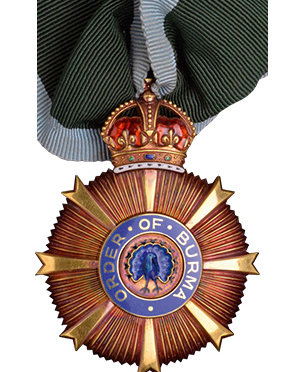
The Order of Burma was awarded by the Governor for long, faithful and honorable service by Commissioned Officers in the Burma Forces.

The Order of Burma was instituted by King George VI three years after Burma became independent of British India. It was awarded by the Governor of British Burma for long, faithful and honorable service by Governor’s Commissioned Officers (for example native Burmese) in the Burma Army, the Burma Frontier Force, and the Burma Military Police.

The award was founded by Royal Warrant on 10 May 1940, and conferred in a single class. It September 1945 the royal warrant was amended to permit awards of the order for gallantry.

Only 24 awards were made.

The Order of Burma Design

The Order was struck in gold and is a rayed circle measuring 52 mm high and 39 mm (1.5 in) in diameter.

The obverse has a central roundel showing a peacock displaying his tail, surrounded by the words ‘ORDER OF BURMA’ and surmounted by an Imperial crown.

The ribbon measures 38 mm and is dark green with light blue edges.

The King’s Medal for Native Chiefs

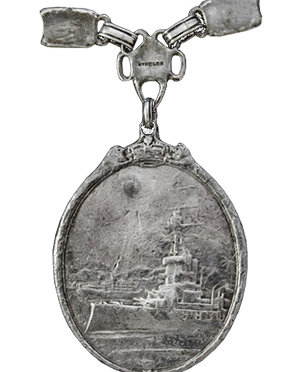
The King’s Medal for Native Chiefs was instituted in 1920 and awarded exceptionally in silver-gilt and usually in silver.

The King’s Medal for Native Chiefs was instituted in 1920 and awarded exceptionally in silver-gilt (First Class) and usually in silver (Second Class).

Various large silver medals were struck for award to native chiefs in various parts of the world, from the eighteenth century onwards. This oval medal was worn around the neck from a silver collar. More modern issues, however, are smaller and intended for wear with a ribbon from the breast.

The medal is normally returned on the death of the recipient.

The King’s Medal for Native Chiefs Design

The medal is struck in silver or silver-gilt and measures 40mm by 34 mm (the original oval with collar) or 36mm by 32mm (the later circular version). 

The obverse bears the crowned effigy of the monarch. The reverse shows a warship, symbolic of imperial power. The medals of Elizabeth II come in two versions: On is larger in size and has a collar, the other is smaller (1955) and fitted with a plain ring for suspension.

The ribbon is yellow watered silk, with two white central stripes (silver-gilt_ or a single white stripe (silver).

The Knight Bachelor’s Badge

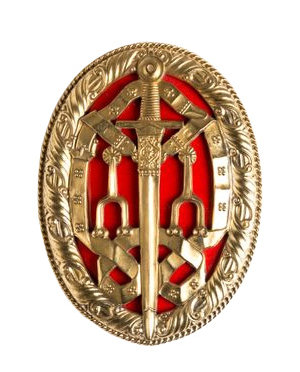
The title of Knight Bachelor (KB) as introduced by King Henry III to recognize a battelier, and the KB badge authorized by George V.

The title of Knight Bachelor (KB) as introduced by King Henry III to recognize a battelier (someone who fought in battle). The badge was authorized by George V in response to a request from the Imperial Society of Knights Bachelors who wished to have a distinctive badge denoting their rank.

Knights Bachelor are the most ancient sort of British knight, but Knights Bachelor rank below knights of chivalric orders. There is no female counterpart to Knight Bachelor.

The Knight Bachelor’s Badge Design

The badge is a silver-gilt and enamel upright oval medallion enclosed by a scroll and bearing a cross-hilted sword, belted and sheathed with the pommel upwards. It’s surrounded by two spurs, rowels upwards, and a sword-belt.

Some pre-war breast badges are struck in metal. The badge measures a maximum of 76.50 millimeters high and 56.50 millimeters wide, but it was reduced in 1933 to 63.25 mm and in 1973 to 54 mm.

The ribbon measures 38 millimeters and is scarlet with broad yellow borders.

The Order of the Companions of Honor

The Order of the Companions of Honor is an order of the Commonwealth founded in 1917 by King George V as a reward for achievements.

The Order of the Companions of Honor is an order of the Commonwealth realms founded on 4 June 1917 by King George V as a reward for outstanding achievements. The Chapel Royal at Hampton Court is now the Chapel of the Order.

The order was initially designed to be bestowed upon a select group of individuals for whom this unique distinction was deemed the most fitting form of recognition, separate from any acceptance of titles or merit classifications. The decoration is now described as “awarded for having a major contribution to the arts, science, medicine, or government lasting over a long period of time“, the first recipients were all decorated for “services in connection with the war“.

The inaugural recipients of this order were honored for their services related to the war, and their names were published in The London Gazette.

The Order's Award Criteria

Today, the Order of the Companions of Honor is awarded to those who have made a significant contribution to the arts, science, medicine, or government over an extended period.

It’s “conferred upon a limited number of persons for whom this special distinction seems to be the most appropriate form of recognition, constituting an honor disassociated either from the acceptance of title or the classification of merit.” 

The order consists of the Sovereign and a maximum 65 members. Appointments to the order are typically made based on recommendations from the prime ministers of the Commonwealth realms. Foreigners or Commonwealth citizens from outside the Commonwealth realms may be added as honorary members.

The Order of the Companions of Honor Design

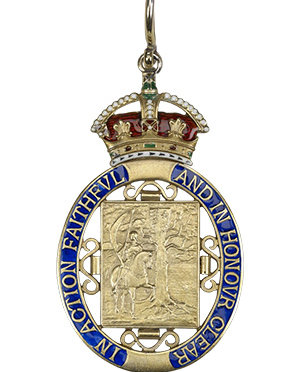
The badge of the Order is struck in silver in the form of an oval medallion measuring 48 millimeters high and 29 millimeters wide. It’s surmounted by an imperial crown with a rectangular panel within, depicting on it an oak tree, a shield with the Royal Arms of the United Kingdom hanging from one branch, and, on the left, a mounted knight in armor. 

The insignia’s blue border bears, in the obverse and in gold letters the motto IN ACTION FAITHFUL AND IN HONOUR CLEARAlexander Pope‘s description in his Epistle to Mr Addison of James Craggs. The oval is surmounted by an imperial crown.

Men wear the badge on a neck ribbon (red with golden border threads) and women on a bow at the left shoulder. The ribbon measures 38 millimeters and is carmine with borders of gold thread.

The British Empire Medal

The British Empire Medal is a British medal awarded for meritorious civil or military service worthy of recognition by the Crown.

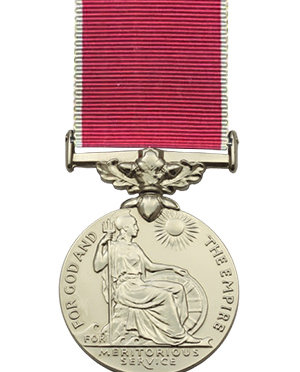
The British Empire Medal (formally known as British Empire Medal for Meritorious Service) is a British medal awarded for meritorious civil or military service worthy of recognition by the Crown. It was created in 1922 to replace the original medal, which had been established in 1917 as part of the Order of the British Empire.

Recipients are entitled to use the post-nominal letters “BEM“. The honor is divided into civil and military medals and, while recipients are not technically counted as members of the Order, these medals are nevertheless affiliated with it.

Between 1922 and 1940, the BEM was usually awarded to people below management or professional level such as to non-commissioned officers of the armed forces, officers below superintendent rank in the police, and personnel below divisional officer level in the fire services. From 1940, the BEM was awarded for acts of gallantry that did not reach the standard of the George Medal.

The British Empire Medal Design

The medal is struck in silver and measures 36 millimeters in diameter, although some specimens measure up to 37.5 millimeters. The words MERITORIOUS SERVICE are inscribed in the exergue. The medal is suspended from a straight bar ornamented with oak leaves. An emblem of crossed silver oak leaves was introduced in December 1957 to denote a gallantry award.

Like the ribbons used for other classes of the Order of the British Empire, the ribbon of the British Empire Medal is rose-pink with pearl-grey edges, with the addition of a pearl-grey central stripe for the military division.

The Empire Gallantry Medal

The Empire Gallantry Medal (or EGM), was a British medal awarded for acts of the gallantry introduced it on 29 December 1922.

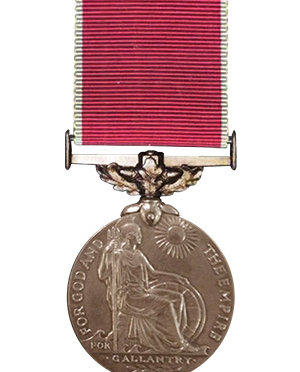
The Medal of the Most Excellent Order of the British Empire for Gallantry, or Empire Gallantry Medal (EGM), was a British medal awarded for acts of the gallantry introduced it on 29 December 1922, when the original Medal of the Order of the British Empire was split into two.

The Medal of the Order of the British Empire for Gallantry (EGM) awarded for acts of gallantry. Shortly after the commencement of the Blitz, King George VI created the George Cross to recognize gallantry by men and women in all walks of civilian life. It was to rank immediately after the Victoria Cross.

Recipients were entitled to use the post-nominal letters “EGM” and were divided into military and civil divisions. The Empire Gallantry Medal was revoked by Royal Warrant on 24 September 1940.

The Empire Gallantry Medal Design

The phrase “For God and the Empire” was inscribed around the upper side of the obverse. The first type of reverse had six lions, with the Royal Cypher centered. The 2nd type of reverse had four lions, two on either side of the Royal Cypher.

The original ribbon was plain purple, with the addition of a thin vertical red stripe for military awards. A silver laurel branch was added diagonally to the ribbon for both types of the award in 1933. The ribbon changed to rose pink with pearl-grey edges in July 1937, with an additional pearl grey vertical stripe for military awards, and stayed in this version until its revocation.

The medal and ribbon were designed first by Langford Jones.

The Centenary of National Independence Commemorative Medal

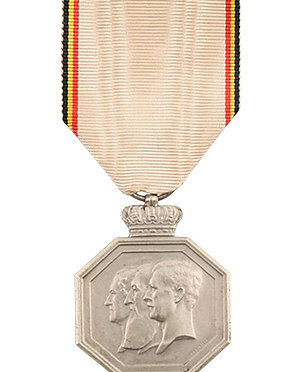
The Centenary of National Independence Commemorative Medal 1830-1930 (Médaille Commémorative du Centenaire de l’Indépendance Nationale 1830-1930 / Herinneringsmedaille van 100 Jaars de Onafhankelijkheid 1830-1930) is a Belgian commemorative medal established on 20 July 1930 by royal decree to commemorate the 100th anniversary of Belgian independence.

It was awarded to serving members of the Belgian Armed Forces and to veterans of the service as well as to civil servants who served honorably for twenty years or more prior to 1 January 1931.

The Centenary of National Independence Commemorative Medal Design

The medal is octagonal, measures 32mm wide by 30mm high and is struck in silvered bronze. It’s surmounted by a crown giving it a total height of 41mm.

The obverse bears the left-facing profiles of kings Leopold I, Leopold II and Albert I of Belgium. The reverse bears the relief years “1830” and “1930” on two rows slightly offset from center superimposed over oak and laurel leaves.

The ribbon is white 38mm wide silk moiré with the national colors of Belgium as 3mm wide edge stripes (1mm black, 1mm yellow and 1mm red). The medal is suspended by a ring through a suspension loop.

The Zeppelin Commemorative Badge

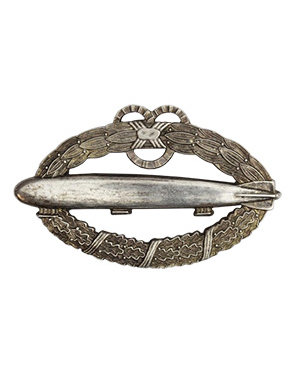
The Zeppelin Commemorative Badge is a badge established in 1920 by the Weimar Republic as a “Badge for Airshipmen.”

Institution: 1 August 1920
Country: Germany

The Zeppelin Commemorative Badge is a badge established on 1 August 1920 by Reichswehrminister Otto Karl Geßler of the Weimar Republic as a “Commemorative Badge for Airshipmen”. The badge was awarded to navy personnel regardless of rank who served on naval airships for at least one year. This condition was waived in case of outstanding merits during the Great War as well as for ex-POWs and crews of naval airships destroyed by enemy fire.

The total true aircrew personnel of the Army Airships numbered around 500 during the War, however during it no badges were issued to them (although the plan existed early on, it was canceled). Instead, the badges were manufactured and issued in the Summer of 1920, as ” Commemorative Badge for Airshipmen”.

The Zepplin badge was a post-war badge, its production was begun in 1920.

The Zeppelin Commemorative Badge Design

The badge measures 67.88mm by 38.77mm and was designed by P. Meybauer in Berlin. It’s struck in silver-plated brass.

The badge has a horizontal oval shape with an airship facing left superimposed on a green enameled wreath. The wreath is made of laurel leaves on its upper part and oak leaves on the lower one. The laurel part of the wreath is tied crosswise on its top by a ribbon that forms three semicircular arcs, two facing above and one beneath. The oak portion in its turn is tied with three ribbons.