The Army Officer Pilot Badge

[vc_row][vc_column width=”1/4″][vc_single_image image=”5593″ img_size=”full”][/vc_column][vc_column width=”3/4″][vc_column_text]

The Army Officer Pilot Badge

[/vc_column_text][vc_column_text]

Time Period: Interwar Period
Institution: 1923
Country: Medals from Japan Japan

[/vc_column_text][vc_separator css=”.vc_custom_1526473075957{padding-top: 16px !important;padding-bottom: 16px !important;}”][vc_column_text]The Army Officer Pilot Badge is a Japanese badge established in 1923 and in two classes: silver for officers and
bronze for NCOs.

As an incentive to lure infantry, artillery, cavalry, and engineer officers into aviation to become pilots, the Japanese Army instituted its pilot’s badge in time for the graduation of the first pilots.

The award was abolished in 1940, but the NCO class badge was still awarded up until the end of WW2.

The Army Officer Pilot Badge Design

The badge measures 37.5 mm by 51.6 mm and is made of multiple pieces in silver and bronze with a gilt star in the center, illustrating wings on either side framing a series of rays emanating from behind the star, and a two-bladed propeller at the base of the wings. It has a vertical pinback.[/vc_column_text][vc_raw_html css=”.vc_custom_1589024511233{padding-top: 24px !important;padding-bottom: 24px !important;}”]JTNDaW5zJTIwY2xhc3MlM0QlMjJlcG4tcGxhY2VtZW50JTIyJTIwZGF0YS1jb25maWctaWQlM0QlMjI1ZWI2OTU4ZmM2NWQ2MDczY2I1YTg1MGElMjIlM0UlM0MlMkZpbnMlM0U=[/vc_raw_html][/vc_column][/vc_row][vc_row][vc_column][vc_column_text css=”.vc_custom_1555950715853{padding-bottom: 24px !important;}”]

Explore More Japanese Medals

[/vc_column_text][vc_basic_grid post_type=”post” max_items=”18″ style=”pagination” items_per_page=”6″ element_width=”2″ gap=”20″ arrows_design=”vc_arrow-icon-arrow_06_left” arrows_position=”outside” paging_design=”none” item=”masonryGrid_Default” grid_id=”vc_gid:1589024428851-9b2cc382-a678-3″ taxonomies=”85″ el_class=”relatedMedals”][/vc_column][/vc_row][vc_row][vc_column][vc_column_text css=”.vc_custom_1555951766219{padding-bottom: 24px !important;}”]

Explore More Medals from Pre-WW1

[/vc_column_text][vc_basic_grid post_type=”post” max_items=”18″ style=”pagination” items_per_page=”6″ element_width=”2″ gap=”20″ orderby=”rand” arrows_design=”vc_arrow-icon-arrow_06_left” arrows_position=”outside” paging_design=”none” item=”masonryGrid_Default” grid_id=”vc_gid:1589024428853-be68fe47-0021-6″ taxonomies=”8″ el_class=”relatedMedals”][/vc_column][/vc_row]
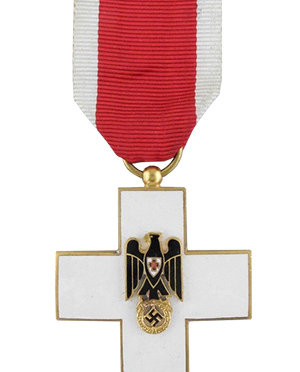
The German Social Welfare Decoration

The Social Welfare Decoration was created by Adolf Hitler as a civil award for services in the social sector.

The Social Welfare Decoration (or “Ehrenzeichen für deutsche Volkspflege” in German) was created by Adolf Hitler as a civil award for services in the social sector on 1 May 1939.

The decoration was issued in three classes and was awarded for a wide variety of service to the German statsuch as WinterhilfswerkNational Socialist People’s Welfare, medical and rescue work, or care of foreign and ethnic Germans.

The medal was a replacement for the German Red Cross Decoration. The main requirement for the award was that the service rendered should be to the benefit of the civil population. Reinhard Heydrich was awarded the decoration for his running of the Gestapo in the 1930s and for providing “security” to the German people. The infamous Doctor Josef Mengele was also awarded the decoration in 1941, for providing medical services to wounded soldiers and civilians alike on the battlefields of the Eastern Front.

It was conferred in four classes consisting of a white-enameled gold Balkenkreuz with Reich eagle and swastika. A “Medal of Social Welfare” was also issued for lesser degrees of service, not warranting the higher presentation of a class award.

The German Red Cross Decoration

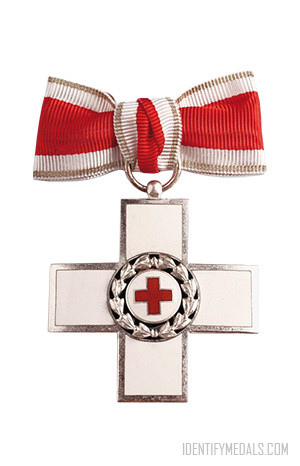
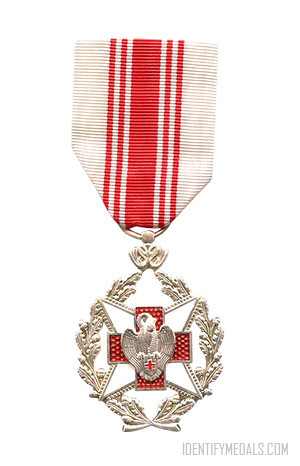
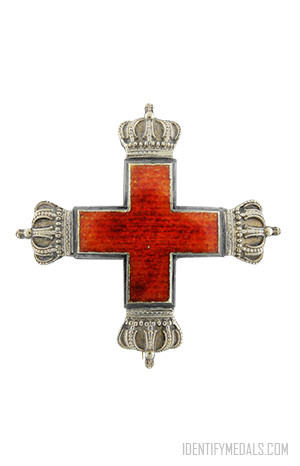
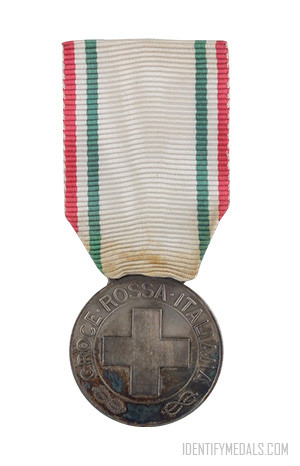
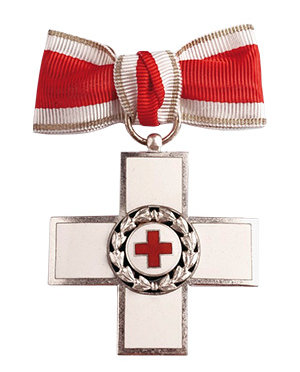
The German Red Cross Decoration (or “Ehrenzeichen des Deutschen Roten Kreuzes” in German) is a decoration founded in 1922.

The German Red Cross Decoration (or “Ehrenzeichen des Deutschen Roten Kreuzes” in German) is a decoration founded in 1922.

It was replaced (by Adolf Hitler) by the Social Welfare Decoration in 1939 and re-founded in its present form on 8 May 1953. It is awarded by the German Red Cross.

The West German Red Cross was recognized by the International Red Cross as the DRK BRD in 1951. The East German Red Cross was recognized by the International Red Cross as the DRK DDR in 1952.

Find Red Cross Medals Online

More Red Cross Medals

The Voluntary Medical Service Medal

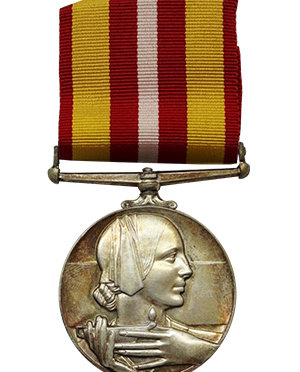
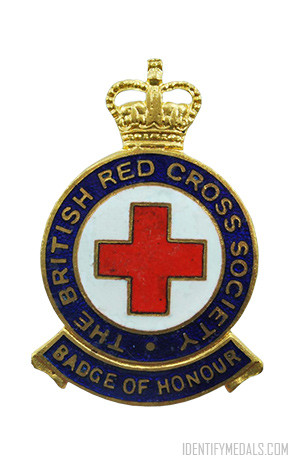
The Voluntary Medical Service Medal is a medal instituted in 1932 by George V and awarded by the British Red Cross and St Andrew’s First Aid. 

The Voluntary Medical Service Medal is a medal instituted in 1932 at the direction of George V and awarded by the British Red Cross and St Andrew’s First Aid.

To qualify for the medal, a member has to accrue fifteen years’ continuous efficient service as a first aid volunteer in either the Red Cross or St Andrew’s. They also need to provide a minimum of ten hours field service per year.

The Voluntary Medical Service Medal Design

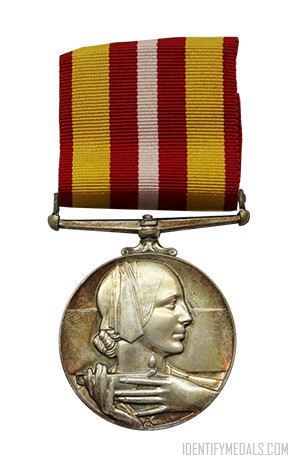
The medal measures 36 millimeters (1.4 inches) in diameter and was designed by Percy Metcalfe, an English artist sculptor and designer recognized mostly for his coin designs and his contribution to the Ashtead Pottery Collection.

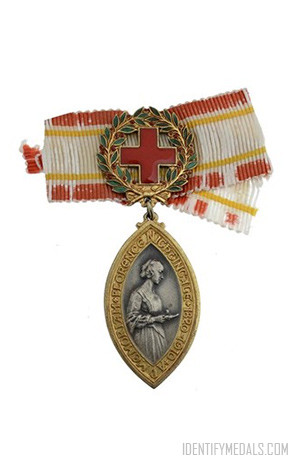
The obverse of the medal bears a symbolic representation of Florence Nightingale carrying a lamp. The reverse features a design of both the Geneva and St Andrew’s crosses to denote the two qualifying organizations. Between the upper arms of the St Andrew’s Cross is the text “LONG AND EFFICIENT SERVICE”.

The medal was originally made of silver, later of silver plated copper, and since the 1960’s of copper-nickel. It is suspended from a straight swivel bar and hangs from a ribbon of red with yellow stripes at the edges and a thin white stripe in the centre. On the suspension ribbon of the medal, clasps embellished with the Geneva cross (St Andrew’s cross in Scotland) are worn to denote five additional years of qualifying service. Up to four silver-gilt emblems can replace the silver type to denote 25, 30, and 35 years of service in the applicable voluntary organisation.

Find Red Cross Medals Online

More Red Cross Medals

The 1931-34 China Incident War Medal

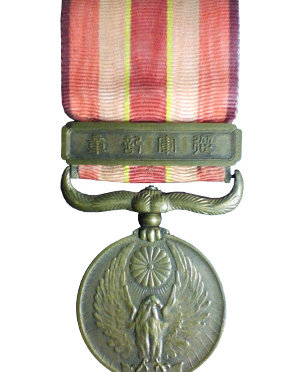
The China Incident Medal (Sina jihen jugun kisho) medal was created in 1939 and awarded for service in China during the Shōwa period.

The China Incident Medal (Sina jihen jugun kisho) medal was created by Imperial Edit No. 496 on July 27, 1939 and awarded for service in China at any time from the 12th through the 20th years of the Shōwa period — Shōwa 12-20 (1937–1945). The decoration was abolished in 1946 by government ordinance No. 177.

Although the Japanese government still uses “China Incident” in formal documents, media in Japan often paraphrase it with other expressions like Japan-China Incident (日華事変 Nikka jihen) or (日支事変 Nisshi jihen). The word Shina is now construed by China as a derogatory term.

The Military Medal of Honor (or 従軍記章 jugun kisho in Japanese) was a military decoration for meritorious service to the Empire of Japan, formerly awarded to all military personnel who participated in battles in a war and effectively abolished during the Allied Occupation of Japan in the post-war years (1945–1951).

The plausible re-institution of a modern equivalent was made unlikely by the adoption of Japan’s post-war Constitution which disavows the right of the state to engage in aggressive war.

The Order of Culture (Japan)

The Order of Culture (Bunka-kunshō) is an order of Japan established in 1937 and conferred by the Emperor of Japan in person.

The Order of Culture (or 文化勲章 Bunka-kunshō in Japanese) is an order of Japan established on February 11, 1937 and conferred by the Emperor of Japan in person on Culture Day (November 3) each year.

Candidates for the Order of Culture are selected from the Persons of Cultural Merit by the Minister of Education, Culture, Sports, Science, and Technology, upon hearing the views of all the members of the selection committee for the Persons of Cultural Merit. The Minister then recommends the candidates to the Prime Minister so that they can be decided by the Cabinet.

The order only has one class and may be awarded to men and women of any country for contributions to Japan’s art, literature, science, technology, or anything related to culture in general. Those that receive the order are also entitled to an annuity for life.

The Order of Culture Design

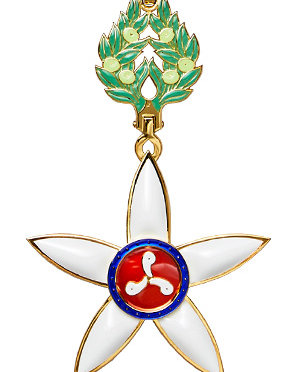
The badge of the Order of Culture is made in gold with white enamel. It has the form of a Tachibana orange blossom, with the central disc bearing three crescent-shaped jades (magatama).

The badge is suspended on a gold and enamel wreath of mandarin orange leaves and fruit, which is in turn suspended on a purple ribbon worn around the neck.

The Hero of Socialist Labor Medal

The Hero of Socialist Labour Medal was the highest Soviet degree of distinction for exceptional achievements in national economy and culture.

The Hero of Socialist Labour Medal (or Геро́й Социалисти́ческого Труда́in Russian) was the highest degree of distinction for exceptional achievements in national economy and culture. It was introduced by decree of the Presidium of the Supreme Soviet of the Soviet Union on December 27, 1938 as an honorary title of the Soviet Union and other Warsaw Pact countries.

The first recipient of the award was Joseph Stalin, awarded by the Presidium of the Supreme Soviet in December 20, 1939. By 1991, at the dissolution of the Soviet Union, over 20,000 people had been awarded the title.

Originally, Heroes of Socialist Labour were awarded the highest decoration of the Soviet Union, the Order of Lenin and a certificate. In order to distinguish it from other Order of Lenin recipients, the “Hammer and Sickle” gold medal was introduced by decree of the Presidium on 22 May 1940. Heroes of Socialist Labour who attained further exceptional achievements were awarded a second “Hammer and Sickle” medal and bronze busts of the Heroes were to be constructed in their hometowns to mark the occasion.

The award provided a similar status to the title Hero of the Soviet Union Medal that was awarded for heroic deeds, but unlike the latter, was not awarded to foreign citizens.

The Hero of Socialist Labor Medal Design

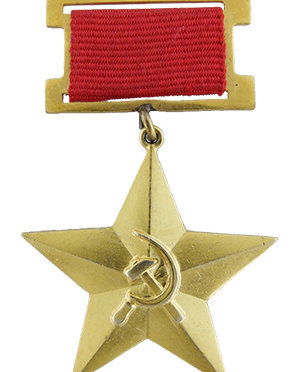
The Honorary title was designed by the artist A. Pomansky as a five-pointed star with smooth dihedral rays on the obverse. The diameter of the star was 33.5 mm. In the center of the obverse, a relief hammer and sickle respectively of 14 and 13 mm. 

The reverse was plain and was surrounded by a slightly raised rim. In the center, the relief inscription “Hero of Socialist Labor” (“Герой Социалистического Труда” in Russian) in 2mm high letters, the award serial number was inscribed just above in 1mm high numbers. The medal weighed 15.25 grams.

The insignia was secured to a standard 25 X 15mm Soviet square mount by a ring through the suspension loop. The mount was covered by a red silk moiré ribbon.

The Hero of the Soviet Union Medal

The title Hero of the Soviet Union Medal was the highest distinction in the Soviet Union. It was established on April 16, 1934.

The title Hero of the Soviet Union Medal (or Герой Советского Союза in Russian) was the highest distinction in the Soviet Union. It was established on April 16, 1934, by the Central Executive Committee of the Soviet Union and was awarded personally or collectively for heroic feats in service to the Soviet state and society.

The first recipients of the title originally received only the Order of Lenin, the highest Soviet award, along with a certificate describing the heroic deed from the Presidium of the Supreme Soviet of the USSR.

Those who received the award were entitled to special privileges, which included a pension with survivor benefits, first priority on the housing list with 50% rent reduction, tax exempt, an annual round-trip first class airline ticket, free bus transportation, and medical and entertainment benefits.

In total, during the existence of the USSR, the title of Hero of the Soviet Union was awarded to 12,777 people, including twice – 154 (9 posthumously), three times – 3 and four – 2. Ninety-five women were awarded the title. The title could also be given to foreigners. In total, forty-four foreign citizens were awarded with it.

The Hero of the Soviet Union title was also given posthumously, though often without the actual Gold Star medal given.

The Hero of the Soviet Union Medal Design

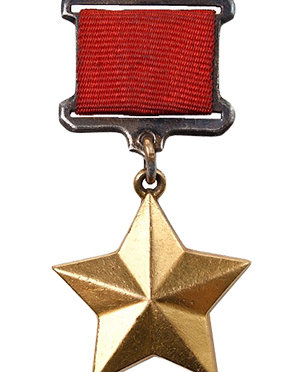
The medal is a gold star hanging from a rectangular suspension device. The medallion measures 32.5 mm in height including the eyelet, 30.3 mm in width; weighs 20.6 g not including the suspension and connecting link. The star is in 23 K gold; the suspension device is in gilded silver.  It has a ribbon in the color(s) of the issuing state (red for the USSR, white/blue/red for the Russian Federation, blue/yellow for Ukraine, red/green for Belarus).

The Hero of the Soviet Union is worn on the left side of the chest above all other orders and medals.

The Medal for Distinguished Labor (Russia)

The Medal For Distinguished Labor was an award of the Soviet Union established in 1938 and bestowed to especially deserving workers.

The Medal “For Distinguished Labor” (or Медаль «За трудовое отличие» in Russian) was a civilian labor award of the Soviet Union established on December 27, 1938 by decree of the Presidium of the Supreme Soviet of the USSR and bestowed to especially deserving workers to recognize and honor high performances in labor or contributions in the fields of science, culture or the manufacturing industry.

In just over fifty years of existence, the medal was bestowed to over two million deserving citizens. The first investiture took place on January 15, 1939 where the Medal “For Distinguished Labor” was presented to 19 employees of the Kalinin armaments plant number 8 for exceptional service to the country in the creation and development of new weapons for the Workers’ and Peasants’ Red Army.

Its statute was amended three times by further decrees and ceased to be awarded following the December 1991 dissolution of the Soviet Union.

The Medal for Distinguished Labor Medal Design

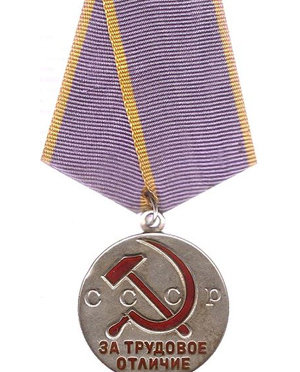
The Medal for Distinguished Labor measured 32 mm in diameter and is circular and struck from .925 silver with a raised rim on both sides.

In the upper 3/4 of the obverse, a 21 mm high by 20 mm wide ruby-red enameled image of the hammer and sickle over the relief inscription “USSR” («СССР») in 3.5 mm high letters. In the lower quarter of the obverse below the hammer and sickle, the sunken and red enameled inscription on two rows “FOR DISTINGUISHED LABOUR” («ЗА ТРУДОВОЕ ОТЛИЧИЕ») in 2 mm high letters. On the otherwise plain reverse, the relief inscription on two rows of 2.5 mm high letters “LABOUR IN THE USSR – A MATTER OF HONOUR” («ТРУД В СССР — ДЕЛО ЧЕСТИ»). The medal was numbered until 1945.

Early awards hung from a small triangular mount covered with a red ribbon with a threaded stub and screw for attachment to clothing. Following the 1943 decree, it was secured by a ring through the medal suspension loop to a standard Soviet pentagonal mount covered by a 24mm wide lilac colored silk moiré ribbon with 2 mm wide yellow edge stripes.

The Medal for Labor Valor (Russia)

The Medal for Labor Valor (Медаль «За трудовую доблесть») was a civilian labor award of the Soviet Union established on December 27, 1938.

The Medal for Labor Valor (or Медаль «За трудовую доблесть» in Russian) was a civilian labor award of the Soviet Union established on December 27, 1938 by decree of the Presidium of the Supreme Soviet of the USSR and bestowed to especially deserving workers to recognize and honor dedicated and valorous labor or significant contributions in the fields of science, culture or the manufacturing industry.

The medal’s statute was amended three times by further decrees. During its existence of just over fifty years, it was bestowed to almost two million deserving citizens, including workers, farmers, specialists of the national economy, workers of science, culture, education, health and other to citizens of the USSR, and in exceptional cases, to foreign nationals.

The first investiture took place on January 15, 1939 where the Medal “For Labor Valor” was presented to 22 employees of the Kalinin armaments plant number 8 for exceptional service to the country in the creation and development of new weapons for the Workers’ and Peasants’ Red Army. The medal ceased to be awarded following the December 1991 dissolution of the Soviet Union.

The Medal for Labor Valor Medal Design

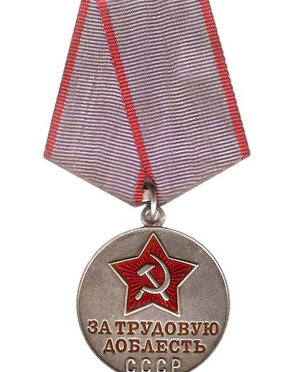
The medal measured 34 mm in diameter (some struck in 1945 measured 35 mm), was circular and struck from .925 silver with a raised rim on both sides.

In the upper obverse, a ruby-red enameled 19.2 mm wide five pointed star with a silver hammer and sickle at its center. Below the star, the inscription in two rows of sunken and red enameled 2.8 mm high letters “FOR VALOUR LABOUR” («ЗА ТРУДОВУЮ ДОБЛЕСТЬ»), at the very bottom, the relief inscription in 3.3 mm high letters “USSR” («СССР»). On the otherwise plain reverse, the relief inscription on two rows of 2.5 mm high letters “LABOUR IN THE USSR – A MATTER OF HONOUR” («ТРУД В СССР — ДЕЛО ЧЕСТИ»).

Early awards hung from a small triangular mount covered with a red ribbon with a threaded stub and screw for attachment to clothing. Following the 1943 decree, the medal was secured by a ring through the medal suspension loop to a standard Soviet pentagonal mount covered by a 24mm wide lilac coloured silk moiré ribbon with 2 mm wide red edge stripes.