The Honored People’s Policeman Medal

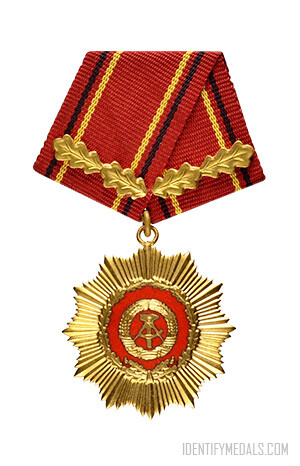
The Honored People’s Policeman Medal was instituted on 15 June 1966 and was awarded for achievements and commitment to the GDR.

The title of Honored People’s Policeman of the German Democratic Republic (or Verdienter Volkspolizist in German) was a prestigious award instituted on 15 June 1966. This title recognized special achievements and personal commitment to the protection of the GDR, as well as exemplary initiatives that contributed to enhancing public safety and order.

Established during a period of heightened focus on internal security and state control, the Honour Title of Meritorious People’s Policeman was part of broader efforts to recognize and incentivize loyalty and excellence within the security forces of East Germany.

The Honored People’s Policeman Medal Criteria

Recipients of this honor were typically members of the People’s Police who demonstrated exceptional dedication and effectiveness in their duties. The award was given to individuals who showed:

  • Outstanding performance in protecting the state and its citizens.
  • Significant contributions to maintaining and improving public safety and order.
  • Exemplary personal commitment and initiative in their police work.
  • Innovative approaches to crime prevention and community safety.

The Honored People’s Policeman Medal Design

The medal awarded with this title is round and gold in color. 

The ribbon is red with thin black and yellow stripes close to the edges.

Right Now on eBay 
Clicking a link to eBay may result in a referral commission being paid if a purchase is made.
Loading...

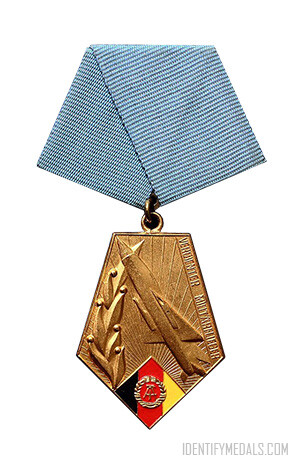
The Meritorious Military Pilot of the German Democratic Republic

The Meritorious Military Pilot of the German Democratic Republic was the highest title awarded by the RDG to military pilots.

The Meritorious Military Pilot of the GDR (or Verdienter Militärflieger der DDR in German) was the highest honorary title awarded to military pilots of the East German National People’s Army. Instituted on August 1, 1974, by the Council of Ministers of the GDR, this prestigious title was bestowed in the form of a medal and was awarded until the dissolution of the GDR in 1990.

Award Criteria

This honorary title was granted to military pilots who demonstrated:

  • Distinguished performance, with outstanding results in both political and military duties.
  • Exceptional contributions to the development and combat readiness of the National People’s Army (NPA).
  • A Class I performance level.
  • An incident-free aviation record. The number of recipients was limited to 10 military pilots per year.

The Pilot of the GDR (DDR) Medal Design

The golden medal was shaped like a pentagon, measuring 31.5 mm in width and 41.5 mm in height. At the bottom tip, the emblem of the NPA, featuring the enameled flag of the German Democratic Republic (GDR), was displayed. The medal’s main design included a MiG-23 or MiG-21 aircraft ascending steeply against a bright rising sun, with a laurel branch on the left and the inscription “VERDIENTER MILITÄRFLIEGER” on the right. The reverse side of the medal was glossy and plain.

Versions

  • 1974–1976: Made from gold-colored nonferrous metal, varnished, with a size of 40.5 × 30 mm including an arched eye. It was mounted on a small medal bar measuring 14 × 25 mm.
  • 1976–1989: Similar to the previous version but with a round eye, mounted on a pentagon bar with a gibbon bar measuring 14 × 25 mm. This version was also brass-plated, and the reverse side featured additional ornamentation.

Buy this Medal

Right Now on eBay 
Clicking a link to eBay may result in a referral commission being paid if a purchase is made.
Loading...

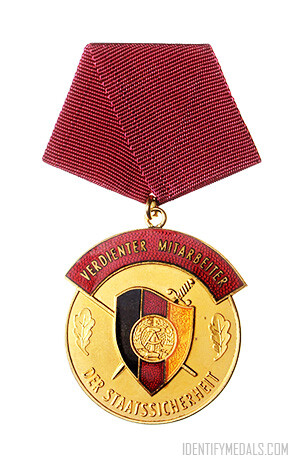
The Meritorious Member of State Security Medal

The Member of State Security Medal was established in 1969 and awarded for outstanding contributions to the protection of the state.

The Honor Title of Meritorious Member of State Security (or Ehrentitel Verdienter Mitarbeiter der Staatssicherheit in German) was an esteemed award in the GDR or East Germany.

It was established to recognize individuals for their exceptional service and contributions to the state security apparatus, known as the Stasi (Ministerium für Staatssicherheit, MfS).

The title was introduced to formally acknowledge and reward significant achievements, dedication, and loyalty among members of the Stasi. Its primary purpose was to incentivize and honor outstanding service that significantly contributed to the effectiveness and operational success of the state security services. In other words, the decoration aimed to boost morale and encourage continued excellence among the Stasi members.

The Meritorious Member of State Security Medal Criteria

The award was given to members of the Stasi who demonstrated exceptional merit, outstanding achievements, and notable contributions to state security.

Recipients were selected based on their dedication, innovative efforts, and impactful actions that enhanced the operational capabilities of the Stasi. This included uncovering espionage, thwarting threats to the state, and other significant contributions to state security.

The Meritorious Member of State Security Medal Design

The medal featured symbolic elements representative of the Stasi and the GDR, including the flag.

The title and accompanying medal were presented during formal ceremonies. High-ranking officials from the Stasi and the GDR government often participated in these ceremonies to emphasize the importance of the award and the recognition of the recipient’s contributions.

Right Now on eBay 
Clicking a link to eBay may result in a referral commission being paid if a purchase is made.
Loading...

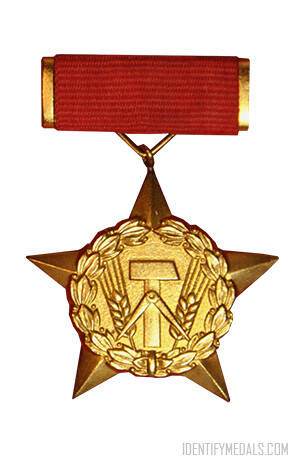
The Hero of Labor (DDR)

The Hero of Labor was created by the German Democratic Republic and awarded for for supporting the socialist economy.

The title Hero of Labor (or Held der Arbeit in German) was a prestigious award in the German Democratic Republic (GDR) conferred to individuals who made significant contributions to the socialist economy.

Instituted on 19 April 1950, this honor was typically awarded for exceptional increases in factory output, agricultural yields, or other substantial contributions to economic development.

The Hero of Labor Award Criteria

Each year, the award was limited to a maximum of 50 recipients. This restriction emphasized the exclusivity and prestige of the honor. The recipients were often workers, engineers, and agriculturalists who demonstrated extraordinary dedication and innovation in their respective fields.

The goal was to incentivize and recognize efforts that aligned with the socialist principles of the GDR, fostering a culture of productivity and excellence.

The Hero of Labor Design

The Hero of Labor medal was a distinctive and symbolic piece of craftsmanship. The medal featured imagery representing labor and industry, such as hammer and sickle motifs, gears, and wheat sheaves. These elements symbolized the unity of workers and peasants in building the socialist state.

Central to the medal’s design was a gold star, a common symbol of excellence and achievement in socialist iconography. This star signified the recipient’s outstanding contributions to the nation’s economic progress.

The medal was suspended from a red ribbon, a color associated with socialism and the labor movement, and often included engravings of the recipient’s name and the date of the award.

Buy this Medal

Right Now on eBay 
Clicking a link to eBay may result in a referral commission being paid if a purchase is made.
Loading...

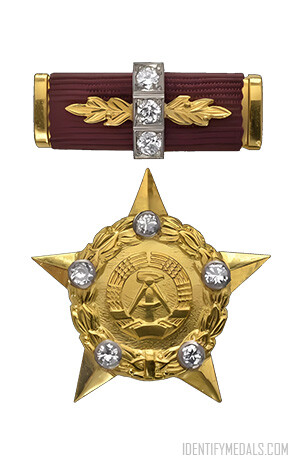
The Hero of the German Democratic Republic

The Hero of the German Democratic Republic (GDR) was an Honorary Title awarded by the East German state and its most prestigious award.

The Hero of the German Democratic Republic (or Held der Arbeit in German) was the highest honor awarded by East Germany, accompanied by a gold star medal, certificate, and financial reward.

Established by the politburo of the Socialist Unity Party on 29 October 1975, it was first awarded on 28 November 1975.

The first recipient was General Heinz Hoffmann on his 65th birthday. The first foreign recipient was Leonid Brezhnev, who was honored three times. Only two recipients, cosmonauts Vladimir Kovalyonok and Aleksander Ivanchenkov, are still alive today. The last citizen of the GDR to bear the title was Sigmund Jähn, who passed away in 2019.

A total of 17 awards were given to 11 recipients.

The Hero of the German Democratic Republic Award Criteria

The title was awarded to individuals who demonstrated extraordinary service or acts of heroism that contributed significantly to the development, international standing, military security, or authority of the GDR. Eligible recipients included combatants against fascism, servicemen of the National People’s Army, civilians cooperating with the armed services, foreign nationals in exceptional cases, and cosmonauts, who were also honored as Cosmonaut of the German Democratic Republic.

The Hero of the German Democratic Republic Privileges

The five-pointed gold star medal was similar to the Soviet Union’s Hero of the Soviet Union. Recipients also received a certificate and financial reward. After 1978, the Order of Karl Marx was a prerequisite for this honor. Both the medal and the certificate had to be returned to the state upon the recipient’s death.

Originally, up to 10 awards could be given annually, with recipients eligible for multiple awards, leading to titles such as “twice Hero” or, uniquely for Leonid Brezhnev, “three times Hero” of the GDR.

The Hero of the German Democratic Republic Design

The design of the Hero of the German Democratic Republic (GDR) medal is inspired by the Soviet Hero of the Soviet Union award. The medal features a five-pointed gold star, symbolizing excellence and achievement. 

The main component of the award was a gold star with five points, which was worn on the left side of the chest. The star was polished and made to stand out, signifying the highest level of honor and valor recognized by the state.

The medal is suspended from a red ribbon, reflecting the socialist values and heritage of the GDR. The red color symbolized the socialist ideology and the connection to the broader communist movement. The ribbon was designed to be worn on the uniform, making the award highly visible.

Alongside the medal, recipients were presented with a certificate documenting their achievements and the reasons for their recognition and a financial reward.

Buy this Medal

Right Now on eBay 
Clicking a link to eBay may result in a referral commission being paid if a purchase is made.
Loading...

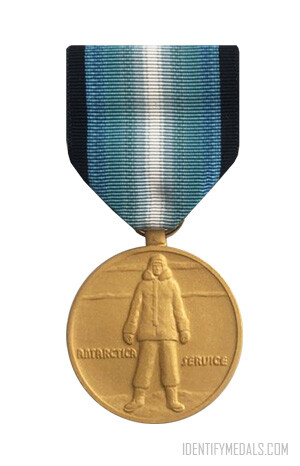
The Antarctica Service Medal

The Antarctica Service Medal was established in 1960 and intended as a military award for previous Antarctica expeditions from 1928 to 1941.

The Antarctica Service Medal (ASM) was established on July 7, 1960, by the United States Congress through Public Law 600 of the 86th Congress. This medal was created to serve as a military award, replacing several commemorative awards issued for prior Antarctic expeditions from 1928 to 1941. The medals made obsolete by the creation of the ASM include the Byrd Antarctic Expedition Medal, the Second Byrd Antarctic Expedition Medal, and the United States Antarctic Expedition Medal.

The ASM is a recognized award of the United States Armed Forces, authorized for wear on active duty uniforms and issued in the name of the U.S. Department of Defense. It can also be awarded to U.S. civilians and foreign citizens participating in U.S. Antarctic expeditions at the invitation of a U.S. agency, such as the National Science Foundation.

The Antarctica Service Medal Criteria

Eligibility for the Antarctica Service Medal requires personnel to train or serve for ten days on the Antarctic continent or on vessels in Antarctic waters (south of 60 degrees latitude). Flight crews qualify by performing transport missions to Antarctica, with one day of service credited for each mission within a 24-hour period. Civilians working in research facilities or on research vessels south of 60 degrees latitude for at least ten days (or thirty days before October 10, 2008) are also eligible, facilitated through the National Science Foundation.

The Antarctica Service Medal Design

The medal is a 1¼ inch bronze piece. The obverse features a polar landscape with a figure in Antarctic clothing, flanked by the words “ANTARCTICA” and “SERVICE.” The reverse displays a polar projection of Antarctica with geodesic lines, overlaid with the words “COURAGE,” “SACRIFICE,” and “DEVOTION,” encircled by penguins and marine life.

The service ribbon, 1⅜ inches wide, has a design symbolizing the Antarctic environment: black and dark blue edges represent five months of darkness, while the center, with colors grading from white to medium blue, symbolizes seven months of sunlight and the aurora australis.

Buy this Medal

Right Now on eBay 
Clicking a link to eBay may result in a referral commission being paid if a purchase is made.
Loading...

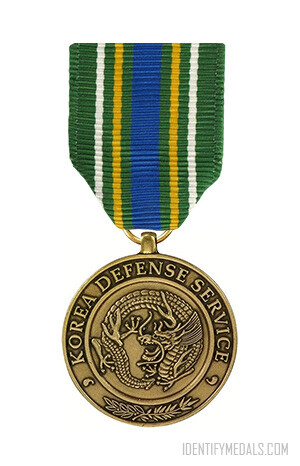
The Korea Defense Service Medal

The Korea Defense Service Medal is an American military service medal awarded to those who have served duty in South Korea in the 1950s.

The Korea Defense Service Medal (KDSM) is a military decoration of the United States Armed Forces, established in 2002 through legislation signed by President George W. Bush. The initiative to create this medal was led by Representative Elton Gallegly (R-CA) and Senator Jeff Bingaman (D-NM). John Sproston designed the final version of the medal.

Recipients of the KDSM are eligible for membership in veterans’ organizations such as the Veterans of Foreign Wars (VFW) and the American Legion.

The Korea Defense Service Medal Criteria

The KDSM is awarded to U.S. Armed Forces members who have served in South Korea in support of its defense post-Korean Armistice Agreement. To qualify, a service member must have served at least 30 consecutive days or 60 non-consecutive days in the South Korean theater. This includes reservists on annual training. Exceptions to the time requirement include participation in combat, injury in the line of duty requiring medical evacuation, or aircrew members who have logged over 30 days of sorties in South Korean airspace.

The medal is retroactive to service performed after July 28, 1954. The National Personnel Records Center verifies the entitlement for discharged members who served in South Korea before the KDSM’s creation. Additionally, service members can receive both the Armed Forces Expeditionary Medal and the KDSM for the same period between October 1, 1966, and June 30, 1974. Only one KDSM is awarded per individual, regardless of the length of service in South Korea.

The Korea Defense Service Medal Design

The KDSM is a bronze medal measuring 1¼ inches in diameter. The obverse features a Korean “circle dragon” with a scroll inscribed “KOREA DEFENSE SERVICE,” flanked by laurel and bamboo sprigs.

The reverse side displays the outline of the Korean Peninsula with two crossed swords.

The medal’s ribbon is mainly green with an ultramarine blue stripe in the center, flanked by golden yellow and white stripes.

Buy this Medal

Right Now on eBay 
Clicking a link to eBay may result in a referral commission being paid if a purchase is made.
Loading...

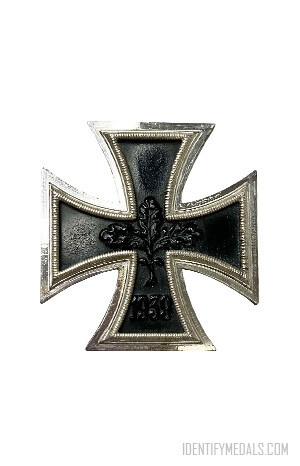
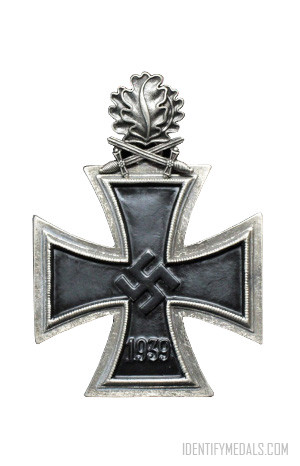
The Iron Cross (EK 1957)

The Iron Cross 1957 was introduced to allow German veterans to wear their WWII decorations in a denazified form.

Institution: 26 July 1957
Country: Germany

The Iron Cross 1957 was officially established on July 26, 1957. It aimed to honor the bravery and leadership of those who had served during World War II while adhering to new legal requirements.

Following the end of World War II, Germany underwent significant political and social changes, including the denazification process to remove Nazi symbols from public life. By the mid-1950s, many German veterans sought recognition for their wartime service without the stigma associated with Nazi imagery. In response, the Federal Republic of Germany (West Germany) introduced the Iron Cross 1957.

This version allowed veterans to wear their decorations in a form that conformed to post-war regulations, promoting reconciliation and respect for individual bravery.

The Iron Cross 1957 Criteria

The criteria for the Iron Cross 1957 remained the same as those of the 1939 version. It was awarded to recognize acts of bravery and leadership in combat. Veterans who had earned the Iron Cross during World War II were eligible to wear the 1957 version, ensuring that their wartime service could be publicly acknowledged without the associated Nazi symbols

More Variations of the Iron Cross

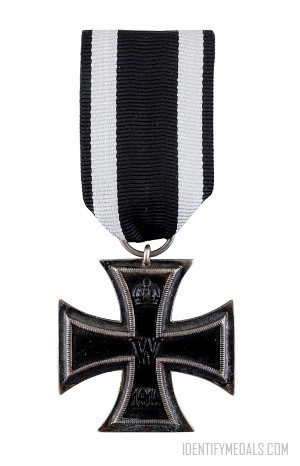
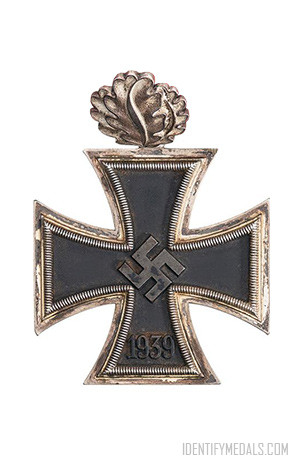
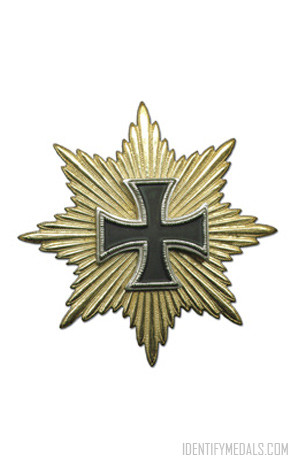
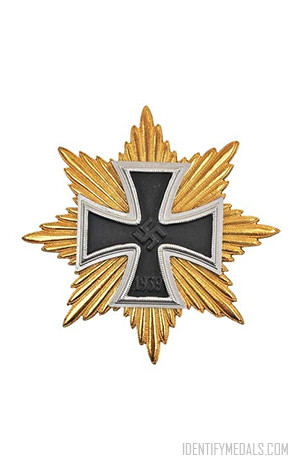
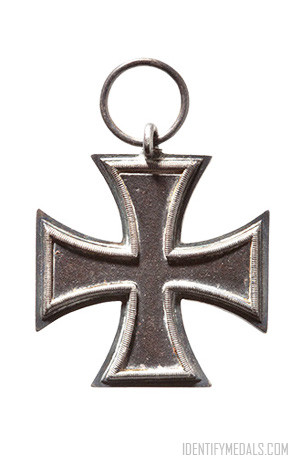
The Iron Cross, a prestigious German military decoration, has undergone several variations since its inception. For example, the Iron Cross 1813 was instituted during the Napoleonic Wars by King Frederick William III of Prussia, the Iron Cross 1914 was awarded during World War I, it was reinstated by Kaiser Wilhelm II, and the Iron Cross 1939 was revived by Adolf Hitler for World War II, with modifications including a swastika.

Find the Iron Cross Medal Online

Right Now on eBay 
Clicking a link to eBay may result in a referral commission being paid if a purchase is made.
Loading...

Further Reading About the Iron Cross

Discover the stories behind the Iron Cross with these compelling books and delve into the rich history and significance of this prestigious military decoration.

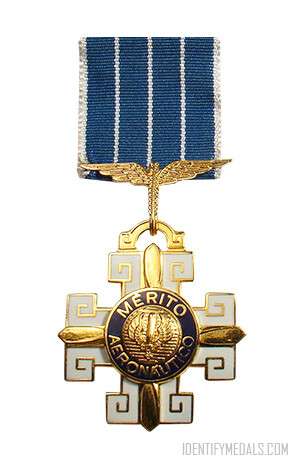
The Aeronautical Merit Medal 

The Aeronautical Merit Medal was created on 11 October 1985 to reward military and civilian personnel for performance in the Air Force.

The Aeronautical Merit Medal (or Medalha de Mérito Aeronáutico in Portuguese) is a military decoration established on October 11, 1985.

It is awarded to military and civilian personnel, both national and foreign, who demonstrate exceptional technical-professional competence, extraordinary performance, and significant personal qualities, thereby contributing to the efficiency, prestige, and mission fulfillment of the Portuguese Air Force.

This medal was one of the first three branch-specific medals created in 1985 for each branch of the Armed Forces. It preceded the Medal of the Cross of Saint George, established by the General Staff of the Armed Forces in 2000, and the Medal of National Defense, created by the Ministry of National Defense in 2002.

The Aeronautical Merit Medal is awarded according to the following criteria:

  • 1st Class (MPMA): Awarded to general officers and colonels.
  • 2nd Class (MSMA): Awarded to lieutenant colonels and majors.
  • 3rd Class (MTMA): Awarded to other officers and sergeant majors.
  • 4th Class (MQMA): Awarded to other sergeants and enlisted personnel.

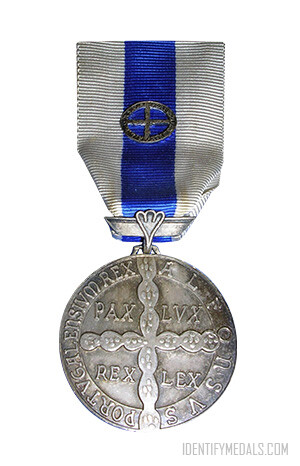
The D. Afonso Henriques Medal

The D. Afonso Henriques Medal is a Portuguese military medal established in 1985 and awarded for high competence within the Portuguese Army.

The Medal of D. Afonso Henriques – Army Merit is a Portuguese military decoration, established on October 11, 1985, originally named the Medal of D. Afonso Henriques – Patron of the Army.

The award recognizes military personnel and civilians, both national and foreign, who demonstrate exceptional technical-professional competence, extraordinary performance, and significant personal qualities, thereby contributing to the efficiency, prestige, and mission fulfillment of the Portuguese Army.

This medal is one of the first three branch-specific medals created in 1985 for each branch of the Armed Forces. It preceded the Medal of the Cross of Saint George, established in 2000 by the General Staff of the Armed Forces, and the Medal of National Defense, introduced by the Ministry of Defense in 2002.

The medal is awarded according to the recipient’s rank and contributions. General officers and colonels are eligible for the 1st Class (MPAH), while lieutenant colonels and majors can receive the 2nd Class (MSAH). The 3rd Class (MTAH) is designated for other officers and sergeant majors, and the 4th Class (MQAH) is for other sergeants and enlisted personnel.